




The class 11 biology formula sheet chapter 10 cell cycle and cell division pulls together every key stage, phase and one-mark fact tested in the CBSE Boards, NEET, CUET and other entrance exams. It lays out the cell cycle, the four stages of mitosis and the substages of meiosis I so students can revise the whole chapter in one pass.
Cell Cycle and Cell Division is one of the highest-scoring chapters in Class 11 Biology, and its terms return in genetics, reproduction and molecular biology later.
- Compares mitosis and meiosis side by side, with chromosome number and daughter-cell counts.
- Lists the four stages of mitosis plus cytokinesis, with the key event of each.
- Breaks down the five substages of prophase I, noting that crossing over happens at pachytene.
This class 11 biology formula sheet chapter 10 cell cycle and cell division is curated by subject experts and checked against the 2026-27 NCERT and recent CBSE and NEET papers.
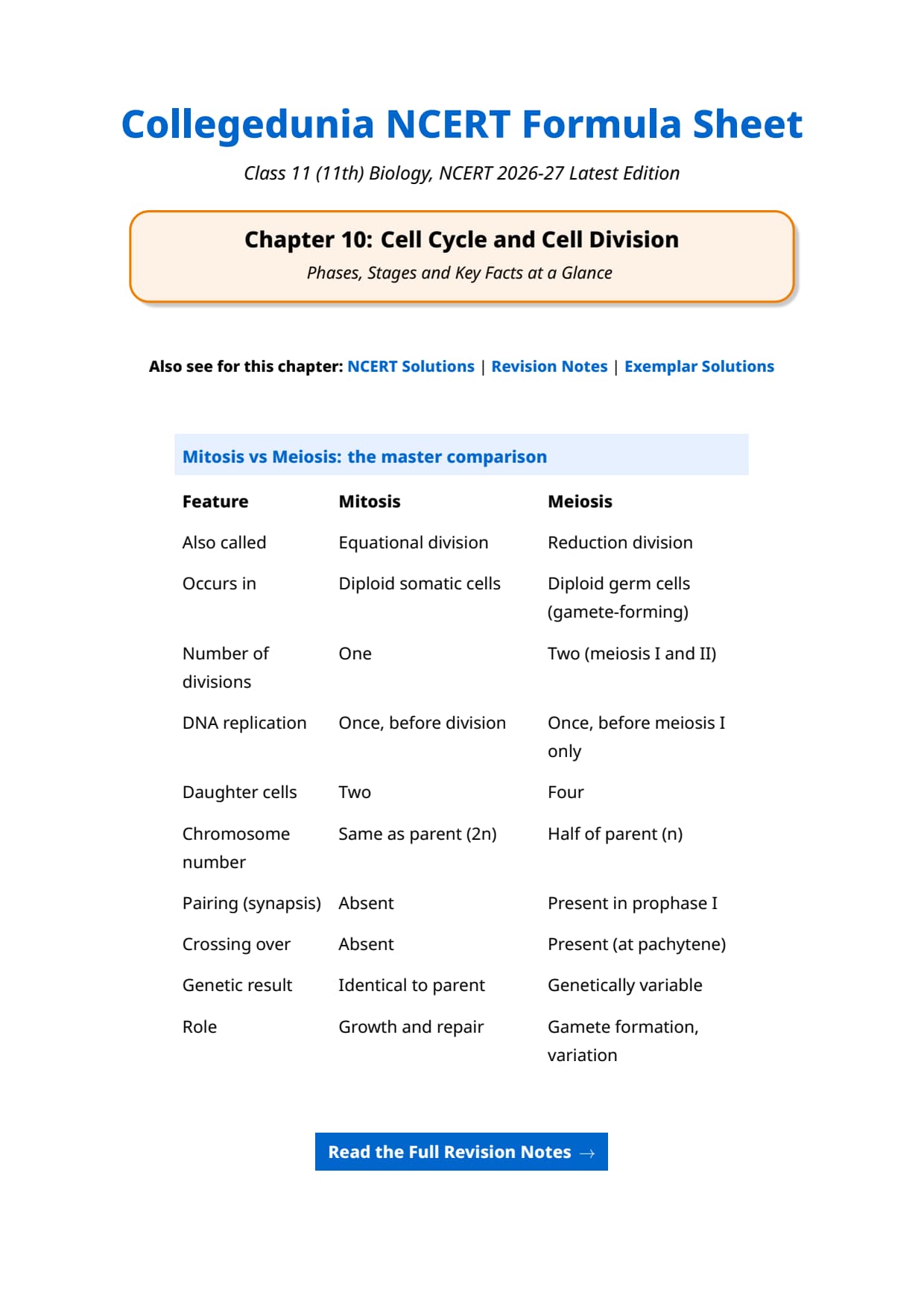
Mitosis vs Meiosis at a Glance
The master comparison sits in the table below. Learn both columns by heart, since NEET often asks students to tell the two divisions apart from a single stated feature.
| Feature | Mitosis | Meiosis |
|---|---|---|
| Chromosome number | Same as parent (2n, equational) | Halved (n, reduction division) |
| Number of daughter cells | Two | Four |
| Crossing over | Absent | Present, at pachytene of prophase I |
| Where it occurs | Diploid somatic cells (growth and repair) | Diploid germ cells forming gametes |
Mitosis keeps the chromosome number the same and makes two identical cells, while meiosis halves it and makes four genetically varied cells.
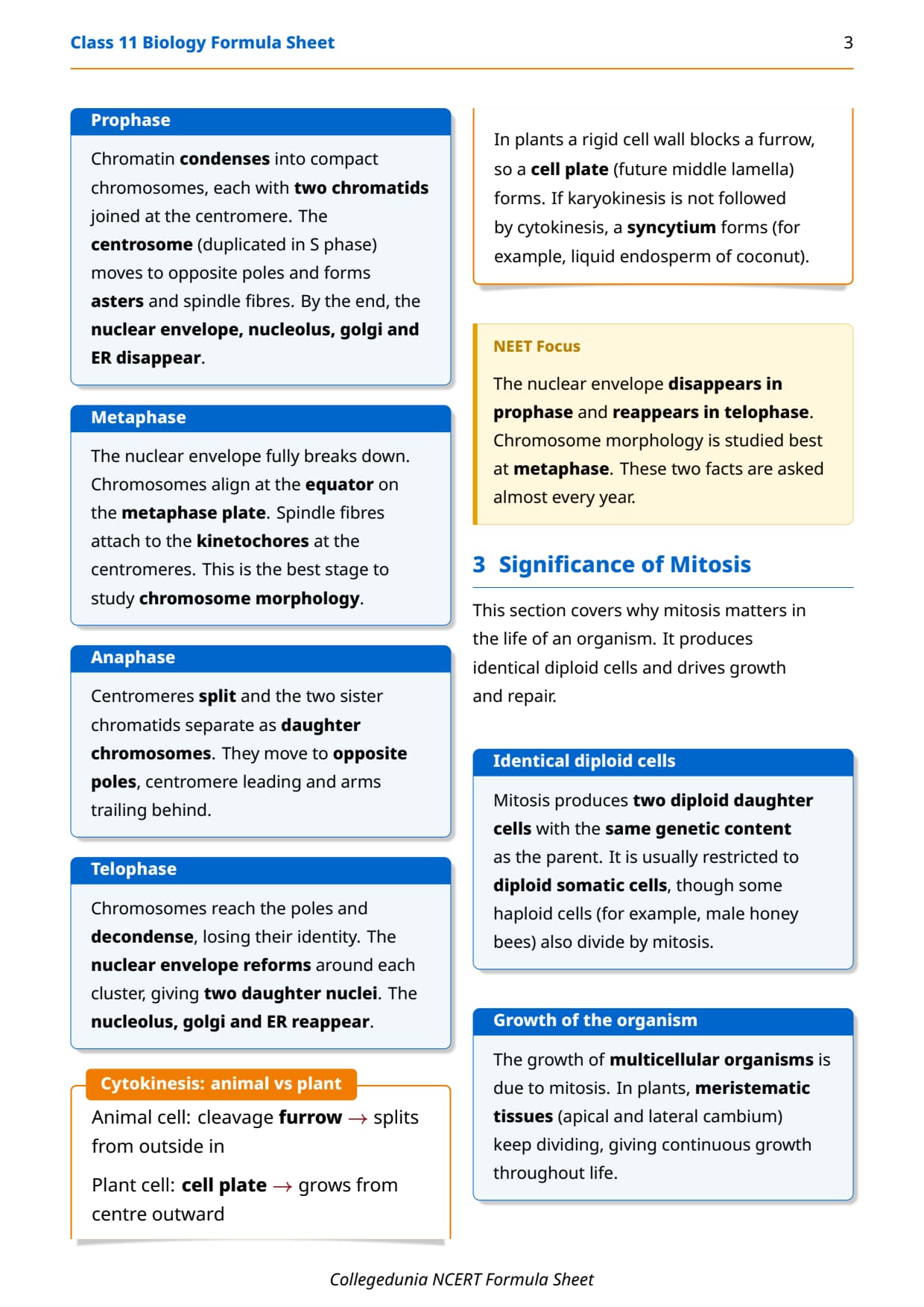
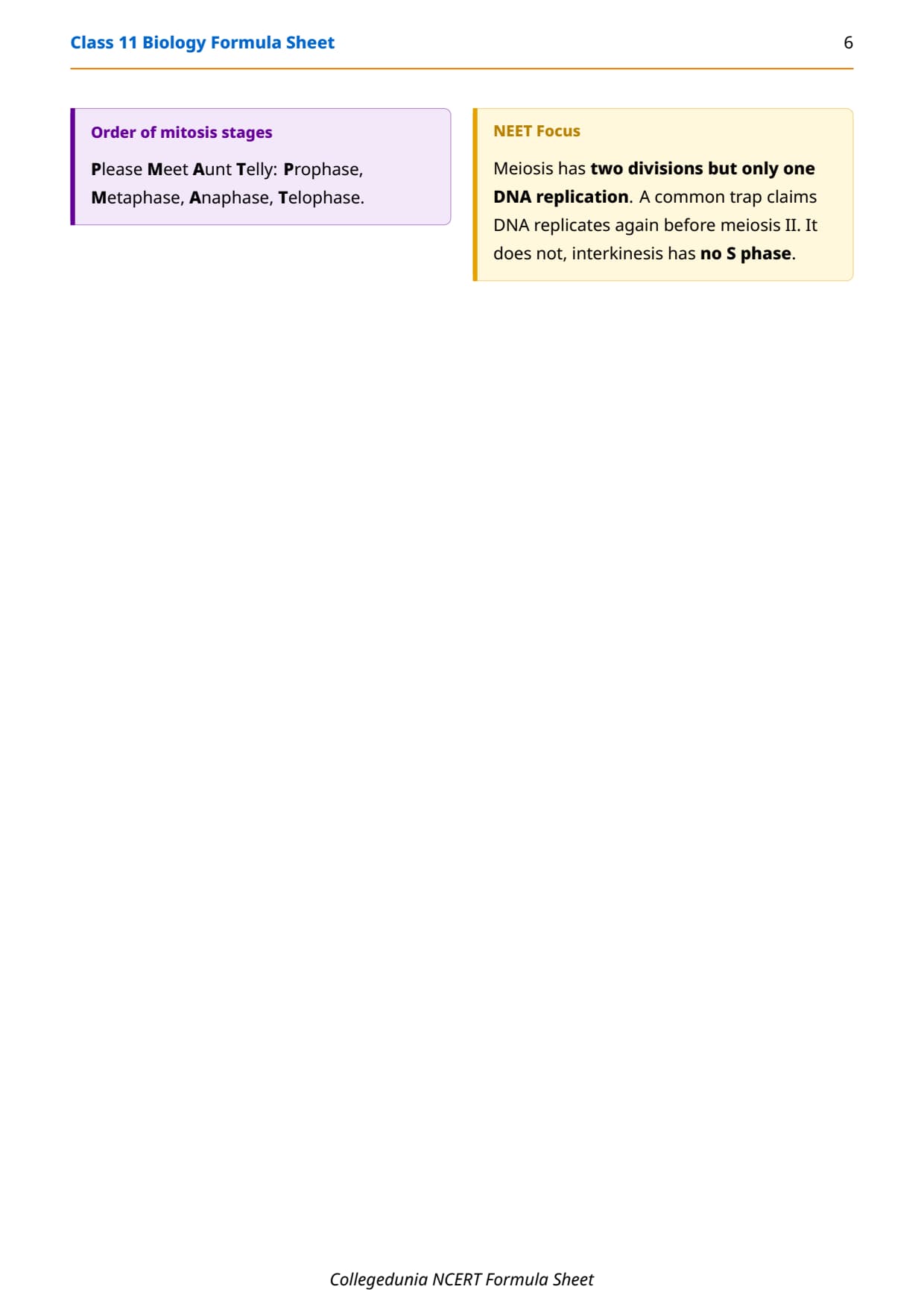
Phases of Mitosis
Mitosis is the M phase of the cell cycle, split into nuclear division (karyokinesis) and cytoplasm division (cytokinesis). The nuclear envelope disappears in prophase and reforms in telophase, a fact asked almost every year.
| Phase | Key event |
|---|---|
| Prophase | Chromatin condenses into chromosomes with two chromatids each; centrosomes move to poles and form the spindle; nuclear envelope and nucleolus start to disappear |
| Metaphase | Chromosomes align at the equator on the metaphase plate; spindle fibres attach to kinetochores; best stage to study chromosome morphology |
| Anaphase | Centromeres split and sister chromatids separate as daughter chromosomes, moving to opposite poles |
| Telophase | Chromosomes reach the poles and decondense; nuclear envelope and nucleolus reappear, giving two daughter nuclei |
| Cytokinesis | Cytoplasm divides: a cleavage furrow in animal cells, a cell plate growing outward in plant cells |
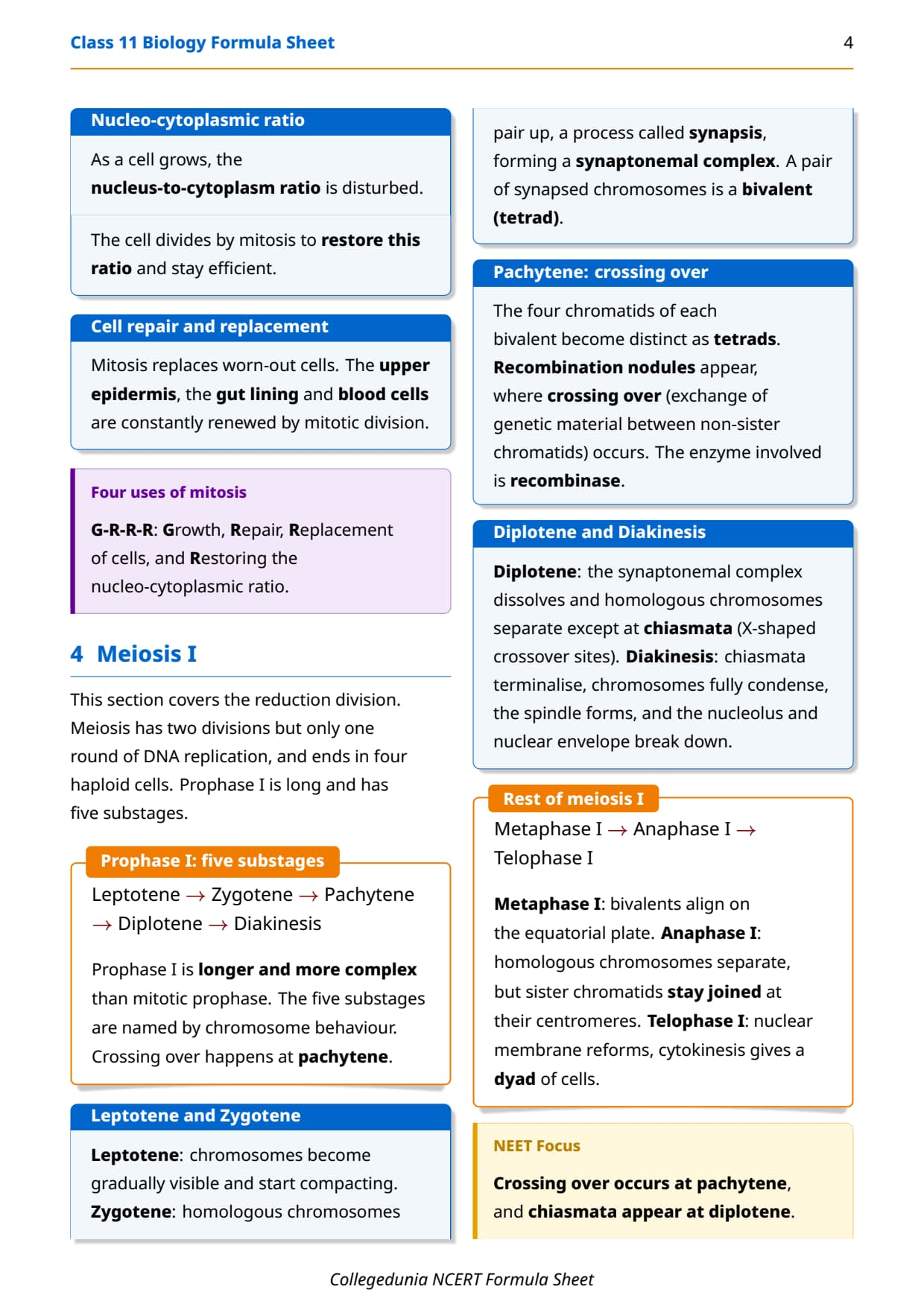
Meiosis I and Prophase I Substages
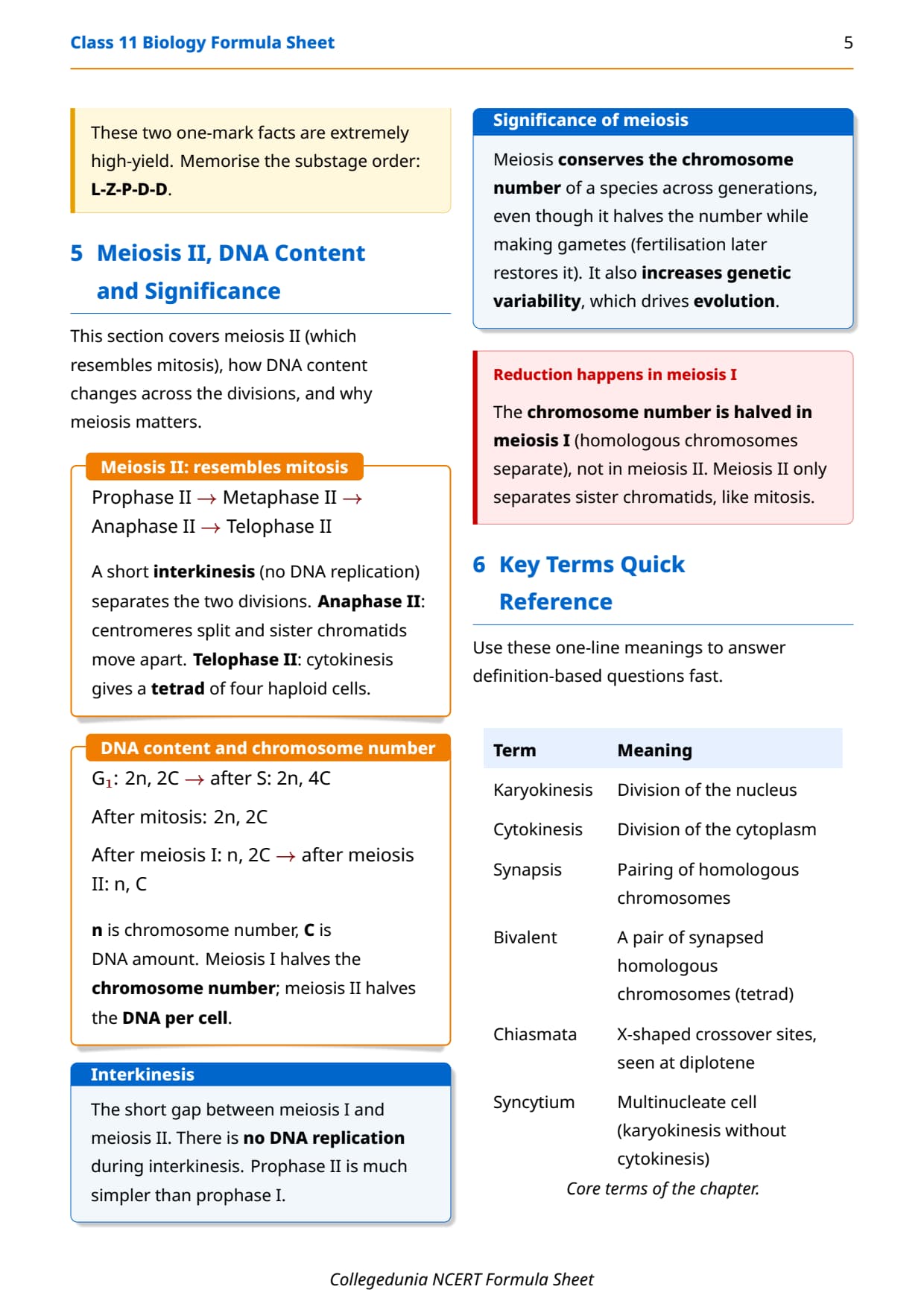
Meiosis has two divisions but only one round of DNA replication, and prophase I is long and complex. Crossing over occurs at pachytene, while chiasmata become visible at diplotene.
| Substage of Prophase I | Event |
|---|---|
| Leptotene | Chromosomes become gradually visible and start to compact |
| Zygotene | Homologous chromosomes pair up (synapsis), forming the synaptonemal complex and bivalents |
| Pachytene | Crossing over, the exchange of segments between non-sister chromatids, takes place at recombination nodules |
| Diplotene | The synaptonemal complex dissolves and homologues separate except at X-shaped chiasmata |
| Diakinesis | Chiasmata terminalise, chromosomes fully condense, the spindle forms and the nuclear envelope breaks down |
Remember the substage order L-Z-P-D-D, and that crossing over is fixed to pachytene.
How to Revise Cell Cycle and Cell Division Before the Exam
This chapter rewards clean stage-by-stage recall more than long answers. A short, ordered revision locks in the phases and their key events.
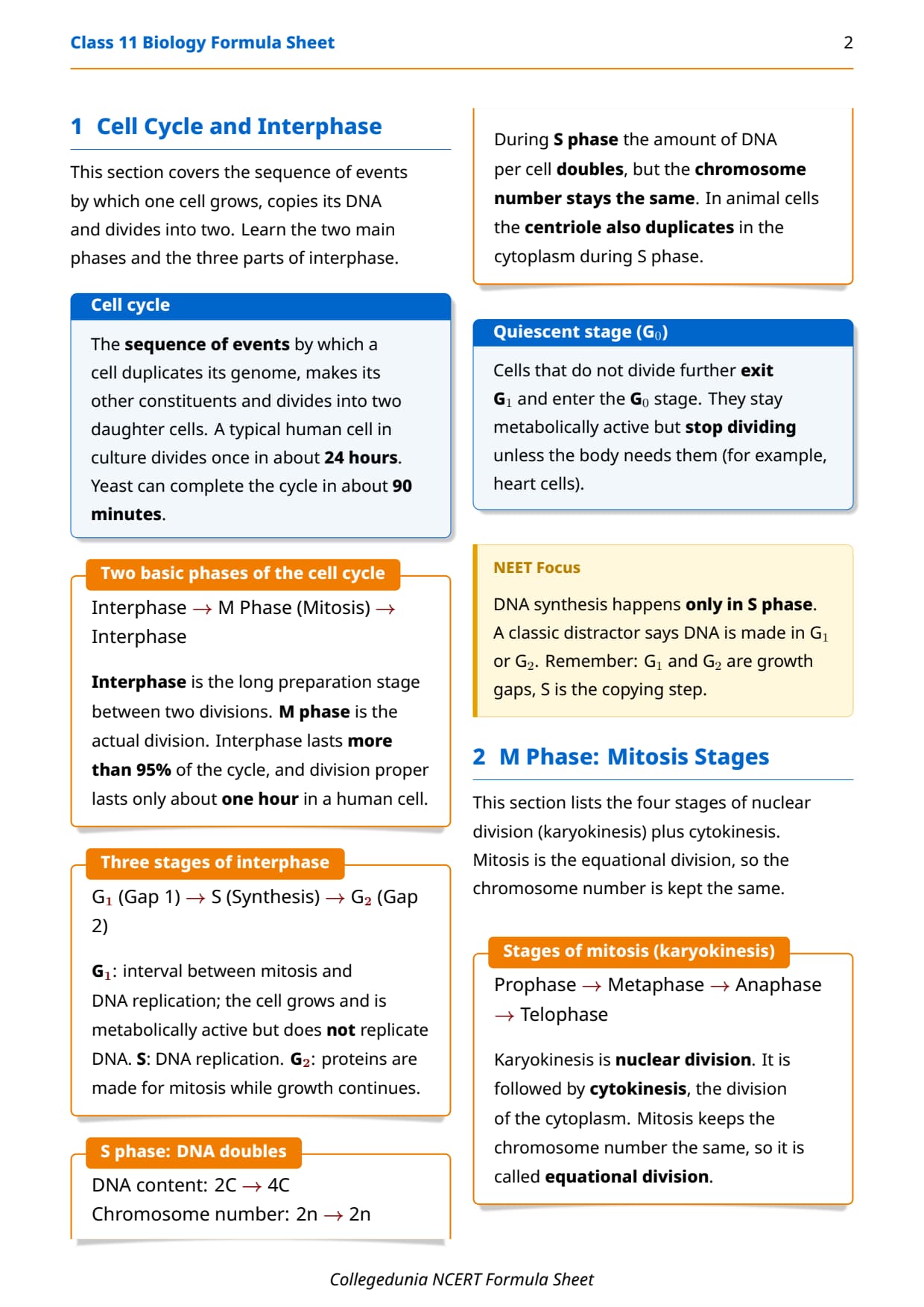
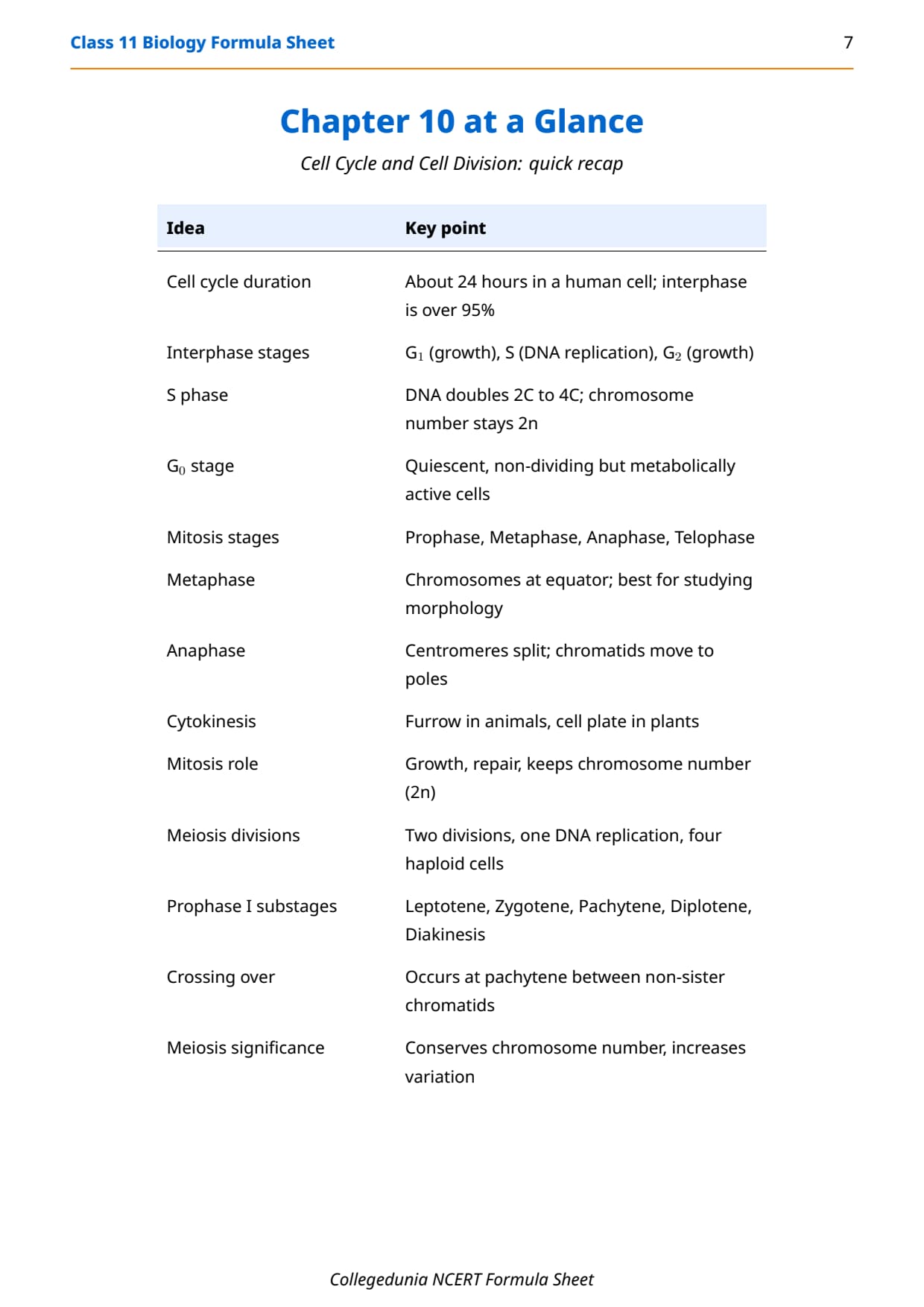
- Write the three interphase stages G1, S and G2 in order, and note that DNA replicates only in S phase.
- List the four stages of mitosis with one key event each, then add cytokinesis.
- Memorise the five substages of prophase I and pin crossing over to pachytene, chiasmata to diplotene.
- Track how DNA content and chromosome number change: meiosis I halves the chromosome number, meiosis II halves the DNA per cell.
Student Feedback on the Cell Cycle and Cell Division Formula Sheet
In a survey of 1,200 NEET aspirants who used this sheet, 78% said the single-page mitosis-versus-meiosis table made the two divisions easy to tell apart. Toppers reported that reciting the prophase I substages L-Z-P-D-D twice a week made the crossing-over question automatic in the exam.
Other Cell Cycle and Cell Division Class 11 Biology Resources
Pair this formula sheet with the solved answers, notes and textbook PDF.
| Resource | Link |
|---|---|
| NCERT Solutions | Cell Cycle and Cell Division Class 11 NCERT Solutions |
| Revision Notes | Cell Cycle and Cell Division Class 11 Notes |
| NCERT Book PDF | Cell Cycle and Cell Division Class 11 Book PDF |
NCERT Formula Sheet for Class 11 Biology: All Chapters
Revise every chapter from one place. Each link opens the formula sheet for that chapter.
| Chapter | Formula Sheet |
|---|---|
| Chapter 1 | The Living World |
| Chapter 2 | Biological Classification |
| Chapter 3 | Plant Kingdom |
| Chapter 4 | Animal Kingdom |
| Chapter 5 | Morphology of Flowering Plants |
| Chapter 6 | Anatomy of Flowering Plants |
| Chapter 7 | Structural Organisation in Animals |
| Chapter 8 | Cell: The Unit of Life |
| Chapter 9 | Biomolecules |
| Chapter 10 | Cell Cycle and Cell Division |
| Chapter 11 | Photosynthesis in Higher Plants |
| Chapter 12 | Respiration in Plants |
| Chapter 13 | Plant Growth and Development |
| Chapter 14 | Breathing and Exchange of Gases |
| Chapter 15 | Body Fluids and Circulation |
| Chapter 16 | Excretory Products and their Elimination |
| Chapter 17 | Locomotion and Movement |
| Chapter 18 | Neural Control and Coordination |
| Chapter 19 | Chemical Coordination and Integration |
FAQs on Cell Cycle and Cell Division Class 11 Biology Formula Sheet
Cell Cycle and Cell Division Formula Sheet - Frequently Asked Questions
Ques. What does the class 11 biology formula sheet chapter 10 cell cycle and cell division cover?
Ans. This class 11 biology formula sheet chapter 10 cell cycle and cell division covers the cell cycle and interphase, the four stages of mitosis with cytokinesis, the five substages of prophase I in meiosis, and how DNA content and chromosome number change across both divisions.
Ques. What are the four stages of mitosis?
Ans. Mitosis has four stages of nuclear division: prophase (chromosomes condense), metaphase (chromosomes line up at the equator), anaphase (sister chromatids separate to opposite poles) and telophase (two daughter nuclei form). Cytokinesis then divides the cytoplasm.
Ques. At which substage of meiosis does crossing over occur?
Ans. Crossing over, the exchange of genetic material between non-sister chromatids of homologous chromosomes, occurs at the pachytene substage of prophase I. Chiasmata, the visible X-shaped crossover sites, appear later at diplotene.
Ques. How do mitosis and meiosis differ in chromosome number?
Ans. Mitosis is an equational division that gives two daughter cells with the same chromosome number as the parent (2n). Meiosis is a reduction division that gives four haploid cells (n); the chromosome number is halved during meiosis I when homologous chromosomes separate.



Comments