




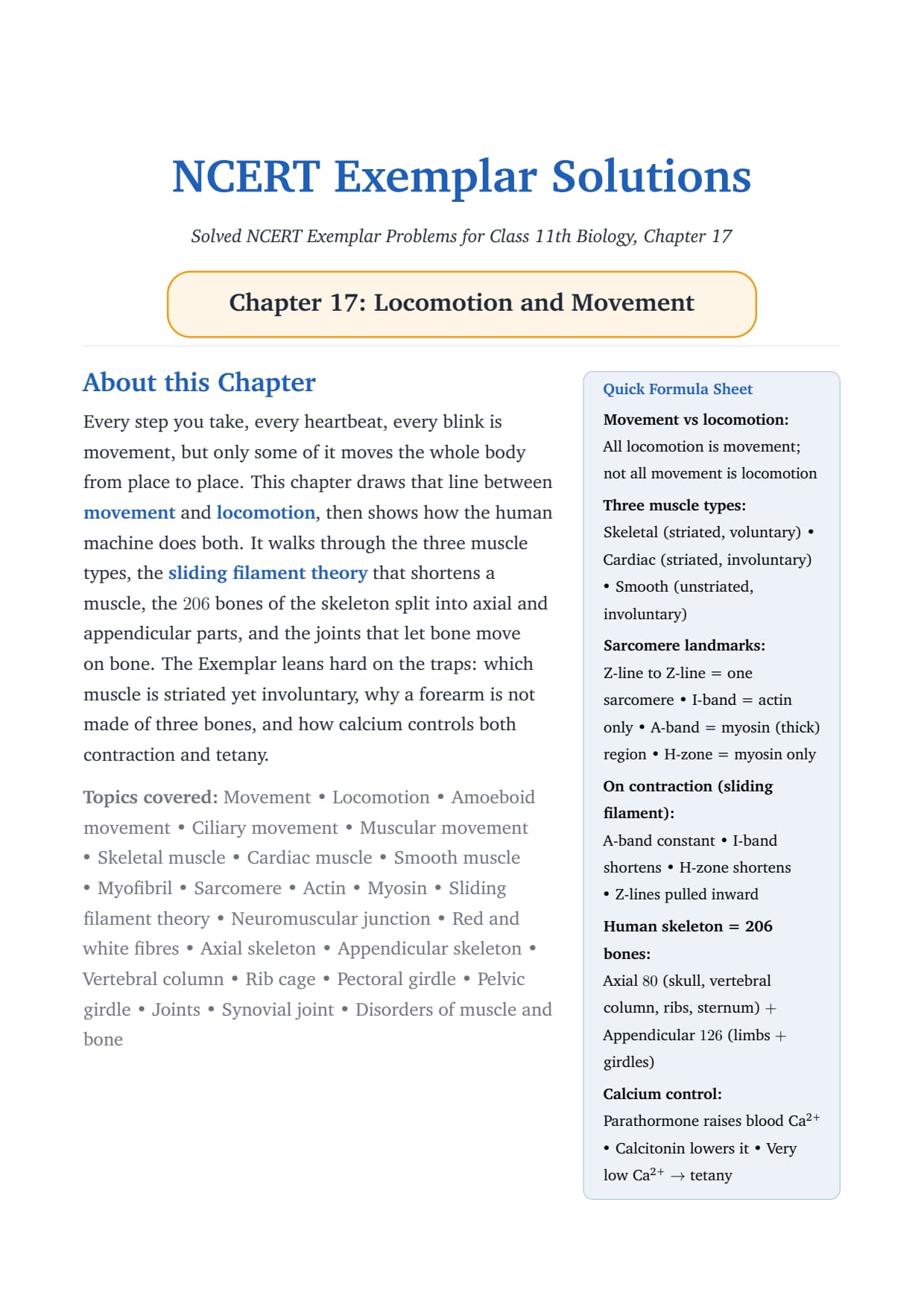
NCERT Exemplar Solutions for Class 11 Biology Chapter 17 Locomotion and Movement solve all 39 questions from the Exemplar book. Every MCQ, Very Short Answer, Short Answer and Long Answer problem is answered step by step in the free 60-page PDF, updated for the 2026-27 syllabus.
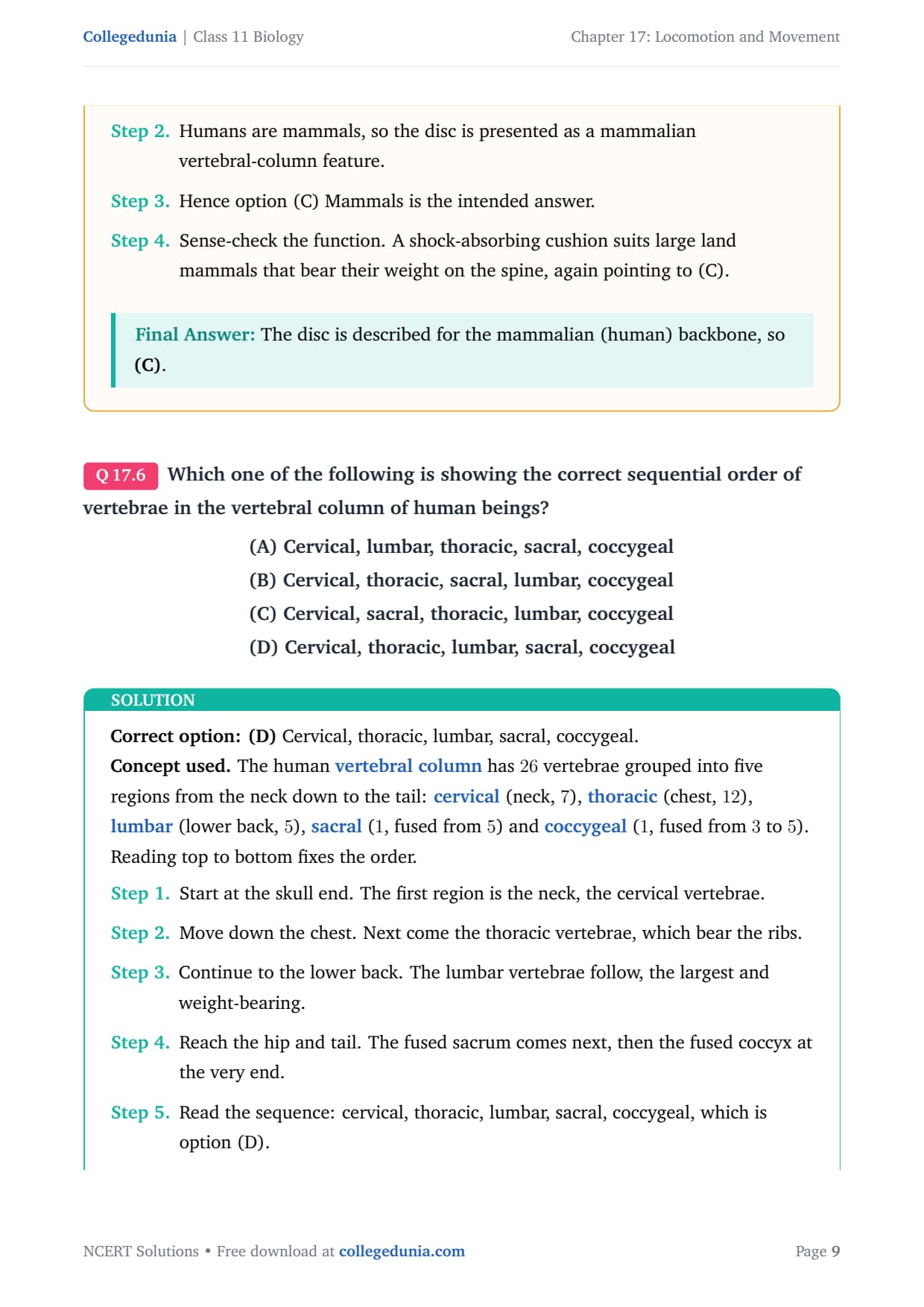
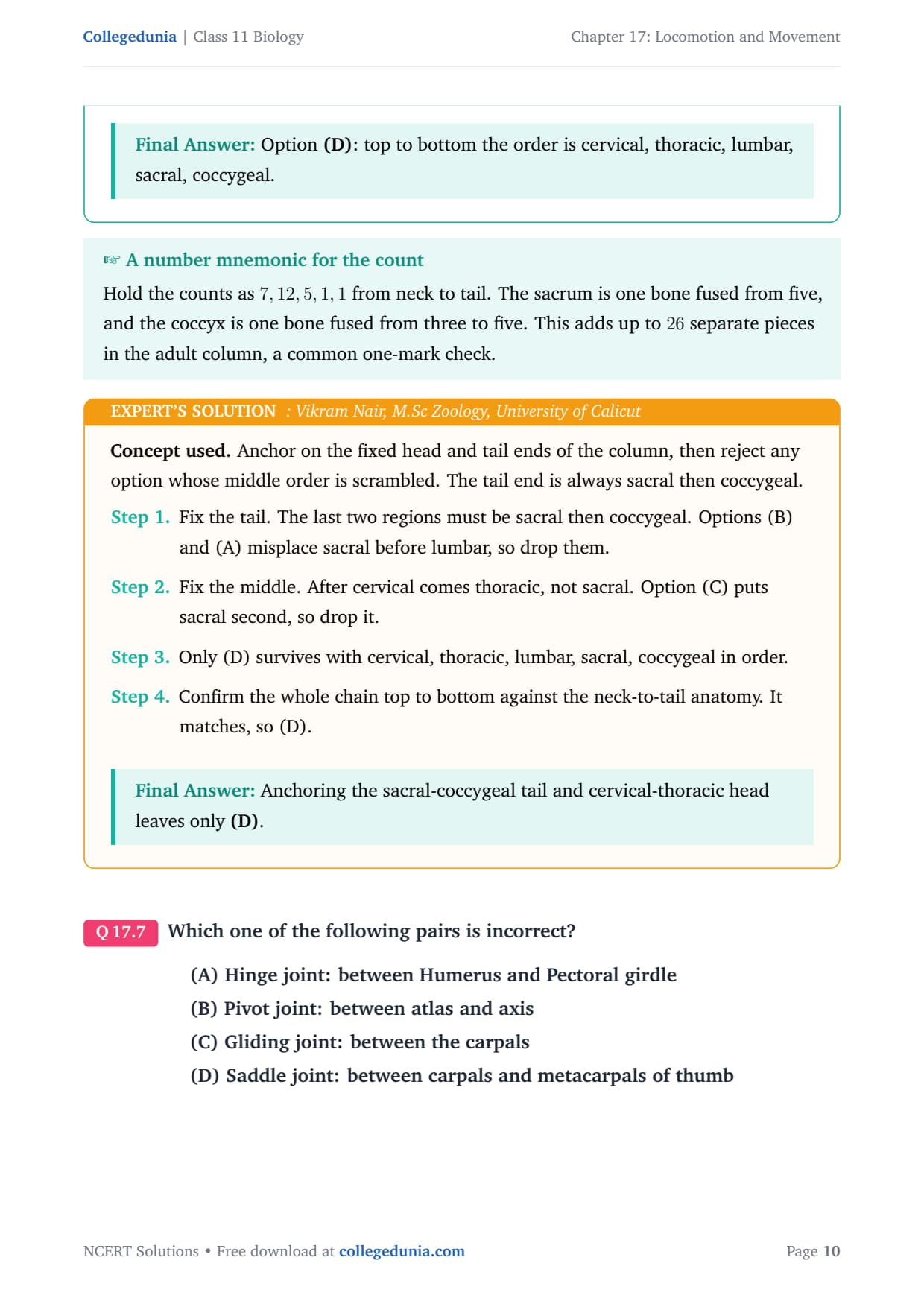
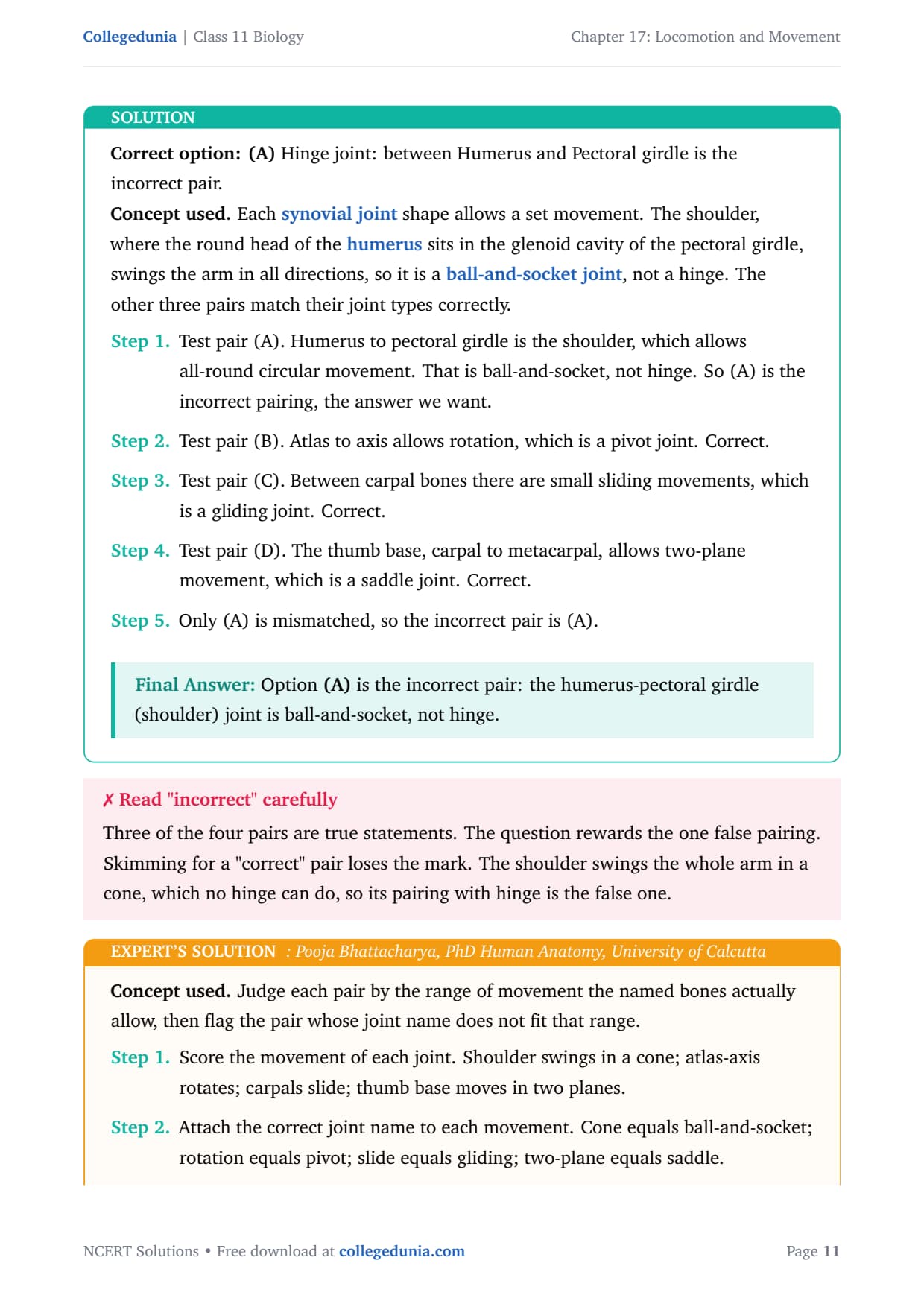
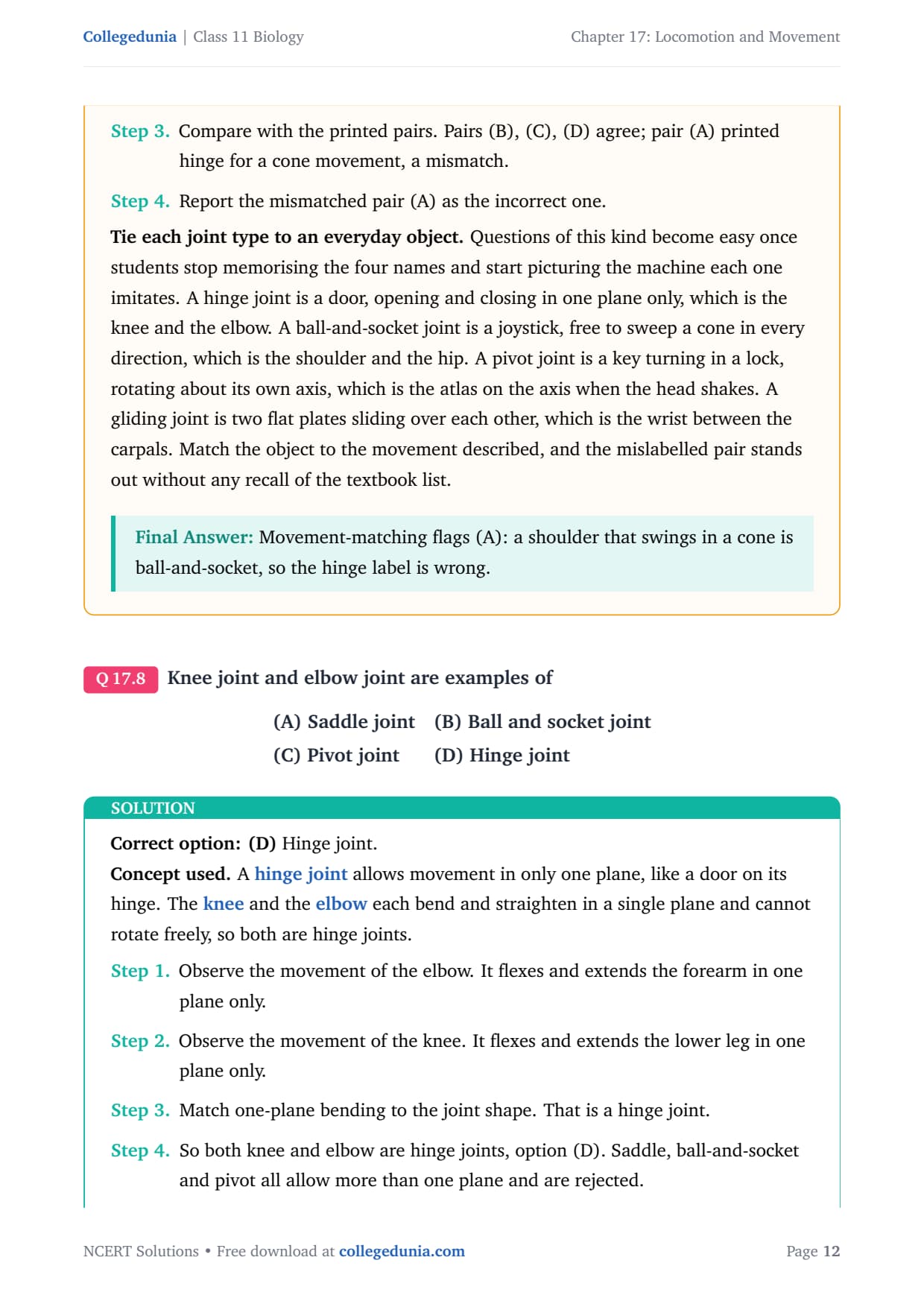
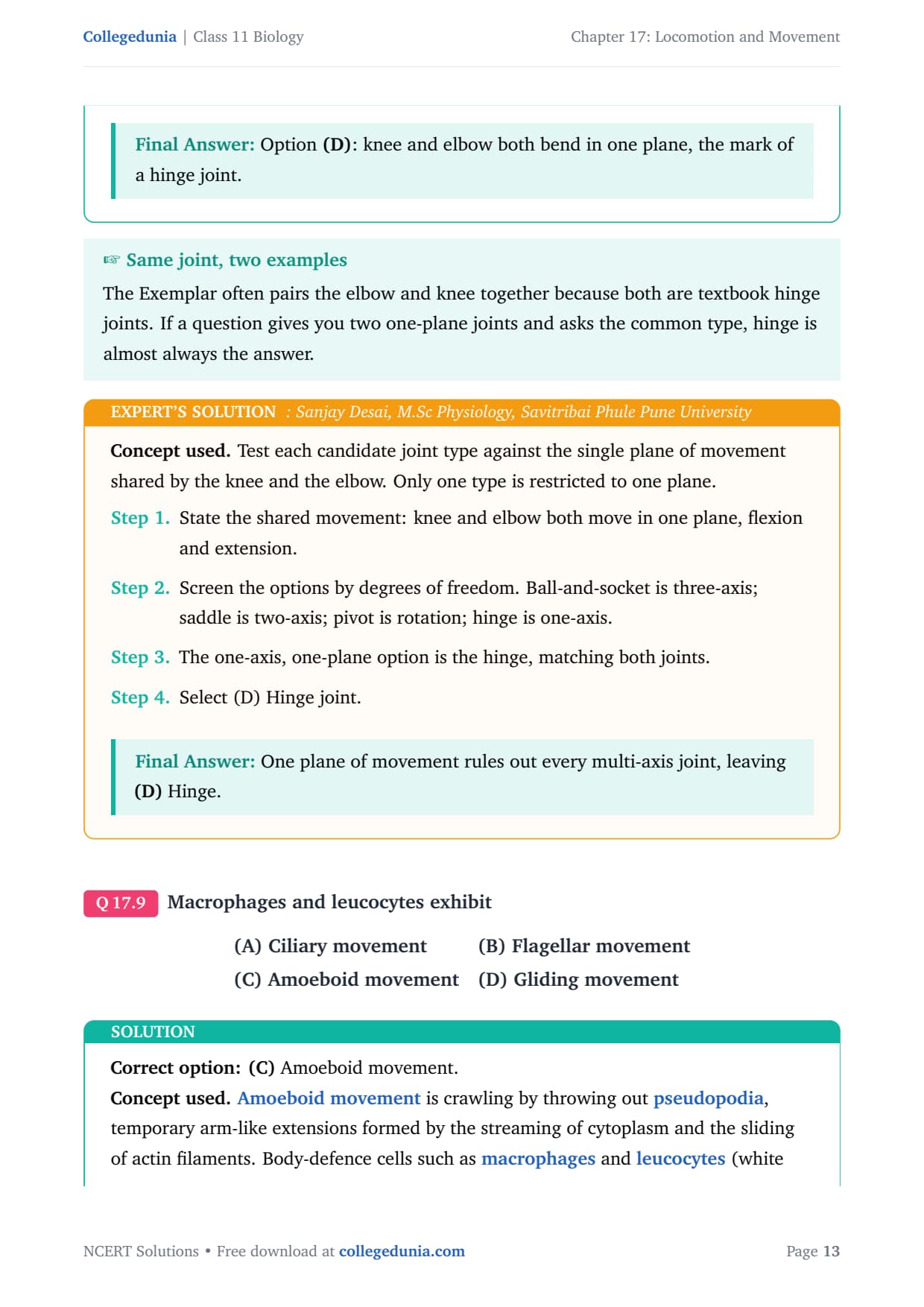
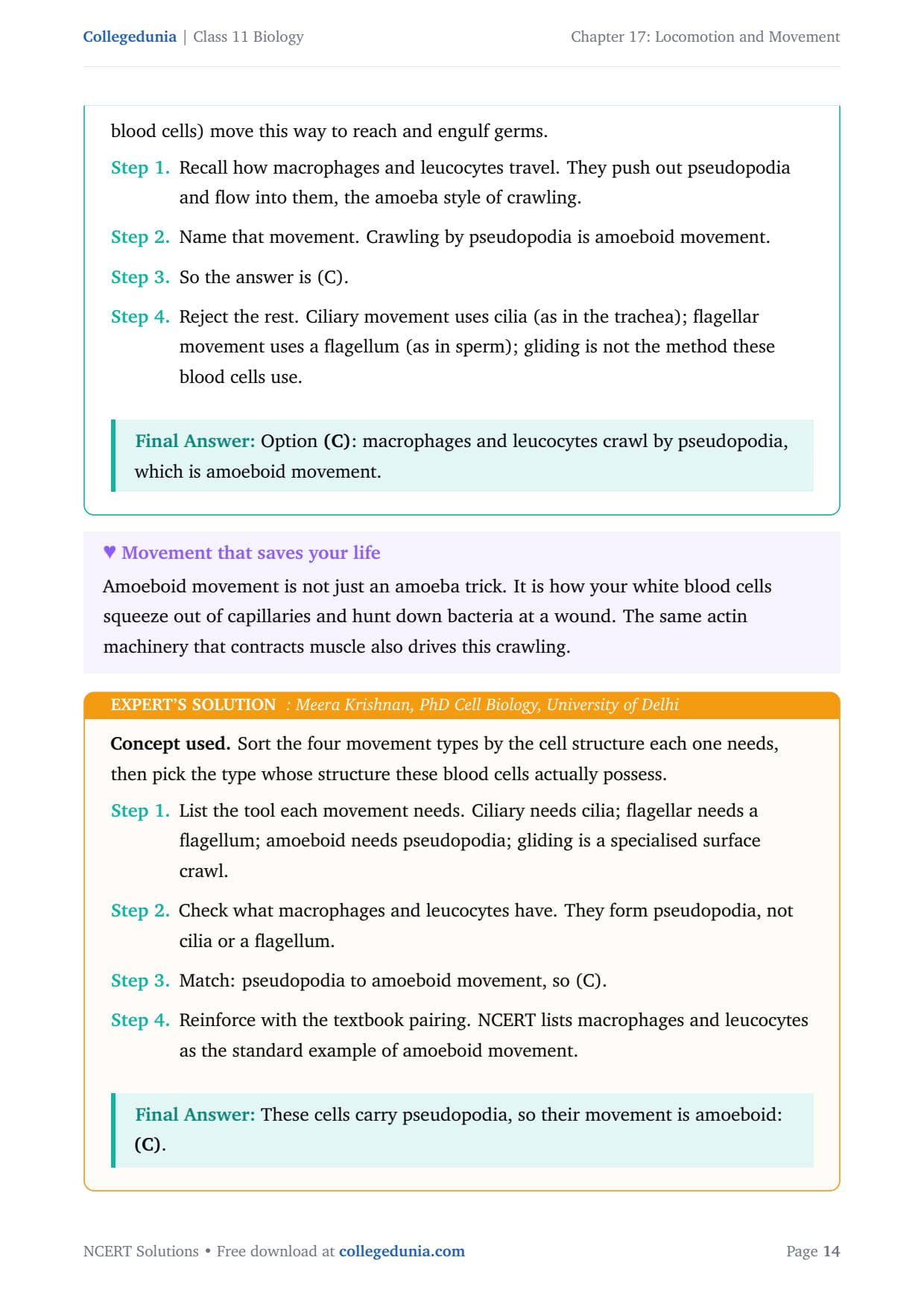
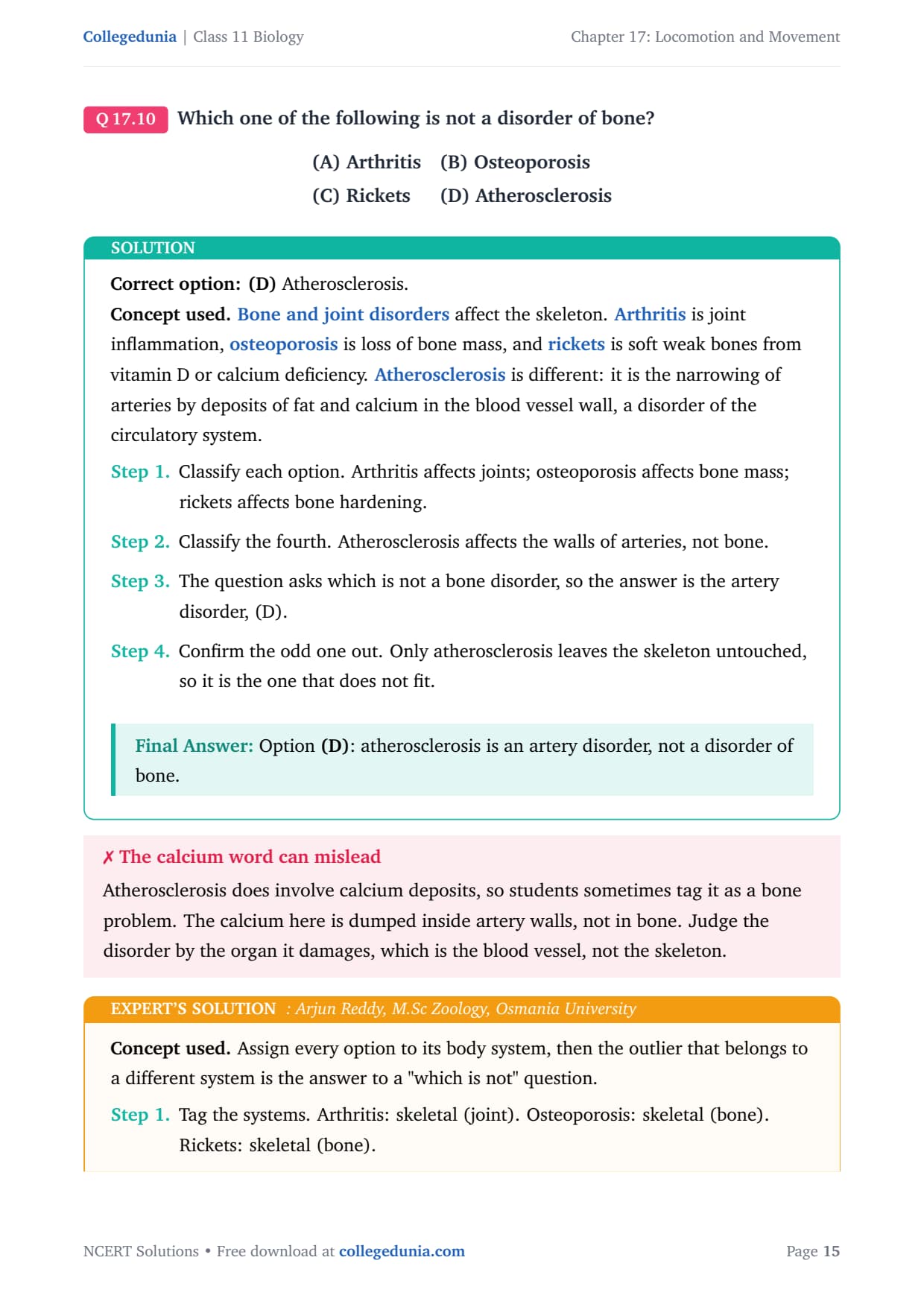
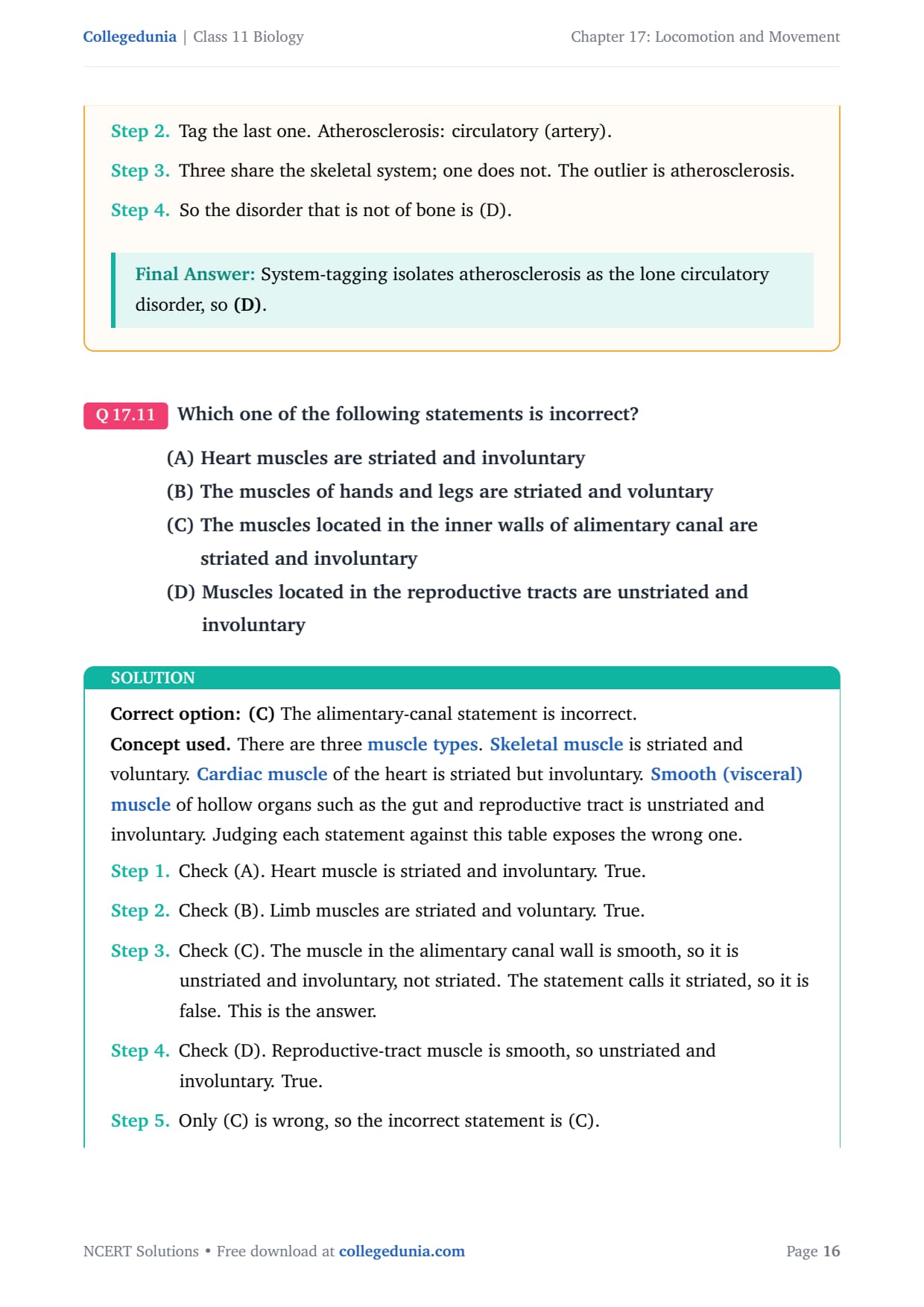
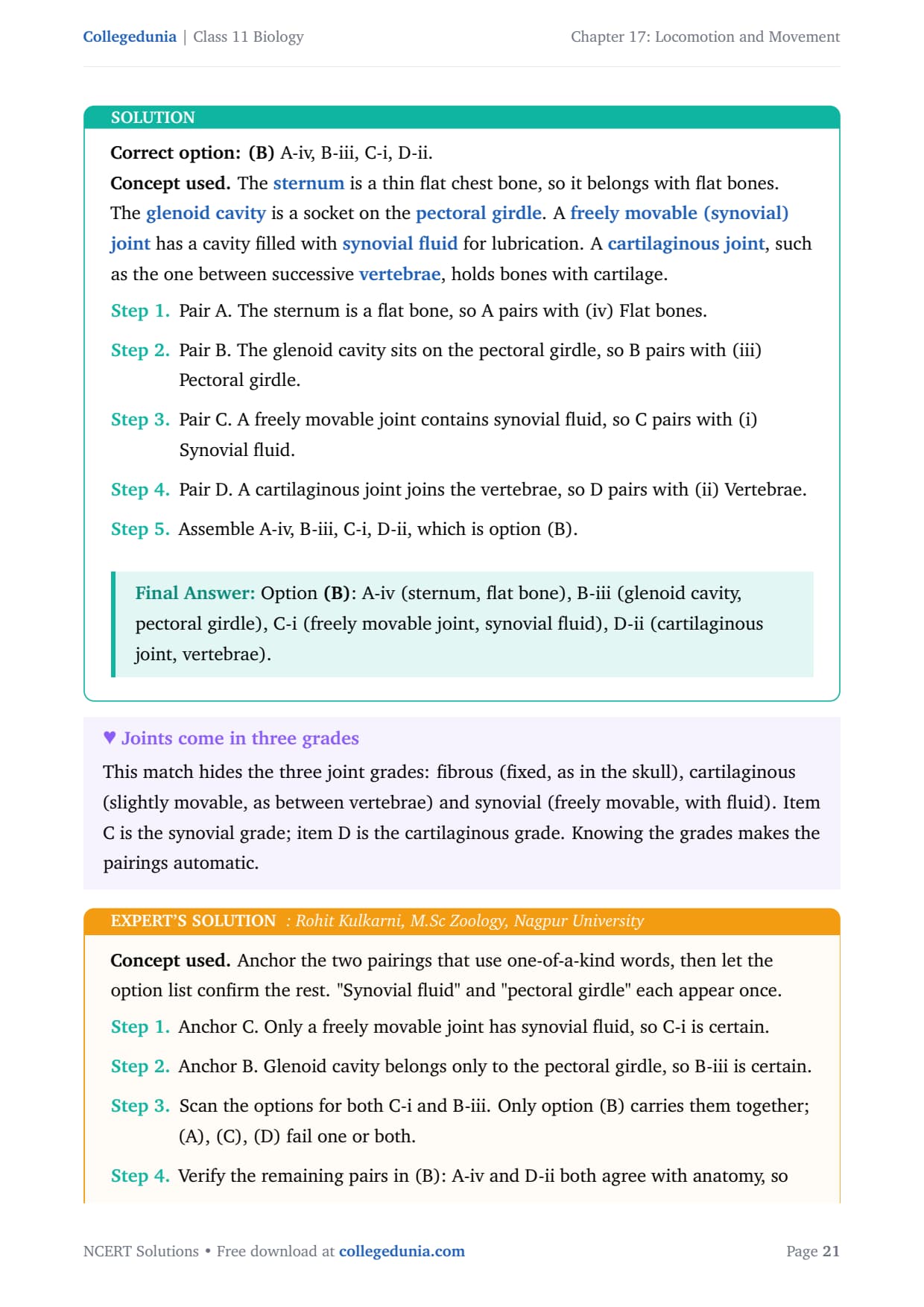
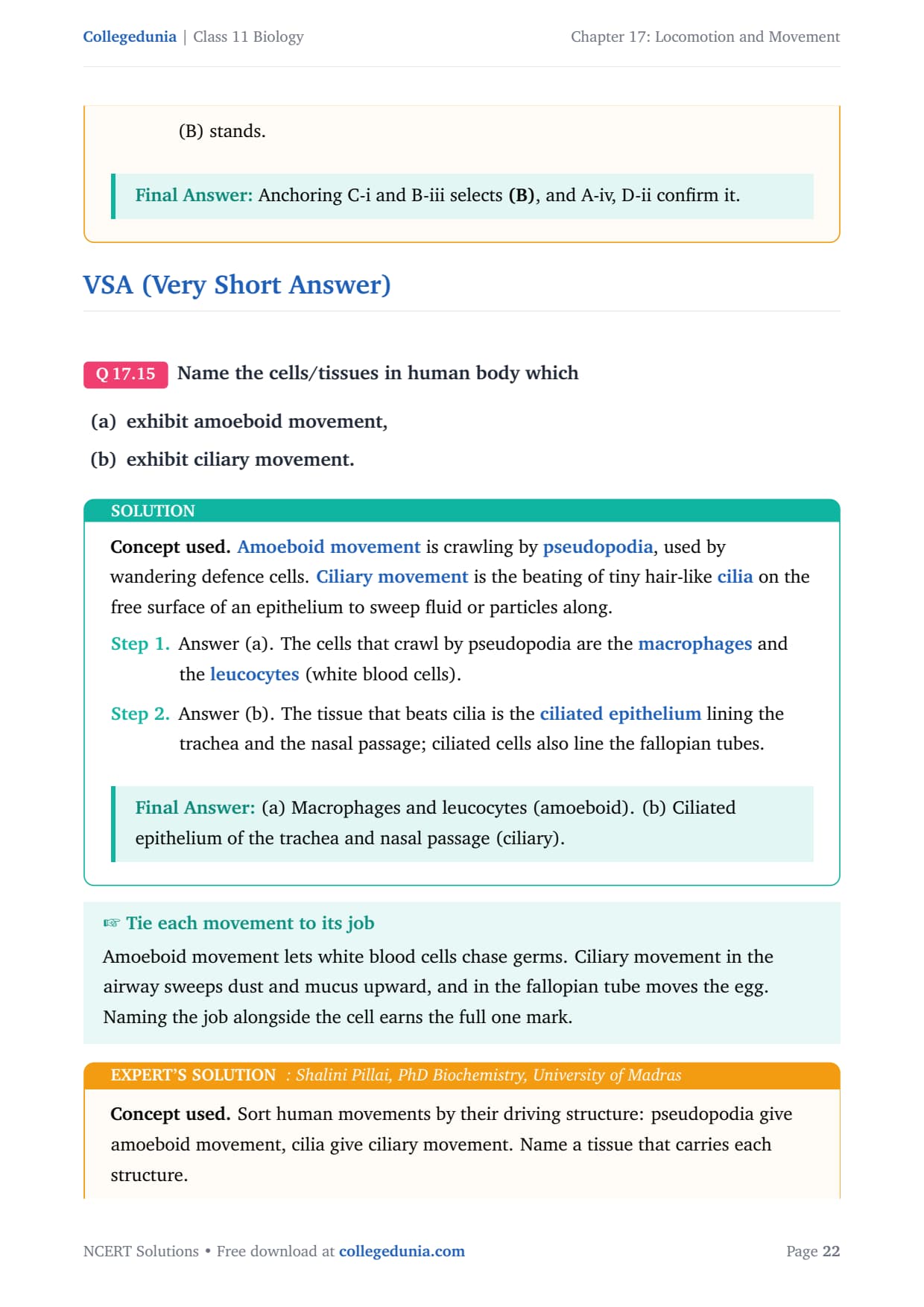
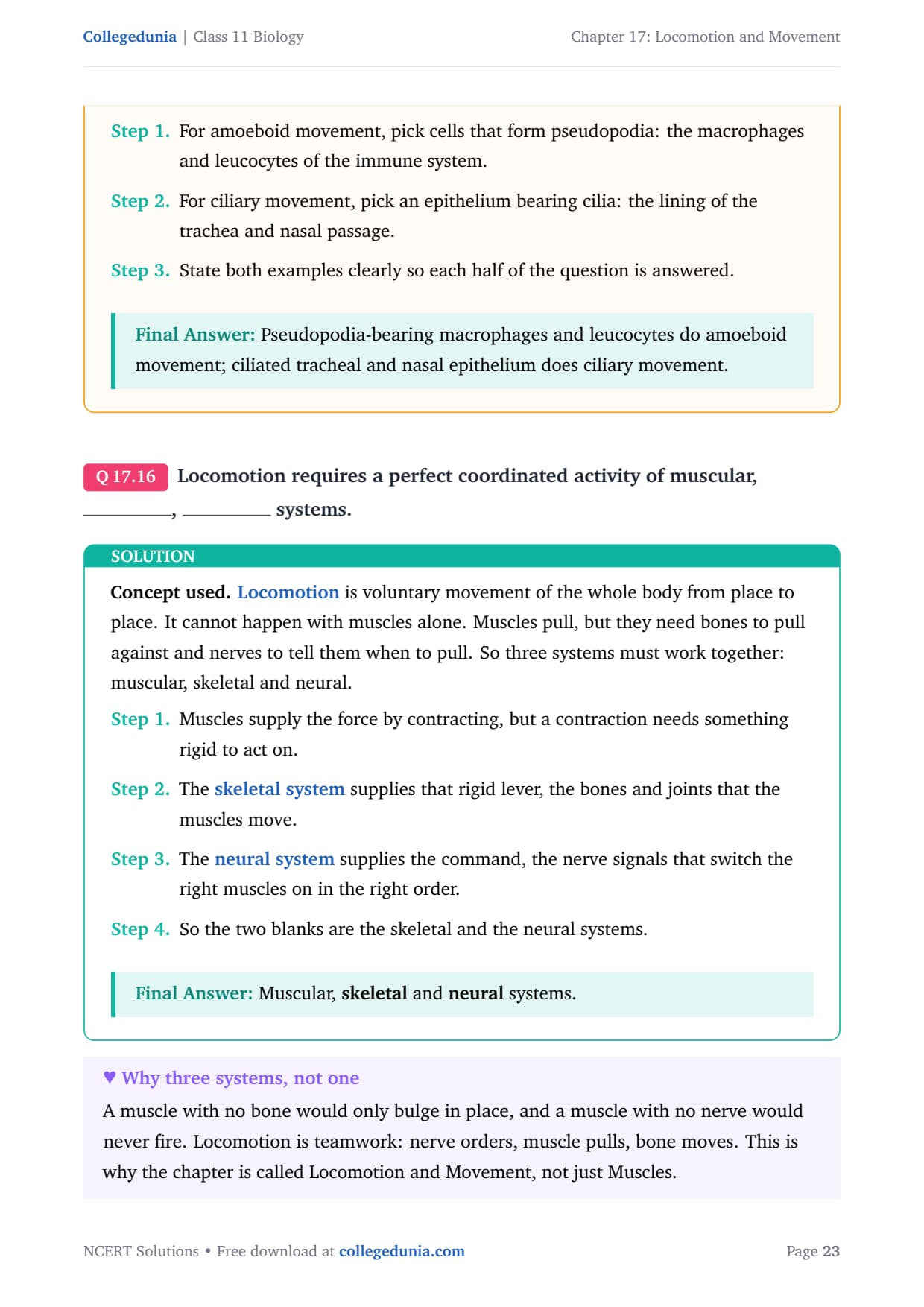
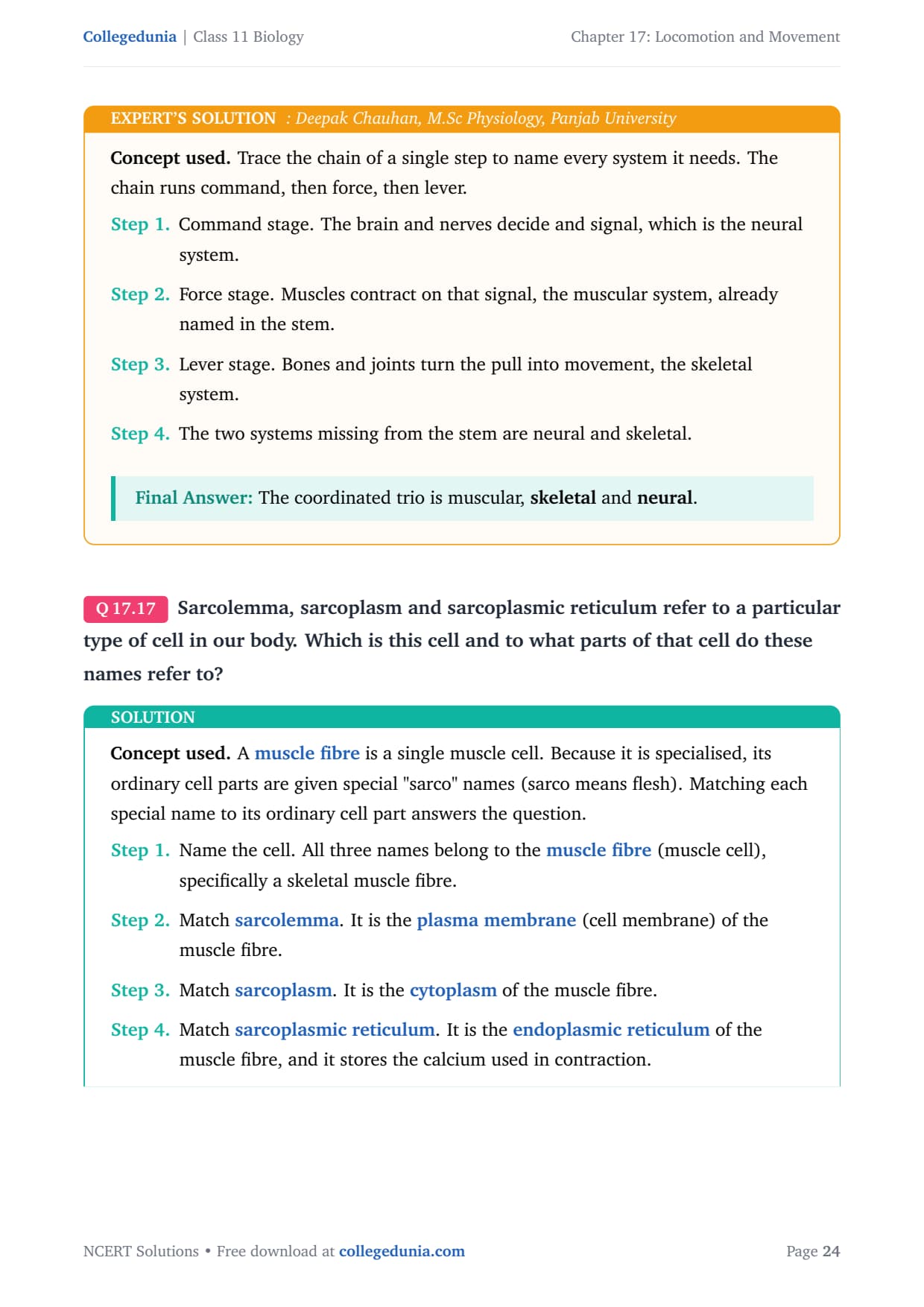
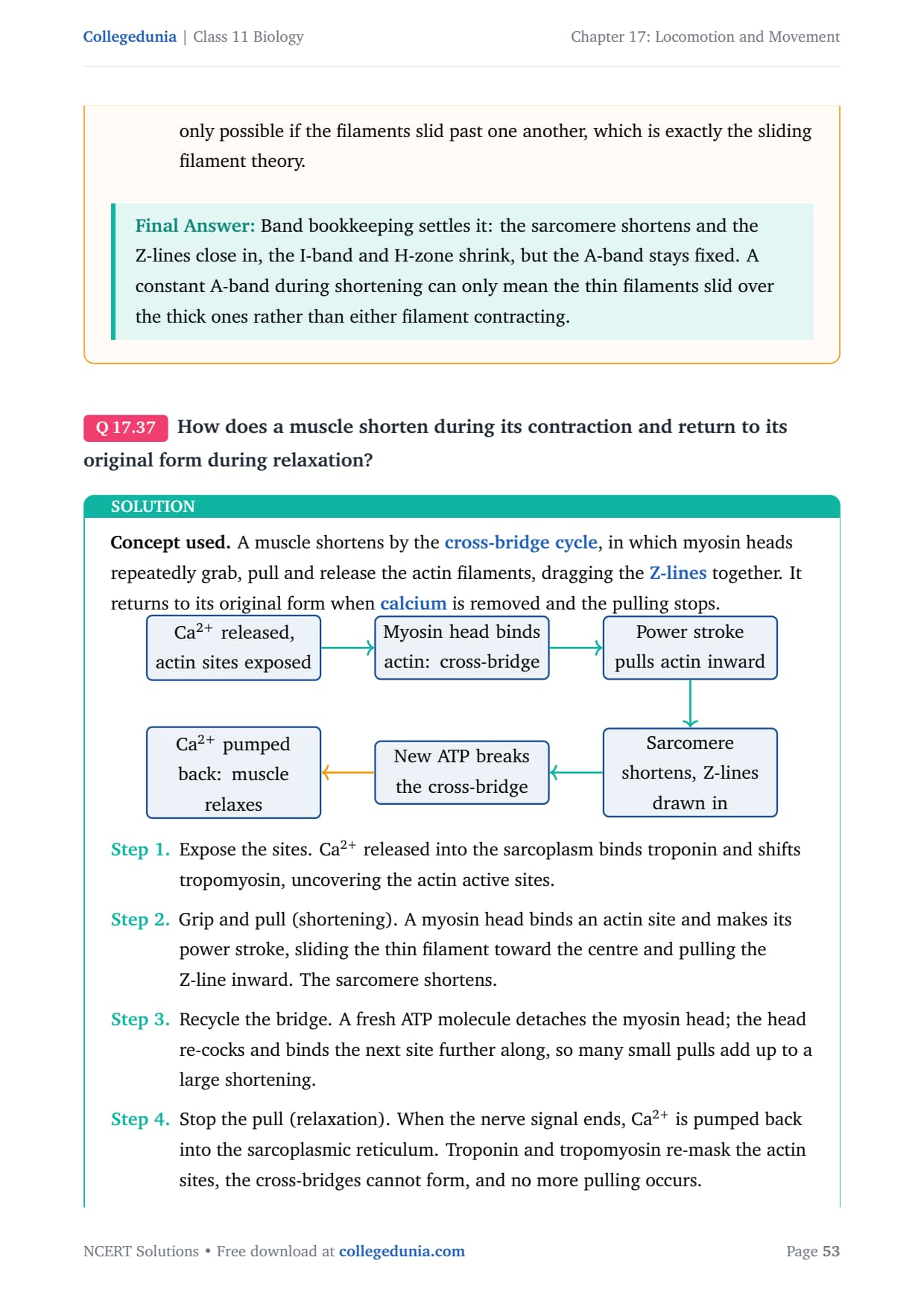
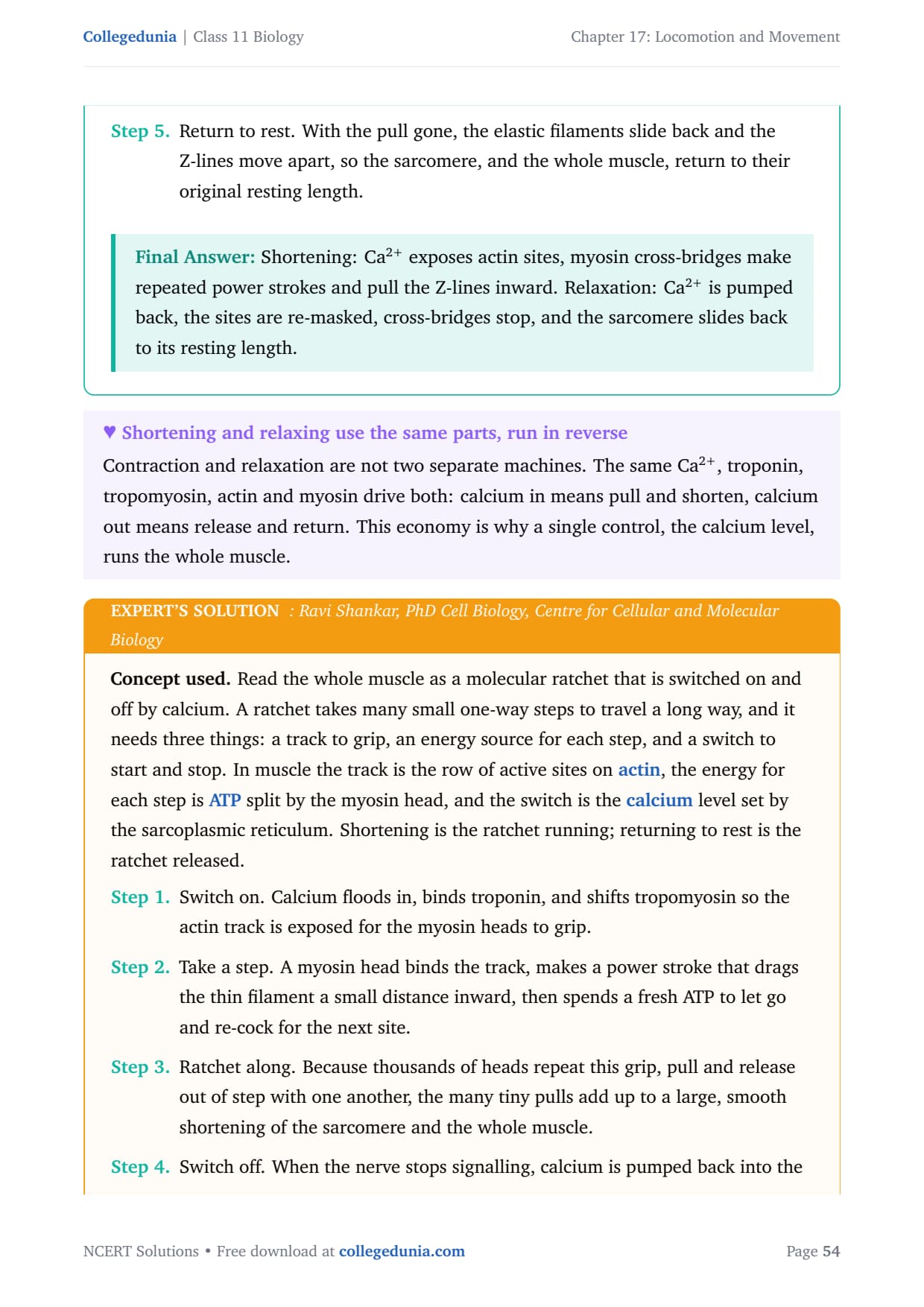
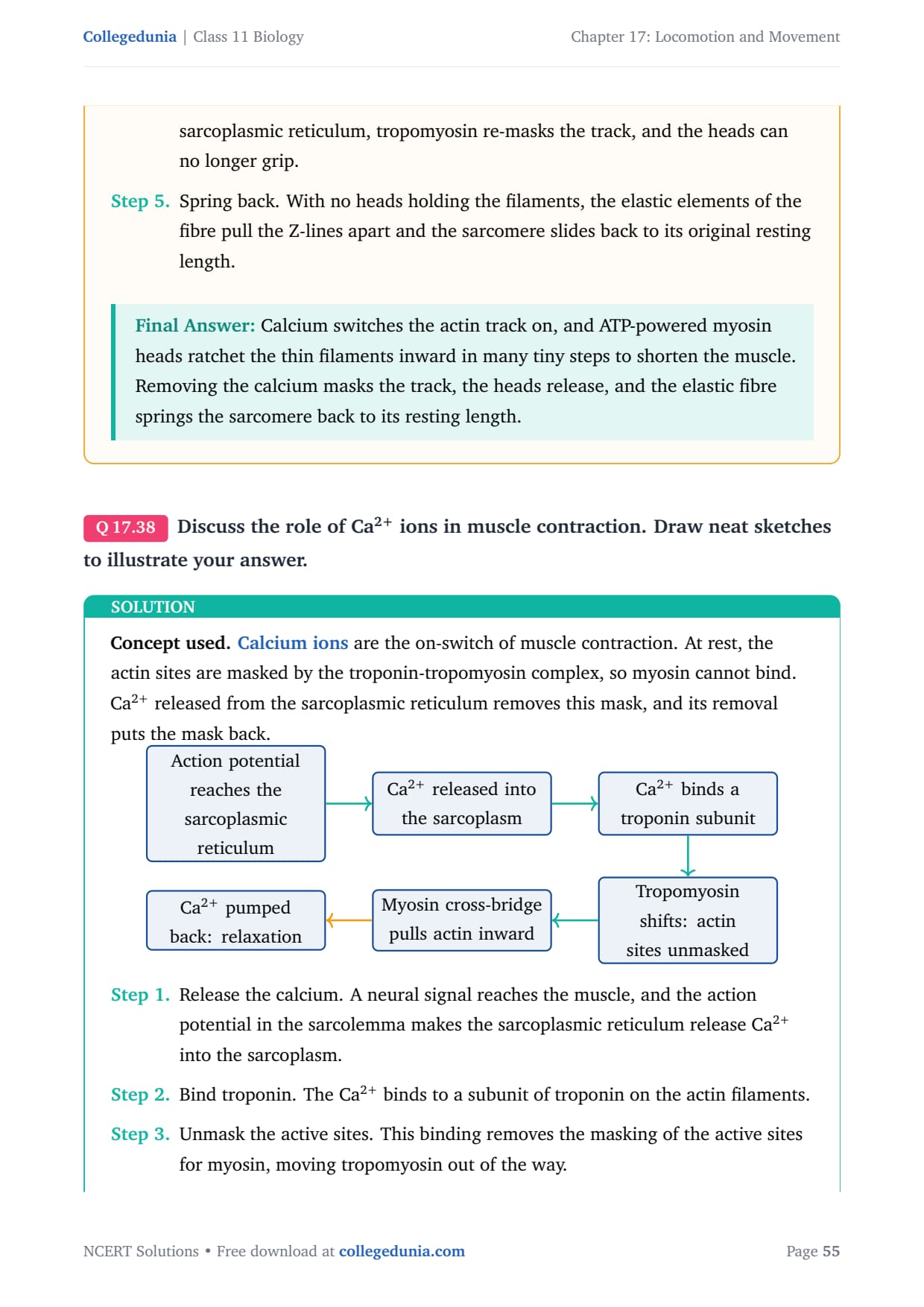
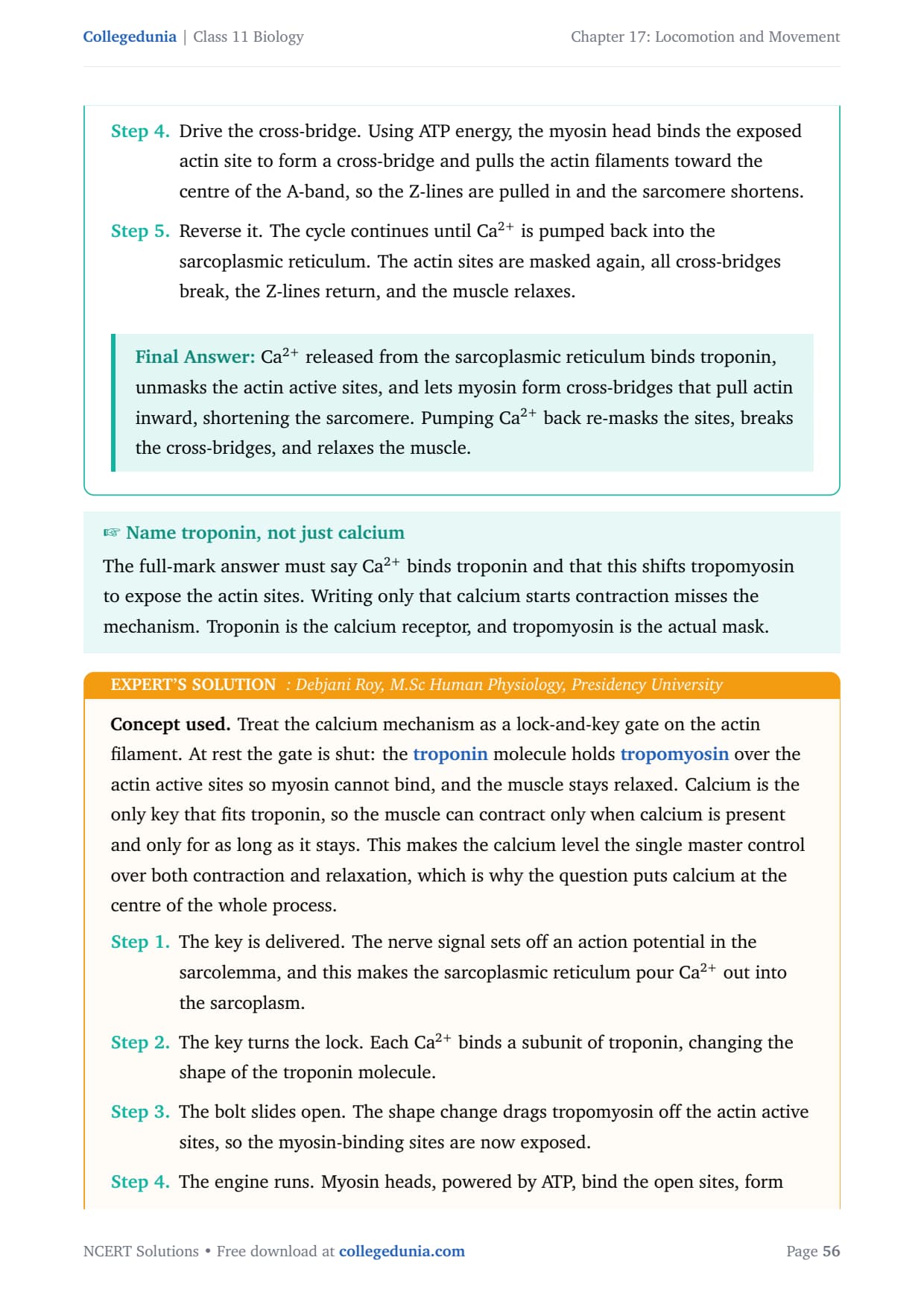
Muscle and bone are asked together in this chapter, and the Exemplar keeps testing the join between them. It moves from the sarcomere to the girdles, then to the disorders that show up when either part fails. Most questions ask you to name an exact structure, not describe a general idea.
- CBSE Weightage: 4 to 5 marks, usually the sliding filament theory plus a short question on joints or a bone disorder
- NEET Weightage: 2 to 3 questions per year from muscle contraction, the skeleton, joint types and muscular disorders
- CUET Weightage: 1 to 2 questions on bones, joints and muscle proteins in the Biology domain paper
All 14 MCQ answers here are matched against the official NCERT Exemplar key, which prints them under the heading CHAPTER 20, and every one of the 14 agrees. Where no official model answer exists, the source is named at the question.
Topics Covered in the NCERT Exemplar Class 11 Biology Solutions Chapter 17
The 39 questions sit on four ideas. Two of them are physiology and two are anatomy, and the Exemplar mixes them inside single questions. A question on a fall in old age, for example, wants bone chemistry and a joint name in the same answer.
- Types of movement: amoeboid movement in macrophages and leucocytes, ciliary movement in the trachea and nasal passage, and muscular movement
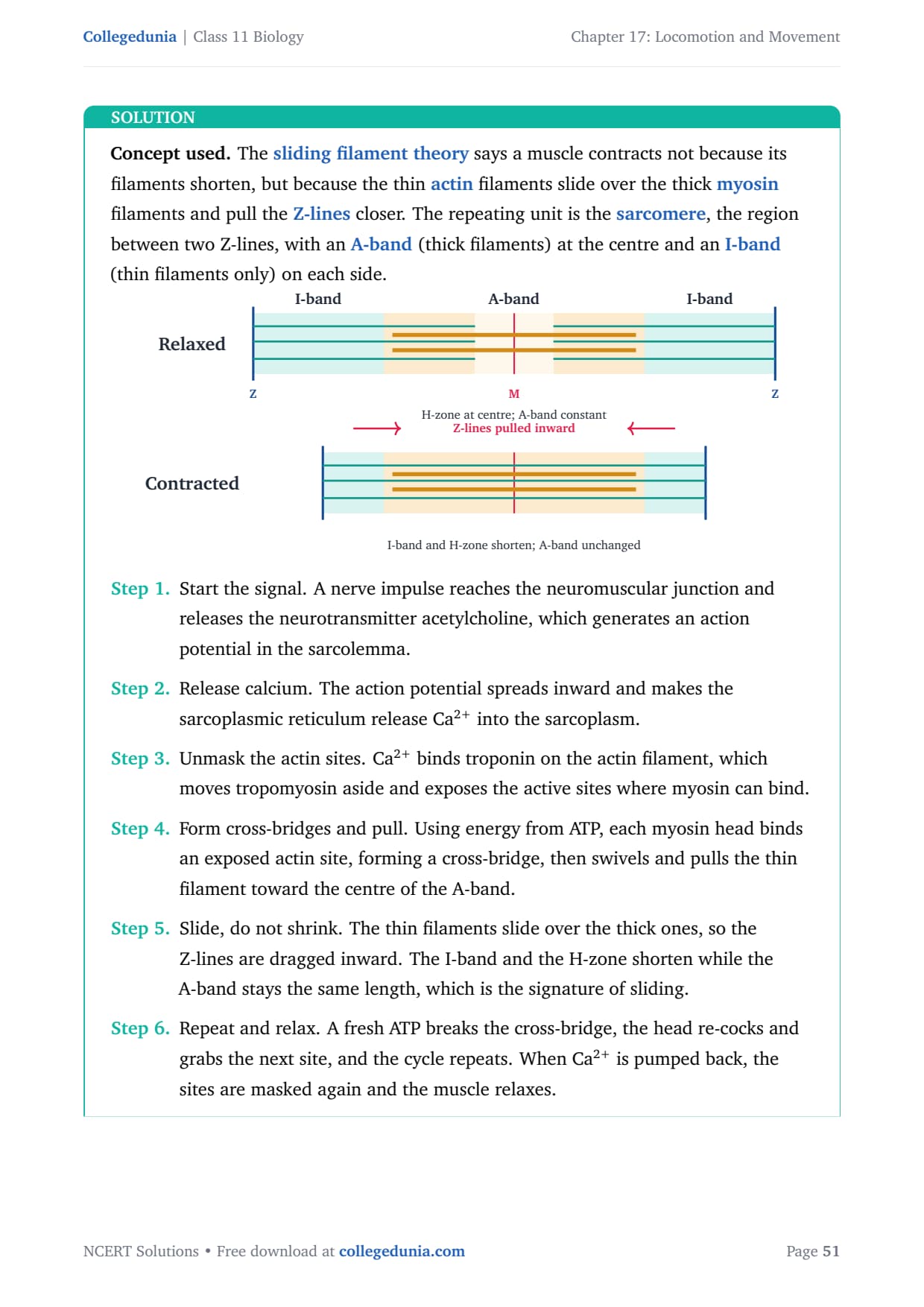
- Muscle structure and contraction: sarcolemma, sarcoplasm and sarcoplasmic reticulum, actin and myosin, red and white fibres, and the sliding filament theory
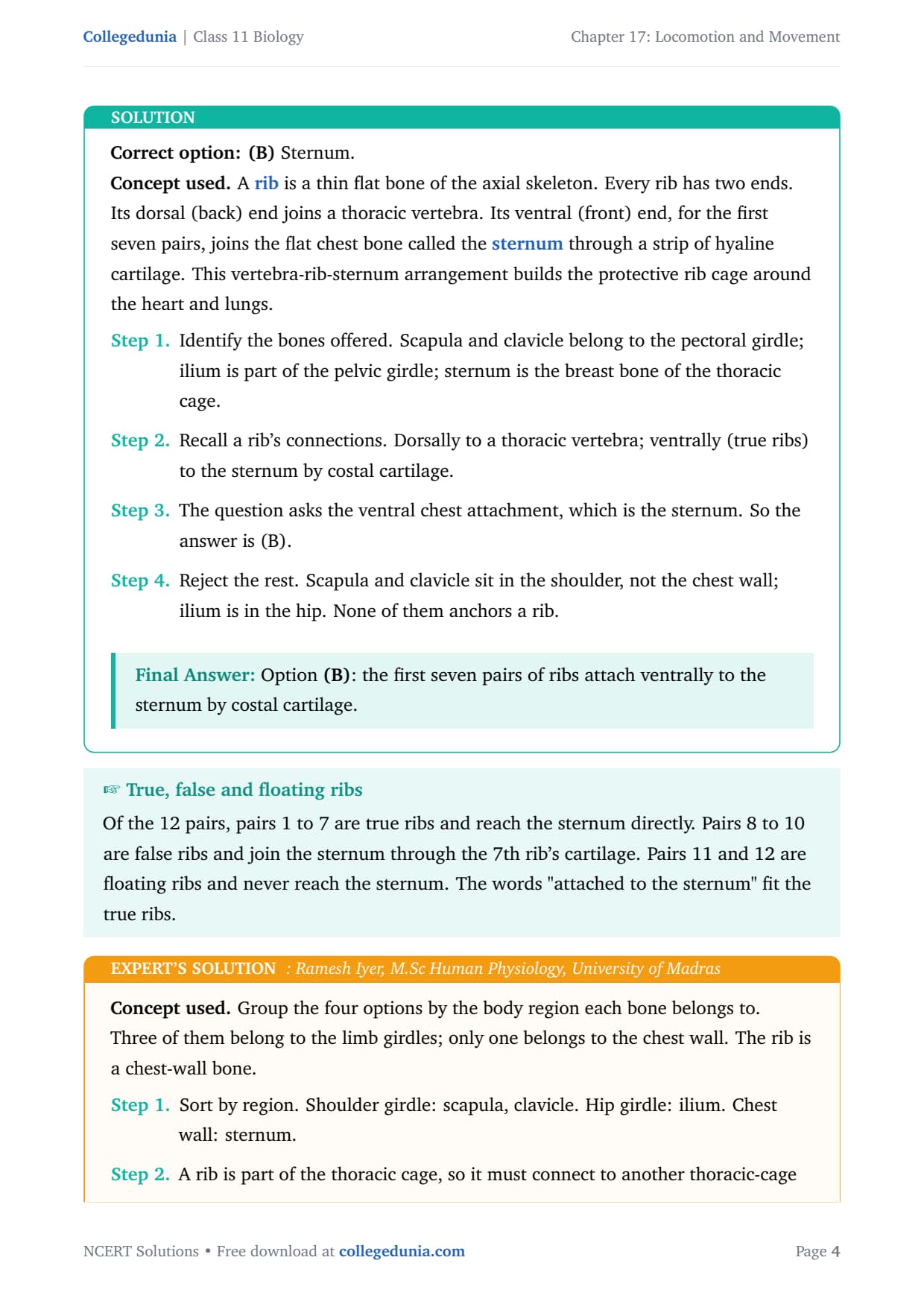
- The skeleton: the vertebral column order, the rib cage, ear ossicles, and the bones of the arm and forearm
- Joints and disorders: pivot, hinge, ball and socket and cartilaginous joints, plus arthritis, osteoporosis, gout, tetany and myasthenia gravis
Question Types in the Locomotion and Movement Exemplar
The four types make different demands here. Over half the chapter is MCQ and Very Short Answer, which makes it strong NEET practice. The six Long Answer questions are the ones boards reuse, since four of them ask for the contraction mechanism in some form. The split is below.
| Question Type | Count | What It Tests |
|---|---|---|
| MCQ (single correct) | 14 | Exact joint types, bone names and muscle properties |
| VSA (Very Short Answer) | 10 | Naming cells, tissues and the three ear ossicles in order |
| SA (Short Answer) | 9 | Applied cases such as gout, stiff joints and calcium exchange |
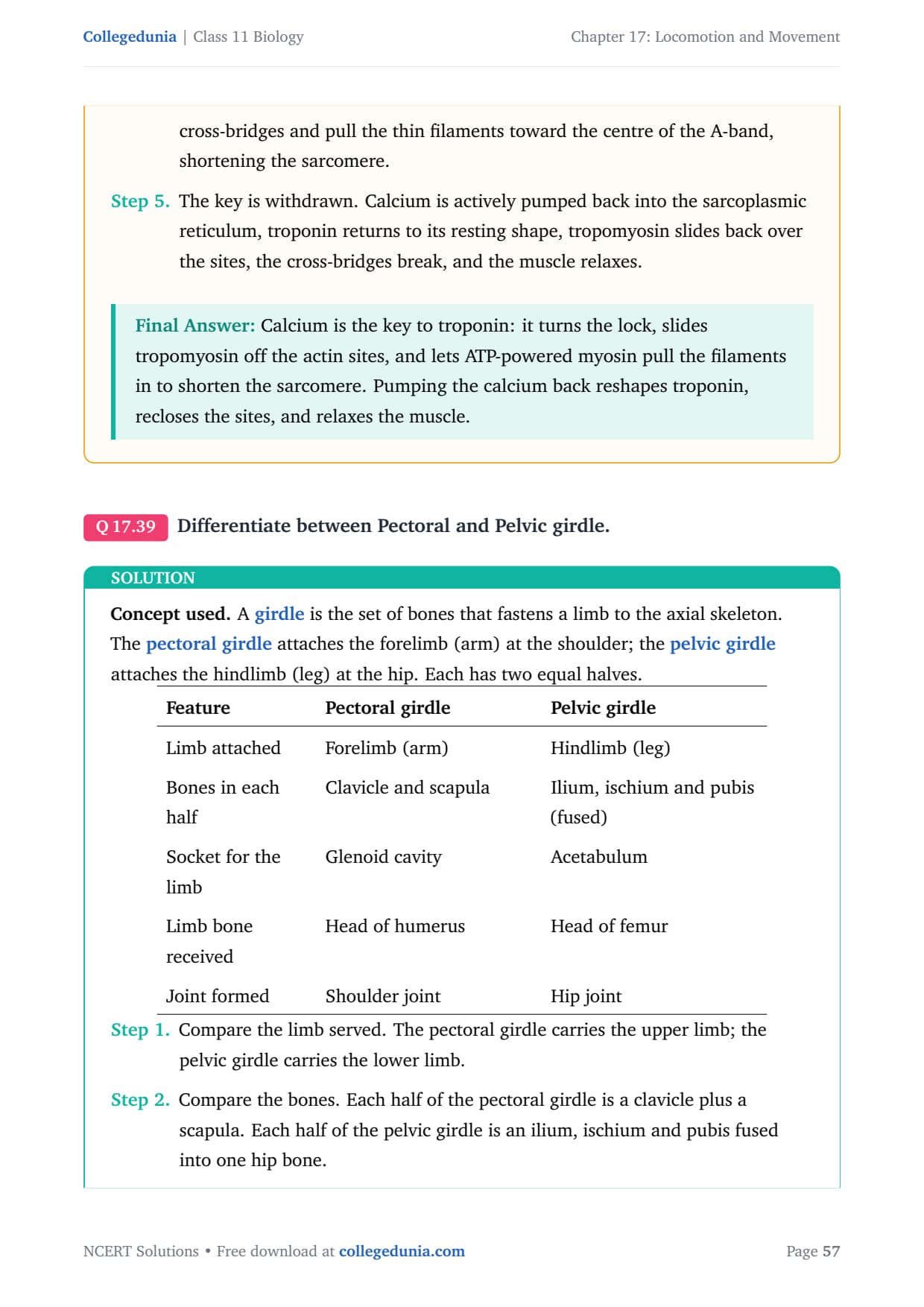
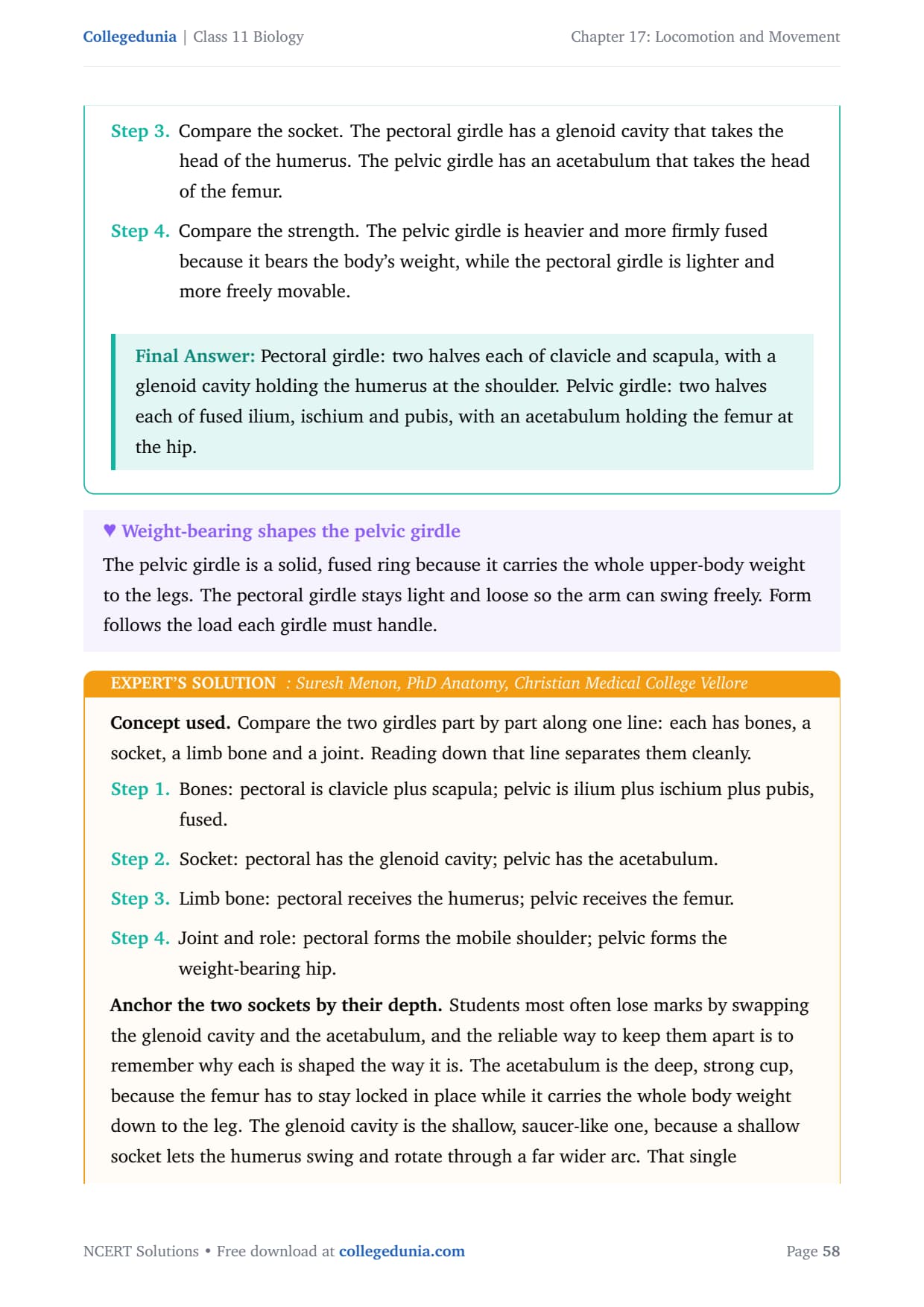
| LA (Long Answer) | 6 | The sliding filament theory and girdle comparison with diagrams |
Why Your Exemplar Book Numbers This as Chapter 20
The Class 11 Biology Exemplar is the older 22-chapter edition. Locomotion and Movement is printed there as Chapter 20, while the current 19-chapter textbook lists it as Chapter 17. The content is the same. Only the number moved.
This matters when you check an answer, because the two answer keys behave differently.
- The MCQ key is chapter-indexed: look under the CHAPTER 20 block, not Chapter 17. It reads 1-c, 2-b, 3-a, 4-c, 5-c, 6-d, 7-a, 8-d, 9-c, 10-d, 11-c, 12-b, 13-b, 14-b.
- The descriptive key is not chapter-indexed: it states that its questions are picked at random across units, so there is no Chapter 20 block to turn to.
- Only 7 of the 25 descriptive questions have an official model answer: the amoeboid and ciliary question, the muscular and skeletal blank, the ear ossicles, gout, girdle articulation, the role of calcium ions, and the pectoral against pelvic comparison.
The other 18 descriptive questions have no printed answer anywhere in the Exemplar. Each one in this PDF is answered from the NCERT Class 11 Biology textbook, with the source named at the question so students can check it.
Common Mistakes Students Make in Locomotion and Movement
The Exemplar builds its wrong options around four confusions. Each one is flagged in the PDF at the question where it appears.
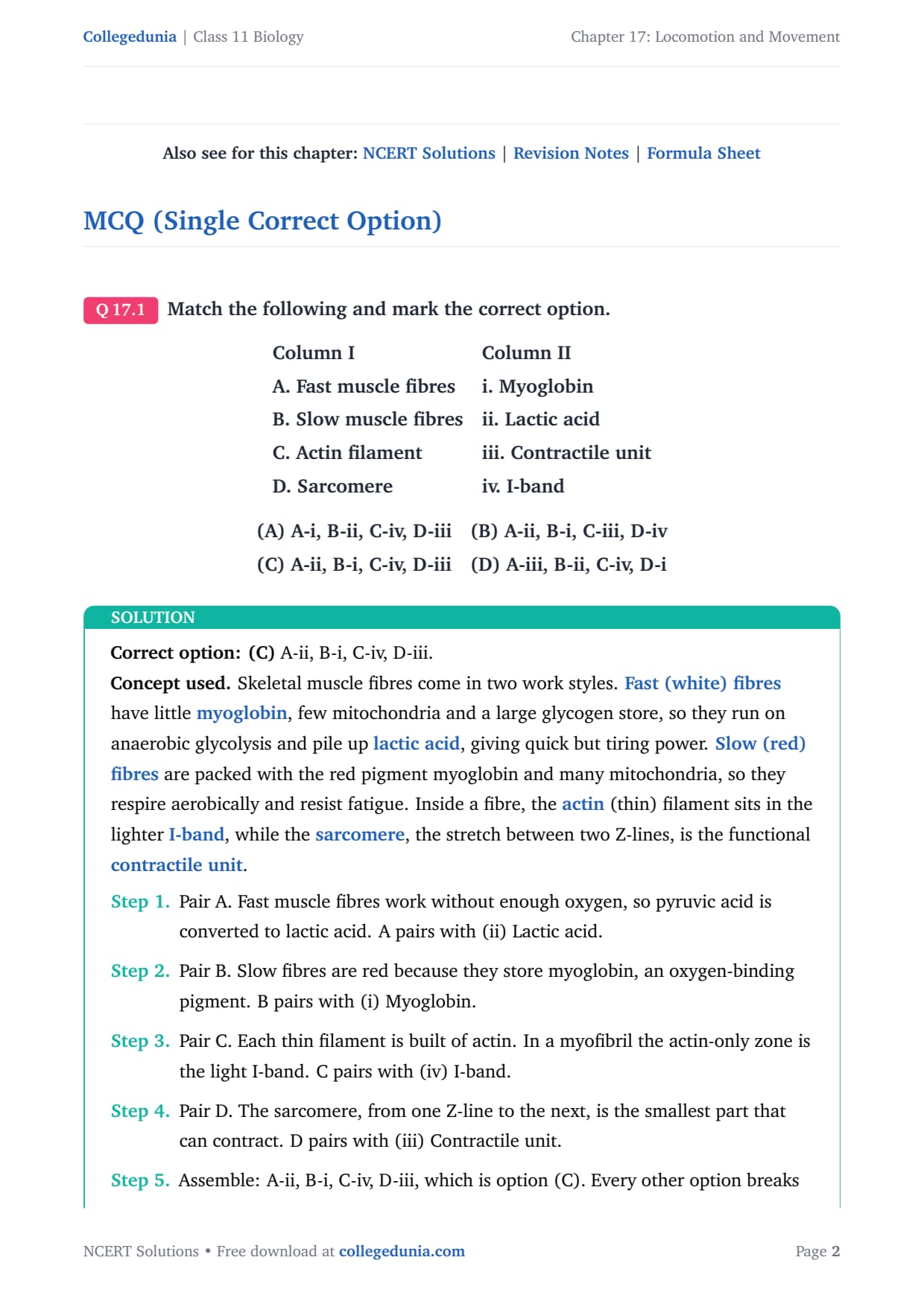
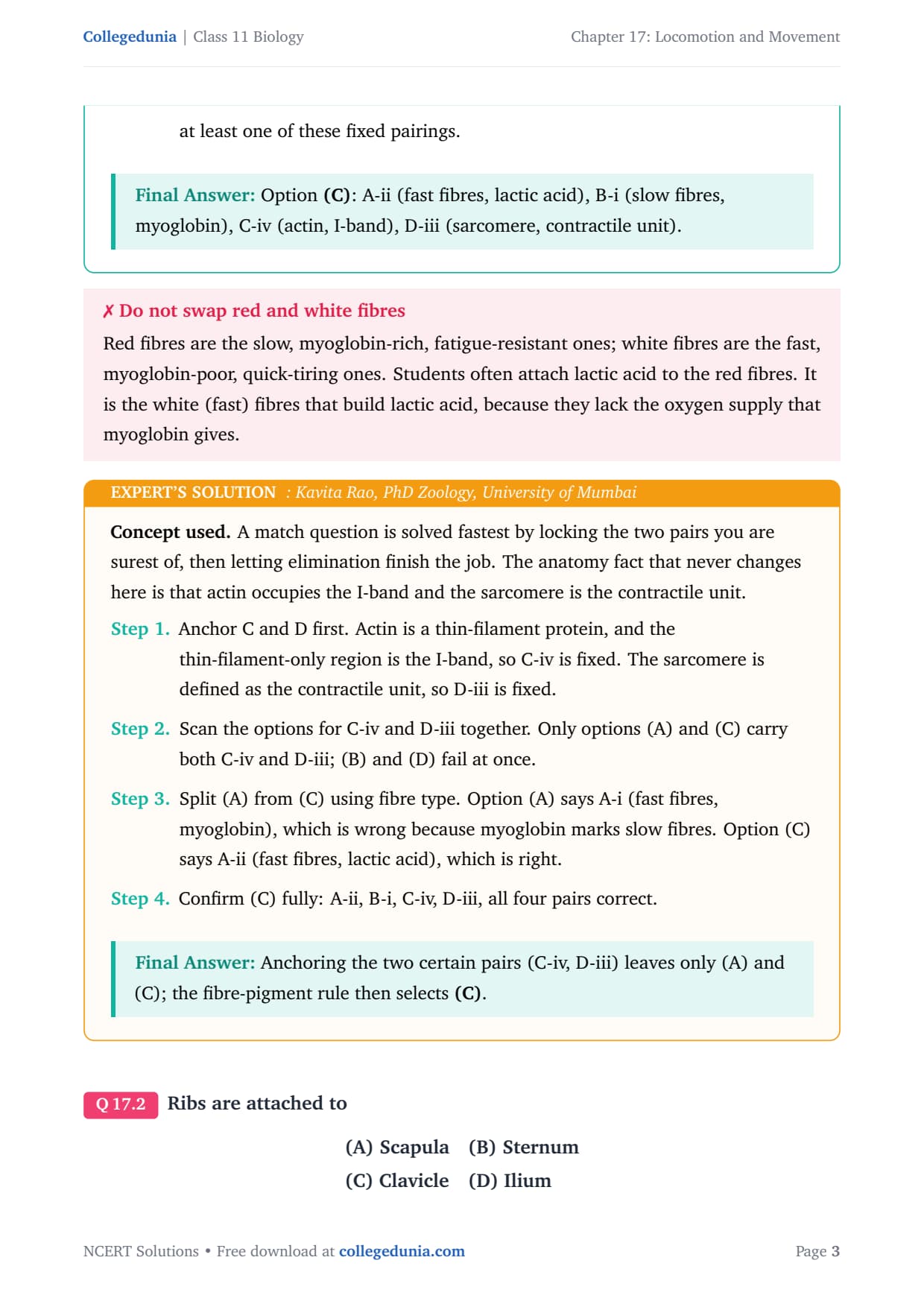
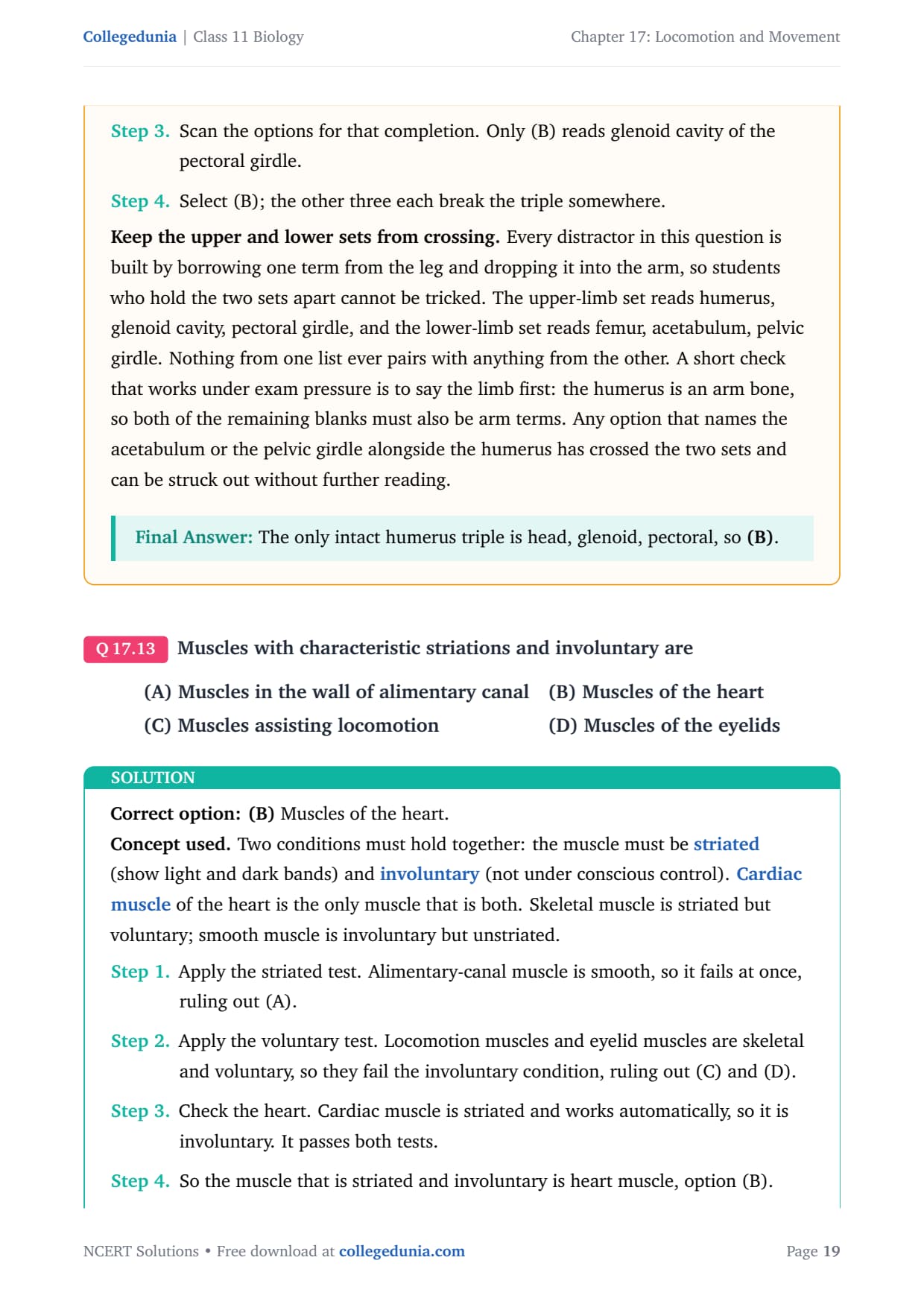
- Swapping red and white fibres: red fibres are slow, rich in myoglobin and resist fatigue. White fibres are fast and build lactic acid because they lack that oxygen store. The treadmill question turns on this.
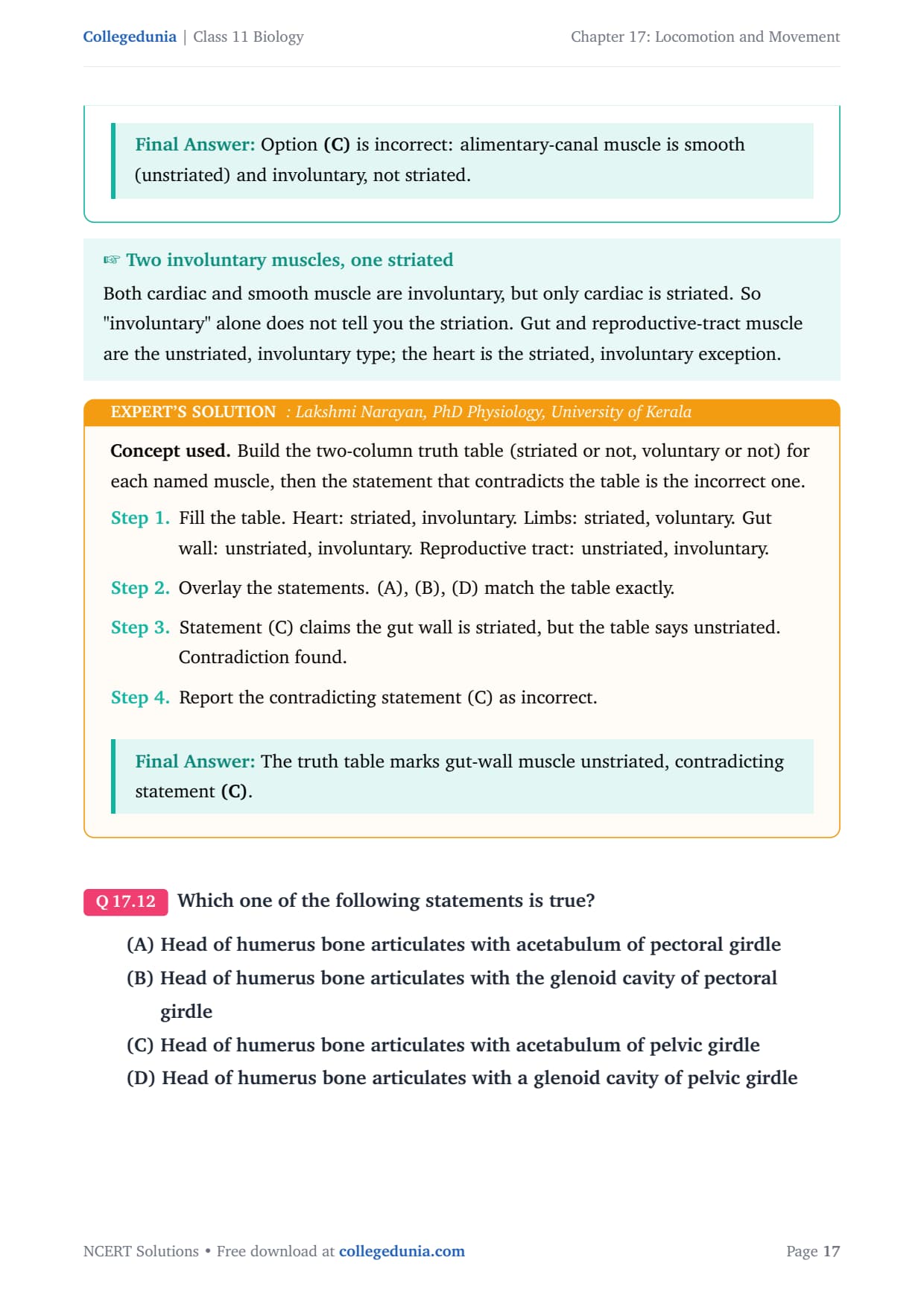
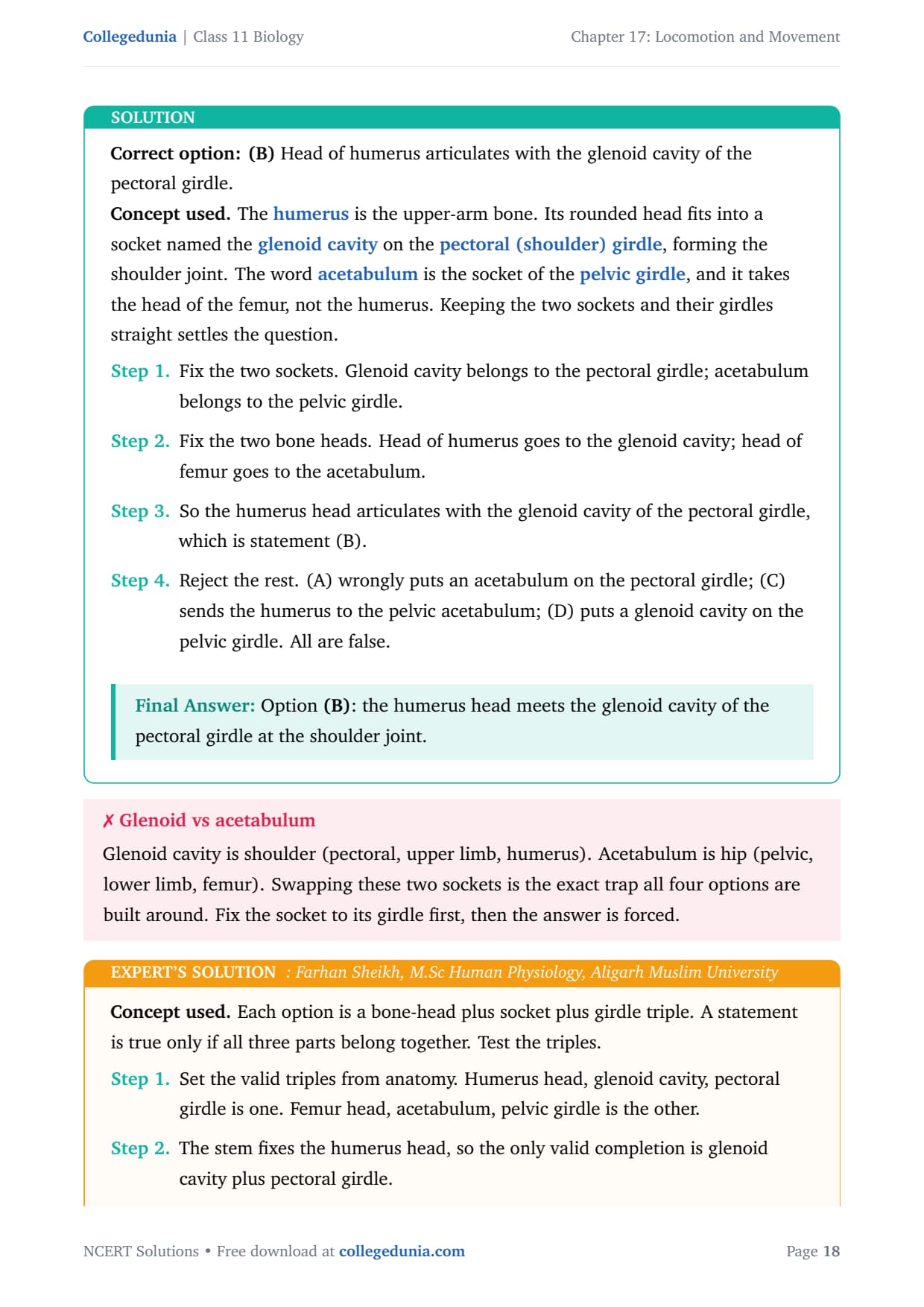
- Mixing the glenoid cavity with the acetabulum: the glenoid cavity is on the pectoral girdle and takes the humerus. The acetabulum is on the pelvic girdle and takes the femur. Two MCQs are built on this swap.
- Calling the forearm three bones: the forearm is the radius and ulna only. The humerus is the arm. Counting three is what makes that Short Answer question wrong.
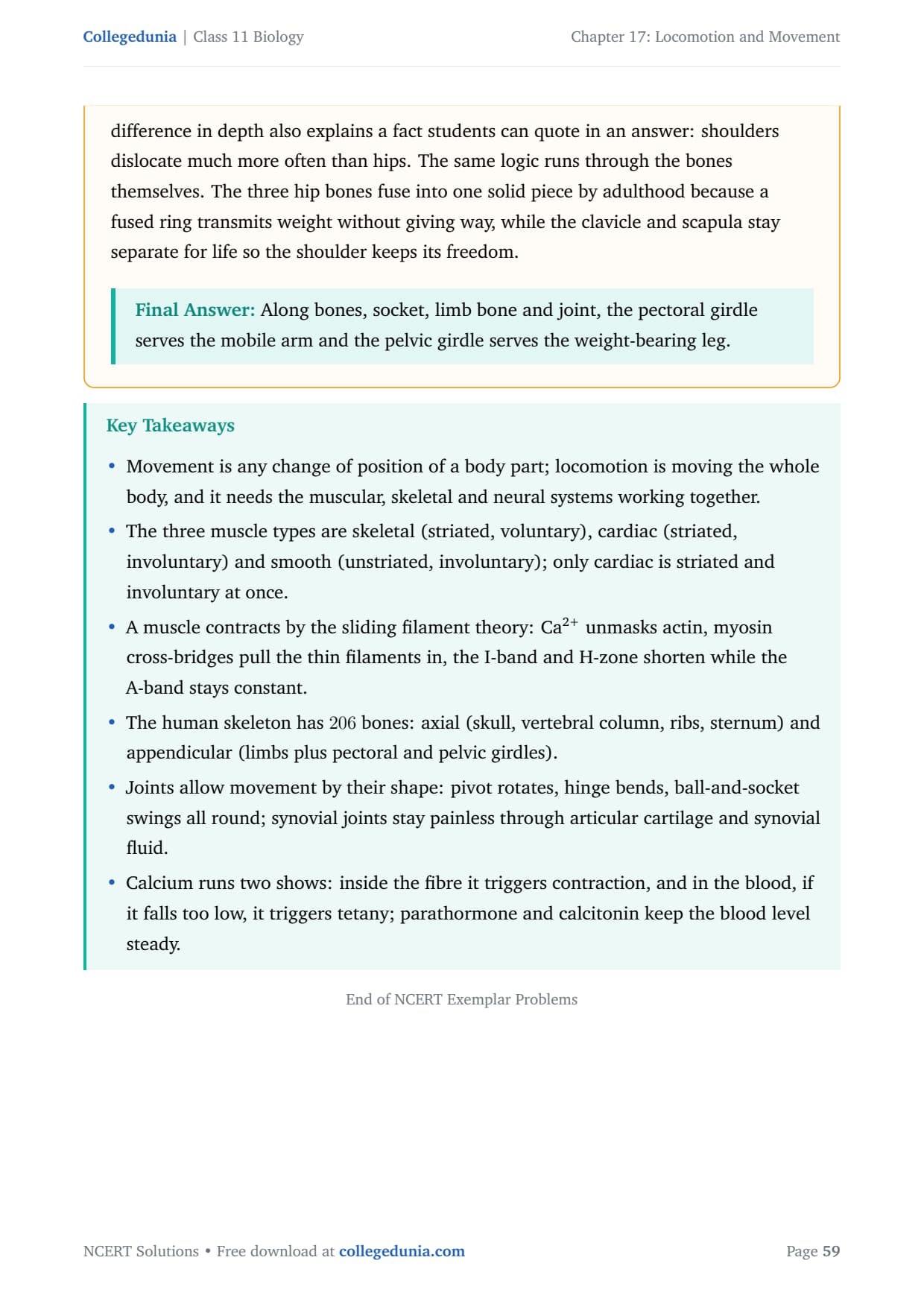
- Confusing the two calcium pools: a rise in calcium inside the muscle fibre causes a normal contraction. A fall in blood calcium causes tetany. The two act in opposite directions.
How to Use These Exemplar Solutions for Boards, NEET and CUET
Attempt each question before you open the solution. Draw the sarcomere once a week until the A-band, I-band and H-zone come without effort, since four Long Answer questions need it.
- Boards: the six Long Answer questions match the diagram-plus-mechanism pattern, especially sliding filament theory and the girdle comparison
- NEET: work the 14 MCQs and 10 Very Short Answers first, since NEET repeats joint types, muscle properties and disorders at that exact level
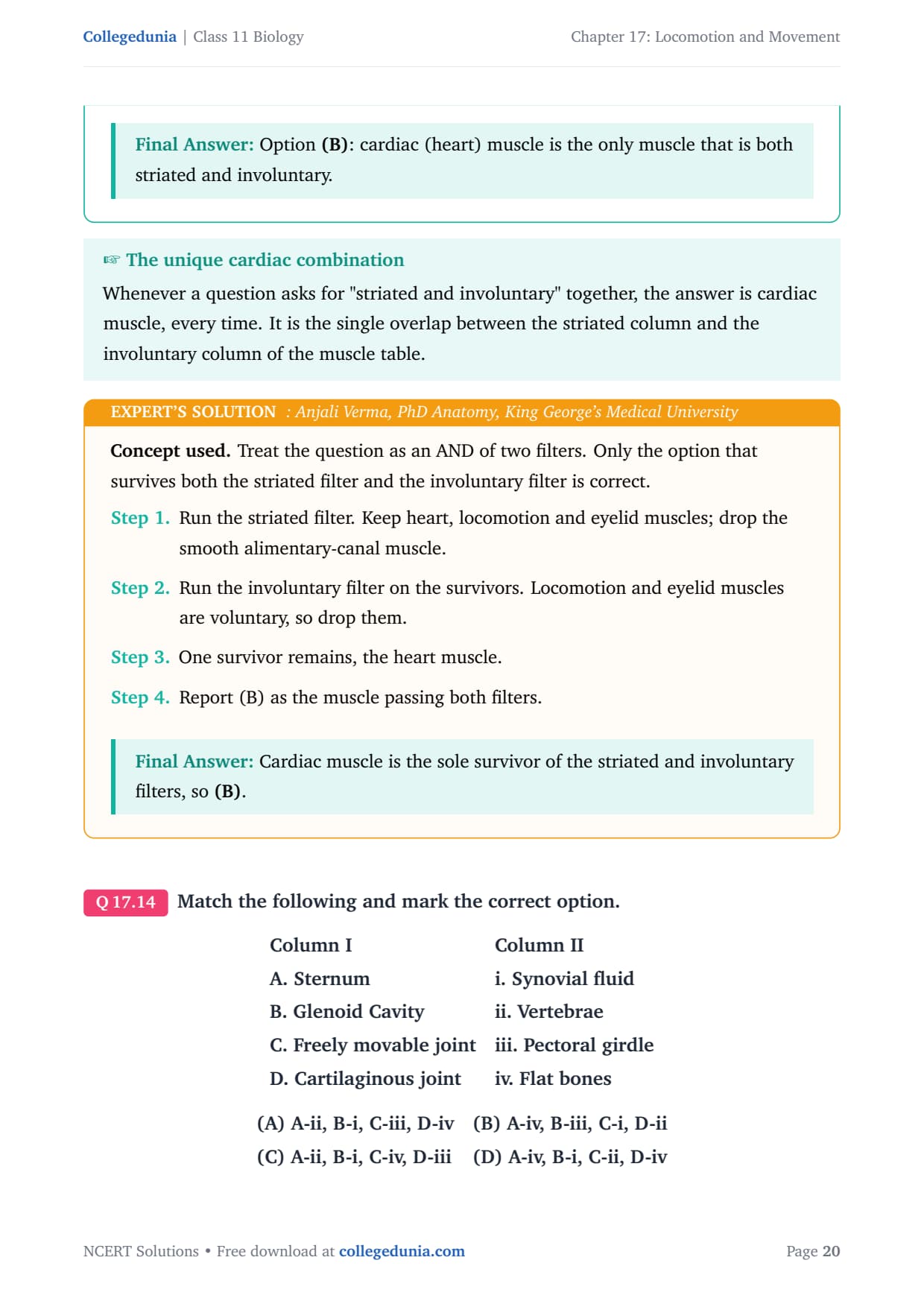
- CUET: the two matching-column MCQs are the closest practice for the domain paper, which rewards precise one-term recall
Student Feedback
Students using Collegedunia's Class 11 Biology Exemplar Solutions told us the calcium questions were the hardest part of this chapter, ahead of the bone-naming questions. Around 7 in 10 said that seeing the inside-the-fibre calcium and the blood calcium separated in one place was what finally fixed the difference.
Other Resources for Class 11 Biology Chapter 17
Collegedunia has the full study material for this chapter. Use the Notes for a first read, then the Exemplar once the sarcomere and the girdles are steady.
Also Check:
- NCERT Solutions for Class 11 Biology Chapter 17
- Class 11 Biology Chapter 17 Notes
- Class 11 Biology Chapter 17 NCERT Book PDF
- Class 11 Biology Chapter 17 Exemplar Questions with Solutions
NCERT Exemplar Solutions for Other Class 11 Biology Chapters
Each chapter below has the same step-by-step treatment and a free PDF, with the question count taken from the Exemplar book itself.
Locomotion and Movement Class 11 NCERT Exemplar Solutions FAQs
Ques. How many questions are there in the Class 11 Biology Locomotion and Movement Exemplar?
Ans. Chapter 17 has 39 questions. They are split into 14 MCQ, 10 Very Short Answer, 9 Short Answer and 6 Long Answer questions. All 39 are solved in the free 60-page PDF on this page.
Ques. Why does my Exemplar book call this Chapter 20 and not Chapter 17?
Ans. The Class 11 Biology Exemplar is the older 22-chapter edition, where this content is printed as Chapter 20. The current textbook has 19 chapters and lists it as Chapter 17. The MCQ answer key also indexes it under Chapter 20, so look there when you check an answer. The content is identical.
Ques. Where is the ATPase of muscle located?
Ans. It sits in the globular head of the myosin filament, which is why the official key marks option (c) for that MCQ. The head hydrolyses ATP and uses the energy to form and pull the cross-bridge. Students who answer actin are thinking of the binding site, not the enzyme.
Ques. What is the difference between red muscle fibres and white muscle fibres?
Ans. Red fibres hold plenty of myoglobin, work aerobically and contract slowly without tiring. White fibres hold little myoglobin, work anaerobically and contract fast but tire quickly. Lactic acid builds in the white fibres, not the red ones. The treadmill question in this chapter depends on that difference.
Ques. Is this Exemplar chapter enough for NEET questions on locomotion?
Ans. It covers the ground well. NEET asks two to three questions a year on muscle contraction, joint types, the skeleton and disorders, and all four appear here. Work the 14 MCQs and 10 Very Short Answers first, then the Long Answer set on sliding filament theory before moving to a coaching module.



Comments