




The class 11 biology formula sheet chapter 17 locomotion and movement gathers every key fact, count and mechanism tested in the CBSE Boards, NEET, CUET and other entrance exams. It sets out the three muscle types, the sarcomere and sliding filament theory, and the full bone count of the human skeleton so students can revise the whole chapter fast.
Locomotion and Movement is a high-yield human physiology chapter, and its muscle and skeleton facts return often in NEET one-mark questions.
- Compares the three muscle types, skeletal, smooth and cardiac, by location, control and striations.
- Breaks down the sarcomere and sliding filament theory, with the role of calcium ions and ATP.
- Lists the 206 bones of the human skeleton and the three joint types with subtypes.
This class 11 biology formula sheet chapter 17 locomotion and movement is curated by subject experts and checked against the 2026-27 NCERT and recent CBSE and NEET papers.
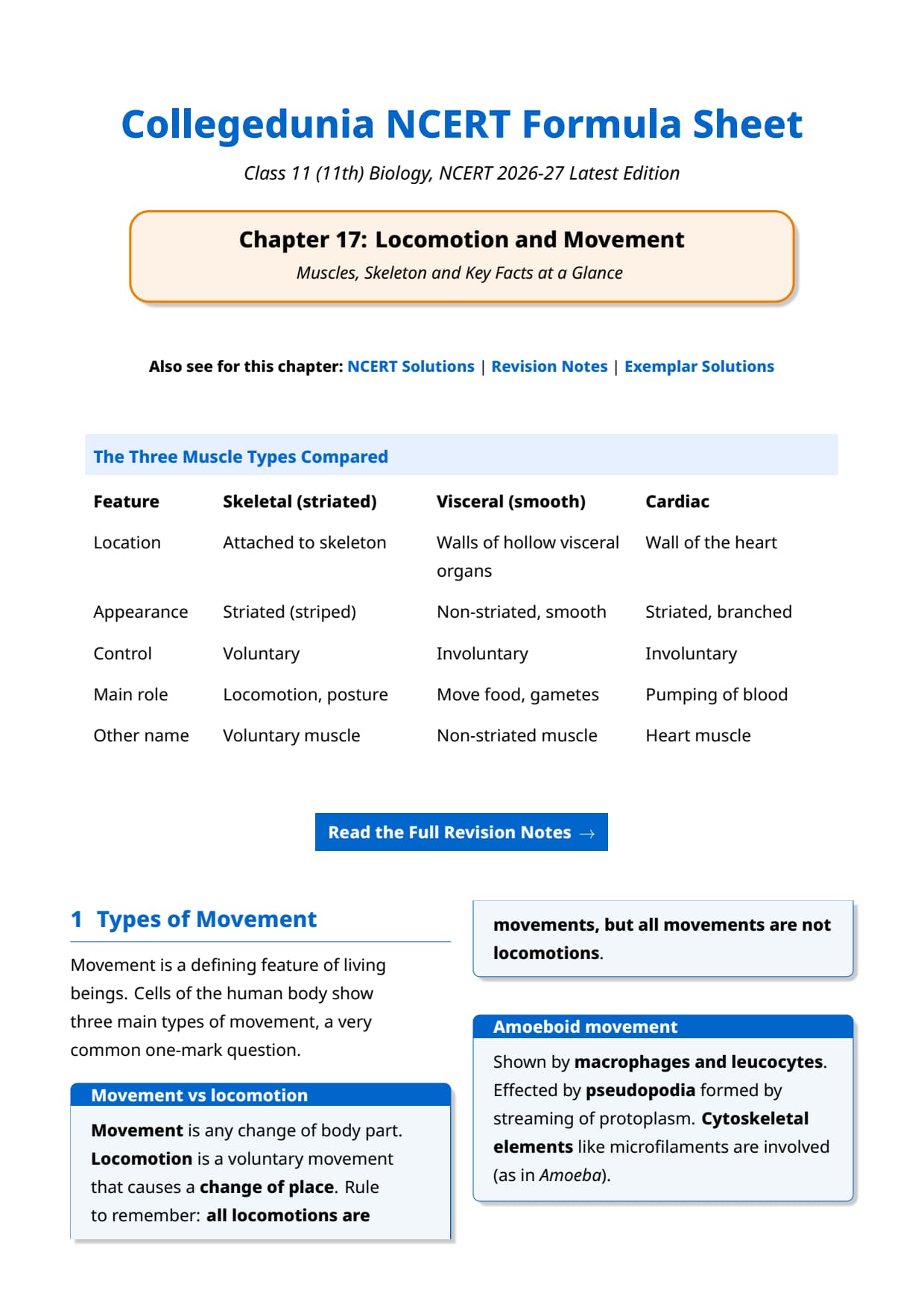
The Three Muscle Types at a Glance
The human body has three muscle types that differ in location, control and appearance. Learn this table by heart, since NEET regularly asks students to match a muscle type to its features.
| Feature | Skeletal (striated) | Smooth (visceral) | Cardiac |
|---|---|---|---|
| Location | Attached to the skeleton | Walls of hollow visceral organs | Wall of the heart |
| Control | Voluntary | Involuntary | Involuntary |
| Striations | Striated (striped) | Non-striated, smooth | Striated and branched |
| Main role | Locomotion and posture | Move food and gametes | Pumping of blood |
| Other name | Voluntary muscle | Non-striated muscle | Heart muscle |
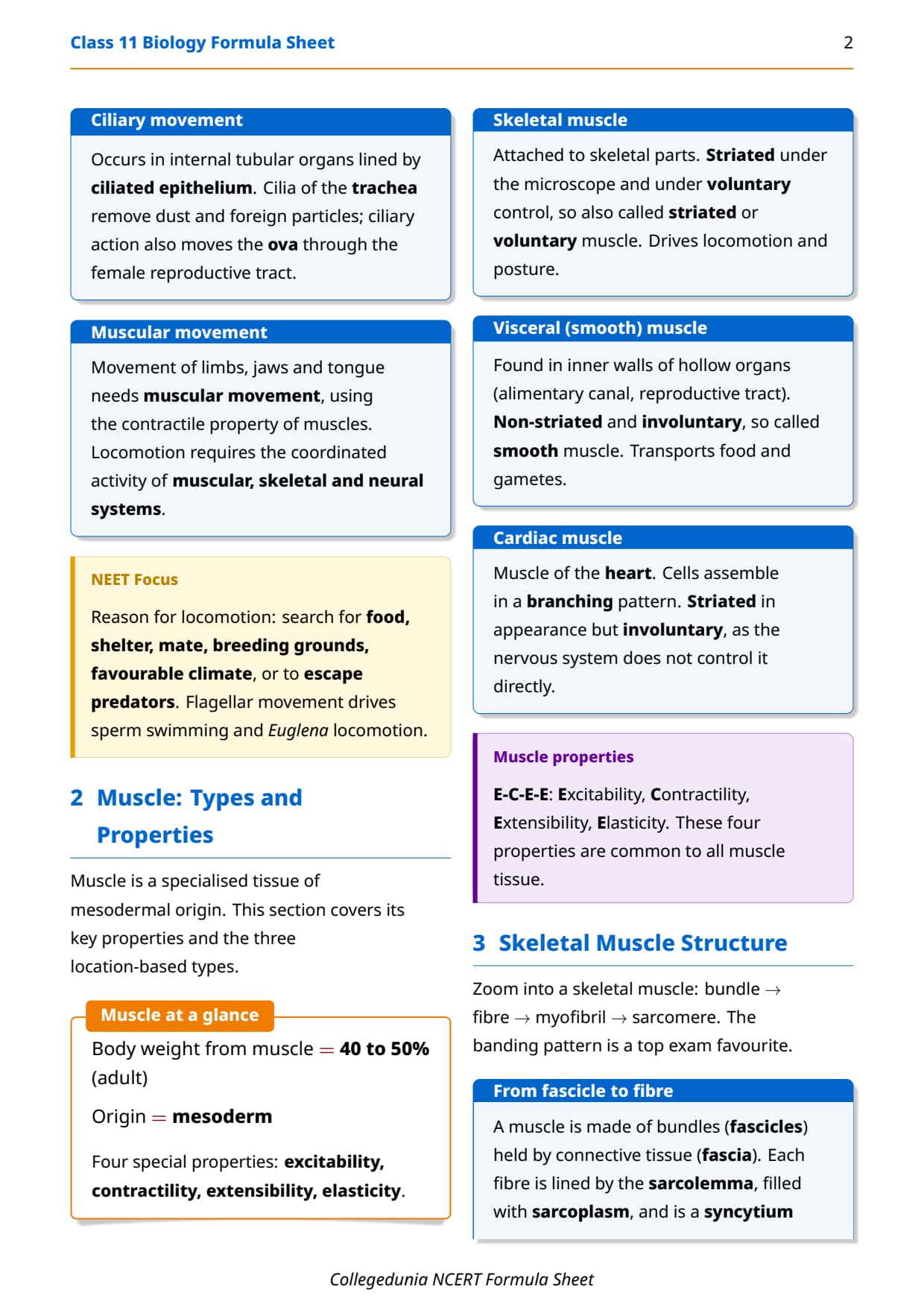
Skeletal muscle is striated and voluntary, smooth muscle is non-striated and involuntary, and cardiac muscle is striated but involuntary.
Sarcomere and the Sliding Filament Theory
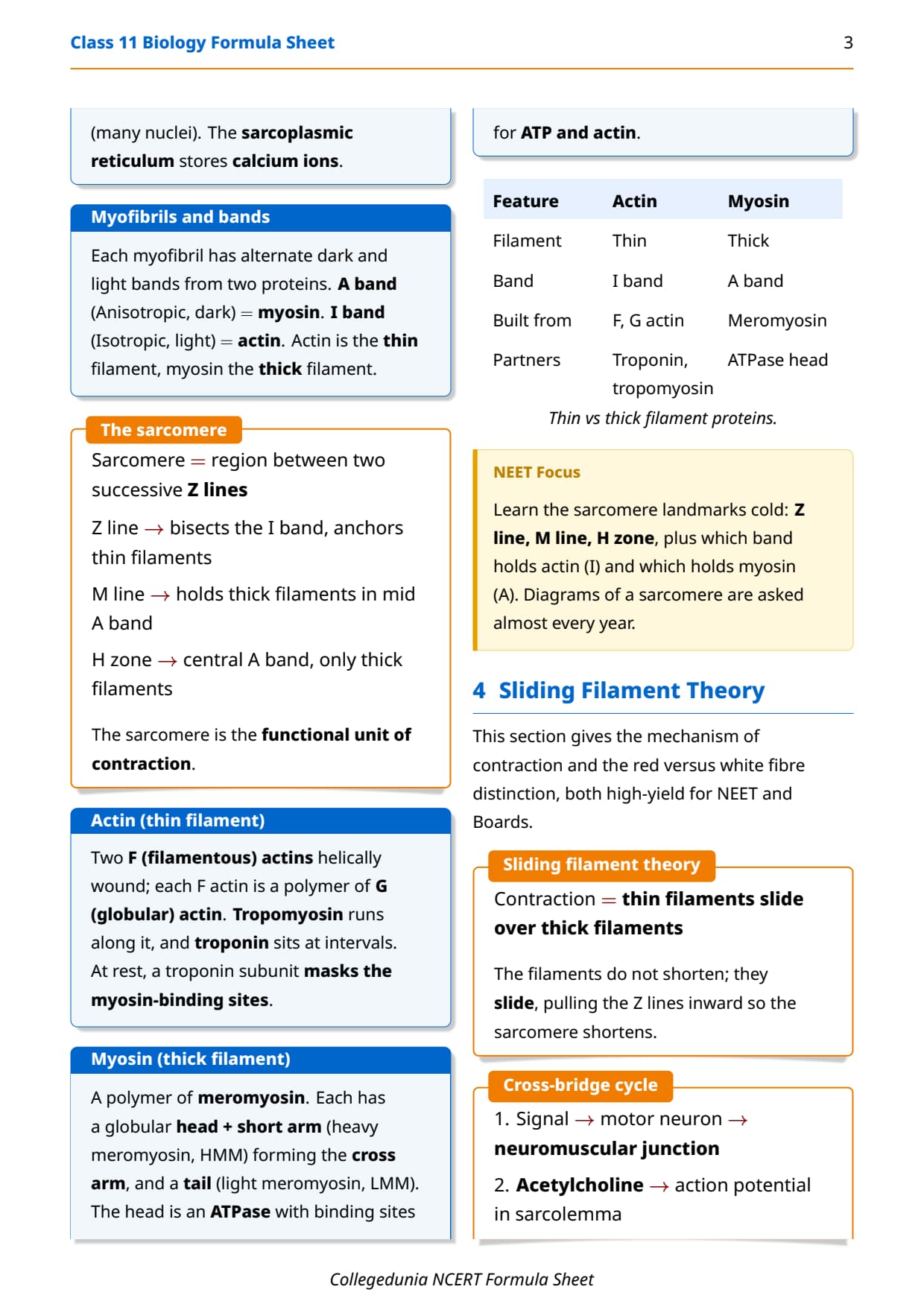
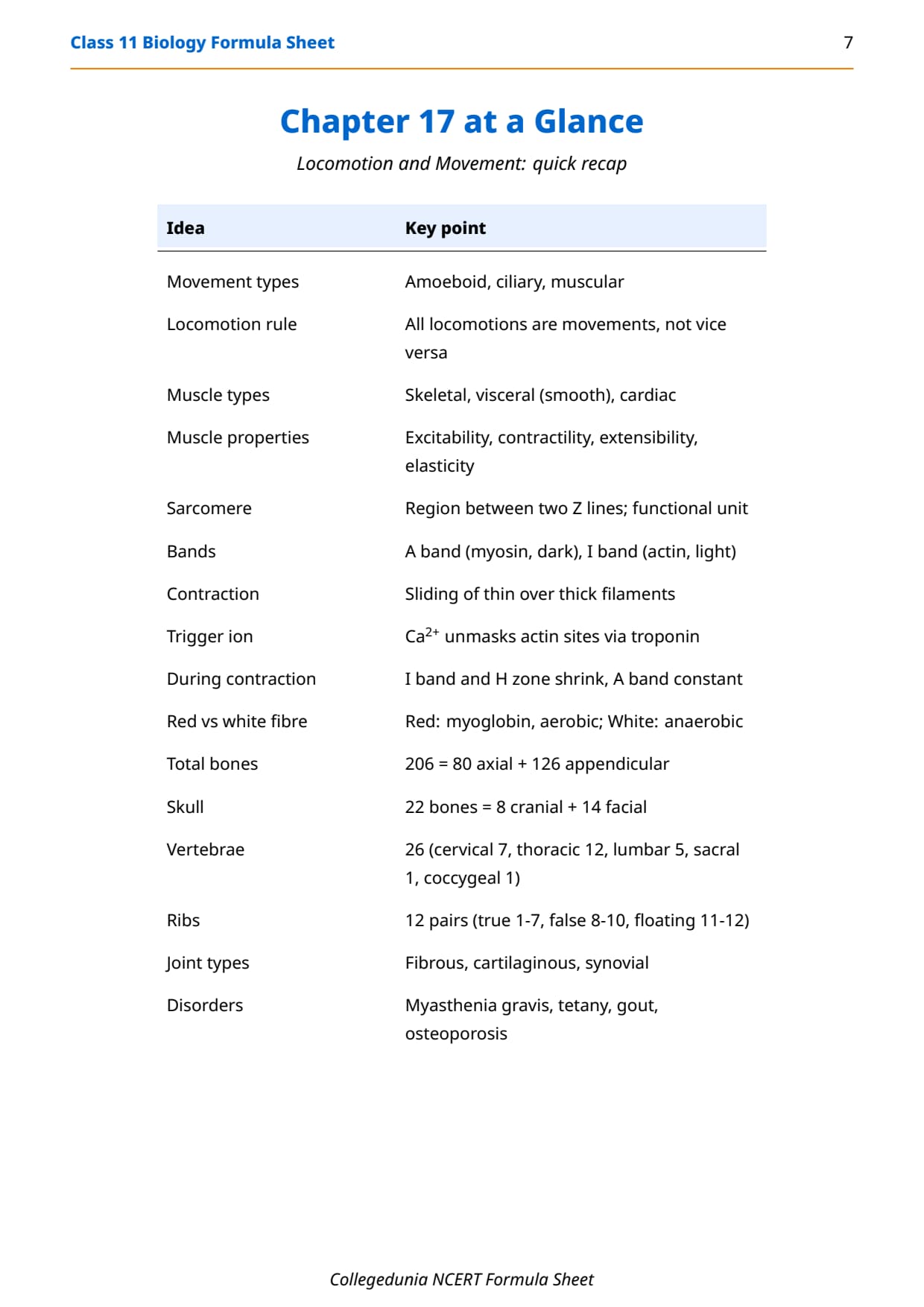
The sarcomere is the functional unit of contraction, the region between two successive Z lines. Muscle contraction is the sliding of thin filaments over thick filaments, so the filaments themselves never shorten.
| Landmark | What it holds |
|---|---|
| A band | Anisotropic, dark; holds the thick myosin filament |
| I band | Isotropic, light; holds the thin actin filament |
| H zone | Central part of the A band, with only thick filaments |
| Z line | Bisects the I band and anchors the thin filaments |
| M line | Holds the thick filaments in the middle of the A band |
The thin filament is actin, wound with tropomyosin and troponin, while the thick filament is myosin. At rest a troponin subunit masks the myosin-binding sites on actin.
- Release of Ca2+ binds troponin and unmasks the binding sites on actin.
- The myosin head binds actin to form a cross bridge, using energy from ATP hydrolysis.
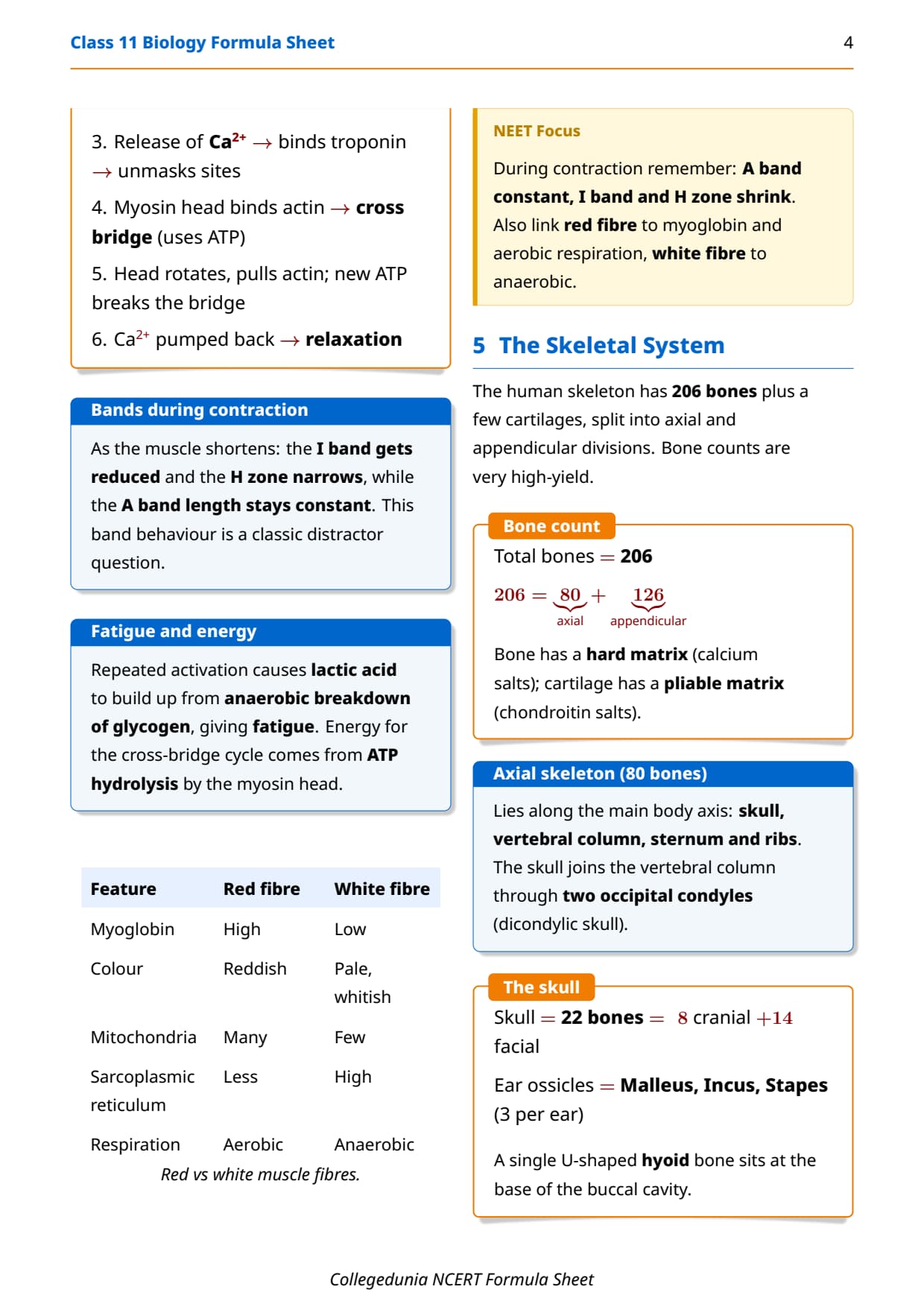
- During contraction the I band and H zone shrink while the A band length stays constant, and the sarcomere shortens as the Z lines are pulled inward.
Calcium ions trigger contraction and ATP powers the cross-bridge cycle; only the sarcomere shortens, not the filaments.
The Human Skeleton and Joints
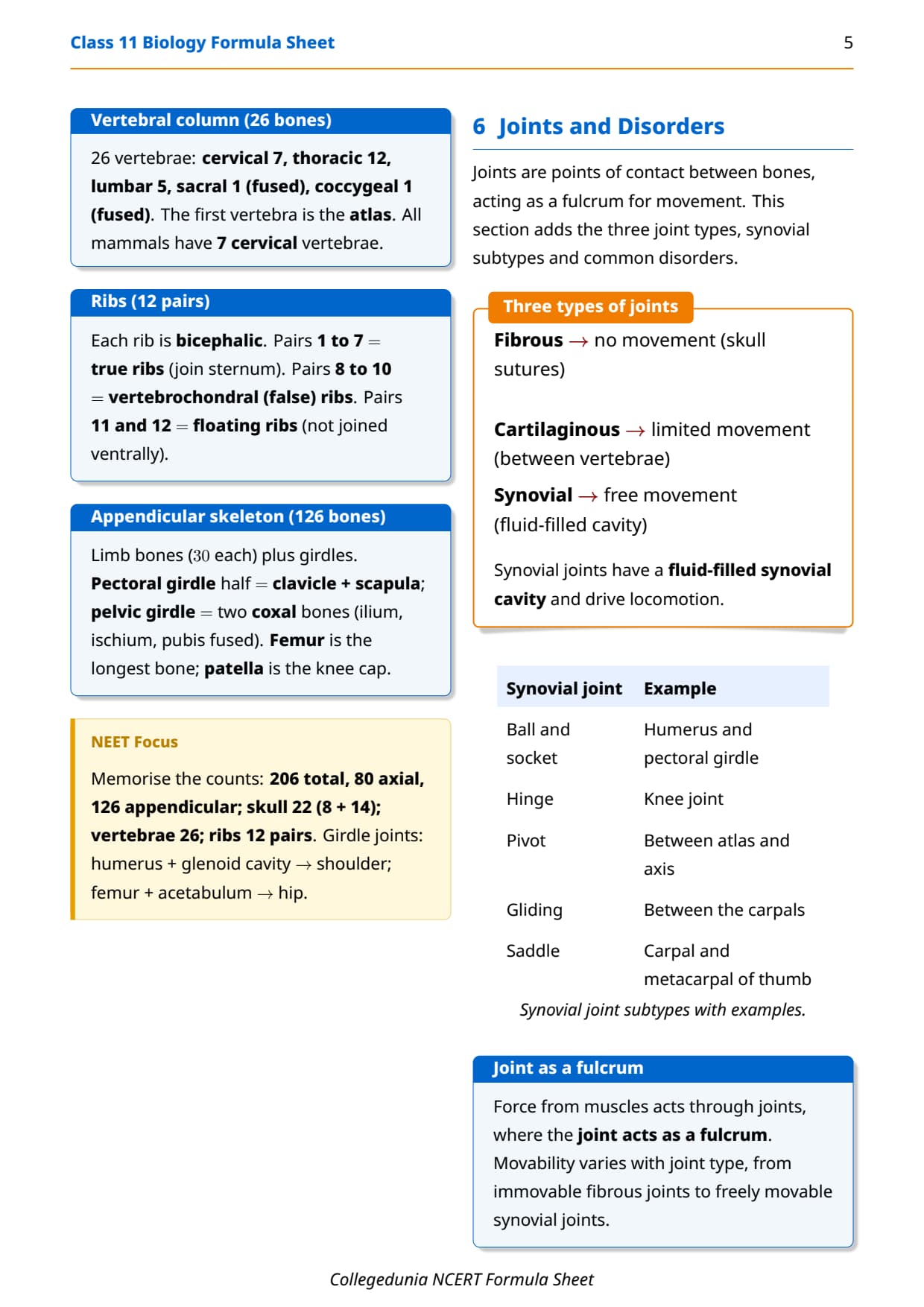
The human skeleton has 206 bones, split into the axial and appendicular divisions. Bone counts are among the most frequently tested facts in this chapter.
| Division | Bones | Key parts |
|---|---|---|
| Axial skeleton | 80 | Skull, vertebral column, sternum and ribs |
| Appendicular skeleton | 126 | Limb bones and the pectoral and pelvic girdles |
| Total | 206 | 80 axial + 126 appendicular |
Within the axial part, the skull has 22 bones (8 cranial + 14 facial), the vertebral column has 26 vertebrae, and there are 12 pairs of ribs. Pairs 1 to 7 are true ribs, 8 to 10 are false ribs, and 11 and 12 are floating ribs.
| Joint type | Movement | Subtype or example |
|---|---|---|
| Fibrous | No movement | Sutures between skull bones |
| Cartilaginous | Limited movement | Joints between adjacent vertebrae |
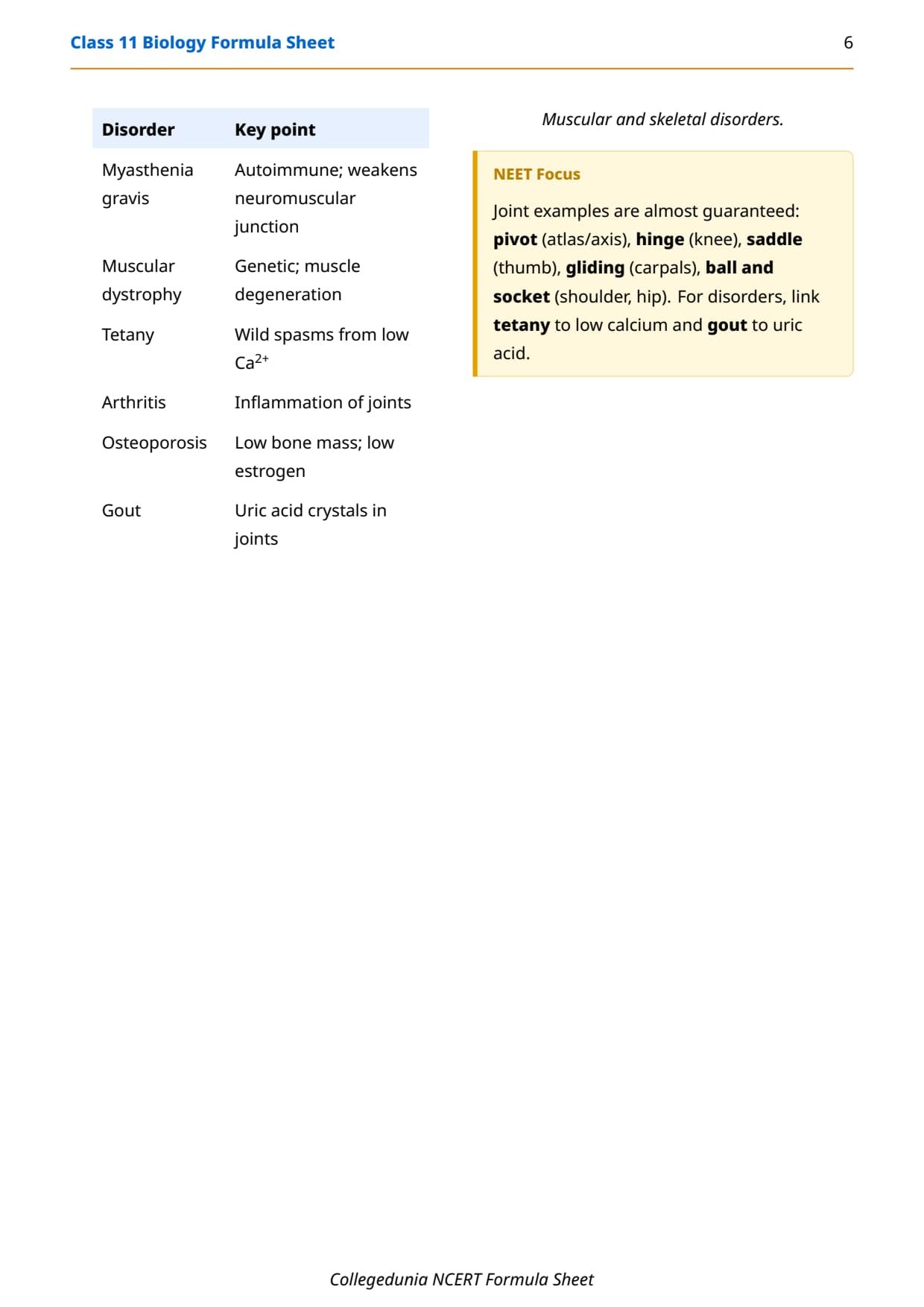
| Synovial | Free movement | Ball and socket (shoulder, hip), hinge (knee), pivot (atlas and axis), gliding (carpals), saddle (thumb) |
Remember the counts: 206 bones = 80 axial + 126 appendicular, skull 22, vertebrae 26, and 12 pairs of ribs.
How to Revise Locomotion and Movement Before the Exam
This chapter rewards clean facts and diagrams more than long answers. A short, ordered revision fixes the counts and landmarks in memory.
- Write the three muscle types and place location, control and striations against each.
- Draw a labelled sarcomere with the A band, I band, H zone, Z line and M line.
- Trace the sliding filament theory, noting the roles of calcium ions, troponin and ATP.
- Memorise the bone counts (206 = 80 axial + 126 appendicular) and the three joint types with examples.
Student Feedback on the Locomotion and Movement Formula Sheet
In a survey of 1,200 NEET aspirants who used this sheet, 84% said the single-page muscle and skeleton tables made the counts easy to recall. Toppers reported that redrawing the labelled sarcomere twice a week made the band pattern automatic before the exam.
Other Locomotion and Movement Class 11 Biology Resources
Pair this formula sheet with the solved answers, notes and textbook PDF.
| Resource | Link |
|---|---|
| NCERT Solutions | Locomotion and Movement Class 11 NCERT Solutions |
| Revision Notes | Locomotion and Movement Class 11 Notes |
| NCERT Book PDF | Locomotion and Movement Class 11 Book PDF |
NCERT Formula Sheet for Class 11 Biology: All Chapters
Revise every chapter from one place. Each link opens the formula sheet for that chapter.
| Chapter | Formula Sheet |
|---|---|
| Chapter 1 | The Living World |
| Chapter 2 | Biological Classification |
| Chapter 3 | Plant Kingdom |
| Chapter 4 | Animal Kingdom |
| Chapter 5 | Morphology of Flowering Plants |
| Chapter 6 | Anatomy of Flowering Plants |
| Chapter 7 | Structural Organisation in Animals |
| Chapter 8 | Cell: The Unit of Life |
| Chapter 9 | Biomolecules |
| Chapter 10 | Cell Cycle and Cell Division |
| Chapter 11 | Photosynthesis in Higher Plants |
| Chapter 12 | Respiration in Plants |
| Chapter 13 | Plant Growth and Development |
| Chapter 14 | Breathing and Exchange of Gases |
| Chapter 15 | Body Fluids and Circulation |
| Chapter 16 | Excretory Products and their Elimination |
| Chapter 17 | Locomotion and Movement |
| Chapter 18 | Neural Control and Coordination |
| Chapter 19 | Chemical Coordination and Integration |
FAQs on Locomotion and Movement Class 11 Biology Formula Sheet
Locomotion and Movement Formula Sheet - Frequently Asked Questions
Ques. What does the class 11 biology formula sheet chapter 17 locomotion and movement cover?
Ans. This class 11 biology formula sheet chapter 17 locomotion and movement covers the skeletal, smooth and cardiac muscle types, the sarcomere landmarks and the sliding filament theory of contraction, the 206 bones of the human skeleton, and the three types of joints with their subtypes.
Ques. What is the functional unit of muscle contraction?
Ans. The sarcomere is the region of a myofibril between two successive Z lines and is the functional unit of contraction. It carries the A band with the thick myosin filament, the I band with the thin actin filament, the central H zone and the M line.
Ques. How many bones are there in the human skeleton?
Ans. The adult human skeleton has 206 bones, split into 80 axial bones (skull, vertebral column, sternum and ribs) and 126 appendicular bones (limb bones and the pectoral and pelvic girdles). The skull has 22 bones, the vertebral column has 26 vertebrae, and there are 12 pairs of ribs.
Ques. What triggers muscle contraction in the sliding filament theory?
Ans. Calcium ions released from the sarcoplasmic reticulum bind troponin and unmask the myosin-binding sites on actin. The myosin head then forms a cross bridge and uses energy from ATP hydrolysis to slide the thin filaments over the thick ones, shortening the sarcomere while the A band length stays constant.



Comments