




The class 11 biology formula sheet chapter 18 neural control and coordination gathers every key fact, value and definition tested in the CBSE Boards, NEET, CUET and other entrance exams. It lists the parts of the brain, the structure of a neuron, and the exact membrane potentials so students can revise the whole chapter fast.

Neural Control and Coordination is a high-yield chapter of Class 11 Biology, and its neuron and brain facts return in almost every NEET paper.
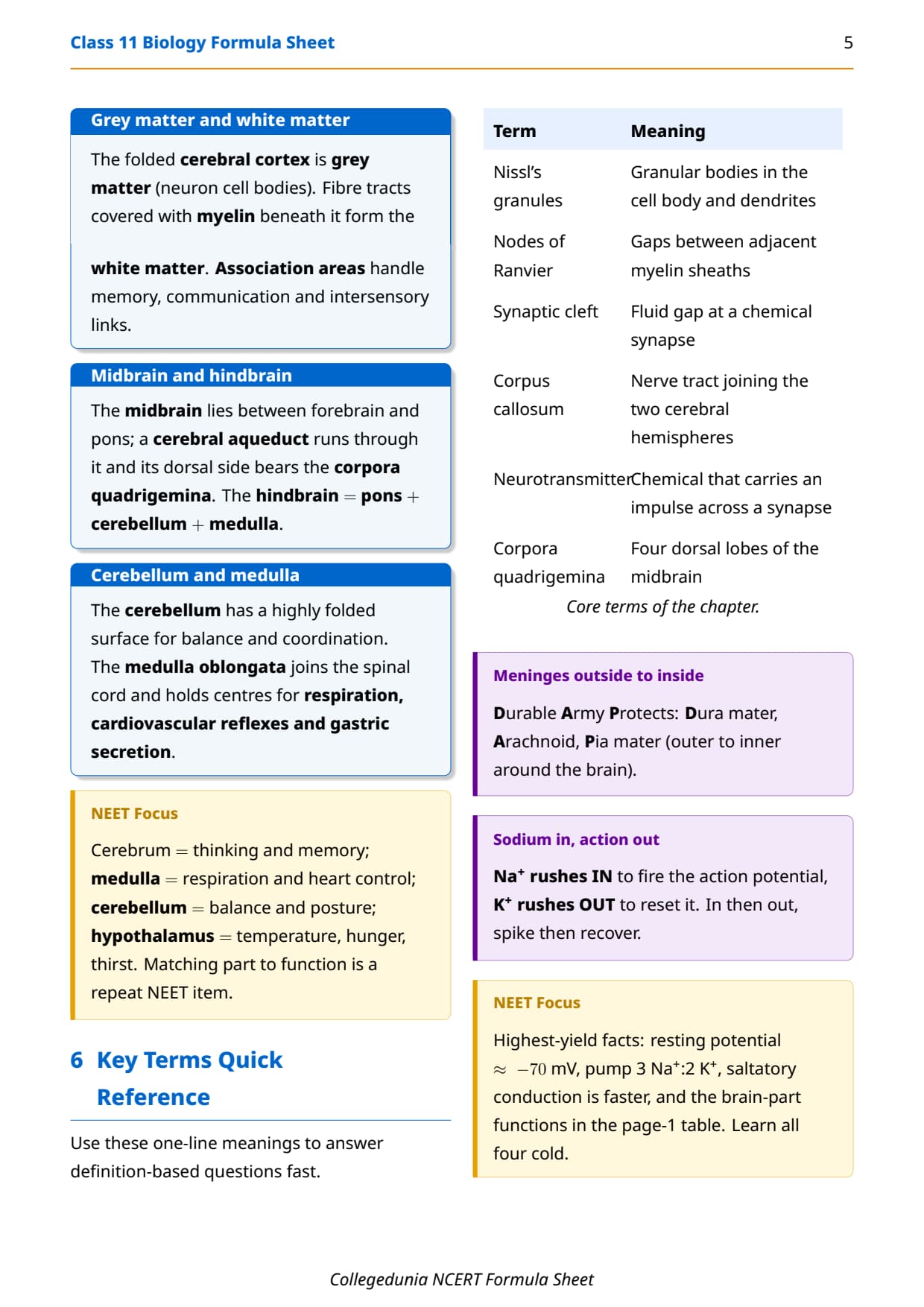
- Maps the parts of the brain, from cerebrum and hypothalamus to cerebellum and medulla, with their functions.
- Breaks down the structure of a neuron and the difference between myelinated and non-myelinated fibres.
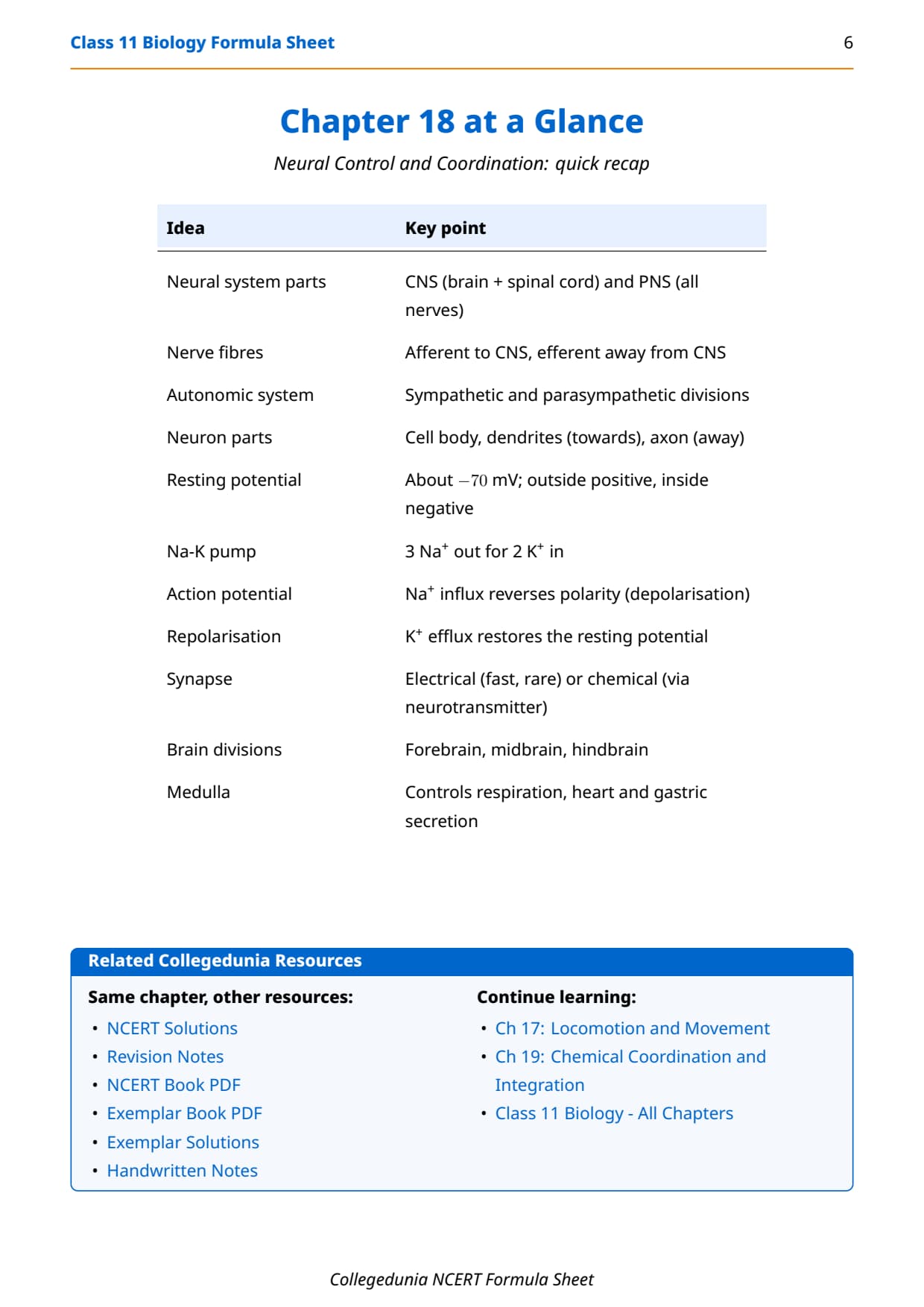
- Fixes the numbers of the resting and action potential, including the sodium-potassium pump ratio.
This class 11 biology formula sheet chapter 18 neural control and coordination is curated by subject experts and checked against the 2026-27 NCERT and recent CBSE and NEET papers.
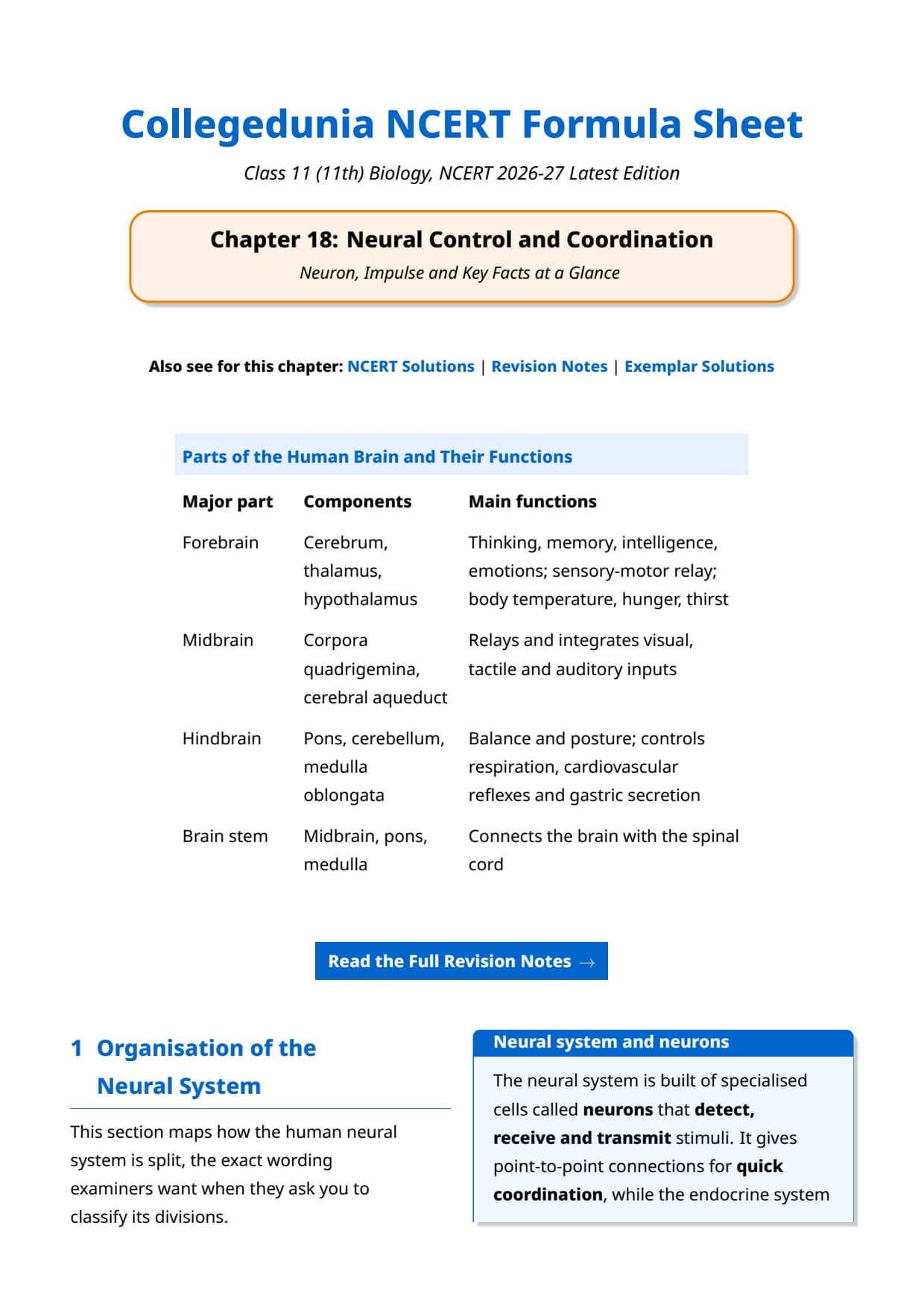
Parts of the Brain at a Glance
Every major region of the human brain sits in the table below, with its components and main job. Learn the part-to-function pairs by heart, since NEET repeatedly asks which region controls a named activity.
| Major part | Components | Main functions |
|---|---|---|
| Forebrain | Cerebrum, thalamus, hypothalamus | Thinking, memory, intelligence and emotions; sensory-motor relay; body temperature, hunger and thirst |
| Midbrain | Corpora quadrigemina, cerebral aqueduct | Relays and integrates visual, tactile and auditory inputs |
| Hindbrain | Cerebellum, pons, medulla oblongata | Balance and posture; controls respiration, cardiovascular reflexes and gastric secretion |
Remember the trio: cerebrum for thinking and memory, cerebellum for balance and posture, and medulla for respiration and heart control.
Neuron Structure and the Nerve Impulse
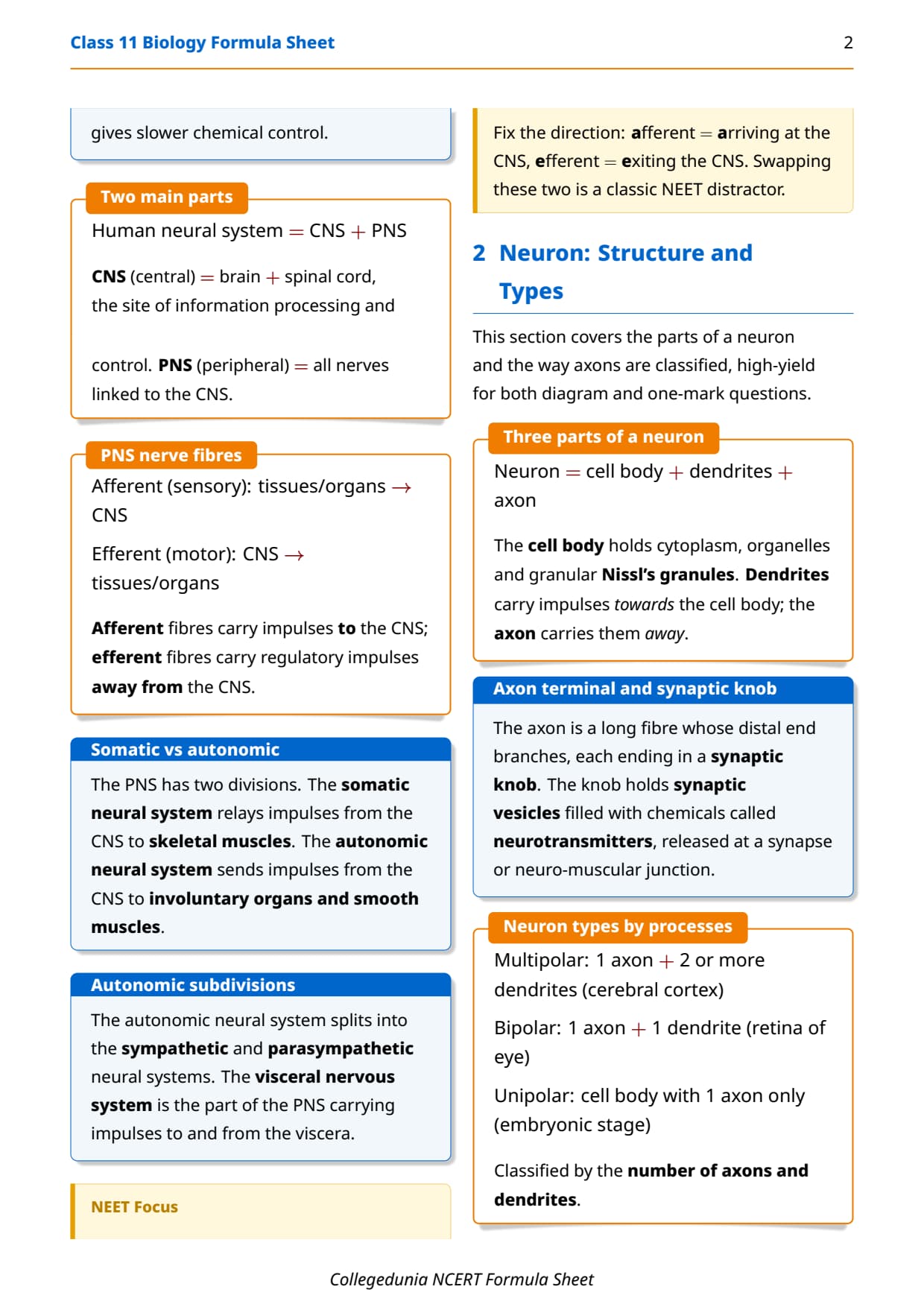
A neuron has three parts, and the way its axon is wrapped decides how fast the impulse travels. These facts drive both diagram and one-mark questions in the Boards and NEET.
| Part | What it does |
|---|---|
| Dendrites | Short branched fibres that carry impulses towards the cell body |
| Cell body | Holds cytoplasm, organelles and granular Nissl's granules |
| Axon | Long fibre that carries impulses away from the cell body; ends in synaptic knobs |
| Myelin sheath | Insulating wrap formed by Schwann cells around myelinated axons |
| Nodes of Ranvier | Unmyelinated gaps between two adjacent myelin sheaths |
The wrapping and the synapse type set the speed of transmission. Note that nodes of Ranvier are the gaps between sheaths, not the sheath itself.
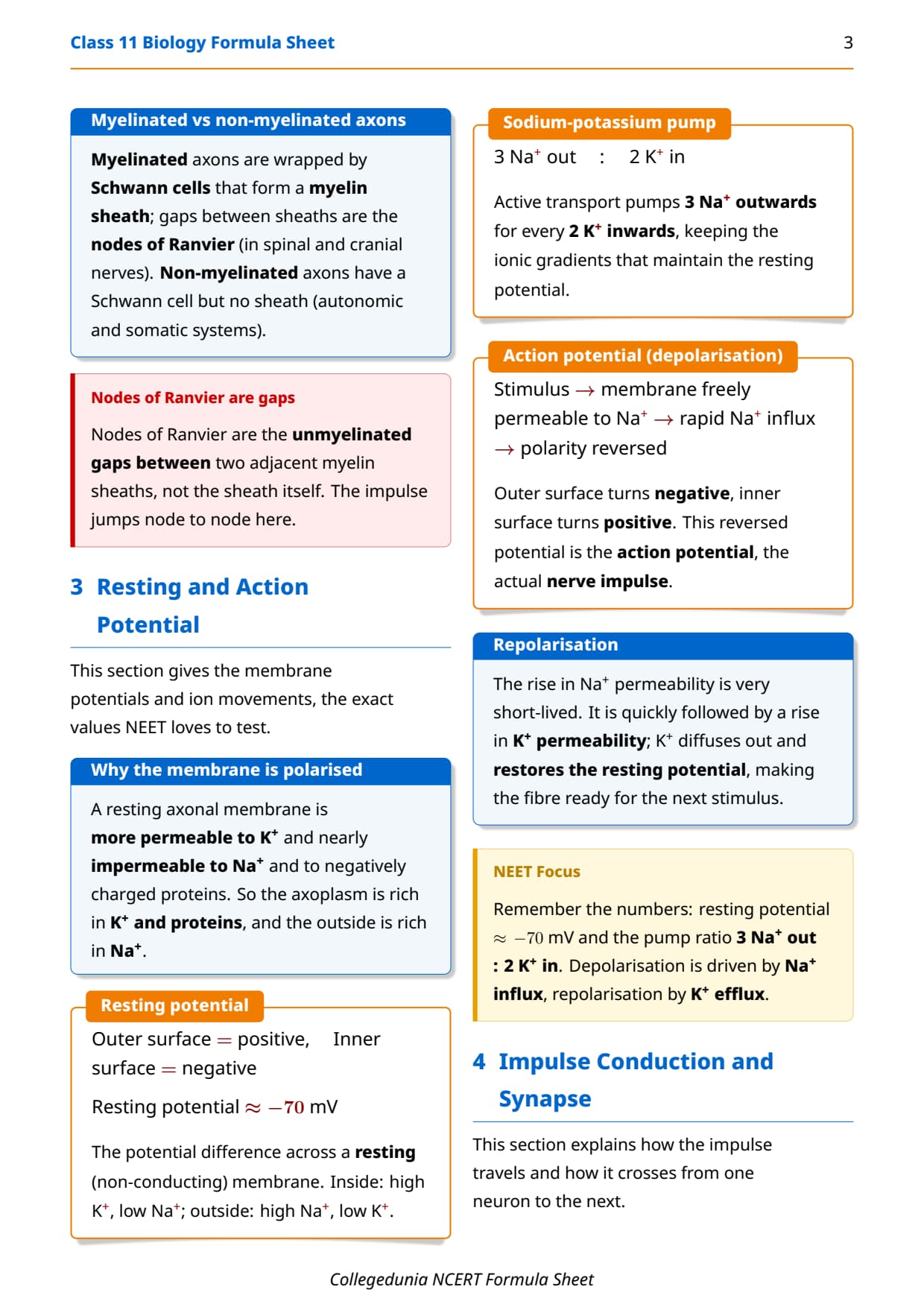
- Myelinated vs non-myelinated: myelinated axons have a myelin sheath and nodes of Ranvier (spinal and cranial nerves); non-myelinated axons have a Schwann cell but no sheath (autonomic and somatic systems).
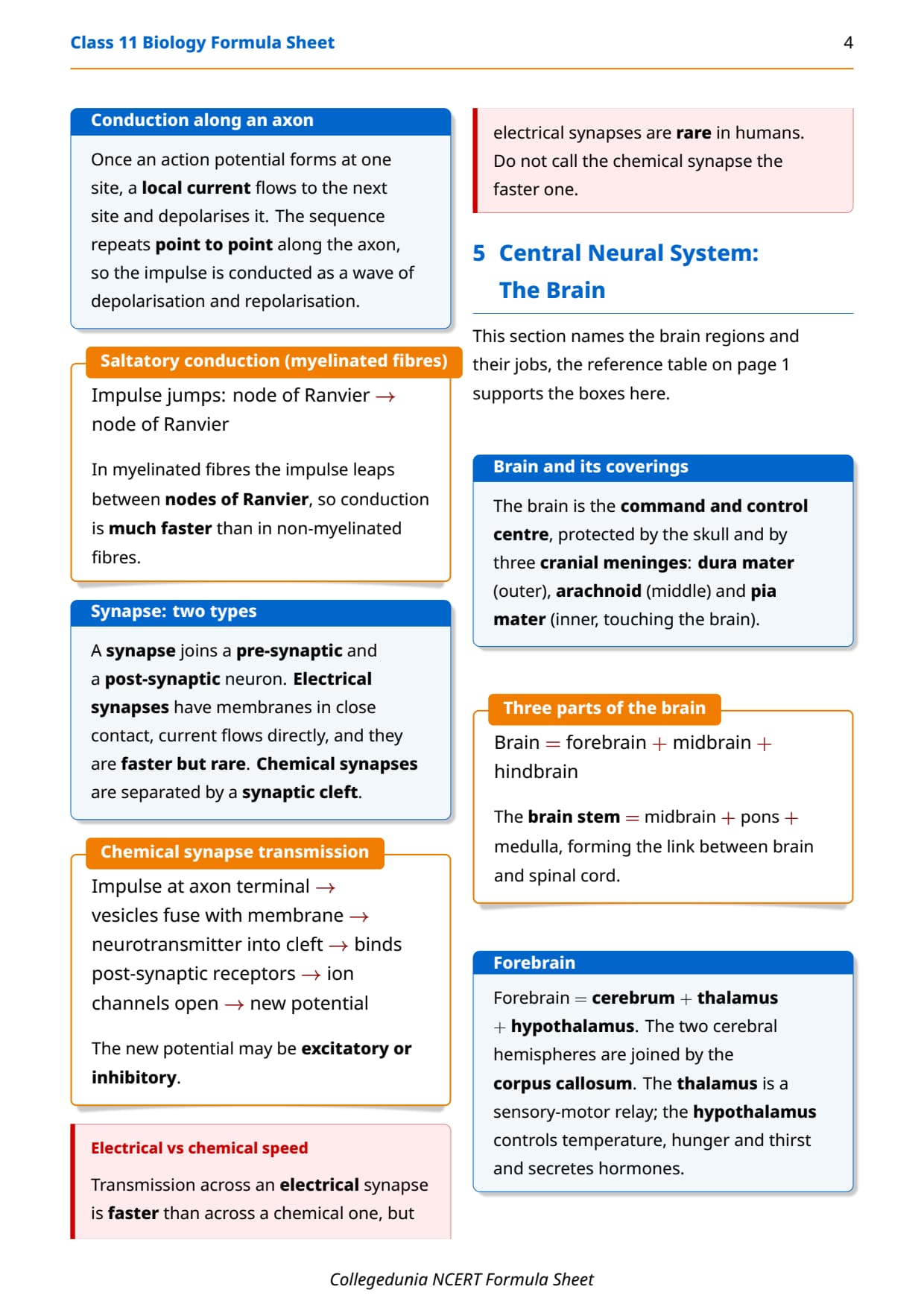
- Saltatory conduction: in myelinated fibres the impulse jumps from one node of Ranvier to the next, so conduction is much faster than in non-myelinated fibres.
- Synapse types: an electrical synapse lets current flow directly and is faster but rare; a chemical synapse is separated by a synaptic cleft and works through neurotransmitters.
Resting and Action Potential
This is the most tested part of the chapter because it is built on exact values. Memorise the resting potential and the pump ratio, then link each ion movement to its phase.
| Event | Key detail |
|---|---|
| Resting potential | About −70 mV; outer surface positive, inner surface negative |
| Sodium-potassium pump | 3 Na+ out for every 2 K+ in, by active transport |
| Depolarisation | Rapid Na+ influx reverses polarity; this is the action potential, the actual nerve impulse |
| Repolarisation | K+ efflux restores the resting potential, readying the fibre for the next stimulus |
At rest the membrane is more permeable to K+ and nearly impermeable to Na+, so the axoplasm stays rich in potassium. A stimulus flips this: depolarisation is driven by sodium influx and repolarisation by potassium efflux.
How to Revise Neural Control and Coordination Before the Exam
This chapter rewards clean values and part-function pairs more than long answers. A short, ordered revision fixes the facts in memory.
- Draw a labelled neuron and mark the dendrites, cell body, axon, myelin sheath and nodes of Ranvier.
- Write the brain regions with their functions, then match cerebrum, cerebellum, medulla and hypothalamus to their jobs.
- Learn the numbers: resting potential of −70 mV and the pump ratio 3 Na+ out : 2 K+ in.
- Note the exam traps: nodes of Ranvier are gaps, and the electrical synapse is the faster one, not the chemical.
Student Feedback on the Neural Control and Coordination Formula Sheet
In a survey of 1,200 NEET aspirants who used this sheet, 78% said the single-page potentials table made the resting and action potential values easy to recall. Toppers reported that revising the brain-part functions twice a week made the matching questions automatic before the exam.
Other Neural Control and Coordination Class 11 Biology Resources
Pair this formula sheet with the solved answers, notes and textbook PDF.
| Resource | Link |
|---|---|
| NCERT Solutions | Neural Control and Coordination Class 11 NCERT Solutions |
| Revision Notes | Neural Control and Coordination Class 11 Notes |
| NCERT Book PDF | Neural Control and Coordination Class 11 Book PDF |
NCERT Formula Sheet for Class 11 Biology: All Chapters
Revise every chapter from one place. Each link opens the formula sheet for that chapter.
| Chapter | Formula Sheet |
|---|---|
| Chapter 1 | The Living World |
| Chapter 2 | Biological Classification |
| Chapter 3 | Plant Kingdom |
| Chapter 4 | Animal Kingdom |
| Chapter 5 | Morphology of Flowering Plants |
| Chapter 6 | Anatomy of Flowering Plants |
| Chapter 7 | Structural Organisation in Animals |
| Chapter 8 | Cell: The Unit of Life |
| Chapter 9 | Biomolecules |
| Chapter 10 | Cell Cycle and Cell Division |
| Chapter 11 | Photosynthesis in Higher Plants |
| Chapter 12 | Respiration in Plants |
| Chapter 13 | Plant Growth and Development |
| Chapter 14 | Breathing and Exchange of Gases |
| Chapter 15 | Body Fluids and Circulation |
| Chapter 16 | Excretory Products and their Elimination |
| Chapter 17 | Locomotion and Movement |
| Chapter 18 | Neural Control and Coordination |
| Chapter 19 | Chemical Coordination and Integration |
FAQs on Neural Control and Coordination Class 11 Biology Formula Sheet
Neural Control and Coordination Formula Sheet - Frequently Asked Questions
Ques. What does the class 11 biology formula sheet chapter 18 neural control and coordination cover?
Ans. This class 11 biology formula sheet chapter 18 neural control and coordination covers the divisions of the neural system, the three parts of a neuron, myelinated and non-myelinated fibres, saltatory conduction, the two synapse types, the brain regions with their functions, and the exact resting and action potential values tested in the Boards and NEET.
Ques. What is the value of the resting potential of a neuron?
Ans. The resting potential across a non-conducting axonal membrane is about −70 mV, with the outer surface positive and the inner surface negative. It is maintained by the sodium-potassium pump, which moves 3 Na+ out for every 2 K+ in.
Ques. What is saltatory conduction?
Ans. Saltatory conduction is the way the nerve impulse leaps between successive nodes of Ranvier along a myelinated axon. Because the impulse skips the insulated myelin regions, conduction is much faster than in non-myelinated fibres.
Ques. Which part of the brain controls respiration and heartbeat?
Ans. The medulla oblongata, part of the hindbrain, holds the centres for respiration, cardiovascular reflexes and gastric secretion. The cerebellum controls balance and posture, the cerebrum handles thinking and memory, and the hypothalamus controls temperature, hunger and thirst.



Comments