




The class 11 biology formula sheet chapter 12 respiration in plants pulls together every pathway, ATP figure and respiratory quotient value tested in the CBSE Boards, NEET, CUET and other entrance exams. It lays out glycolysis, the Krebs cycle, the electron transport system and the RQ values so students can revise the whole chapter in minutes.
Respiration in Plants is a numbers-heavy chapter, and the ATP balance sheet plus the RQ values are its most repeated exam questions.
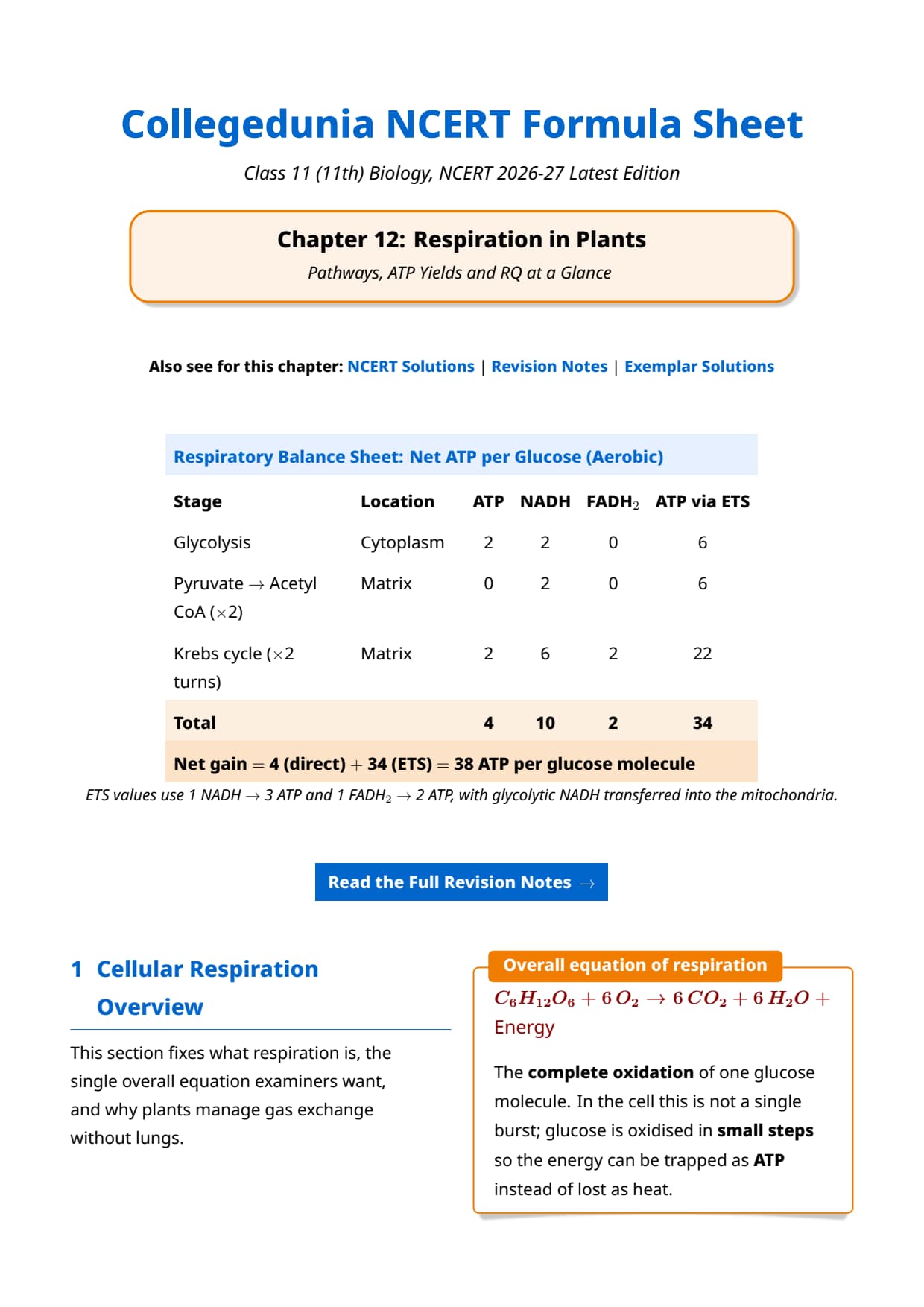
- Gives the net ATP yield per glucose, stage by stage, up to the NCERT total of 38 ATP in aerobic respiration.
- Maps each stage to its site and key products, from cytoplasmic glycolysis to the inner-membrane ETS.
- Lists the respiratory quotient values for carbohydrate, fat, protein and organic acid substrates.
This class 11 biology formula sheet chapter 12 respiration in plants is curated by subject experts and checked against the 2026-27 NCERT and recent CBSE and NEET papers.
ATP Yield per Glucose at a Glance
The respiratory balance sheet is the single most tested calculation in this chapter. Learn the whole table by heart, because NEET and the Boards often ask the ATP made at one stage or the grand total.
| Stage | NADH | FADH2 | ATP (direct) | ATP via ETS |
|---|---|---|---|---|
| Glycolysis (cytoplasm) | 2 | 0 | 2 | 6 |
| Link reaction (×2) | 2 | 0 | 0 | 6 |
| Krebs cycle (×2 turns) | 6 | 2 | 2 | 22 |
| Total | 10 | 2 | 4 | 34 |
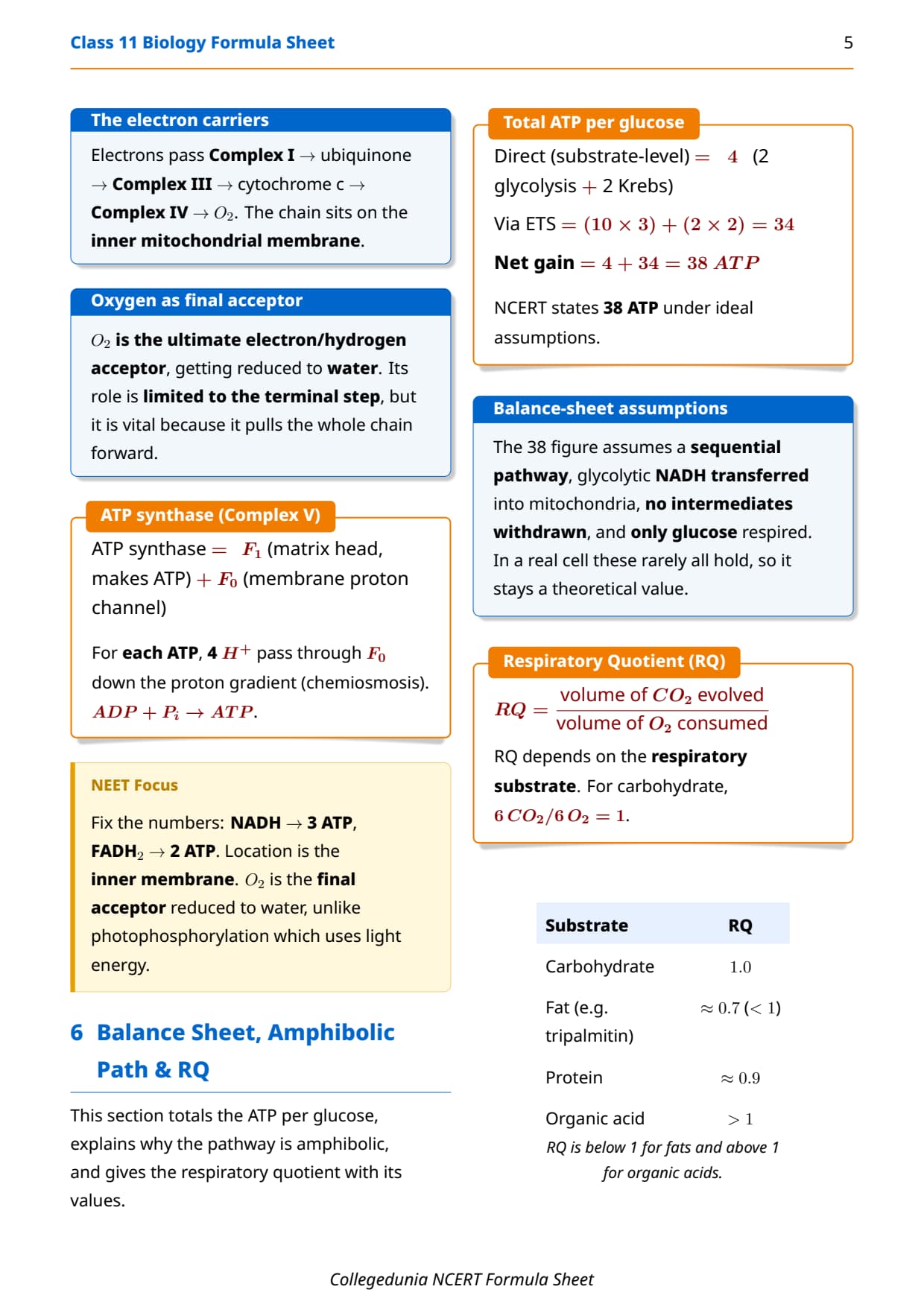
Net gain = 4 direct ATP + 34 ATP via the ETS = 38 ATP per glucose molecule under the NCERT ideal assumptions (1 NADH → 3 ATP, 1 FADH2 → 2 ATP).
Glycolysis, Krebs Cycle and ETS
Each stage of respiration runs in a specific site and leaves a specific set of products. These location-and-product pairs are frequent one-mark questions, so tie every stage to where it happens.
| Stage | Site | Key products |
|---|---|---|
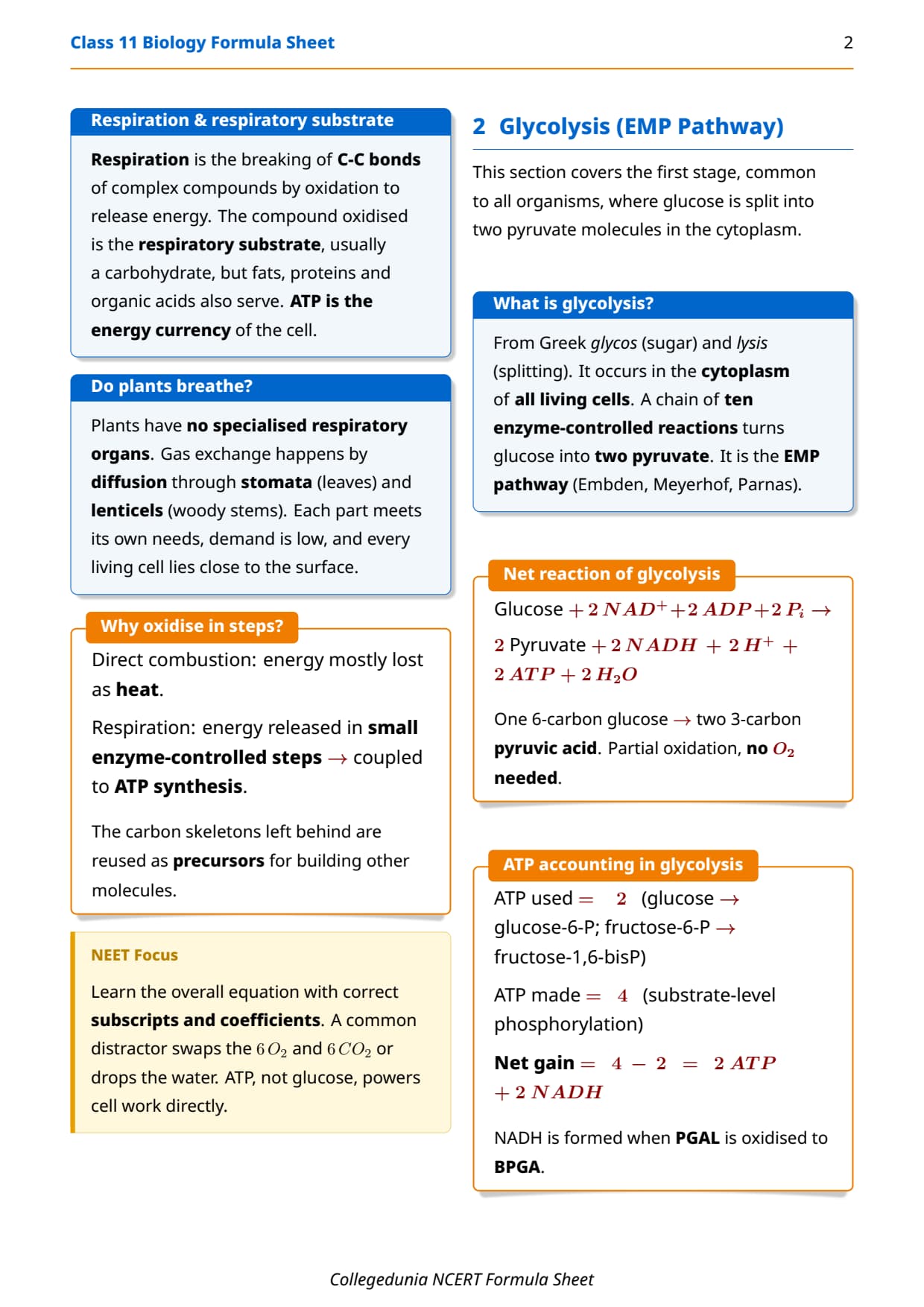
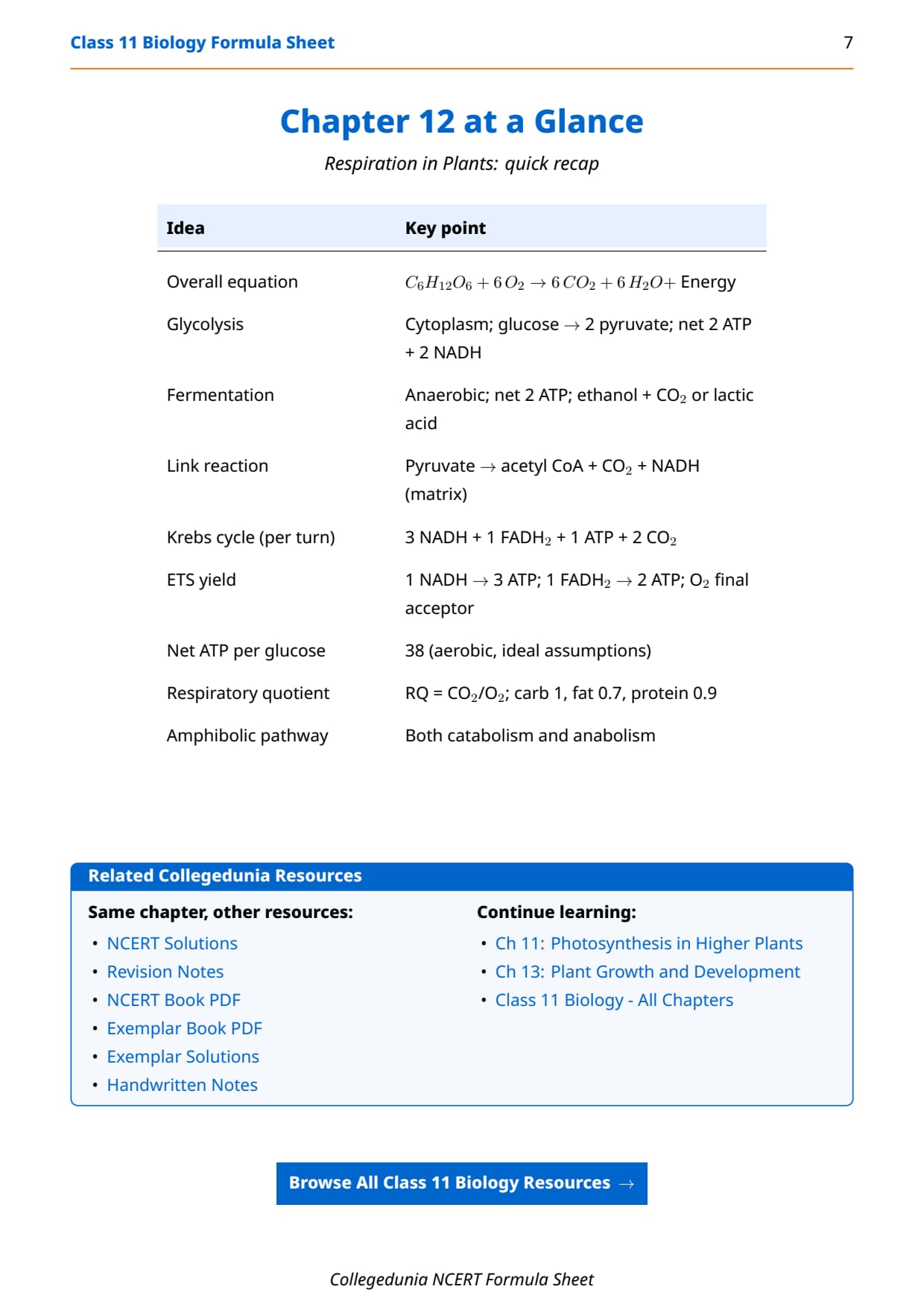
| Glycolysis (EMP pathway) | Cytoplasm | 2 pyruvate, 2 ATP, 2 NADH |
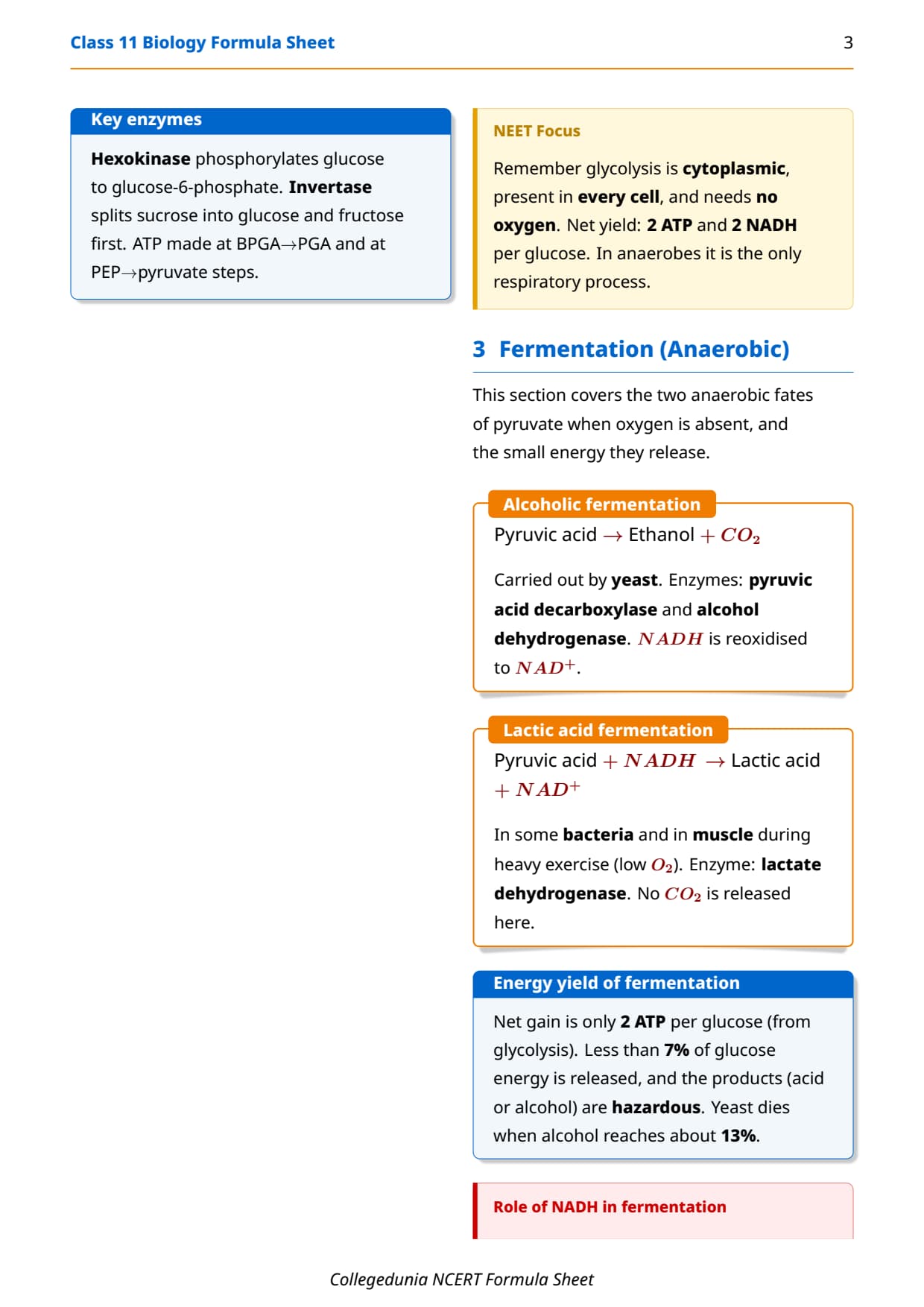
| Fermentation (anaerobic) | Cytoplasm | Ethanol + CO2, or lactic acid; net 2 ATP |
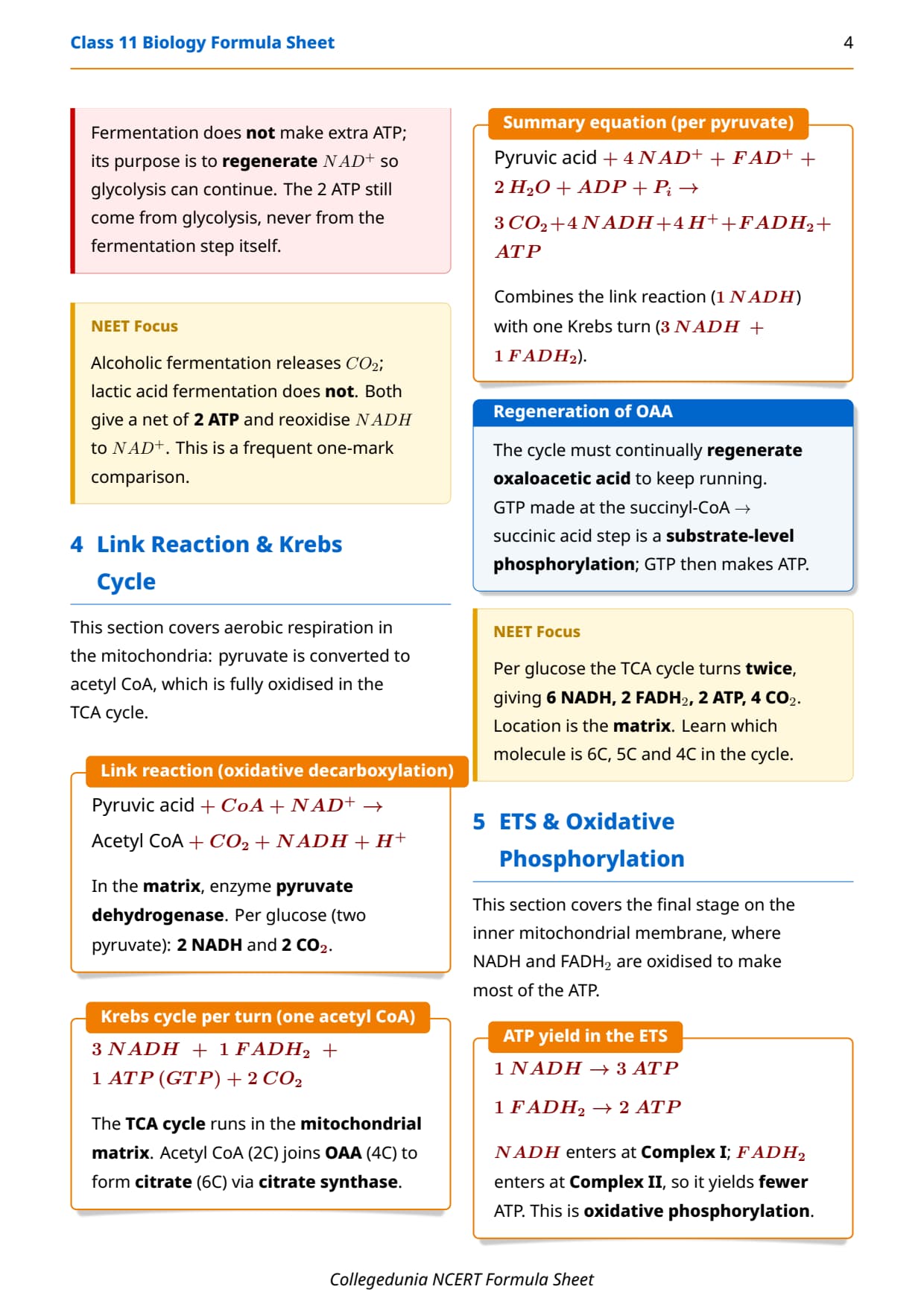
| Link reaction | Mitochondrial matrix | Acetyl CoA, CO2, NADH |
| Krebs cycle (per turn) | Mitochondrial matrix | 3 NADH, 1 FADH2, 1 ATP, 2 CO2 |
| ETS and oxidative phosphorylation | Inner mitochondrial membrane | ATP, water (O2 as final acceptor) |
Glycolysis needs no oxygen and occurs in every living cell, while the link reaction, Krebs cycle and ETS are aerobic and confined to the mitochondria. In the ETS, NADH enters at Complex I and FADH2 enters at Complex II, so FADH2 yields fewer ATP.
Respiratory Quotient (RQ) Values
The respiratory quotient tells you which substrate is being respired. It is defined as RQ = CO2 evolved / O2 consumed, and its value depends entirely on the respiratory substrate.
For pure carbohydrate the overall equation is C6H12O6 + 6O2 → 6CO2 + 6H2O, so the RQ works out to 6CO2 / 6O2 = 1.
| Substrate | RQ value |
|---|---|
| Carbohydrate | 1 |
| Fat (e.g. tripalmitin) | ≈ 0.7 (less than 1) |
| Protein | ≈ 0.9 |
| Organic acid | greater than 1 |
RQ is below 1 for fats and above 1 for organic acids; in living cells pure fats or proteins are almost never respired alone.
How to Revise Respiration in Plants Before the Exam
This chapter rewards clean numbers and correct locations more than long explanations. A short, ordered revision locks in the balance sheet and the RQ values.
- Write the net ATP totals: 2 from glycolysis, and 38 in all for aerobic respiration under NCERT assumptions.
- Memorise each stage with its site, cytoplasm for glycolysis and the mitochondria for the link reaction, Krebs cycle and ETS.
- Learn the ETS ratios: 1 NADH gives 3 ATP and 1 FADH2 gives 2 ATP, with O2 as the final acceptor.
- Fix the RQ values for carbohydrate, fat, protein and organic acid, and note the difference between alcoholic and lactic acid fermentation.
Student Feedback on the Respiration in Plants Formula Sheet
In a survey of 1,200 NEET aspirants who used this sheet, 84% said the single-page ATP balance sheet made the 38 ATP calculation easy to reproduce under exam pressure. Toppers reported that reciting the RQ values and the stage-wise sites twice a week made them automatic before the exam.
Other Respiration in Plants Class 11 Biology Resources
Pair this formula sheet with the solved answers, notes and textbook PDF.
| Resource | Link |
|---|---|
| NCERT Solutions | Respiration in Plants Class 11 NCERT Solutions |
| Revision Notes | Respiration in Plants Class 11 Notes |
| NCERT Book PDF | Respiration in Plants Class 11 Book PDF |
NCERT Formula Sheet for Class 11 Biology: All Chapters
Revise every chapter from one place. Each link opens the formula sheet for that chapter.
| Chapter | Formula Sheet |
|---|---|
| Chapter 1 | The Living World |
| Chapter 2 | Biological Classification |
| Chapter 3 | Plant Kingdom |
| Chapter 4 | Animal Kingdom |
| Chapter 5 | Morphology of Flowering Plants |
| Chapter 6 | Anatomy of Flowering Plants |
| Chapter 7 | Structural Organisation in Animals |
| Chapter 8 | Cell: The Unit of Life |
| Chapter 9 | Biomolecules |
| Chapter 10 | Cell Cycle and Cell Division |
| Chapter 11 | Photosynthesis in Higher Plants |
| Chapter 12 | Respiration in Plants |
| Chapter 13 | Plant Growth and Development |
| Chapter 14 | Breathing and Exchange of Gases |
| Chapter 15 | Body Fluids and Circulation |
| Chapter 16 | Excretory Products and their Elimination |
| Chapter 17 | Locomotion and Movement |
| Chapter 18 | Neural Control and Coordination |
| Chapter 19 | Chemical Coordination and Integration |
FAQs on Respiration in Plants Class 11 Biology Formula Sheet
Respiration in Plants Formula Sheet - Frequently Asked Questions
Ques. What does the class 11 biology formula sheet chapter 12 respiration in plants cover?
Ans. This class 11 biology formula sheet chapter 12 respiration in plants covers glycolysis, fermentation, the link reaction, the Krebs cycle and the ETS, along with the stage-wise ATP yields totalling 38 ATP per glucose and the respiratory quotient values for each substrate.
Ques. How many ATP are produced per glucose in aerobic respiration?
Ans. Aerobic respiration yields a net 38 ATP per glucose, made of 4 direct ATP from substrate-level phosphorylation and 34 ATP from the ETS, using 1 NADH → 3 ATP and 1 FADH2 → 2 ATP. This is a theoretical value that assumes a sequential pathway with no intermediates withdrawn.
Ques. What is the respiratory quotient and its value for carbohydrate?
Ans. The respiratory quotient is RQ = CO2 evolved / O2 consumed. For carbohydrate it is 1 because C6H12O6 + 6O2 → 6CO2 + 6H2O. Fat gives about 0.7, protein about 0.9 and organic acids give more than 1.
Ques. Where does each stage of respiration take place?
Ans. Glycolysis occurs in the cytoplasm and needs no oxygen. The link reaction and the Krebs cycle occur in the mitochondrial matrix, and the electron transport system with oxidative phosphorylation runs on the inner mitochondrial membrane, where O2 acts as the final electron acceptor and is reduced to water.



Comments