




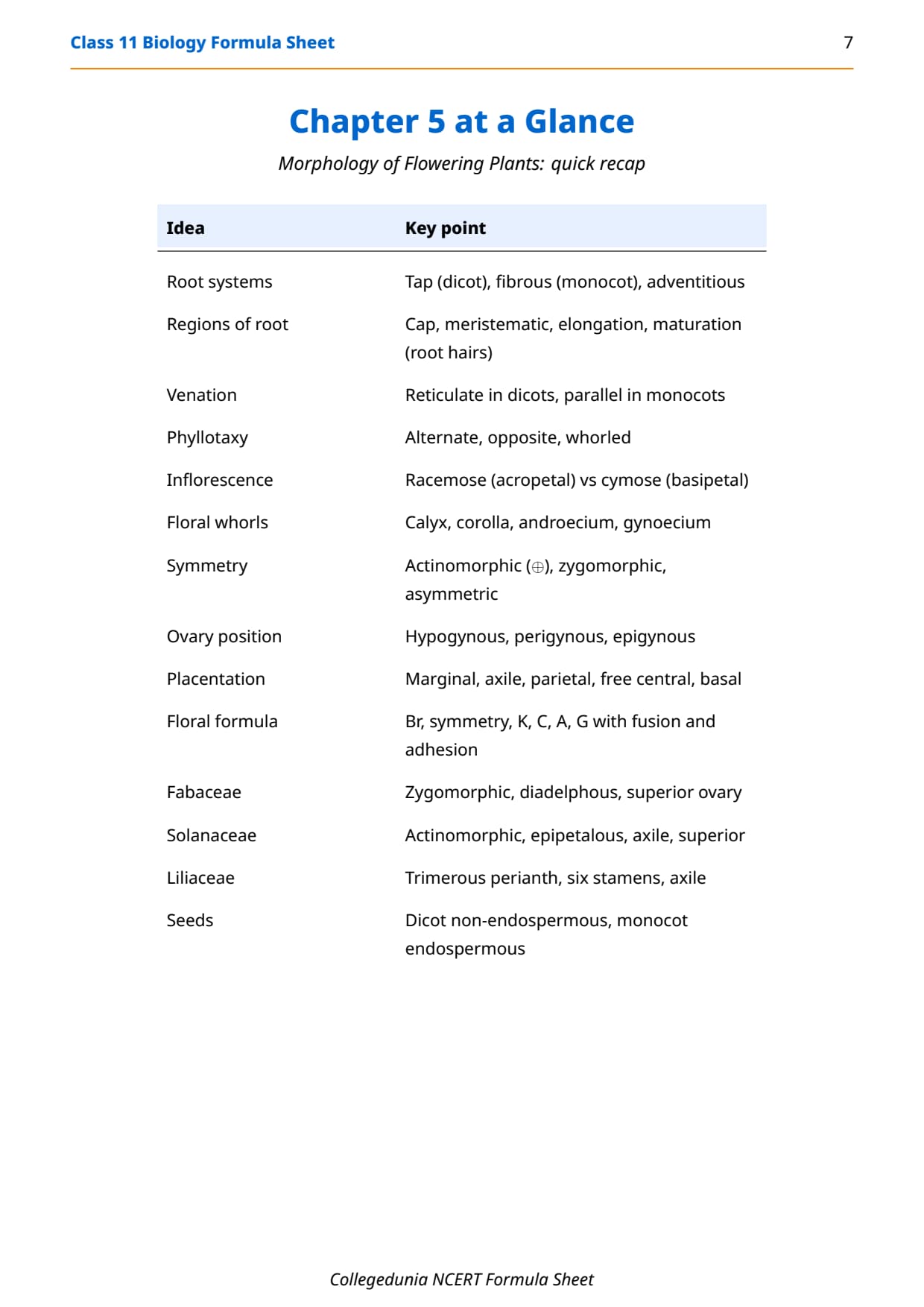
The class 11 biology formula sheet chapter 5 morphology of flowering plants gathers every key term, floral formula symbol and modification example tested in the CBSE Boards, NEET, CUET and other entrance exams. It puts the root, stem and leaf modifications, the aestivation and placentation types, and the full floral formula notation in one place so students can revise the whole chapter fast.
Morphology of Flowering Plants is a high-yield chapter for NEET, and its terms and floral formulae return in the reproduction and taxonomy units.
- Lists the floral formula symbols for calyx, corolla, androecium, gynoecium and the symmetry and sex signs.
- Tabulates the common root, stem and leaf modifications with their standard examples.
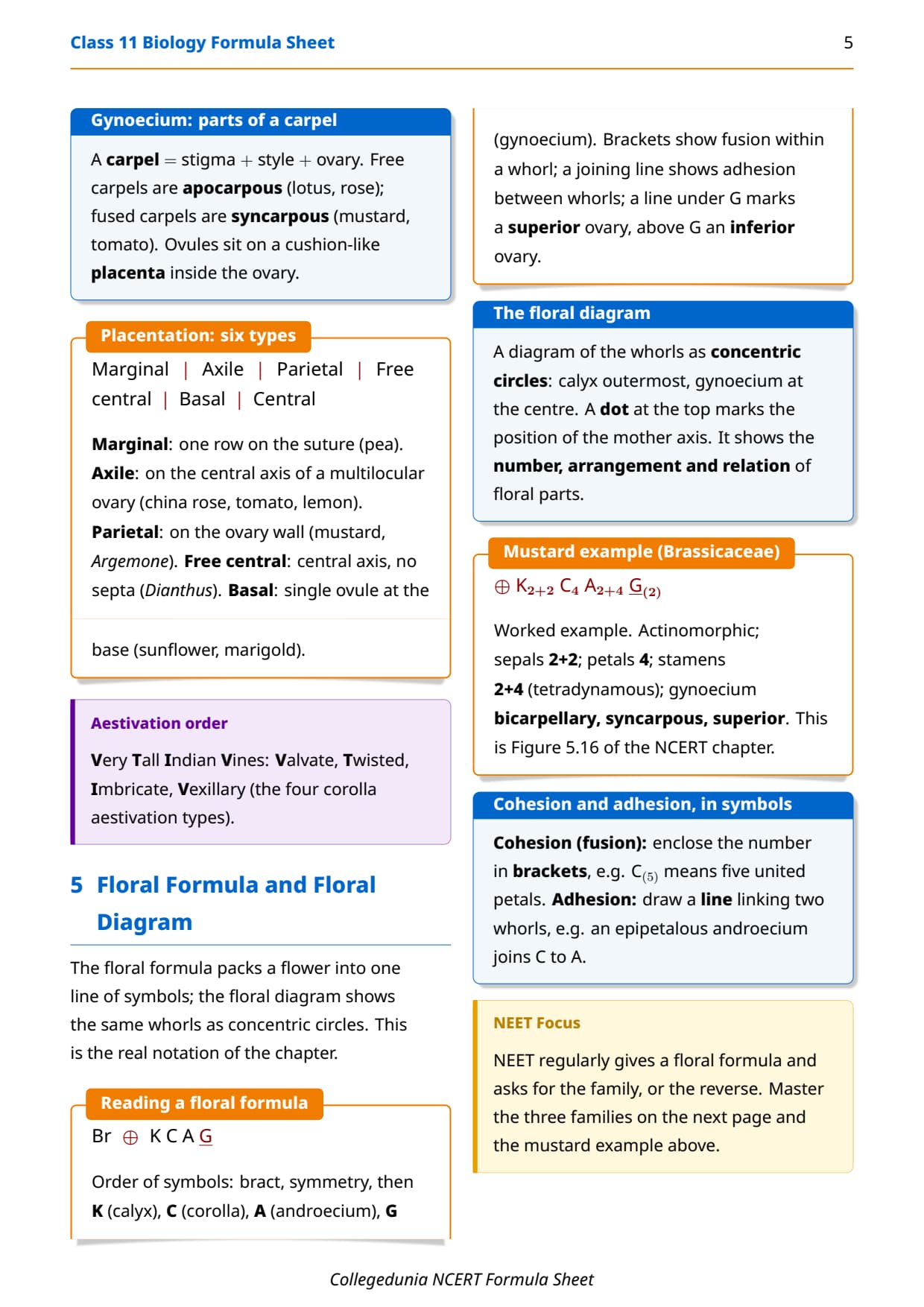
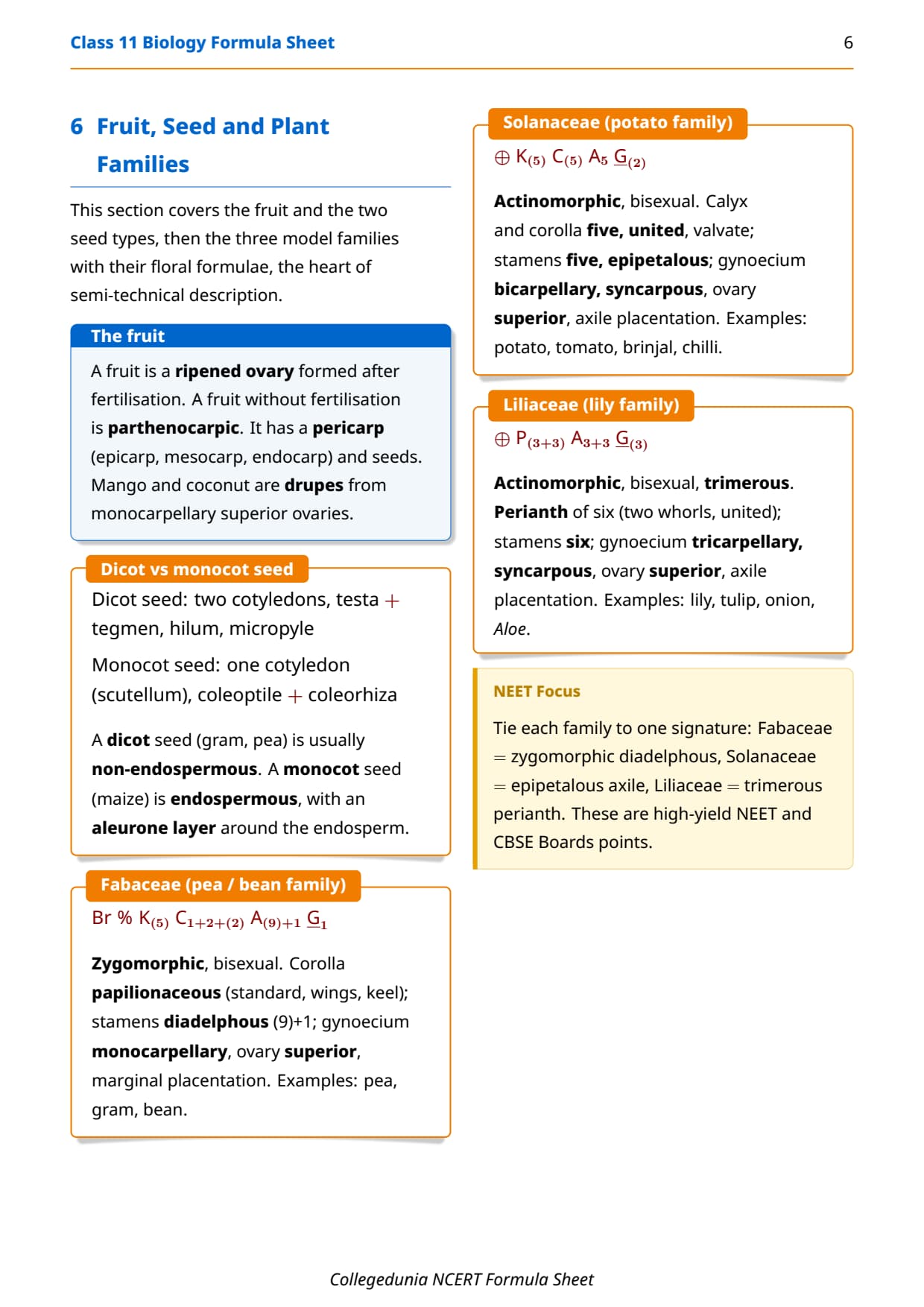
- Sets out the aestivation and placentation types plus the three model family floral formulae.
This class 11 biology formula sheet chapter 5 morphology of flowering plants is curated by subject experts and checked against the 2026-27 NCERT and recent CBSE and NEET papers.
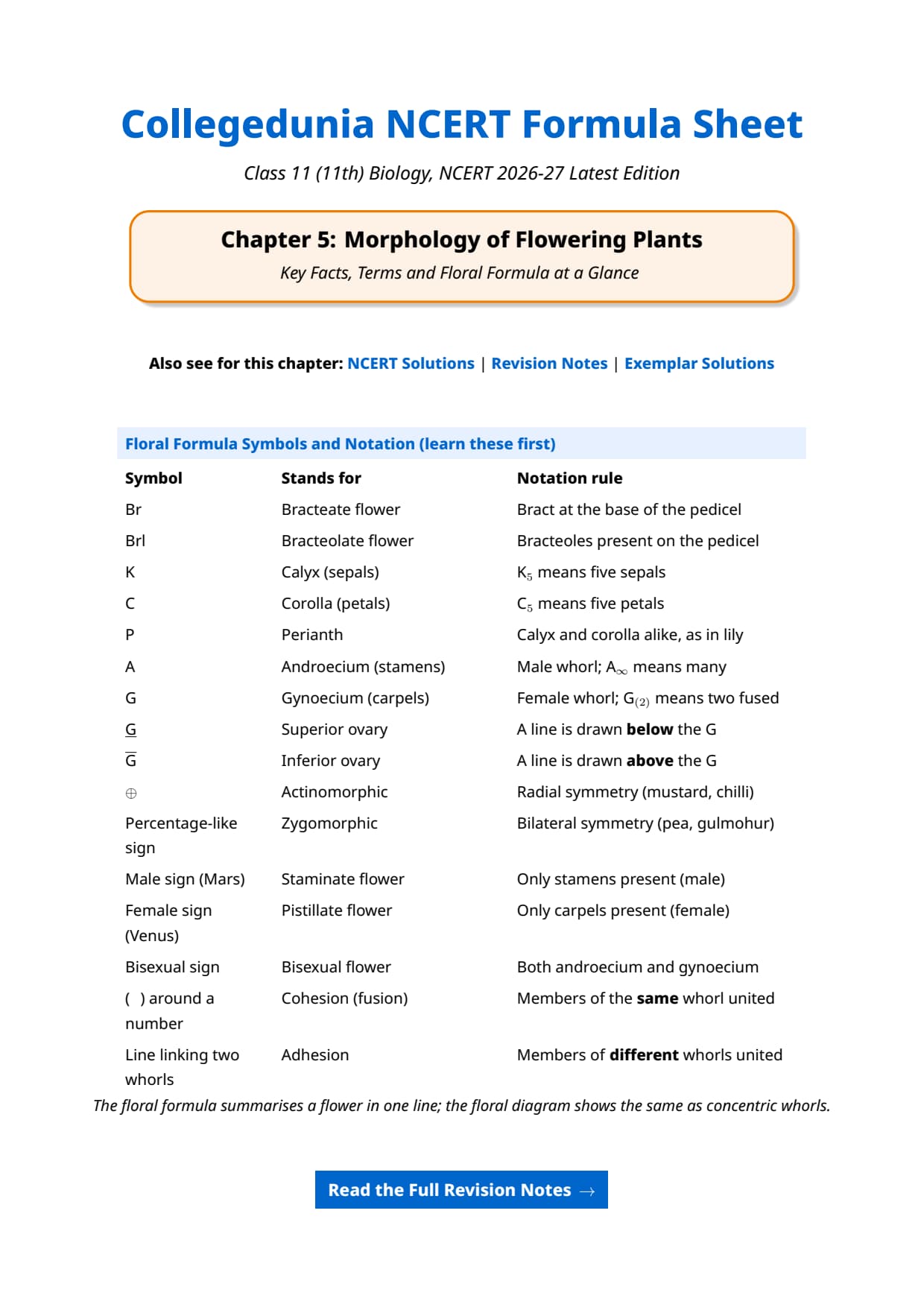
Floral Formula Symbols at a Glance
The floral formula summarises a whole flower in one line, so the symbols below are the notation of the chapter. Learn every symbol and its meaning by heart, since NEET regularly gives a floral formula and asks for the family, or the reverse.
| Symbol | Stands for | Meaning / notation rule |
|---|---|---|
| Br | Bracteate | A bract is present at the base of the pedicel |
| Brl | Bracteolate | Bracteoles are present on the pedicel |
| K | Calyx (sepals) | K5 means five sepals |
| C | Corolla (petals) | C5 means five petals |
| P | Perianth | Calyx and corolla alike, as in Liliaceae |
| A | Androecium (stamens) | Male whorl; A∞ means many stamens |
| G | Gynoecium (carpels) | Female whorl; G(2) means two fused carpels |
| Line below G | Superior ovary | A line drawn below the G marks a superior ovary (hypogynous) |
| Line above G | Inferior ovary | A line drawn above the G marks an inferior ovary (epigynous) |
| ⊕ | Actinomorphic | Radial symmetry (mustard, chilli) |
| % (percentage sign) | Zygomorphic | Bilateral symmetry (pea, gulmohur) |
| ♂ (Mars) | Staminate flower | Only stamens present (male flower) |
| ♀ (Venus) | Pistillate flower | Only carpels present (female flower) |
| ⚧ | Bisexual flower | Both androecium and gynoecium present |
| ( ) around a number | Cohesion (fusion) | Members of the same whorl are united |
| Line linking two whorls | Adhesion | Members of different whorls are united |
Read the symbols in order: bract, symmetry, then K, C, A, G. A line under G means a superior ovary and a line above G means an inferior ovary.
Root, Stem and Leaf Modifications
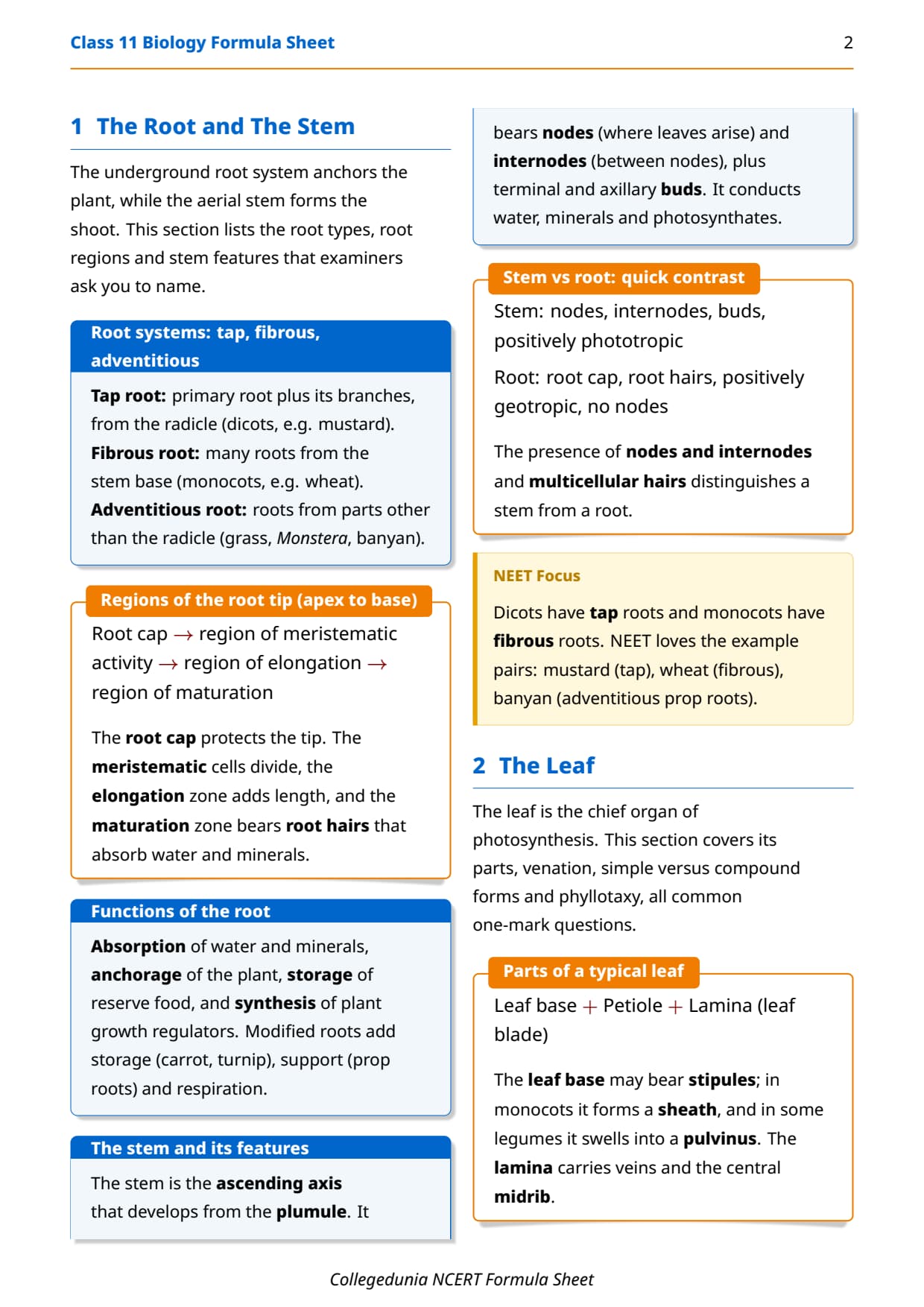
Roots, stems and leaves change shape to store food, give support or help the plant climb. NEET pairs each modification with a named plant, so learn the example column along with the type.
| Organ | Modification | Example |
|---|---|---|
| Root | Storage (tap root) | Carrot, turnip, beetroot |
| Root | Prop root (support) | Banyan |
| Root | Stilt root (support) | Maize, sugarcane |
| Root | Pneumatophore (respiration) | Rhizophora (mangrove) |
| Stem | Underground storage: rhizome | Ginger |
| Stem | Underground storage: tuber | Potato |
| Stem | Tendril (climbing) | Gourds, grapevine |
| Stem | Thorn (protection) | Citrus, Bougainvillea |
| Stem | Phylloclade (photosynthesis) | Opuntia, Euphorbia |
| Leaf | Tendril (climbing) | Pea |
| Leaf | Spine (protection) | Cactus, Aloe |
| Leaf | Storage (fleshy leaves) | Onion, garlic |
| Leaf | Pitcher (insect trap) | Nepenthes |
A tendril and a thorn can arise from either a stem or a leaf, so always name the source organ, as in stem tendril of gourd versus leaf tendril of pea.
Aestivation and Placentation Types
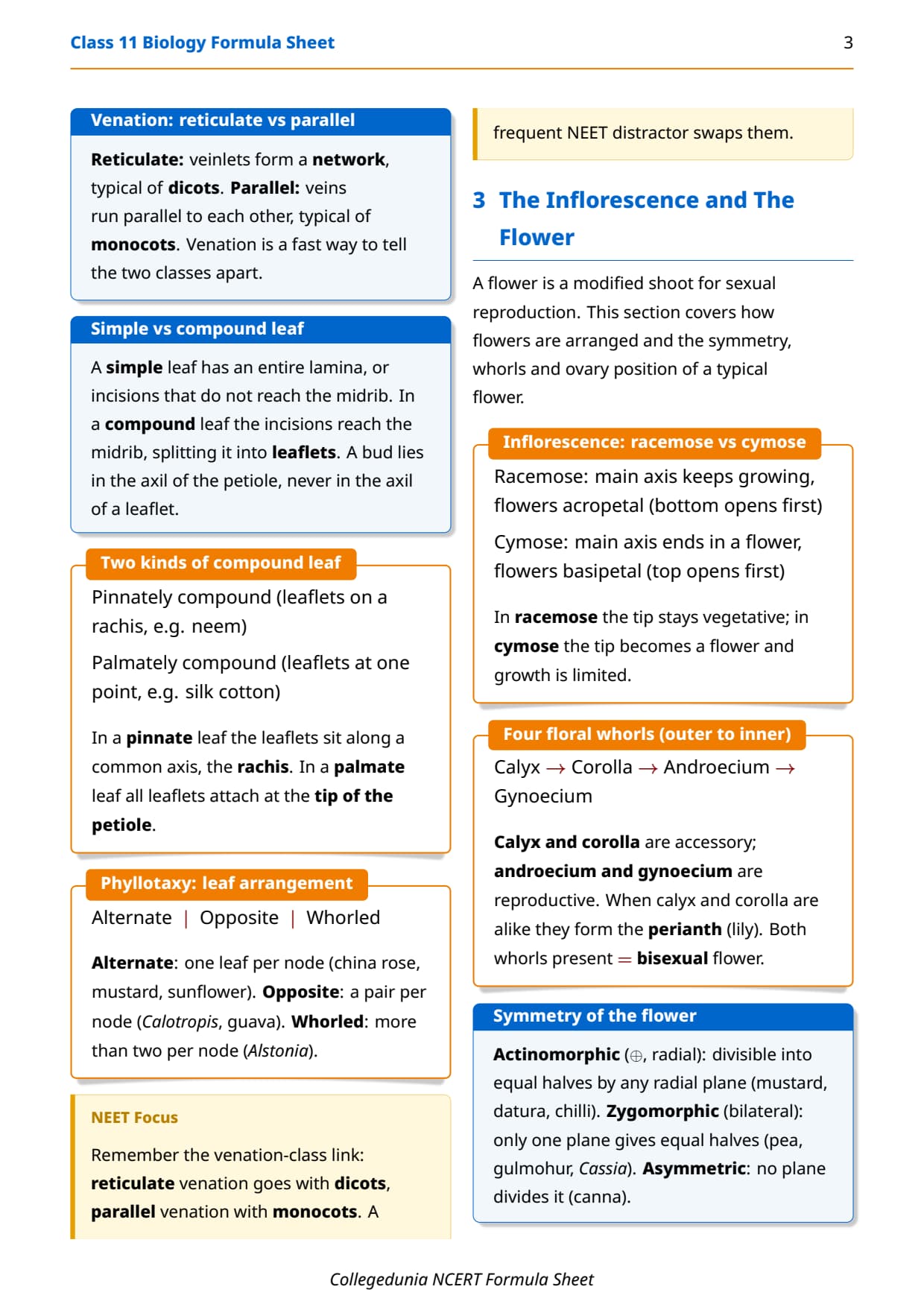
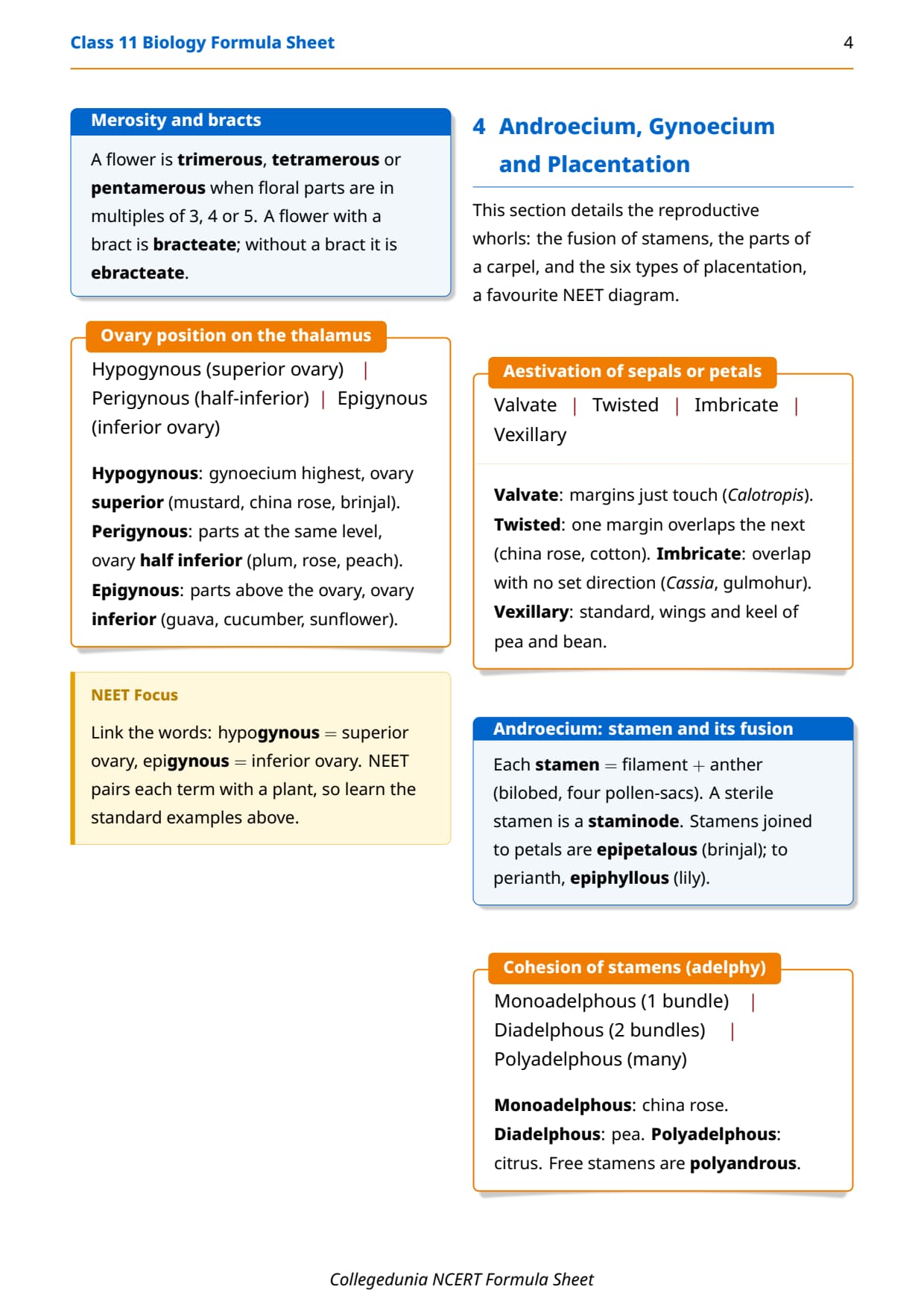
Aestivation is how sepals or petals are arranged in a bud, while placentation is how ovules attach inside the ovary. Both are favourite NEET diagram questions, so the tables below list every type with its standard example and the three model family floral formulae.
| Type | Description and example |
|---|---|
| Valvate (aestivation) | Margins just touch without overlap (Calotropis) |
| Twisted (aestivation) | One margin overlaps the next in a set direction (china rose, cotton) |
| Imbricate (aestivation) | Overlap with no set direction (Cassia, gulmohur) |
| Vexillary (aestivation) | Standard, wings and keel of pea and bean |
| Marginal (placentation) | Ovules in one row on the suture (pea) |
| Axile (placentation) | Ovules on the central axis of a multilocular ovary (china rose, tomato, lemon) |
| Parietal (placentation) | Ovules on the ovary wall (mustard, Argemone) |
| Free central (placentation) | Ovules on a central axis with no septa (Dianthus) |
| Basal (placentation) | A single ovule at the base of the ovary (sunflower, marigold) |
The three model families each have a signature floral formula that examiners quote often.
| Family | Floral formula and signature |
|---|---|
| Fabaceae (pea family) | Br % K(5) C1+2+(2) A(9)+1 G1 (superior); zygomorphic, papilionaceous, diadelphous |
| Solanaceae (potato family) | ⊕ K(5) C(5) A5 G(2) (superior); actinomorphic, epipetalous, axile |
| Liliaceae (lily family) | ⊕ P(3+3) A3+3 G(3) (superior); actinomorphic, trimerous perianth, axile |
Tie each family to one signature: Fabaceae is zygomorphic and diadelphous, Solanaceae is epipetalous and axile, and Liliaceae has a trimerous perianth.
How to Revise Morphology of Flowering Plants Before the Exam
This chapter rewards clean terms and worked floral formulae more than long answers. A short, ordered revision fixes the notation and examples in memory.
- Write out the floral formula symbols in order and decode the mustard example ⊕ K2+2 C4 A2+4 G(2).
- List the root, stem and leaf modifications with one example each, noting which organ a tendril or thorn came from.
- Draw the four aestivation types and the five placentation types, then match each to its plant.
- Memorise the three family floral formulae for Fabaceae, Solanaceae and Liliaceae, since NEET asks the family from the formula.
- Revise the ovary positions: hypogynous (superior), perigynous (half inferior) and epigynous (inferior), with their examples.
Student Feedback on the Morphology of Flowering Plants Formula Sheet
In a survey of 1,200 NEET aspirants who used this sheet, 78% said the single-page floral formula table made the symbols easy to recall in the exam hall. Toppers reported that writing the three family floral formulae twice a week made the family-from-formula questions automatic before the exam.
Other Morphology of Flowering Plants Class 11 Biology Resources
Pair this formula sheet with the solved answers, notes and textbook PDF.
| Resource | Link |
|---|---|
| NCERT Solutions | Morphology of Flowering Plants Class 11 NCERT Solutions |
| Revision Notes | Morphology of Flowering Plants Class 11 Notes |
| NCERT Book PDF | Morphology of Flowering Plants Class 11 Book PDF |
NCERT Formula Sheet for Class 11 Biology: All Chapters
Revise every chapter from one place. Each link opens the formula sheet for that chapter.
| Chapter | Formula Sheet |
|---|---|
| Chapter 1 | The Living World |
| Chapter 2 | Biological Classification |
| Chapter 3 | Plant Kingdom |
| Chapter 4 | Animal Kingdom |
| Chapter 5 | Morphology of Flowering Plants |
| Chapter 6 | Anatomy of Flowering Plants |
| Chapter 7 | Structural Organisation in Animals |
| Chapter 8 | Cell: The Unit of Life |
| Chapter 9 | Biomolecules |
| Chapter 10 | Cell Cycle and Cell Division |
| Chapter 11 | Photosynthesis in Higher Plants |
| Chapter 12 | Respiration in Plants |
| Chapter 13 | Plant Growth and Development |
| Chapter 14 | Breathing and Exchange of Gases |
| Chapter 15 | Body Fluids and Circulation |
| Chapter 16 | Excretory Products and their Elimination |
| Chapter 17 | Locomotion and Movement |
| Chapter 18 | Neural Control and Coordination |
| Chapter 19 | Chemical Coordination and Integration |
FAQs on Morphology of Flowering Plants Class 11 Biology Formula Sheet
Morphology of Flowering Plants Formula Sheet - Frequently Asked Questions
Ques. What does the class 11 biology formula sheet chapter 5 morphology of flowering plants cover?
Ans. This class 11 biology formula sheet chapter 5 morphology of flowering plants covers the floral formula symbols for calyx, corolla, androecium and gynoecium, the symmetry and sex signs, the common root, stem and leaf modifications with examples, the four aestivation and five placentation types, and the three model family floral formulae for Fabaceae, Solanaceae and Liliaceae.
Ques. How do you read a floral formula?
Ans. A floral formula lists the bract (Br), the symmetry sign (⊕ for actinomorphic, % for zygomorphic), then K (calyx), C (corolla), A (androecium) and G (gynoecium). Brackets around a number show fusion within a whorl, a joining line shows adhesion between whorls, a line under G marks a superior ovary and a line above G marks an inferior ovary.
Ques. What are the types of placentation?
Ans. Placentation is the arrangement of ovules inside the ovary. The main types are marginal (pea), axile (china rose, tomato, lemon), parietal (mustard, Argemone), free central (Dianthus) and basal (sunflower, marigold). NEET often shows a section of an ovary and asks students to name the placentation.
Ques. What are the floral formulae of the three model plant families?
Ans. Fabaceae is Br % K(5) C1+2+(2) A(9)+1 G1 with a superior ovary; Solanaceae is ⊕ K(5) C(5) A5 G(2) with a superior, axile ovary; and Liliaceae is ⊕ P(3+3) A3+3 G(3) with a trimerous perianth and axile placentation. These three formulae are high-yield for NEET and the CBSE Boards.



Comments