



Exams Prep Master
Stomata are the pores that are present on the underside of leaves in a plant. They enable the transfer of the gasses oxygen and carbon dioxide. In simple language stomata is the only reason plants breathe. Stomata functions as a mouth of the plant. There are numerous kinds of stomata and they are mainly classified on the basis of characteristics and number of surrounding subsidiary cells. Anomocytic Stomata, Anisocytic Stomata, Gramineous Stomata etc. are a few types of stomata present in the plant. Here in this article, we will discuss the stomata, different types of stomata and their structures.
| Table of Contents |
Key Takeaways: Stomata, Photosynthesis, Stoma, Guard Cells, Anomocytic Stomata, Paracytic Stomata, Diacytic Stomata.
Anatomy of Stomata
[Click Here for Sample Questions]
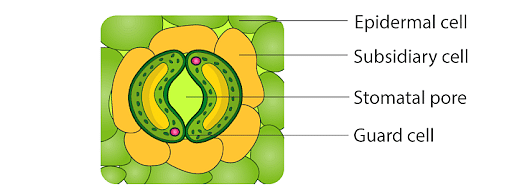
Anatomy of Stomata
What is Stomata?
[Click Here for Sample Questions]
The pores present in the leaf of a plant are called stomata. A single pore is called stoma. Stomata is usually present in the epidermis layer of leaves. However, stomata are also present in the steam of a plant. They facilitate the movement of carbon dioxide and oxygen essential for photosynthesis.
Read more: Difference between Mitochondria and Plastids
Types of Stomata
[Click Here for Sample Questions]
Stomata are classified on the basis of the subsidiary cells that surround them and the strength of their cluster.
- Anomocytic Stomata - It is known as the irregular celled type of ranunculaceous cells. Anomocytic stomata are adjacent by cells that are similar to epidermal layers in terms of shape and size. It appears to be embedded in the epidermal cells.
- Anisocytic Stomata - Anisocytic Stomata is boarded by three subsidiary cells which are lopsided. Anisocytic stomata is also called cruciferous or unequal celled typed stomata.
- Paracytic Stomata - They are also called parallel-celled type or rubiaceous cells. One or more Subsidiary cells are present on each side of paracytic stomata. The longitudinal axes of these subsidiary cells lie parallel to the aperture of the guard cells.
- Diacytic Stomata - The walls of diacytic cells lie at right angles to the guard cells. Diacytic stomata are also called caryophyllaceous or cross-walled stomata.
- Gramineous Stomata - Gramineous stomata have two guard cells shaped like dumbbells. Each guard cell has a narrow middle portion and two bulbous ends. The narrow central part is sturdy and thickened; the subsidiary cells are parallel to the long axis of the pore.
Read more: Sexual Reproduction in Flowering Plants
Structure of Stomata
[Click Here for Sample Questions]
Stomata are enclosed by guard cells. Stomata become rigid when they absorb fluids. Due to this stomata operate by opening and closing as per the turgidity of the guard cells. Cell walls that encircle stomata are thinner, flexible and robust. Each guard cell is different in dicots and monocots, however the mechanism of each stomata is the same.
Read more: Excretion Plants
What is Stomata Made up of?
- Epidermal Cell:- Epidermal cell is the outermost player of a plant. It is made up of specialised cells that derive from the dermal tissues. Its job is to provide mechanical support to the plant.
- Subsidiary Cell:- Subsidiary cells are situated adjacent to guard cells in the stroma of a league. It provides support in the movement of guard cells. Subsidiary cells are usually developed in mother cells proximity. Although, they can grow independently also.
- Stomatal Pore:- These are the minute pores found below the surface of a leaf. Stomatal pore plays a key role in exchange of gases such as carbon dioxide and oxygen.
- Guard Cells:- Guard cells are similar to the shape of the kidney. Their main function is to carry out the opening and closing mechanism of stomata.
Functions of Stomata
[Click Here for Sample Questions]
The integral function performed by stomata is diffusion of gases. The guard cells play a key role in this function by opening and closing at the perfect time for gases. The process of gas and water exchange is called transpiration. When air is inhaled by plants, they use carbon atoms to prepare food and reserve it for energy. The oxygen that is bonded with hydrogen gets diffused in the atmosphere. This is the reason for water droplets on leaves. Along with this, stomata also plays a key role in photosynthesis.
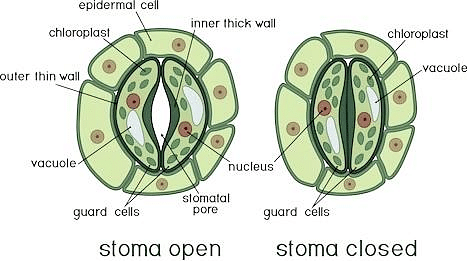
Functions of Stomata
Water is necessary for plants to produce food. The roots in plants gulp in water from the soil via osmotic pressure. Then, water moves wherever the concentration of ions, atoms and molecules is the highest.
Things to Remember
- Stomata is present on the underside of leaves and helps in transfer of carbon dioxide and oxygen.
- In a plant there are a total of five types of stomata. Some of them are Anomocytic Stomata, Anisocytic Stomata etc.
- Stomata is surrounded by guard cells that are just like the shape of the kidney.
Sample Questions
Ques. What is the role played by stomata in photosynthesis? (2 marks)
Ans. Stomata does not actively participate in photosynthesis. It plays a facilitator role in photosynthesis. Stomata mainly helps in the entry and exit of gases from leaves.
Ques. On which stomata is present in plants? (1 mark)
Ans. Stomata is generally found in the green parts of plants such as leaves and steam.
Ques. What are the different types of stomata? (2 marks)
Ans. Different types of stomata are:
- Anomocytic Stomata
- Anisocytic Stomata
- Paracytic Stomata
- Diacytic Stomata
- Gramineous Stomata
Ques. Why does a plant need a stomata? (1 mark)
Ans.Stomata are present in the epidermis of cells in plants. They are required to allow transaction of gases during photosynthesis.
Ques. Explain the structure of stomata? (1 mark)
Ans. Stomata are small bean-shaped pores located in the epidermis of the cell. Stomatal opening is surrounded by guard cells.
Ques. What is the definition of guard cells? (1 mark)
Ans. Two bean-shaped cells that surround stomata are known as guard cells. They are an integral component in the process of photosynthesis.
Ques. What is the main function of stomata? (1 mark)
Ans. The main function of stomata is to allow the transition of carbon dioxide and oxygen in plants.
Check-Out:



Comments