



Content Writer
Alkynes are unsaturated compounds that have at least one triple bond. The general formula for the compound is CnH2n-2. The first stable member of the group is Ethylene (C2H2).
- Alkynes are the base materials used for making organic compounds.
- It consists of no other functional groups and forms a homologous series.
- Alkynes are hydrophobic in nature.
- The compound is traditionally known as acetylenes, though it specifically refers to the compound ethyne.
- Each of the carbon atoms in acetylene is sp hybridisation.
- Alkynes are most commonly used for the production of a large number of organic compounds, such as chloroprene.
- The compound is used as a fuel for oxyacetylene torches in welding.
General Formula: CnH2n-2
Key Terms: Alkynes, Ethylene, Homologous Series, Unsaturated Compounds, Functional Groups, Carbon, Atoms, Electron, Alkenes, Orbital, Corrosion, Oxygen, Bonds, Polymers
What are Alkynes?
[Click Here for Sample Questions]
Alkynes are unsaturated compounds that consist of at least one carbon-carbon triple bond. Like alkenes, these compounds also include carbon orbital overlaps, resulting in a weak zone between the carbon atoms.
Since pi bonds are weaker than sigma bonds, alkynes' reactivity ensures that sigma bonds are formed, resulting in a robust and stable structure. Alkynes can undergo both addition and reduction processes, making them reactive.
- Although these compounds have low acidity, the addition reaction occurs when they come into contact with a metal surface.
- It will initiate the corrosion process.
- Some alkynes, such as acetylene and ethyne, can burn in oxygen to produce water and carbon monoxide.
- Corrosion inhibitors can be made from certain alkyne polymers (cathodes).

Alkynes
Read More:
Structure of Alkynes
[Click Here for Sample Questions]
The structure of alkynes is as follows:
- The perpendicular orientation of the sigma bond and two pi bonds originate from the sp hybridization of the carbon-carbon triple bond.
- The electrons' near closeness in this geometric orientation causes molecules to be less stable.
- The structure of the carbon-carbon triple bond substantially influences the reactivity and the acidity of terminal alkynes.
- A ten-membered carbon ring is the smallest that may handle this function.
- It occurs without significant strain due to its linear configuration (the bond angle of a sp-hybridized carbon is 180o).

Nomenclature of Alkynes
[Click Here for Sample Questions]
The nomenclature of alkynes is divided into two categories which are as follows:
Common Name
The members of the alkynes group are named in terms of acetylene derivatives.
IUPAC Name
According to the IUPAC standard, the nomenclature of alkyne compounds is similar to the nomenclature of alkane compounds. As a result, it is quite identical except that the suffix “yne” is replaced with the suffix “ane”.
- The counting of the compound will start with the first carbon triple bond.

Nomenclature of Alkynes
Isomerism in Alkynes
[Click Here for Sample Questions]
Alkynes is an organic compound that exhibit three types of isomerism which are as follows:
Chain Isomerism
These types of alkynes compounds are formed by different arrangement of carbon atoms that are arranged in straight-chain or branched chain.
Example of Chain IsomerismExample: 4-methylpent-2-yne and hex-2-yne |
Position Isomerism
Position Isomerism is formed due to the difference in the location of the triple bond.
Example of Position IsomerismExample: Pent-1-yne and pent-2-yne |
Functional Isomerism
Functional Isomerism involves with alkadienes being represented by the general formula CnH2n-2.
Example of Functional IsomerismExample: But-1-yne and buta-1,3-diene |
Properties of Alkynes
[Click Here for Sample Questions]
Properties of alkynes are divided into the category of physical and chemical properties which are as follows:
Physical Properties of Alkynes
The physical properties of alkynes are as follows:
- Alkynes are nonpolar, unsaturated hydrocarbons with physical properties similar to alkanes and alkenes.
- They are soluble in organic solvents, polar solvents with a low solubility, and insoluble in water.
- These compounds have slightly higher boiling points than alkanes and alkenes.
- Ethane, for example, has a boiling point of -88.6°C, but ethene has a boiling point of -103.7°C.
- Ethyne has a boiling temperature of -84.0°C.
Chemical properties of Alkynes
[Click Here for Sample Questions]
The chemical properties of alkynes are as follows:
Addition of Electrophilic Reagents
Alkynes are involved in the majority of alkene addition reactions, with similar regio- and stereoselectivity. Although these electrophilic additions to alkynes are slow, they do happen and are generally regioselective, according to Markovnikov's Rule.
- One issue is that the results of these additions are substituted alkenes, and so can be added again.
- Halogen substituents on a double bond lessen the nucleophilicity of the bond, lowering the rate of electrophilic addition processes.
- As a result, determining the product of an initial addition to an alkyne will be further added to a saturated product is a delicate balancing.

Addition of Hydrogen Halide to an Alkyne
Anti-addition occurs when excess HX is added, resulting in the formation of a geminal dihaloalkane. HI > HB r> HCl > HF is the reactivity order of hydrogen halides according to Markovnikov's rule.
- Hydrogen element adds to the carbon with the most hydrogens.
- The halogen element adds to the carbon with the fewest hydrogen.
- The more stable carbocation is where protonation takes place.
- Haloalkanes are formed when HX is added.
Addition of HX to an Alkyne
As an example, HBr attacks the double bond in 2-butyne to produce 2-bromobutane, as seen in the diagram below.
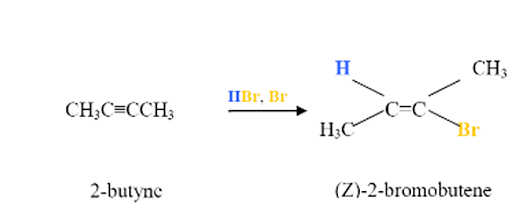
Addition of HX to Terminal Alkyne
This image depicts the addition of HBr to an asymmetric molecule. What happens if you have too much HBr? According to Markovnivov's rule, adding too much HX results in a geminal dihaloalkane.

Reaction Addition of Halogens (Cl2, Br2, I2)
It involves the addition of halogen to an alkyne, which is similar to adding halogen to an alkene. First, the trans-alkene is obtained. A tetrahalogened alkane is formed when halogen is used in excess.

Alkynes Homologous Series
[Click Here for Sample Questions]
A homologous series is a type of series that involves the collection of carbon atoms in which the hydrogen atom replaces the same type of functional group.
- As the same type of functional groups are added, compounds will have similar chemical properties.
- It exhibits the gradation of physical properties.
The table below explain different types of alkynes:
| Alkyne Compound | Alkyne Formula |
|---|---|
| Ethyne | C2H2 |
| Propyne | C3H4 |
| 1-Butyne | C4H6 |
| 1-Pentyne | C5H8 |
| 1-Hexyne | C6H10 |
| 1-Heptyne | C7H12 |
| 1-Octyne | C8H14 |
| 1-Nonyne | C9H16 |
| 1-Decyne | C10H18 |
Tests for the Presence of a Triple Bond
[Click Here for Sample Questions]
Tests for presence of a triple bond in alkynes are represented by following test which are as follows:
With Ammoniacal Silver Nitrate
In this test, alkynes will form a white precipitate of silver acetylide in reaction with ammoniacal silver nitrate.
With Ammnoniacal Cuprous Chloride
In this test, alkynes will form a red precipitate of cuprous acetylide in reaction with ammoniacal cuprous chloride.
Also Read:
Uses of Alkynes
[Click Here for Sample Questions]
The uses of alkynes are as follows:
Fuel for Rockets
The dominant alkyne in acetylene is used as a fuel, with millions of kilos produced annually through fractional oxidation of natural gases.
Synthesis of Organic Substances
Organic chemicals such as ethanoic acid, acrylic acid, and ethanol are made from some of these alkynes.
Solvents made of organic materials
Ethyne, for example, is an alkyne that is used to make organic solvents.
Polymers
A polymer is a macromolecule made up of numerous subunits that are repeated. Vinyl chloride, for example, is used as a starting ingredient for PVC.
Fruits are artificially ripened
Alkynes are used to make toxic mustard gas by artificially ripening fruits and as a general anaesthetic.
Lighting that is transportable
Acetylene was first used to power portable lamps known as acetylene gas lamps, which were found in homes, bicycles, and automobiles.
Cutting and welding
Acetylene is used to weld or cut materials that demand high temperatures of 3500 degrees Celsius, and it is the gas that can produce the brightest flame of all the gases.
Plastics made of polyethylene
Ethylene is a derivative of acetylene that is used to make polyethylene polymers. Production of chemicals. Acetylene is also used to make a variety of inorganic chemicals, including vitamins A and E.
Manufacturing Products are made in industries.
Because of its capacity to undergo various chemical reactions, acetylene, also known as ethyne, is useful in the creation of products in industries.
Anti-tumor Agents
When used in pharmaceuticals, many alkynes are hazardous to humans. Specific alkynes known as ene-diynes, on the other hand, have a potent and aggressive anti-tumor chemical. An example of an anti-tumor acting agent is calicheamicin.
Production of a hot flame
Oxy-acetylene, also known as oxyethylene, is a gas made by combining ethyne with oxygen to produce high flames for cutting and welding.
Lamps provide illumination
Individual lamps, such as the hunter's and miner's lamp, are lit by ethyne.
Polypropene Nitrile production
Propenonitrile polymerizes in the presence of a peroxide initiator, yielding a substantial synthetic fibre known as polypropene nitrile.
Neoprene manufacturing
Neoprene is a synthetic rubber that will not burn or absorb oils.
Production of pharmaceuticals
Many medications on the market, such as the antiviral efavirenz and the antifungal terbinafine, include alkynes.
Things to Remember
- Alkynes are valuable reagents in the synthesis of polymers, which is a major industrial use.
- It is an unsaturated hydrocarbon with at least one carbon—carbon triple bond between two carbon atoms.
- The chain is numbered to keep the number of double or triple bonds to a minimum.
- The structure of these compounds contains one in number σ bond and two feeble π bonds.
- Functional, ring chain or positional isomerism are types of isomerism of alkynes.
Sample Questions
Ques: Explain the bond structure in Alkynes? (2 marks)
Ans: An alkyne is an unsaturated hydrocarbon with at least one carbon-carbon triple bond in organic chemistry. The simplest acyclic alkynes form a homologous series with the generic chemical formula CnH2n-2.since they only have one triple bond and no other functional groups.
Ques: Which alkynes have isomers? (2 marks)
Ans: The structural isomers of an alkyne with four carbon atoms in the chain are 1-butyne and 2-butyne. 1-Butyne is a terminal alkyne having a linear shape due to the triple bond between the first three carbon atoms in the chain.
Ques: How are alkynes prepared? (2 marks)
Ans: Dehydrohalogenation is used to produce alkynes from vicinal dihalides. Halogens are the elements of Group 17 that we are familiar with. Dehydrohalogenation is the process of removing the hydrogen and halogen atoms from a substance. When two comparable atoms are bonded at nearby places, the word vicinal is employed.
Ques: Why are alkynes non-polar? (1 mark)
Ans: Because alkynes contain only carbon and hydrogen, they are nonpolar and, like alkanes and alkenes, are not soluble in water. They are also less dense than water.
Ques: Why are alkynes known as unsaturated hydrocarbons? (2 marks)
Ans: Alkynes, like alkenes, are unsaturated because they can react with hydrogen to produce a completely saturated alkane in the presence of a catalyst. Each bond denotes the removal of two hydrogen atoms from the chemical formula of an alkane with the same amount of carbon atoms.
Ques: Why are alkynes slightly soluble in water? (2 marks)
Ans: The electrons of the triple bond in alkyne are more tightly bound in the triple bond than the electrons of the double bond in alkene and the sigma electrons of alkane due to the increased electronegativity of the C-atom in alkyne. As a result, the alkyne is slightly more soluble in water, which is a polar solvent, than the alkene and alkane.
Ques: Why are alkynes called olefins? (2 marks)
Ans: Alkenes and alkynes, which have double and triple bonds, are examples of unsaturated hydrocarbons. Alkenes are known as olefins because ethylene, the first member of the alkene family also known as ethene, was discovered to produce oily compounds when exposed to chlorine and bromine.
Ques: What are the uses of alkynes? (3 marks)
Ans: The uses of alkynes are as follows:
- Alkynes are used to make toxic mustard gas by artificially ripening fruits and as a general anaesthetic.
- Acetylene was first used to power portable lamps known as acetylene gas lamps, which were found in homes, bicycles, and automobiles.
- Individual lamps, such as the hunter's and miner's lamp, are lit by ethyne.
- Neoprene is a synthetic rubber that will not burn or absorb oils.
Ques: What is Addition of electrophilic reagents? (3 marks)
Ans: Most alkene addition processes include alkynes, which have comparable regio- and stereoselectivity. Markovnikov's Rule indicates that these electrophilic additions to alkynes are usually regioselective, despite their modest rate of occurrence.
- Naturally, a drawback of these additions is that they produce substituted alkenes, which make them amenable to further additions.
- The nucleophilicity of a double bond is reduced by halogen substituents, which slows down the rate of electrophilic addition reactions.
- Consequently, it takes careful balancing to decide whether the product of a first addition to an alkyne will be added again to a saturated product.
Ques: What are the physical properties of alkynes? (3 marks)
Ans: The physical properties of alkynes are as follows:
- Alkynes are nonpolar, unsaturated hydrocarbons with physical properties similar to alkanes and alkenes.
- They are soluble in organic solvents, polar solvents with a low solubility, and insoluble in water.
- These compounds have slightly higher boiling points than alkanes and alkenes.
- Ethane, for example, has a boiling point of -88.6°C, but ethene has a boiling point of -103.7°C.
Ques: What is the addition and reduction process of alkynes? (2 marks)
Ans: Alkynes can undergo both addition and reduction processes, making them reactive. Although alkynes have low acidity, the addition reaction that occurs when they come into contact with a metal surface starts the corrosion process. Some alkynes, such as acetylene and ethyne, can burn in oxygen to produce water and carbon monoxide, both of which are essential for corrosion. Corrosion inhibitors can be made from certain alkynes polymers (cathodes).
For Latest Updates on Upcoming Board Exams, Click Here: https://t.me/class_10_12_board_updates
Check-Out:



Comments