



Education Content Expert
Polyvinyl Chloride (PVC) is a high-strength thermoplastic polymer made from the polymerization of vinyl chloride.
- PVC is the third most extensively produced synthetic polymer globally, with around 40 million tonnes produced yearly.
- It is widely used to produce pipes, wire and cable insulation, medical devices, etc.
- Polyvinyl Chloride is a white, brittle solid material available in form of powder or granules.
- It is lightweight, durable, low-cost, and can easily be processed.
In recent times, PVC material has been replacing traditional construction and building materials like wood, metals, concrete, rubber, ceramics, etc in several applications due to its favorable properties.
| Table of Content |
Key Terms: Polyvinyl Chloride, PVC, Polymer, Polymerization, Vinyl Chloride, Thermoplastic Polymer, Monomers, Emulsion Polymerization
What is Polyvinyl Chloride?
[Click Here for Sample Questions]
Polyvinyl Chloride (PVC) is an economical and versatile thermoplastic polymer used worldwide.
- PVC is created through the polymerization of the vinyl chloride monomer.
- Resin is the primary component used in the manufacturing of PVC.
- PVC material is now used in place of ceramics, metal, concrete, wood, rubber, and many others.
- Since PVC is amorphous in nature, it can be easily mixed with various chemicals/substances.
- Many attributes can be instilled in items with PVC additives, including anti-mist, varied colors, elasticity, fire retarding, flexibility, impact resistance, and microbe prevention.

Polyvinyl Chloride
Read More:
| Relevant Concepts | ||
|---|---|---|
| Types of Plastics | Neoprene | Effects of Plastics |
| Difference Between Thermoplastic and Thermosetting Plastic | Thermosetting Polymer | Polypropylene |
Origin of Polyvinyl Chloride
[Click Here for Previous Year Questions]
Eugen Baumann, a German chemist, developed Polyvinyl Chloride (PVC) in 1872.
- PVC was commercially employed later in the twentieth century by Russian chemists Ivan Ostromislensky and Fritz Klatte.
- They had difficulty processing this hard polymer, and the entire process sometimes would fail.
- Waldo Semon and the B.F. Goodrich Company proposed the PVC processing technology in 1926.
- The use of various chemicals resulted in a flexible PVC in this method.
- PVC was later commercialized and is now widely utilized in various industries.
Properties of Polyvinyl Chloride
[Click Here for Sample Questions]
The important properties of Polyvinyl Chloride are listed below:
- PVC is a lightweight, durable, and abrasion-resistant material by nature.
- All inorganic chemicals have no effect on this flexible thermoplastic polymer.
- Due to its high dielectric strength and vapor barrier capacity, PVC is an excellent insulation material.
- It is resistant to adverse weather conditions, stress, and corrosion.
- PVC materials have an inherent flame-retardant property.
- It has high tensile strength and is naturally stiff.
- It is a cost-effective option.
- It requires less maintenance and is resistant to grease and oil.
- Because the durability is higher, the product will last longer.
- Because of the high chlorine concentration, PVC goods self-extinguish.
- PVC can be made more flexible and softer by adding plasticizers such as phthalate, and it can be bent to meet the user's needs.
The mechanical properties of PVC are listed below
| Mechanical Properties of PVC | |
|---|---|
| Elongation Break | 20-40% |
| Notch Test | 2-5 kJ/m2 |
| Glass Transition Temperature | 82°C (180°F) |
| Water Absorption (Astm) | 0.04 - 0.4 |
| Effective Heat Of Combustion | 17.95 MJ/kg |
| Specific Heat | 0.9 kJ/(kg. K) |
| Dielectric Breakdown Voltage | 40 MV/m |
Read More: Polymers MCQs
Preparation of Polyvinyl Chloride
[Click Here for Previous Year Questions]
Polymerization of vinyl chloride monomers results in polyvinyl chloride. The two commercially feasible processes for producing polyvinyl chloride are
- Suspension PVC (S-PVC)
- Emulsion PVC (E-PVC)
Suspension polymerization accounts for 80% of total polyvinyl chloride synthesis while emulsion polymerization accounts for just 12%. Suspension polymerization produces particles with larger diameters of 100-180 m, whereas emulsion polymerization produces smaller diameters of roughly 0.2 m.

Preparation of Polyvinyl Chloride
Suspension Polymerization
- The monomer is introduced with a polymerization initiator and other additives in a pressure-tight reactor.
- The content in the reaction vessel is then mixed continuously to maintain suspension and ensure uniform particle size of PVC resin.
- A typical suspension polymerized PVC has an average particle size of 100-150 µm with a range of 50-250 µm.
Emulsion Polymerization
- In this method, surfactants (soaps) are used to disperse the vinyl chloride monomer in water.
- The monomer is trapped inside soap micelles that are protected by the soap.
- The polymerization takes place with the help of water-soluble initiators.
- The initial particles are solid, smooth-surfaced spheres.
- They are then grouped into irregularly shaped aggregates with an average particle size of 40-50 µm with a range of 0.1-100 µm.
Also Check:
Uses of Polyvinyl Chloride
[Click Here for Sample Questions]
The uses of Polyvinyl Chloride are as follows:
- Plasticized PVC is utilized in flooring, while unplasticized PVC (PVC-U) is used to make window frames.
- PVC is used to make sewage pipes and other pipe applications where the usage of metal is prohibitively expensive or vulnerable to corrosion.
- It is utilized in various industries, including construction, electronics, electrical cables, automotive, medical, and packaging.
- Aprons, shower curtains, raincoats, jackets, and sports bags are all made from PVC fabric.
- It is utilized in garden hoses and faux leather upholstery.
- PVC is used in the construction industry for electrical wire insulation or flooring in hospitals, schools, houses, and other sectors where a hygienic atmosphere is necessary.
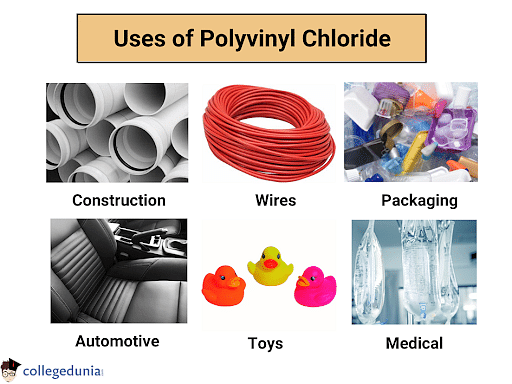
Uses of Polyvinyl Chloride
Read More: Uses of Polyester
Things to Remember
- Polyvinyl Chloride is a highly dense and durable thermoplastic polymer.
- Polyvinyl chloride is the third most widely used plastic in the world.
- Polyvinyl Chloride was first prepared by Eugen Baumann in 1872.
- It has high tensile strength and resists deformation as compared to other plastics.
- Resin is the main component in the production of PVC.
- The two types of polymerization used to prepare polyvinyl Chloride are Suspension PVC and Emulsion PVC.
- PVC has a wide range of applications in the field of electrical wiring, construction, electronics, automobiles, medical packaging, etc.
Previous Years’ Questions
- PVC is an example of… (JIPMER 2013)
- The product of the addition polymerization reaction is… (KCET 1993)
- Which polymer is used in the manufacture of paints and lacquers… (JEE Main 2015)
- Which of the following statements is false… (JEE Main 2018)
- Polymer of sucrose is… (MGIMS Wardha 2011)
- Bakelite is a product of the reaction between… (NEET 1992)
- Polystyrene is an example of…
- Freon used as refrigerant is… (AIIMS 2012)
- Polymer formation from monomers starts by… (AIEEE 2005)
- Terylene is a condensation polymer of ethylene glycol… (NEET 1999)
Sample Questions
Ques. What is PVC? (3 Marks)
Ans. PVC, also known as polyvinyl chloride, is a polymer of monomer vinyl chloride. Polyvinyl Chloride is the third most widely used thermoplastic polymer in the world polyethylene and polypropylene. It has a wide range of uses in the building industry. It has a relatively high glass transition temperature because of the large size of its molecules and its polar carbon-chlorine bond.
Ques. Where is PVC used? (3 Marks)
Ans. Various industries, including construction, electronics, automobiles, and medicine use PVC. It is also used to make sewage pipes and other pipe applications where the usage of metal is prohibitively expensive or vulnerable to corrosion. It is used in the construction industry for electrical wire insulation or flooring in hospitals, schools, houses, and other sectors where a hygienic atmosphere is necessary.
Ques. What are plasticizers? (3 Marks)
Ans. Plasticizers are typically transparent, organic liquid substances that are added to PVC formulation to produce a flexible film and improve the product's ability to be processed and used. They are the most widely used additives in plastics. They increase the flow and thermoplasticity of a polymer by decreasing the viscosity of the polymer melt. Some of the common plasticizer chemistries include citrates, benzoates, ortho-phthalates, terephthalates, adipates, sebacates, and trimellitates.
Ques. What is UPVC? (2 Marks)
Ans. Unplasticized polyvinyl chloride, or UPVC for short, is also referred to as rigid PVC due to its stiffness and lack of plasticity. This material is quite safe because it doesn't contain phthalates or BPA. In fact, mouthguards and dental retainers are made of UPVC because they are reliable and secure.
Ques. Is PVC Toxic? (2 Marks)
Ans. Burning PVC can harm your health by releasing hydrogen chloride (HCl) gases. PVC-free electrical wire insulation is occasionally recommended when there is a high fire risk. Fumes may also be released when the substance is melting such as during prototyping and manufacturing processes like 3D printing, CNC machining, and injection molding.
Ques. How is PVC made? (3 Marks)
Ans. PVC is prepared by radical polymerization of vinyl chloride to produce material composed of an average of 10,000 to 24,000 monomer units. The techniques used to create polyvinyl chloride are
- Suspension-based Polymerization
- Emulsion-based Polymerization
- Bulk Polymerization
Ques. What are the disadvantages of Polyvinyl Chloride? (3 Marks)
Ans. When utilizing PVC, one must consider several disadvantages:
- The heat stability of polyvinyl chloride is extremely low.
- Due to this, during production, chemicals that stabilize the material at higher temperatures are often applied.
- When polyvinyl chloride melts or is burned, it releases poisonous gases.
Ques. What are the advantages of Polyvinyl Chloride? (3 Marks)
Ans. PVC offers a number of crucial advantages to various sectors, cementing its position as one of the most famous and commonly utilized plastics on the market. Its advantages are as follows:
- It is simple and easy to find reasonably priced polyvinyl chloride.
- PVC has outstanding tensile strength.
- It has excellent water and chemical resistance.
- PVC is the best plastic material in the market that optimizes all performance and safety requirements at the lowest cost.
Ques. What is the temperature at which vinyl chloride is produced when acetylene interacts with dry hydrogen chloride in a multi-tubular reactor filled with mercuric chloride catalyst and supported over activated carbon? (2 Marks)
Ans. The acetylene and dry hydrogen chloride combination are introduced to the multi-tube reactor, which is kept at 90-100 degrees Celsius. The reactor bed is supported by activated carbon, which is filled with mercuric chloride catalysts.
Ques. What is the Limiting Oxygen Index (LOI) of PVC? (2 Marks)
Ans. The Limiting Oxygen Index is the minimal concentration of oxygen required to support polymer burning. It is given as a percentage. PVC offers excellent flame retardancy. PVC has an LOI of 45% or higher, whereas air has 20% oxygen.
Ques. Which additive in PVC pipe leads to the contamination of potable water? (1 Mark)
Ans. Lead is added to PVC pipes to improve their stability and workability. It has been discovered that it leaches into drinkable water from the surface of PVC pipes, polluting it.
Ques. Is polyvinyl a plastic? (2 Marks)
Ans. Yes. Polyvinyl Chloride (PVC) is one of the most commonly and widely used thermoplastic polymers throughout the world PET and P.P. Polyvinyl Chloride is a naturally white and very brittle plastic before the additions of plasticizers.
Ques. Is PVC biodegradable? (2 Marks)
Ans. No, Polyvinyl Chloride is a non-biodegradable polymer that has a wide range of applications in industry and household. Thus, it is still in use in spite of being a threat to the environment due to its non-biodegradable nature.
Check-Out:



Comments