




BITSAT Physics syllabus 2027 has a total of 18 units from the Class 11th and 12th NCERT curriculum. BITS Pilani releases the BITSAT syllabus PDF on the official website after releasing the BITSAT notification.
- BITSAT Physics syllabus carries a total of 30 questions in the BITSAT question paper and carries a total of 90 marks.
- Important topics and chapters in BITSAT syllabus include Modern Physics, Electrostatics and Current Electricity, Wave Motion and Wave Optics, and Heat & Thermodynamics.
- Modern Physics carries a weightage of around 10-13%, and Electrostatics and Current Electricity carry around 10-12% weightage in BITSAT Physics question paper.
- Wave Motion and Wave Optics carry a weightage of around 10-11% in the BITSAT Physics syllabus.
- 9-10% weightage in BITSAT Physics syllabus is given to Wave Motion and Wave Optics and 10% weightage is given to Heat and Thermodynamics.
- 5-6% weightage is given to topics like Rotational Motion and Simple Harmonic Motion each.
- Topics like Units, Dimensions, & Errors, and Gravitation each carry a weightage of around 3-4%.
- To cover the BITSAT syllabus for Physics, you should consider books like NCERT Physics, H.C. Verma, Arihant Physics by D.C. Pandey, Problems in General Physics by I.E. Irodov, etc.
Related Articles:
Key Summary
- BITSAT syllabus 2027 for Physics is most likely to remain the same as last year BITSAT Physics syllabus.
- BITSAT Physics syllabus has 10 units from Class 11th and 8 units from Class 12th.
- Physics in BITSAT 2027 question paper carries a weightage of around 23% weightage.
- From BITSAT Physics syllabus, is given a weightage of 4 questions out of 12 bonus questions.
- BITSAT marking scheme for Physics is same as other sections in the BITSAT question paper.
BITSAT Physics Syllabus 2027 Overview
| Particulars | Details |
|---|---|
| Exam Name | BITSAT 2027 |
| Subject | Physics |
| Syllabus Basis | NCERT Class 11 and 12 for Physics |
| Number of Units | 18 |
| Number of Questions | 30 |
| Total Marks For the Subject | 90 |
| Marking Scheme | +3 (correct), −1 (incorrect), 0 (unattempted) |
| Changes in Syllabus | No Changes Reported |
BITSAT Physics Syllabus 2027: Units, Chapters and Topics
The BITSAT Physics syllabus covers 18 units from NCERT Class 11 and 12.
- Topics like Electrostatics, Current Electricity, Optics, and Modern Physics carry the highest weightage in BITSAT Physics.
- These four units account for roughly 40% of Physics questions in recent BITSAT sessions.
| Unit No. | Chapter | Sub-topics |
|---|---|---|
| 1 | Units & Measurement | Sub-topics of Units & Measurement – SI units; fundamental and derived units; dimensional analysis; errors in measurement; significant figures; least count of instruments. |
| 2 | Kinematics | Sub-topics of Kinematics - Scalars and vectors; projectile motion; relative velocity; uniform and non-uniform circular motion; equations of motion in one and two dimensions. |
| 3 | Newton’s Laws of Motion | Sub-topics of Newton’s Laws - Newton’s three laws; free body diagrams; static and kinetic friction; rolling friction; connected bodies; Atwood machine; banking of roads. |
| 4 | Impulse and Momentum | Sub-topics of Impulse & Momentum - Impulse-momentum theorem; conservation of linear momentum; elastic and inelastic collisions in 1D and 2D; coefficient of restitution; centre of mass motion. |
| 5 | Work and Energy | Sub-topics of Work & Energy - Work-energy theorem; kinetic and potential energy; conservative and non-conservative forces; conservation of mechanical energy; power; spring force. |
| 6 | Rotational Motion | Sub-topics of Rotational Motion - Angular displacement, velocity, and acceleration; torque; moment of inertia; theorems of parallel and perpendicular axes; angular momentum; rolling without slipping. |
| 7 | Gravitation | Sub-topics of Gravitation - Newton’s law of gravitation; gravitational field and potential; escape velocity; orbital velocity; geostationary satellites; Kepler’s three laws. |
| 8 | Mechanics of Solids and Fluids | Sub-topics of Solids & Fluids - Stress, strain, and elastic moduli; surface tension; viscosity; Bernoulli’s theorem; equation of continuity; Pascal’s law; Archimedes’ principle. |
| 9 | Oscillations | Sub-topics of Oscillations - Simple harmonic motion; time period; amplitude; energy in SHM; simple and compound pendulum; damped and forced oscillations; resonance. |
| 10 | Waves | Sub-topics of Waves - Wave speed; progressive and stationary waves; superposition principle; standing waves in strings and pipes; beats; Doppler effect. |
| 11 | Heat and Thermodynamics | Sub-topics of Heat & Thermodynamics - Thermal expansion; calorimetry; heat transfer (conduction, convection, radiation); ideal gas laws; first and second laws of thermodynamics; Carnot cycle; entropy; kinetic theory of gases. |
| 12 | Electrostatics | Sub-topics of Electrostatics - Coulomb’s law; electric field and potential; Gauss’s law and its applications; capacitance; energy stored in a capacitor; dielectrics; series and parallel combinations of capacitors. |
| 13 | Current Electricity | Sub-topics of Current Electricity - Ohm’s law; drift velocity; Kirchhoff’s laws; Wheatstone bridge; potentiometer; cells in series and parallel; electrical power and heating effect of current. |
| 14 | Magnetic Effect of Current | Sub-topics of Magnetic Effect of Current - Biot-Savart law; Ampere’s circuital law; force on a current-carrying conductor; torque on a current loop; moving charges in a magnetic field; galvanometer conversion. |
| 15 | Electromagnetic Induction | Sub-topics of Electromagnetic Induction - Faraday’s and Lenz’s laws; self and mutual inductance; AC circuits; LC oscillations; transformers; resonance in RLC circuits; power factor. |
| 16 | Optics | Sub-topics of Optics - Ray optics: reflection and refraction at plane and curved surfaces; total internal reflection; lenses and mirrors; optical instruments. Wave optics: Young’s double-slit experiment; diffraction at a single slit; polarisation. |
| 17 | Modern Physics | Sub-topics of Modern Physics - Photoelectric effect; de Broglie wavelength; Bohr’s atomic model; hydrogen spectral series; X-rays; radioactivity; nuclear reactions; fission and fusion; mass-energy equivalence. |
| 18 | Electronic Devices | Sub-topics of Electronic Devices - Energy bands in solids; p-n junction diode; Zener diode as voltage regulator; LED; photodiode; BJT transistors; logic gates (AND, OR, NOT, NAND, NOR); basic digital electronics. |
Also Check:
BITSAT Physics Syllabus 2027: Topic-Wise Weightage
BITSAT Physics topic-wise weightage has not been officially released by BITS Pilani; however, the authority has notified the subject's overall weightage.
“Lucky Jethani {IIT B}” on YouTube shared an analysis on BITSAT chapter-wise weightage for each section of the BITSAT syllabus 2027. You can watch the video below to check the BITSAT Physics chapter-wise weightage.
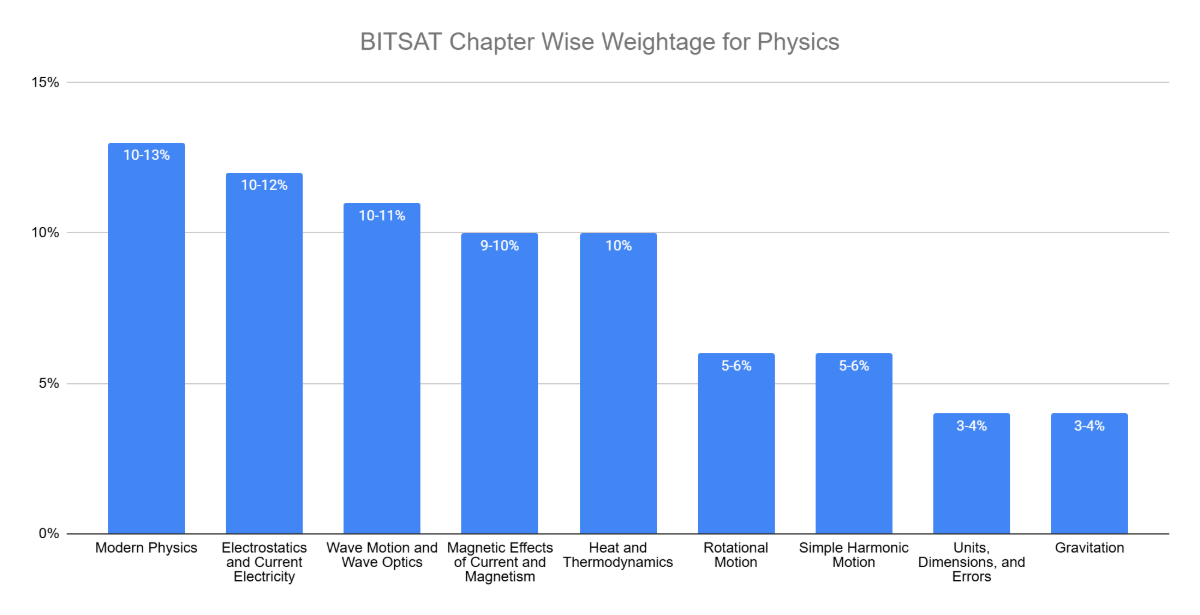
- High Weightage Topics: Topics with the highest weightage in BITSAT Physics include Modern Physics (10-13%), Electrostatics and Current Electricity (10-12%), Wave Motion and Wave Optics (10-11), and Heat and Thermodynamics (10%).
- Moderate Weightage Topics: Topics carrying moderate weightage in BITSAT Physics include Magnetic Effects of Current and Magnetism (9-10%), Rotational Motion (5-6%), Simple Harmonic Motion (5-6%).
- Low Weightage Topics: Topics in BITSAT Physics carrying low weightage include Units, Dimensions, & Errors (3-4%), and Gravitation (3-4%).
| BITSAT Chapters | Weightage (%/Questions) |
|---|---|
| Modern Physics | 10-13% |
| Electrostatics and Current Electricity | 10-12% |
| Wave Motion and Wave Optics | 10-11% |
| Heat and Thermodynamics | 10% |
| Magnetic Effects of Current and Magnetism | 9-10% |
| Rotational Motion | 5-6% |
| Simple Harmonic Motion | 5-6% |
| Units, Dimensions, and Errors | 3-4% |
| Gravitation | 3-4% |
Source: YouTube
Also Read:
BITSAT Physics Syllabus 2027: Important Books
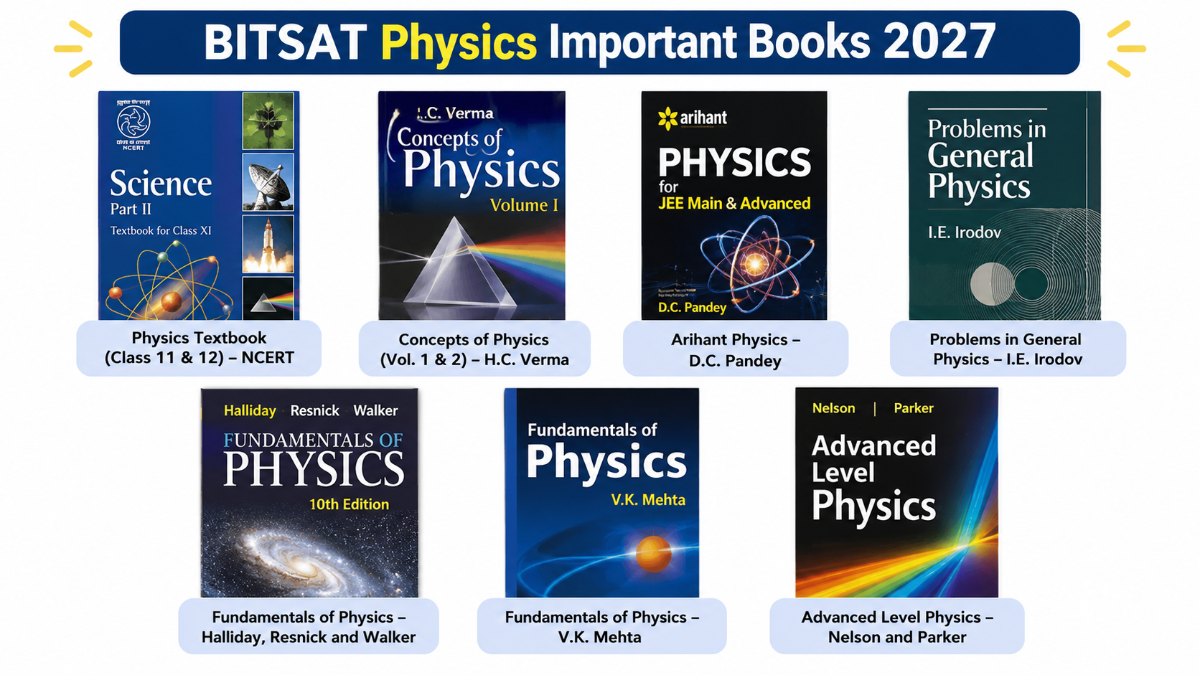
You can consider NCERT Class 11 and 12 Physics to cover the basic concepts of the BITSAT Physics syllabus. You can also consider books like Concepts of Physics by H.C. Verma, Arihant Physics by D.C. Pandey, Problems in General Physics by I.E. Irodov, etc. to cover the higher concepts of the BITSAT Physics syllabus.
| Book Name | Author/Publisher |
|---|---|
| Physics Textbook (Class 11 & 12) | NCERT |
| Concepts of Physics (Volume 1 & 2) | H.C. Verma |
| Arihant Physics | D.C. Pandey |
| Problems in General Physics | I.E. Irodov |
| Fundamentals of Physics | Halliday, Resnick and Walker |
| Fundamentals of Physics | V.K. Mehta |
| Advanced Level Physics | Nelson and Parker |
Read More:
BITSAT Physics Syllabus 2027: Paper Pattern
As per the exam pattern for BITSAT 2027, Physics carries a total of 30 questions for a total of 90 marks.
- For each correct answer, you will get +3 marks, and -1 mark for each incorrect answer.
- 4 bonus questions are asked from Physics if all 130 questions are answered and time is still remaining.
| Section | Questions | Marks | Duration |
|---|---|---|---|
| Physics | 30 | 90 | 3 Hours (no section-wise time limit) |
| Chemistry | 30 | 90 | |
| Mathematics / Biology | 40 | 120 | |
| English Proficiency | 10 | 30 | |
| Logical Reasoning | 20 | 60 | |
| Total (Main Paper) | 130 | 390 | |
| Bonus Questions (if all 130 attempted) | 12 | 36 |
Also Read:
How to Download BITSAT Physics Syllabus 2027
Follow these steps to download the official BITSAT syllabus from the BITS Pilani admissions portal. The syllabus is part of the Information Bulletin — there is no separate subject-wise PDF.
- Step 1: Visit the official admissions website at admissions.bits-pilani.ac.in.
- Step 2: Look for the "Information Bulletin" or "BITSAT 2027 Brochure" link on the homepage — it appears once BITS Pilani opens the 2027 application window.
- Step 3: Click the link — the bulletin opens as a PDF in a new browser tab.
- Step 4: Navigate to the Syllabus section in the PDF’s table of contents.
- Step 5: Press Ctrl + S (Windows) or Cmd + S (Mac) to save the PDF to your device.
- Step 6: Alternatively, click the download icon in your browser’s PDF viewer to save the file directly.
BITSAT Physics Syllabus 2027: Preparation Tips
- Prioritise high-weightage chapters: Focus on Current Electricity, Electrostatics, Modern Physics, Optics and Magnetism.
- Maintain a formula notebook: Record formulas, units, dimensional relations, and common numerical shortcuts chapter-wise.
- Practise numerical MCQs: Solve JEE Main PYQs and BITSAT-level questions to improve calculation speed.
- Focus on NCERT concepts: Revise definitions, graphs, experimental concepts, and fundamental laws.
- Practise time-bound questions: Aim to solve straightforward Physics MCQs within 1–1.5 minutes.
- Revise Modern Physics regularly: Cover Photoelectric Effect, Atoms, Nuclei and Semiconductor Electronics.
- Analyse mock-test errors: Separate conceptual mistakes, calculation errors, and questions taking excessive time.
- Avoid lengthy calculations: Learn approximation and option-elimination techniques wherever applicable.
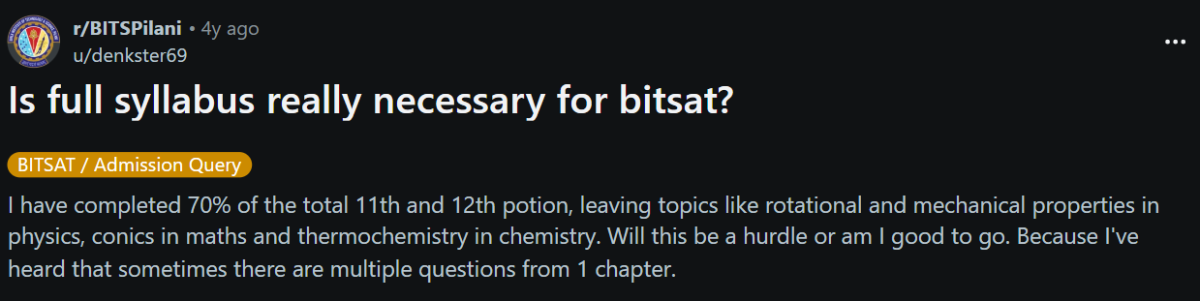
User in a Reddit post asked whether completing 70% of the Class 11 and 12 syllabus is enough for BITSAT or if leaving topics such as Rotational Motion, Mechanical Properties, Conic Sections and Thermochemistry could affect their score.
Completing only 70% of the syllabus is risky because BITSAT can test concepts from across the prescribed syllabus, and chapter-wise question distribution is not fixed. Prioritise the remaining topics by covering their basic concepts, formulas and standard MCQs rather than attempting advanced-level problems; do not skip entire chapters. Aim to reach at least 90% syllabus coverage before intensive mock practice, and use mock-test analysis to identify recurring weak chapters and revise them.
Source: Reddit
Also Read:
BITSAT Previous Years’ Question Papers
| BITSAT Exam Year | Question Paper with Solution PDF |
|---|---|
| BITSAT 2025 | Download PDF |
| BITSAT 2024 | Download PDF |
| BITSAT 2023 | Download PDF |
| BITSAT 2022 | Download PDF |
| BITSAT 2021 | Download PDF |
| BITSAT 2020 | Download PDF |
| BITSAT 2019 | Download PDF |
| BITSAT 2018 | Download PDF |
| BITSAT 2017 | Download PDF |
| BITSAT 2016 | Download PDF |
BITSAT Mock Tests
| BITSAT Section | Mock Test Link |
|---|---|
| Physics | Attempt Here |
| Chemistry | Attempt Here |
| Mathematics | Attempt Here |
| Biology | Attempt Here |
| English and LR | Attempt Here |
BITSAT Physics Syllabus 2027 FAQs
Ques. Is the BITSAT 2027 syllabus the same as the 2026 syllabus?
Ans. The official BITSAT 2027 syllabus has not been released yet as of October 2026. BITS Pilani has kept the syllabus consistent across recent cycles. Until the 2027 Information Bulletin is published in December 2026, prepare using the 2026 topic list — changes are unlikely.
Ques. Which subject has the highest weightage in BITSAT 2027?
Ans. Mathematics (or Biology for B.Pharm) has the highest weightage — 40 questions worth 120 marks out of 390 total. Physics and Chemistry each follow with 30 questions (90 marks). Logical Reasoning comes next with 20 questions (60 marks).
Ques. Is NCERT enough for BITSAT preparation?
Ans. NCERT forms the essential base for Physics, Chemistry, and Mathematics/Biology. You must complete all NCERT chapters thoroughly first. However, BITSAT also tests trickier numericals and application-based problems — reference books like H.C. Verma for Physics and Arihant Calculus for Mathematics are necessary after NCERT.
Ques. Where can I download the BITSAT 2027 official syllabus PDF?
Ans. The official syllabus is part of the BITSAT Information Bulletin, available at admissions.bits-pilani.ac.in. The 2027 brochure is expected in December 2026. Until then, use the 2026 Information Bulletin from the same portal as your preparation reference.
Ques. Which Physics chapters are most important for BITSAT?
Ans. Based on past BITSAT sessions, the most important Physics chapters are Electrostatics, Current Electricity, Optics, and Modern Physics. These four chapters contribute approximately 12–15 questions out of 30 in the Physics section.
Ques. Does BITSAT have a dedicated syllabus for English and Logical Reasoning?
Ans. Yes. BITSAT has separate sections for English Proficiency (Grammar, Vocabulary, Reading Comprehension, Composition — 10 questions, 30 marks) and Logical Reasoning (Verbal and Nonverbal — 20 questions, 60 marks). Both are part of the official Information Bulletin syllabus and together carry 90 marks.
Ques. How many units are in the BITSAT Physics syllabus?
Ans. The BITSAT Physics syllabus has 18 units, covering topics from NCERT Class 11 and 12. These range from Kinematics and Newton’s Laws (Class 11) to Modern Physics and Electronic Devices (Class 12).
Ques. Can B.Pharm aspirants appear in BITSAT 2027?
Ans. Yes. Students applying for the B.Pharm programme at BITS Pilani must attempt the Biology section instead of Mathematics. The Biology section covers 10 units from NCERT Class 11 and 12 and carries 40 questions (120 marks). Students applying for B.E. programmes must select Mathematics.
Ques. What is the total marks in BITSAT 2027?
Ans. The main BITSAT paper has 130 questions worth 390 marks. Students who attempt all 130 questions within the 3-hour window become eligible for 12 bonus questions (36 marks). The maximum possible score is therefore 426 marks.
Ques. What books should I follow for Mathematics in BITSAT?
Ans. Start with NCERT Class 11 and 12 Mathematics. Then use R.D. Sharma for comprehensive topic practice and Arihant’s Differential Calculus and Integral Calculus books for the two highest-scoring chapters. Solve at least five full-length BITSAT mock papers to get comfortable with the question pace.
Ques. Is Modern Physics included in the BITSAT 2027 syllabus?
Ans. Yes. Modern Physics is Unit 17 of the BITSAT Physics syllabus. It covers the photoelectric effect, de Broglie wavelength, Bohr’s atomic model, X-rays, radioactivity, and nuclear reactions. It typically contributes 2–3 questions in the Physics section.
Ques. How should I cover the full BITSAT 2027 syllabus in six months?
Ans. Divide six months into three phases. In months one and two, cover NCERT thoroughly for all three science subjects. In months three and four, move to reference books for Physics, Chemistry, and Mathematics while starting daily English and LR practice (30 minutes daily). In months five and six, shift to full-length mock tests and targeted revision of weak chapters. Aim for at least 20 full-length mocks before exam day.



Comments