


Calculate the average atomic mass of the bromine atom.

Collegedunia Team logo

Collegedunia Team

Content Curator

The average atomic mass of an element is the weighted average of the masses of its isotopes, taking into account their natural abundances. To calculate the average atomic mass of bromine, we need to determine the masses of its isotopes and their relative abundances.

The two isotopes of bromine are Br-79 and Br-81. The mass of Br-79 is 78.918 amu, while the mass of Br-81 is 80.916 amu. The natural abundance of Br-79 is 50.69%, while the natural abundance of Br-81 is 49.31%.
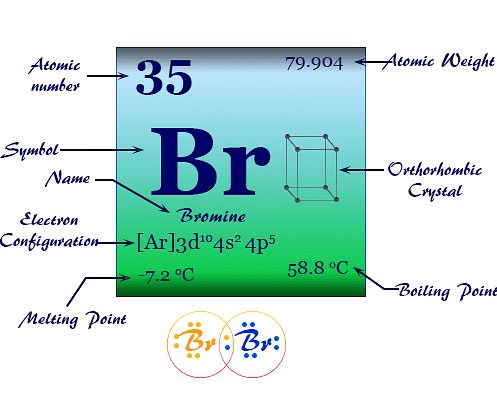
Bromine Atomic Mass

Bromine Atomic Mass

To calculate the average atomic mass of bromine, we multiply the mass of each isotope by its natural abundance, and then add the results:

(mass of Br-79) x (natural abundance of Br-79) + (mass of Br-81) x (natural abundance of Br-81)

= (78.918 amu) x (0.5069) + (80.916 amu) x (0.4931) = 39.9129 amu + 39.9253 amu

= 79.8382 amu

Therefore, the average atomic mass of bromine is 79.8382 amu.

Check out:

CBSE CLASS XII Related Questions

  • 1.
    Draw the structure of 'X' in the following reaction:


      • 2.
        Write the name of basic building units of proteins and nucleic acids. How can you differentiate between Fibrous and Globular proteins on the basis of their structures ?


          • 3.

            Explain the Finkelstein reaction.


              • 4.

                (i) A first order reaction is 20% complete in 10 minutes. Calculate the time taken when 80% of the reaction will be completed.

                [Given : log 5 = 0.7, log 4 = 0.6]

                (ii) For a chemical reaction \( \mathrm{R \rightarrow P} \), variation in \( \ln[\mathrm{R}] \) vs. time (t) graph is given below :

                (I) Predict the order of the reaction.

                (II) Write the slope of the curve.


                  • 5.

                    (i) Why do Zr and Hf exhibit similar properties ?

                    (ii) "\( E^\circ \) for \( \mathrm{Mn^{3+}/Mn^{2+}} \) couple is more positive than that for \( \mathrm{Fe^{3+}/Fe^{2+}} \)." Justify the statement.

                    [Atomic number : Mn = 25, Fe = 26]


                      • 6.

                        A reaction \( \mathrm{A \rightarrow B} \) follows second order kinetics. How will the rate of reaction be affected if the concentration of (i) A is increased by three times, and (ii) A is reduced to half ?

                          CBSE CLASS XII Previous Year Papers

                          Comments


                          No Comments To Show
