



Content Curator
Conformers Conformations are different spatial configurations of atoms that emerge from constrained rotation around a single link. Conformational isomers and conformers are terms used to describe different conformations. Diverse conformations can occur in any molecule when one covalent bond unites two polyatomic groups, each of which has at least one atom that does not lie along the axis of the single connection in question. The simplest sort of molecule is hydrogen peroxide, which has two hydroxyl groups that can rotate around the axis of the oxygen-oxygen connection. The presence of more than one such single link in a molecule complicates situations without affecting the essence of the molecule. Propane (CH3CH2CH3) is an example of this type of molecule.
Also read: Precipitation Titration
Key Terms: Conformers, Conformations, electron distribution, molecular orbital, sigma molecular, isomers.
What is Conformation?
[Click Here for Sample Questions]
In alkanes, the electron distribution in the sigma molecular orbital is symmetrical around the C-C bond's internuclear axis. As a result, unfettered rotation around the C-C single bond is possible. Different spatial arrangements of carbon atoms in space are observed as a result of this rotation, which can transform into one another. Confirmation, conformer, or rotamer refers to a spatial configuration of carbon and hydrogen atoms that may be transformed into one another by rotating around a C-C single bond. Rotation around C-C single bonds allows alkanes to have an endless variety of conformations. However, due to repulsive interactions between the electron clouds of C-H bonds, this rotation is not free. Torsional strain is the name for this repulsive relationship.
Because of the process of attracting or repulsive forces that differ with the distances between different components of the structure, each visible conformation of a molecule represents a position of variable potential energy. If these forces were absent, all conformations would have the same energy, and rotation around the solitary bond would be fully free. If the forces are strong, the energy or stability of different conformations varies greatly: the molecule will normally occupy a steady-state (one with low energy) and will only change to another steady-state after absorbing enough energy to reach and pass through the uneven intervening conformation.
Read More: Oxoacids of Phosphorous
Conformational Isomers
[Click Here for Previous Year Questions]
Conformational isomers (conformers) or rotational isomers are distinct arrangements of atoms in a molecule that can be generated by rotating around a single carbon-carbon bond (rotamers). Alkanes and cycloalkanes, as well as their substituted derivatives, show this sort of isomerism.
It's important to note that rotation around a sigma bond isn't entirely free. It is hampered by an energy barrier ranging from 1 to 20 kJ in certain bonds. There is the possibility of weak repulsive interactions between nearby carbon atom bonds or electron pairs. Torsional strain is a term for this type of repulsive contact. Conformational isomers or conformers are the terms used to describe these various arrangements.
Read More:
| Concept Related to this Unit | ||
|---|---|---|
| Organic Solvent | Hydrogen Spectrum | Group 15 Elements |
| Coupling Reaction | Chemical Tranquilizers | Iodoform Test |
Difference Between Conformation and Configuration
[Click Here for Sample Questions]
The phrase conformation should not be confused with the term configuration, which refers to the spatial arrangements of atoms in a molecule that can only be changed by breaking and creating bonds, whereas the spatial arrangements in conformation can only be changed by rotating around a single bond.
Read More: Difference Between Galvanic Cell and Electrolytic Cell
Types of Conformational Isomers
[Click Here for Previous Year Questions]
- Eclipse Conformation
The carbon atoms are arranged in such a way that the hydrogen atoms are parallel to one another. It acts as a steric barrier between them. In the eclipsed conformation, the hydrogen atoms connected to the two carbon atoms are as near to each other as feasible. Because of the proximity of hydrogen atoms, it is said to be a little unstable.

- Staggered Conformation
The hydrogen atoms connected to the two carbon atoms are as far apart as possible in this configuration. The atoms in the staggered conformation are evenly spaced from one another, and these conformations are more stable and preferred than the eclipsed conformation. Because the hydrogen atoms are separated by a large distance, it is more stable. Between the electron clouds of C-H bonds, the distance generates the least repulsive force and the least energy.
Read More: What is depression in freezing point
Representation of Eclipsed and Staggered Conformation
[Click Here for Sample Questions]
- Sawhorse Projections
The link between carbon atoms is depicted as a long straight line in this projection. The front carbon atom is classified in the lower half of the line, whereas the rear carbon atom is classified in the higher part. Because each carbon atom in ethane is coupled to three hydrogen atoms, each carbon atom has three lines connecting it, each representing C-H bonds elevated at a 120° angle to each other.

- Newman Projections
The closer of the two carbon atoms in ethane is portrayed as a dot in this projection, while the rear carbon atom is shown as a circle. Three lines, either bulging out of the circle or branching from the dotted lines, depict the three hydrogen atoms associated with each carbon atom. These lines are at a 120° angle to each other and are raised.
Read More: Boiling Point Elevation

Conformational Isomers of Ethane
[Click Here for Previous Year Questions]
At room temperature, ethane, an organic molecule, is a colorless and odorless gas. There are seven sigma bonds and six carbon-hydrogen bonds in this molecule. Two carbons protrude at 120° angles from the six carbon-hydrogen linkages. The staggered conformation is the one with the lowest energy. All of the C-H bonds on the front carbon are positioned at 60° relative to the C-H bonds on the back carbon in this conformation. The space between bonds is likewise maximized, in addition to the 60° placement.
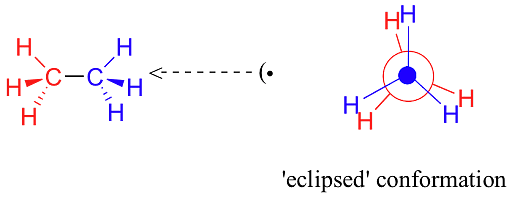
Conformational Isomers of Ethane
Furthermore, the molecules now have the maximum energy conformation of ethane, which is the 'eclipsed' conformation, after rotating the front CH3 group 60 degrees clockwise. The hydrogens on the front carbon are as close as feasible to the hydrogens on the back carbon in this configuration. When compared to the staggered conformation, the eclipsed conformation produces 3 kcal/mol more energy.
Read More: Rate of Reaction
Conformational Isomers of Butane
[Click Here for Sample Questions]
Butane is an alkane with C-C bonds. It differs from that of ethane in a few ways. Different conformational isomerism is achieved in butane when the molecule is rotated around the C-C bond axis. The methyl group connected to the two end carbon atoms gives butane two substituents. The methyl group has a larger surface area than hydrogen atoms. The gauche or staggered shape of butane is obtained by rotating the front methyl group by 60 degrees. The gauche becomes the eclipsed conformation of butane when the methyl group is rotated by 120 degrees.

Conformational Isomers of Butane
Read More: Energy level Diagram
Points To Remember
- One is more likely than the others among the various structural isomers of ethane that can be formed by rotation around the core carbon bond.
- In the Newmann projection, staggered groups with bonds enclosing dihedral angles of 60o do not cause as much interference.
- In the Newmann projection, eclipsed groups with bonds encompassing dihedral angles of 0o suffer from space overcrowding.
- Butane's spin around the C2-C3 bond. The two methyl groups are 180 degrees apart in the first staggered configuration.
- The butane molecule is now in a staggered configuration if we move the front (blue) carbon 60 degrees clockwise.
Read More:
Sample Questions
Ques. What is the Newman projection formula in stereochemistry? (2 marks)
Ans. The Newman projection aids in viewing a chemical bond's conformation from front to back. The front atom is shown by a line, whereas the back carbon is represented by a circle. The front carbon atom in the projection is referred to as proximal, while the back carbon atom is referred to as distal. The dihedral angle between the proximal and distal atoms is best represented using the Newman projection. In the case of ethane, the closer carbon atom can be represented as a dot, while the farther carbon atom can be shown as a circle.
Ques. Are conformers the same molecule? (2 marks)
Ans. The rotation of single bonds creates dynamic molecules. Rotation around the carbon-carbon bond, on the other hand, can lead to a variety of molecular conformations. Stereoisomerism is best illustrated by conformers. Identical compounds are the same chemical with all atoms in the same spatial orientation.
Ques. What is the meaning of chiral structure? (2 marks)
Ans. In chemistry, a molecule or ion is said to be chiral if it cannot be superimposed on its mirror counterpart by any combination of rotations and translations. The substance is considered to have point chirality when the center corresponds with an atom. In organic chiral compounds, a stereocenter is frequently an asymmetric carbon.
Ques. What are the types of structural isomers? (2 marks)
Ans. There are three forms of structural isomers: chain isomers, functional group isomers, and positional isomers. Chain isomers are molecules with the same molecular formula but distinct layouts or divisions. The functional group's isomers have the same formula but different functional groups.
Ques. What is the difference between conformational isomers and stereoisomers? (2 marks)
Ans. Constitution isomers are referred to as structural isomers in some texts. Stereoisomers are two molecules that have the same shape but have different stereochemistry. Because conformational isomers are temporarily different variations of the same molecule, they are not known as isomers.
Ques. What is conformation in stereochemistry? (2 marks)
Ans. The study of atom group configurations in a molecule, as well as the energy associated with these configurations, is known as conformational analysis. Conformations are the many shapes that atom groups assume as they rotate around distinct carbon-carbon axes. The range of conformations includes eclipsed, gauche, and anti.
Ques. What is Newman's projection formula? (2 marks)
Ans. A Newman projection, which is useful in alkane stereochemistry, visualizes the conformation of a chemical bond from front to back, with the front atom portrayed as a dot and the back carbon as a circle. This picture vividly demonstrates the unique dihedral angle between the proximal and distal atoms.
Ques. What is the Newman formula for projection? (2 marks)
Ans. A Newman projection depicts the conformation of a chemical bond from front to back, with a line representing the front atom and a circle indicating the back carbon. It is useful in alkane stereochemistry. The atom closest to the front is referred to as proximal, whereas the atom closest to the back is referred to as distal.
Ques. What is Diastereoisomerism? (2 marks)
Ans. Stereoisomers that can't be overlaid on top of one other and don't mirror reflections of each other are called diastereomers. Stereoisomers containing two or three stereocenters are known as diastereomers. Stereoisomers that are not connected with artefacts and mirror images that are not enantiomers are referred to as diastereomers.
Ques. Why do diastereomers have different properties? (2 marks)
Ans. Stereoisomers that are not connected with artefacts and mirror images that are not enantiomers are referred to as diastereomers. The reactivity and physical characteristics of diastereomers can differ. They have a variety of melting points, as well as different densities and boiling points. They have two or more stereocenters.
Ques. Define an enantiomer? (2 marks)
Ans. Enantiomers are mirror reflections of each other in chiral compounds. In addition, the molecules cannot be superimposed on one another. This means that the molecules cannot be stacked on top of one another, and only one molecule can be supplied at a time. Chiral compounds having one or more stereo-centers can be enantiomers.
Ques. What is meant by Superimposable? (2 marks)
Ans. Superimposable (superposable): the ability to place one thing on top of another, usually so that both are visible. The ability for an object to be positioned over another object is frequently interchanged with the broader term superimposable, which implies that visibility is not limited.
Do Check Out:



Comments