



Content Curator
Cotangent formula is a trigonometric function that represents the reciprocal of the tangent of an angle. It is expressed as the ratio of the length of the adjacent side to the length of the opposite side in a right triangle for a given angle. In mathematics, the formula of cotangent of an angle θ (in radians) can be represented as:
| cot(θ) = adjacent side/opposite side = 1/tan(θ) |
- One of the six trigonometric expressions is cotangent. It is also called by the name "cot."
- The cotangent formula, like some other trigonometric ratios, is determined as the percentage of the edges of a right-angled triangle.
- The base and perpendicular ratio of a right-angled triangular is equal to the cot x formula.
- The cotangent is the tangent's reciprocal trigonometric proportion.
- It is the equal or exponential inverse of the tangent, with tan cot = 1 being the proportional or multiplicative inverse.
Read Also: Inverse tan
| Table of Content |
Key terms: Cotangent formula, Angle, Triangle, Right-Triangle, Real Numbers, Function, Trigonometry, Trigonometric Ratio, Trigonometry Table, Cosec, Secant, Sine, Tan
What is Cotangent?
[Click Here for Sample Questions]
Cotangent is one of the most fundamental trigonometric ratios. This is one of the reciprocal arrangement trigonometric ratios, along with cosec, sec, and cot. It's commonly written as "cot x," where x represents the angle between a right-angled triangle's base and hypotenuse.
Cotangent is also known as cotan and cotangent x. The proportion of the corresponding point (the side next to the angle) to the opposing side is the cotangent of an angular position in a right triangle (the side opposite to the angular).
It is used in trigonometry to solve for unknown side lengths or angles in a right triangle and has several properties, including:
- cot(θ) = 1/tan(θ)
- cot(θ) = cot(π/2 – θ)
- cot(-θ) = – cot(θ)
- cot(θ + π) = – cot(θ)
The cotangent of an angle is a trigonometric function that represents the reciprocal of the tangent of the angle, or the ratio of the length of the adjacent side to the length of the opposite side in a right triangle for that angle. Mathematically, the formula for the cotangent of an angle θ (in radians) is given as:
| cot(θ) = adjacent side/opposite side |
where the adjacent side and opposite side are the lengths of the sides in a right triangle relative to the angle θ.
Below is the Cotangent table:
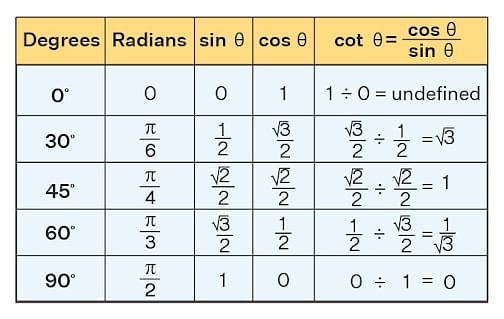
Cotangent Table
Cotangent Properties
[Click Here for Previous Year Questions]
The Properties of Cotangent Formula are:
- Reciprocal of a tangent: The cotangent of an angle θ is equal to the reciprocal of the tangent of θ. Mathematically, this can be expressed as: cot(θ) = 1/tan(θ)
- Symmetry: The cotangent of an angle θ is equal to the cotangent of π/2 – θ.
- Sign: The cotangent of an angle θ is negative for angles in the second and third quadrants, and positive for angles in the first and fourth quadrants.
- Periodicity: The cotangent of an angle θ is equal to the negative cotangent of θ + π.
Trigonometric Functions Detailed Video Explanation
Read More:
Cotangent Formula
[Click Here for Sample Questions]
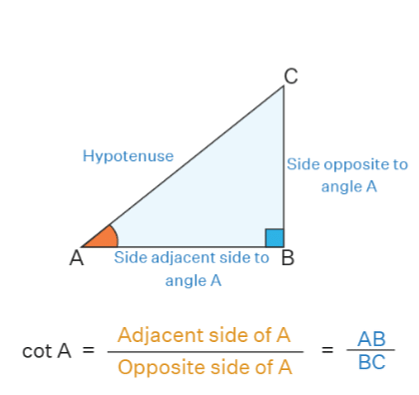
For an arc, the cotangent equation is: cot = (adjacent side) / (Opposite side).
Consider the right-angled triangle ABC, which is right-angled at B.
The part that is next to A is AB, while the one that is opposing A is BC.
Then the cotangent of A (also known as cot A) is,
(Adjoining side of A) / (Opposite side of A) = (AB) / cot A = (Adjacent side of A) / (BC).
Cotangent in Terms of Tan
The cotangent of an angle θ is the reciprocal of the tangent of θ, meaning that the two functions are inversely related. Mathematically, the relationship between cotangent and tangent can be expressed as:
cot(θ) = 1/tan(θ)
This means that if the value of the tangent of an angle is known, this formula can be used to find the cotangent of that angle, and vice versa.
For example, if the tangent of an angle θ is equal to 2, then the cotangent of that angle would be equal to 1/2. Similarly, if the cotangent of an angle θ is equal to 3, then the tangent of that angle would be equal to 1/3. The other formula to write cot in terms of tan is cot θ = tan (π/2 – θ) (or) tan(90° – θ).
Cotangent in Terms of Cosec
The cotangent of an angle θ is related to the cosecant of θ through the following formula:
cot(θ) = 1/tan(θ) = cosec(θ) / adjacent side = cosec(θ) / cos(θ)
Here, the adjacent side is referred to the side of a right triangle adjacent to the angle θ, and cosec(θ) refers to the reciprocal of the sine of θ .
If the value of the cosecant of an angle θ is known, then we can use the formula to find the cotangent of that angle, by dividing the cosecant by the cosine of the angle. Thus, the cot in terms of csc is, cot θ = √(csc2θ - 1)
This relationship between cotangent and cosecant can be useful in solving problems in trigonometry that involve either function and in understanding the properties of cotangent and its relationship to the other basic trigonometric functions.
Also Read: Sin Cos Formulas
Trigonometry Table
[Click Here for Previous Year Questions]
Trigonometry is among the most significant areas of mathematics that have a wide range of applications. The field of mathematics known as "trigonometry" studies the relationship between both the sides and degrees of a right-angle triangle.
As a result, using trigonometric equations, ratios, or identities, it is possible to find the necessary or missing angles or sides of a right triangle. The ratios in trigonometry can be expressed in degrees or radians. 0°, 30°, 45°, 60°, and 90° are amongst the most regularly utilized trigonometric angles in computations.
| Angles | 0° | 30° | 45° | 60° | 90° |
|---|---|---|---|---|---|
| Sinθ | 0 | ½ | 1/√2 | √3/2 | 1 |
| Cos θ | 1 | √3/2 | 1/√2 | ½ | 0 |
| Tanθ | 0 | 1/√3 | 1 | √3 | ∞ |
| Cosecθ | ∞ | 2 | √2 | 2/√3 | 1 |
| Secθ | 1 | 2/√3 | √2 | 2 | ∞ |
| Cotθ | ∞ | √3 | 1 | 1/√3 | 0 |
Cotangent Formula Functions
[Click Here for Sample Questions]
Many basic mathematical functions can be used to express the cotangent value. The cotangent function can alternatively be expressed as a proportion of the cosine and sine functions, both of which are special examples of the generalized hypergeometric, Bessel, Struve, and Mathieu functions. However, these depictions are ineffective.

Cotangent Formula Functions
It's easier to think of the cotangent function as a subset of a single special function. Whenever their second portion is equal to 0 or 1, double regular Jacobi elliptic forms deteriorate into the cotangent function.
Domain and Range of Cotangent
The domain of the cotangent function is all real numbers except for π/2 + kπ (where k is an integer) due to the fact that tangent function is undefined at these angles. This is because at angles of π/2 + kπ, the sides of the right triangle become vertical and the denominator of the tangent function becomes zero.
The range of the cotangent function is all real numbers. This is because the reciprocal of the tangent function can take any real value (positive, negative, or zero), except for those values for which the tangent function is undefined (i.e., π/2 + kπ).
So, the domain and range of the cotangent function are:
- Domain: all real numbers except for π/2 + kπ (where k is an integer)
- Range: all real numbers
Read Also: Cot Tan Formula
Derivative of Cotangent
Let y = cot x = (cos x) / (sin x). After applying the quotient rule,
y' = [ sin x d/dx(cos x) - cos x d/dx(sin x) ] / (sin x)2
= [ sin x (- sin x) - cos x (cos x) ] / sin2x
= [-sin2x - cos2x] / sin2x
= - [sin2x + cos2x] / sin2x
= -1/sin2x … [By using the trigonometric identity sin2x + cos2x = 1]
= -csc2x … [This is because sin x = 1/csc x and csc x = 1/sin x]
Hence, the derivative of cot x is -csc2x.
Graphical Representation of Cotangent Formula
[Click Here for Previous Year Questions]
Becaus the cotangent value is the reciprocal of the tangent value, when the tan role is 0, it goes to infinity, and vice versa.
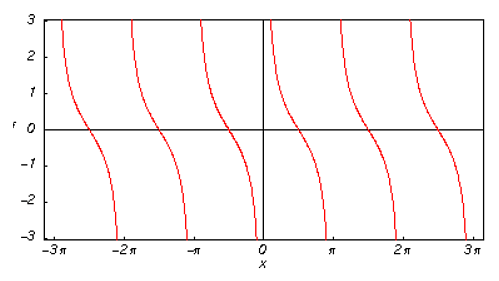
Graph of Cotangent Formula
Also Read: Inverse Trigonometric Functions
Cotangent on Unit Circle
The cotangent, like some of the other trigonometric factors, can be expressed as a line segment connected to the unit circle. The cotangent for a 45-degree angle of rotation is shown in the diagram. The cotangent is the line section AF (drawn in red), which is tangent to the circle at point A. The PF line section is a continuation of the OP line segment.
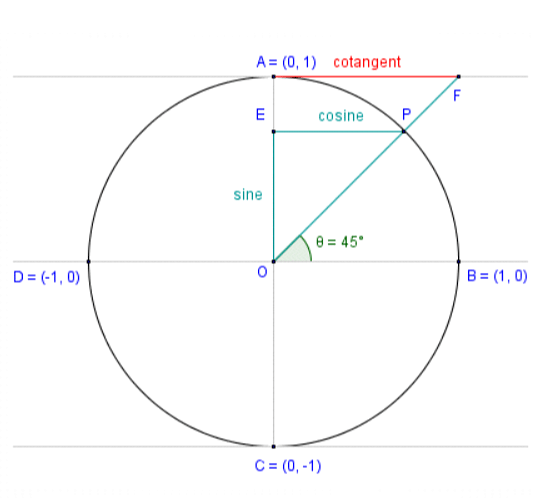
Cotangent on Unit Circle
For the Latest Updates on Upcoming Board Exams, Click Here: https://t.me/class_10_12_board_updates
Things to Remember
- A negative angle's cotangent is the inverse of a positive angle's cotangent. For any x in the domain, cot (-x) = -cot x. As a result, we can deduce that cotangent is a peculiar function.
- Because the cotangent value is not established for integer multiples, there are vertical asymptotes on the graph of cotangent at all multiples.
- The subset of all real numbers (R) minus n (where n Z) is the realm of cotangent.
- The cotangent function can produce in any real number, as we could see from the unit circle, and therefore its scope is the subset of all real numbers (R).
- Whenever the tangent value is zero, the cotangent value is unknown.
Also Read:
Previous Year Questions
- If cos x = |sin x| then, the general solution is...(KCET - 2019)
- If one side of a triangle is double the other and the...(KCET - 2009)
- If sin3θ = Sinθ , how many solutions...(KCET - 2007)
- If the angles of a triangle are in the ratio...(KCET 2006)
- In a triangle ABC, a[b cos C − c cos B]...(KCET - 2014)
- The number of solutions for the equation Sin 2x + Cos… (KCET - 2008)
- The number of solutions of the equation sin2x + 2sinx… (UPSEE - 2018)
- The value of sin10∘⋅sin30∘⋅sin50∘−sin70∘...(KCET - 2011)
Sample Questions
Ques. What is the domain & Range of the Cotangent formula? (3 Marks)
Ans. We understand that for integer multiples of, sin x equals zero, hence the cotangent function is indeterminate for all integer multiples of. As a result, for any number n, cot n is not given. As a result, the domain of cotangent is described as the collection of all real numbers (R) except n (where n equals Z). The cotangent operation can produce in any real number, as we can understand from unit circle, and thus its range is the set of all actual figures (R). Thus,
Apart from all integer multiples of, the range of cotangent is the range of real numbers.
The collection of all real numbers is the spectrum of cotangent.
Ques. Prove the equation: csc x / (tan x + cot x) = cos x. (3 Marks)
Ans. Therefore, we imply the formula of cotangent which is cot x = (cos x) / (sin x) and the equation of tangent which is tan x = (sin x)/ (cos x). Also, csc x = 1/sin x. Then we will find
LHS = csc x / (tan x + cot x)
= (1/sin x) / (sin x/cos x + cos x/sin x)
= (1/sin x) / [ (sin2x + cos2x)/sin x cos x ]
= (1/sin x) / (1/sin x cos x) --- [Because sin2x + cos2x = 1]
= (1/sin x) × (sin x cos x)/1
= cos x
= RHS
Hence, We have proof of the identity csc x / (tan x + cot x) = cos x.
Ques. Examine cot (x - π) + cot (2π - x) + cot x. (4 Marks)
Ans. We apply the following cotangent formulas to solve this.
cot (-x) = - cot x
cot (π - x) = - cot x
cot (2π - x) = - cot x
Then we get:
cot (x - π) + cot (2π - x) + cot x
= - cot (π - x) + cot (2π - x) + cot x
= - (-cot x) - cot x + cot x
= cot x
Hence, The answer iscot (x - π) + cot (2π - x) + cot x = cot x.
Ques. PR + QR = 25 cm and PQ = 5 cm in the triangle PQR, which is right-angled at Q. Calculate the sin, cos, and tan P values. (5 Marks)
Ans. Provided,
In the PQR triangle,
5 cm (PQ)
25 cm = PR + QR
Let's pretend that QR = x.
Then PR = 25 – QR = 25 – x is calculated.
By applying Pythagoras theorem:

PR2= PQ2+ QR2
Therefore, by substitution of the value of PR, PQ and QR, we get;
(25 – x)2= (5)2+ (x)2
252+ x2– 50x = 25 + x2
625 – 50x = 25
50x = 600
x = 12
So, QR = 12 cm
PR = 25 – QR = 25 – 12 = 13 cm
Hence,
sin P = QR/PR = 12/13
cos P = PQ/PR = 5/13
tan P = QR/PQ = 12/5
Ques. Evaluate the cotangent of x if sin x = 3/5 and cos x = -4/5 applying the cotangent formula. (2 Marks)
Ans. We are aware that cot x = (cos x) / (sin x)
= (-4/5) / (3/5)
= -4/3
Hence, cot x = -4/3.
Ques. The altitudeof a right-angled triangle is 9 units and the foundation of the triangle is 13 units. Find the base of Tanθ and Cotθ. (2 Marks)
Ans. The provided Altitude = 9 units and Base = 13 units.
Tanθ=Altitude/Base=913
Cotθ=Base/Altitude=139
Therefore, Tanθ = 9/13, Cotθ = 13/9
Ques. Evaluate the value of 2 cot(53°)/4 cot(127°). (2 Marks)
Ans. By applying trigonometric identities, we know, cot(53°) = -cot(180° - 53°) = -cot 127°.
⇒ cot(53°) = -cot(127°)
⇒ Value of 2 cot(53°)/4 cot(127°) = -2/4 = -1/2
Ques. A 60-foot pole was seen by a man. The pole cast a 20-foot-long shadow, as per his calculations. Using trigonometry, determine the sun's angle of altitude from the shadow's point. (3 Marks)
Ans. We will let x be the angle of elevation of the sun, then
tan x = 60/20 = 3
x = tan-1(3)
or x = 71.56 degrees
Therefore, The angle of elevated sun is 71.56º.
Ques. Find the value of (cos (18°) cosec (9°) sec (9°))/2. [Hint: Use cot 18° = 3.0777] (3 Marks)
Ans. By applying trigonometry formulas,
(cos (18°) cosec (9°) sec (9°))/2 = cos (18°)/(2 sin (9°) cos (9°))
Applying sin 2aformula,
2 sin (9°) cos (9°) = sin (2 × 9°) = sin 18°
⇒ cos (18°) / sin (18°) = cot 18°
⇒ (cos (18°) cosec (9°) sec (9°))/2 = 3.0777
Ques. Find the value of 5 cot(18°)/9 cot(162°). (2 marks)
Ans. By applying trigonometric identities, we will know, cot(18°) = -cot(180° - 18°) = -cot 162°.
⇒ cot(18°) = -cot(162°)
⇒ Value of 5 cot(18°)/9 cot(162°) = -5/9
Ques. What is the period of Cotangent formula and Cotangent on Unit Circle? (3 Marks)
Ans. Because the cotangent function is positives in the first and third quadrants (and the angles in the third quatrain are + the angles in the first quadrant), it can have a shorter time frame. As a result, the duration of cotangent is, i.e. cot ( + ) = cot We understand that every position on the unit circle offers the appropriate angle's cos and sin values. Since we have the cot x formula, we simply split the equivalent value of cos by the matching value of sin to determine the cotangent of the corresponding angle (sin x).
Check-Out:



Comments