



Education Content Expert
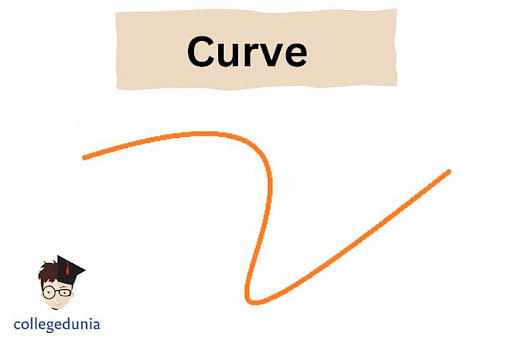
Curve is a line or shape that is smoothly drawn in a plane having a bent or turns in it. A curve is defined as a continuous and smooth flowing line without any sharp turns. A curve can be identified very easily. A line that bends and changes its direction at least once is classified as a curve. A circle and an ellipse are a few examples of curved shapes.
Geometry is a branch of Mathematics that deals with sizes, shapes, and the properties of figures. It is divided into two main types namely Plane or Two-Dimensional Geometry and Solid or Three-Dimensional Geometry. Two-dimensional geometry involves the study of 2D shapes like lines, curves, polygons, etc. Three-dimensional geometry involves the study of 3D shapes such as cubes, cuboids, spheres, cylinders, etc.
| Table of Content |
Key Terms: Curve, Closed Curve, Open Curve, Line, Circle, Curved Line, Simple Curve, Upward Curve, Geometry
Meaning of Curve
[Click Here for Sample Questions]
Curve is a smooth, gradually bending line. It is a form of a line that has some bent in it. A curve refers to the path traced by the continuous motion of a point that changes its direction at least once without any sharp turns. A curve may be an open curve or a closed curve.
- Two-dimensional curved shapes include Circles, Ellipses, Parabolas, Hyperbolas, Arcs, Sectors, and Segments.
- Three-dimensional curved shapes include Spheres, Cylinders, and Cones.
Curve
Read More:
| Related Topics | ||
|---|---|---|
| Straight Lines | Line Segment | Line of Symmetry |
| Perpendicular Line Formula | Point Slope Form Formula | Intersecting Lines and Non-intersecting Lines |
Types of Curves
[Click Here for Sample Questions]
Curves are categorized into different types. Curves can be two-dimensional such as parabolas, circles, hyperbolas, ellipses, sectors, etc, or can be three-dimensional such as cones, spheres, and cylinders.
Simple Curve
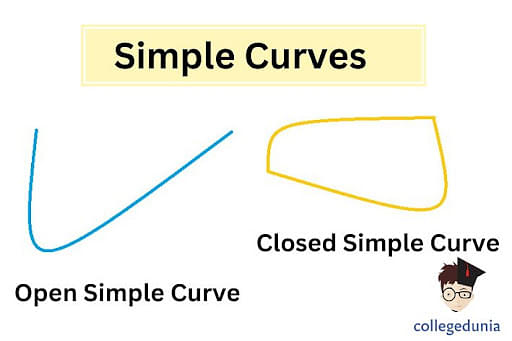
A curve that changes its direction but does not connect itself is known as a simple curve. A simple curve changes its direction but does not intersect or criss-cross itself while changing direction. It can be open as well as closed.
Simple Curve
Non-Simple Curve
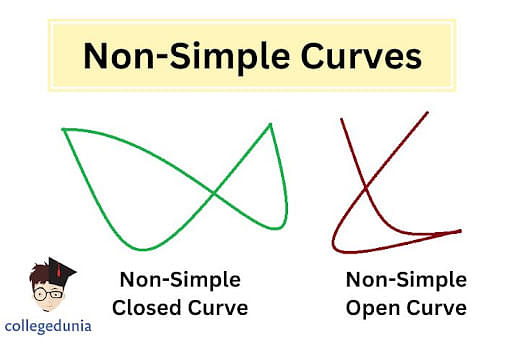
A curve that crosses its path is called a non-simple curve. It means the curve that intersects itself while changing its direction is a non-simple curve.
Non-Simple Curve
Open Curve
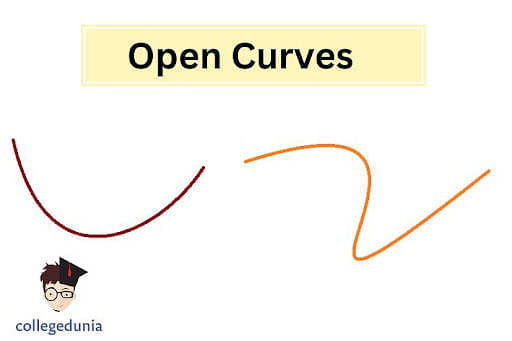
A curve that has two endpoints and does not enclose the area within itself is known as an open curve.
Open curve
Closed Curve
A curve that does not have any endpoints and encloses an area is known as a closed curve. A closed curve is formed by joining the starting and endpoints of an open curve together. Some examples of closed curves are circles, polygons, ellipses, etc.
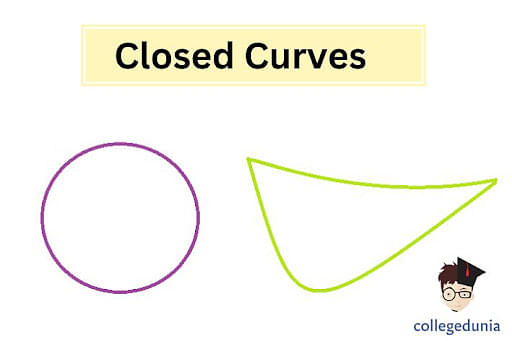
Closed curve
Upward Curve
A curve that points in the upward direction is referred to as an upward curve. An upward curve is also known as concave upward or convex downward curve.

Upward curve
Downward Curve
A curve that points in the downward direction is called a downward curve. A downward curve is also known as a concave downward or convex upward curve.

Downward curve
Curved Line
[Click Here for Sample Questions]
A curved line refers to a smooth and continuous line that is not straight and is bent. If the curvature is not zero, then it is considered a curve line.
Curved Line Images
There are several objects that are in the shape of a curved line. Examples of curved line images include railway tracks at the turning points, tracks of a roller coaster, paths of a road particularly for hill areas, and so on. Curve-shaped lines are also there in maths such as parabola, ogive curve, arrows, etc.

Curved Line Images
Area Between Curves
[Click Here for Sample Questions]
Area refers to the region occupied in the two-dimensional surface or a planar lamina. In order to find the area between the given two curves, the concept of integration is used. The area between the two curves is determined by calculating the difference between the integrals of two functions.
The area between the two curves is calculated using the formula:
\(A = \int_a^b (f(x) - g(x))dx\)Where f(x) refers to the curve with greater value.
Read More:
| Chapter-Related Topics | ||
|---|---|---|
| Cumulative Frequency Curve | Parabola Graph | Polygon Curve Angle |
| Tangents and Normal | Graphs | Application of Integrals |
Things to Remember
- A curve is defined as a line or surface that bends in a smooth, continuous way without sharp angles.
- A curve can be closed as well as open.
- There are several types of curves such as Simple Curve, Non-Simple Curve, Open Curve, Closed Curve, Upward Curve, and Downward Curve.
- Curves can be seen in several real-life situations such as a railway track, turns on roads, etc.
- The area between the two curves is calculated using .\(A = \int_a^b (f(x) - g(x))dx\)
Sample Questions
Ques. What is the major difference between a curve and a line? (3 Marks)
Ans. A curve is defined as a line having different shapes while a line has a straight shape. A straight line can be changed into a curve as per requirements. A straight line is a short line joining any two points and moving in one direction only. However, a curve is bent in shape and doesn’t move in a pre-defined direction. Curves can be bent in a sine wave or circle pattern as per the need.
Ques. What are the types of curves in Mathematics? (3 Marks)
Ans. The various types of curves in Mathematics are as follows:
- Simple Curve
- Non-Simple Curve
- Open Curve
- Closed Curve
- Upward Curve
- Downward Curve
Ques. Define Curve. (1 Mark)
Ans. A curve is defined as a shape or a line that is smoothly drawn in a plane having a bent or turns in it. A curve can be open as well as closed.
Ques. What are Algebraic and Transcendental Curves? (3 Marks)
Ans. Algebraic Curve is defined as a plane curve in which the set of points is situated on the Euclidean plane. It is represented in the form of a polynomial. The set of points for an algebraic curve does fulfill a polynomial equation.
A curve that doesn’t represent an algebraic form is called a transcendental curve. These curves can have an infinite number of intersecting points together with a straight line.
Ques. Is a straight line a curve? (2 Marks)
Ans. No. A straight line is not considered to be a curve. Neither a curve can be a straight line. A curved line consists of points that are not linear to two given points. Thus, a curve moves in other directions from the straight line which forms by joining collinear points.
Ques. Is a polygon a curve? (2 Marks)
Ans. Yes, a polygon is a type of simple closed curve. A polygon is a union of three or more line segments whose endpoints meet. The line segments are referred to as the sides of the polygon.
Ques. Explain the closed curve with the help of an example. (3 Marks)
Ans. A closed curve is defined as a curve in which the starting point and ending point meet each other. Such type of curve creates a path that may start from any point and conclude at the same point. A closed curve doesn’t necessarily have to appear like a curve. For instance, a square is a form of a closed curve with no endpoints that stays on a flat surface.
Ques. What does a curve mean in Maths? (2 Marks)
Ans. In Mathematics, a curve can be defined as the constant movement of points in all directions. Thus, it means that each and every possible shape can be classified as a curve as all the shapes are formed by the movement of the points in one or multi-dimension.
Ques. What are the components of a closed curve or figure? (3 Marks)
Ans. There are three components of a closed curve or figure:
- The point that lies inside the closed curve is called the interior.
- The point that lies lying outside the closed curve is called the exterior.
- The point that lies on the curve constitutes the boundary.
Ques. Is a square considered a curve? (1 Mark)
Ans. Yes, a square is a curve. It is classified as a closed curve whose all endpoints are connected together.
Check-Out:



Comments