



Education Journalist | Study Abroad Lead
Transition elements or transition metals are present in d block in groups ranging from group IV to group X. They vary in their oxidation state. The oxidation state refers to the degree of oxidation, that is, the loss of electrons of an atom in a chemical compound. It can be positive, negative or zero. The d-subshells of transition elements are partially filled in the ground state and oxidation state differ variably. The presence of variable oxidation states is the characteristic feature of transition elements. The oxidation state ranges from group IV to group X and is the highest in the middle of the series, for Example-Manganese (Mn) and Rhenium (Re) and lowest at extreme ends, for Example- Zinc (Zn) and Cadmium (Cd). The lowest oxidation state means that elements have few electrons to share. It happens due to the presence of ligands that have a π-acceptor character with σ-bonding. Greater the oxidation state higher will be the stability of that element. Mn has high oxidation states in the oxides but not in halides.
| Table of Contents |
Key takeaways: Transition elements, d-block, oxidation state, Manganese, electronic configuration.
What are transition elements?
[Click Here for Sample Questions]
Transition elements are those elements that are present in the d-block. Their d-subshells are partially filled in the ground state and their oxidation state differs from each other by unity, for example- VII, VIII, VIV, VV. The characteristic feature of transition elements is that they have variable oxidation states. However, in non-transition elements, the oxidation state differs by two units.
What is the oxidation state?
[Click Here for Sample Questions]
The oxidation state refers to the degree of oxidation. This means the capacity of an atom to lose electrons in a chemical compound. It can be positive, negative or zero. It differs variably and is the characteristic feature of transition elements. It ranges from group IV to group X. The oxidation state is the highest in the middle or near it of the series.
Some of the oxidation states of transition elements are given as follows:
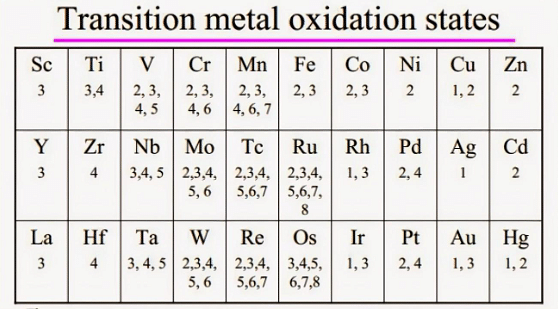
Oxidation state of transition metals or elements
Oxidation state of transition elements
[Click Here for Sample Questions]
Oxidation state means the ability of an element to lose electrons. The oxidation state of few elements are as tabulated below-
| Element | Outer electronic configuration | Oxidation states |
|---|---|---|
| Zn | 3d104s2 | +2 |
| Ni | 3d84s2 | +2, +3, +4 |
| Fe | 3d64s | +2, +3, +4, +5, +6 |
| Mn | 3d54s2 | +2, +3, +4, +5, +6, +7 |
| Sc | 3d14s2 | +2, +3 |
Oxidation state of transition elements can be depicted from table given above. For example- the oxidation state of Fe ranges from +2 to +7. In + 2 oxidation state, it loses 2 electrons from the 4s subshell. However, in the +3 oxidation state, it loses 3 electrons, two from the 4s subshell and one from the d subshell. Among all, +2 (ferrous) and +3 (ferric) are more common. Similarly, scandium shows a +2 oxidation state by losing both of its 4s- electrons. However, it also shows a +3 oxidation state, by losing 2 s- electrons and 1 d- electron.
Variable state of oxidation elements
[Click Here for Sample Questions]
Manganese (Mn) and Rhenium (Re) are present in the middle of the series and have oxidation states ranging from +2 to +7. Similarly, in Technetium (Tc), the oxidation state ranges from +2 to +8. However, it is clearly visible that the elements present at extreme ends oxidation state have a smaller number of oxidation states. For example, in extreme right there is Zinc (Zn) and Cadmium (Cd), both have only one oxidation state, that is 2. In the extreme left, there is Scandium (Sc), Yttrium (Y) and Lanthanum, all having only one oxidation state, that is 3. This means they have few electrons to share. The low oxidation state is due to the presence of ligands that are capable of π-acceptor character in addition to the σ-bond. For example, in Ni(CO)4 and Fe(CO)5, the oxidation state of nickel and iron is zero. The bonds are ionic in the case of +2 and +3 oxidation states. The molecules with a higher oxidation state have covalent bonds.
Stability of oxidation states
[Click Here for Sample Questions]
The electronic configuration of elements is the basis of the stability of their oxidation state. The higher the stability, the greater will be the oxidation state. In group 6, Mo(VI) and W(VI) are more stable than Cr(VI). This is because Cr(VI) act as a strong oxidising agent in form of dichromate in an acidic medium, whereas MoO3 and WO3 are not. Mn exhibits high oxidation states in the oxides but not in halides. For example- Mn in Mn2O7 has a +7 oxidation state which is higher as compared to Mn fluorides, MnF4. However, other elements such as Fe2O3 exhibit +3 oxidation states and V2O4 has a +4 oxidation state. However, in the case of halides, Mn doesn’t exhibit a +7 oxidation state, however, MnO3F is known.
Things to Remember
- Transition elements are present in the d block and their d subshells are partly filled in the ground state. For example- Sc, Fe, Os etc.
- The elements like Zn, Cd and Hg are exceptions and known as non-transition elements as their orbitals are completely filled in their ground state as well as in their general oxidation state.
- The oxidation state is the ability of an atom in a chemical compound to lose electrons from its valence shell, also known as the degree of oxidation.
- The bonds are ionic in the case of +2 and +3 oxidation states. The molecules with a higher oxidation state have covalent bonds.
- Greater the oxidation state higher will be the stability of that element. Mo(VI) and W(VI) are more stable than Cr(VI). This is because Cr(VI) act as a strong oxidising agent in form of dichromate in an acidic medium, whereas MoO3 and WO3 are not.
Sample Questions
Ques. Mo(VI) and W(VI) are more stable than Cr(VI). Give reason. [3 Marks]
Ans. The stability of an element depends upon the oxidation state. This means, greater the oxidation state, greater will be the stability. The electronic configuration of elements is the basis of the stability of their oxidation state. The compound will form covalent bonds. As we move down the group, Mo and W are bigger than Cr. This makes the Mo and W more stable than Cr (VI). In the form of dichromate, Cr(VI) is a strong oxidising agent in acidic medium but Mo(VI) in Mo(3) and W(VI) in W(3) are not as they are already stable.
Ques. What are non-transition elements? [3 Marks]
Ans. The non-transition elements are s and p block elements.They include alkali metals like sodium (Na), Potassium (K) etc, Chalcogens like Oxygen (O), Sulphur (S) etc., alkaline earth metals like magnesium(Mg), Strontium (Sr) etc. and Halogens like Chlorine (Cl), Bromine(Br) etc. Their d orbitals are fully filled as contrast to transition elements that have partially filled d-orbitals. However, there are some elements that are considered as non-transition elements and they are present in the transition element group. They include Zn, Cd and Hg. They are known as non-transition elements as their orbitals are completely filled in their ground state as well as in their general oxidation state. Therefore, these elements are not transition elements.
Ques. Why transition elements are of different colours? [3 Marks]
Ans. Transition elements are of different colours as their electrons have the tendency to absorb the radiation of different wavelengths. For example-When a light in form of light waves falls on an atom, the electron gets excited, and it jumps from lower energy d orbital to higher energy d orbital (d-d transition). The frequency of light absorbed depends on the behaviour of the ligand. For example- if green light falls on an atom and if electrons jump from thedyzorbital to thedz2orbital, then the compound will reflect all the colours except green. Thus, the compound will appear green.
Ques. What are inner transition elements? [3 Marks]
Ans. The inner transition elements are f-block elements. Their 4f and 5f orbitals are filled and their series are known as lanthanoids. Their third last shell is filled with electrons. They form coloured ions and show varied valences. They are radioactive and synthetic beyond atomic number 92 up to 103. They are not found in nature in the earth’s crust. They are found in two series- 4f series known as lanthanoids and 5f series known as actinoids. The Th, U and Pa provide nuclear energy. Their outer shell electronic configuration and energies are similar and thus give oxidation state +3. This also results in their similar properties like the same size, similar outer shell electronic configuration etc.
Ques. What is the oxidation state? [3 Marks]
Ans. The oxidation state of an atom in a chemical compound represents the number of electrons lost by it. It is also known as oxidation of the atom. It is the hypothetical charge bear by an atom when it’s all its bonds are completely ionic in nature. The oxidation state is either zero, positive, or negative. For example, the oxidation state of Fe ranges from +2 to +7. It loses 2 electrons from 4s subshell for + 2 oxidation state. Similarly, it loses 3 electrons, two from 4s subshell and one from d subshell from 4s subshell for + 3 oxidation state. The +2 (ferrous) and +3 (ferric) are more common among all oxidation states. Similarly, scandium shows a +2 oxidation state by losing both of its 4s- electrons. However, it also shows a +3 oxidation state, by losing 2 s- electrons and 1 d- electron.
Ques. What is meant by lowest and highest Oxidation States? [3 Marks]
Ans. The oxidation state of an atom in a chemical compound represents the number of electrons lost by it. The oxidation state can be highest or lowest. The lowest oxidation means the least amount of electrons lost by an element in order to increase its oxidation number. Similarly, the highest oxidation means the maximum number of electrons lost by an element in order to decrease its oxidation number. For example- The lowest oxidation state of N is -3 in NH3. Whereas its highest oxidation number is +5 in NO3-.
Ques. All transition metals are d-block elements, but all d-block elements are not transition elements. Justify. [3 Marks]
Ans. Transition elements are d block elements and have partially and progressively filled d orbitals. For example- Mn, Cr, Fe and Co etc. However, all d- block elements that do not have partially filled d- orbitals are not considered as transition elements. For example, Zn, Cd and Hg. These elements are exceptions. Thus, all transition elements are d-block elements, but all d-block elements are not transition elements. So such elements are exceptional.
Ques. Why Copper (I) ion is not known in an aqueous solution? [3 Marks]
Ans. The Copper (I) ion is not known in an aqueous solution as it undergoes disproportionation in an aqueous solution. The equation is given below.
2Cu+ → Cu2+ + Cu
In above reaction, Cu2+(aq) is more stable than Cu+(aq) because Δhyd(hydration enthalpy) for Cu2+(aq) is much more negative than that for Cu+(aq).
Read Also:



Comments