



Education Journalist | Study Abroad Lead
Titration is a chemical analysis used to determine the concentration of one solution by using the titration formula. It is an analytical technique that uses a known concentration (Titrate) to determine the concentration of an unknown substance. A solution whose concentration has already been identified is referred to as a frozen solution. The purpose of titration is to identify the pH of a chemical substance.
| Table of Contents |
Read More: Physical properties of Aldehydes, Ketones and Carboxylic acids
Key Takeaways: Quantitative Analysis, Ions, Concentration, Neutralisation, Volume, Stoichiometric equation, Titration, Acid, Base, Solution
Titration
[Click Here for Sample Questions]
Titration is a quantitative analysis in nature. It is used to determine the concentration of an unknown solution using the titration formula. Using this method, the acid/ base of a known concentration can neutralise the acid/ base of the unknown concentration.
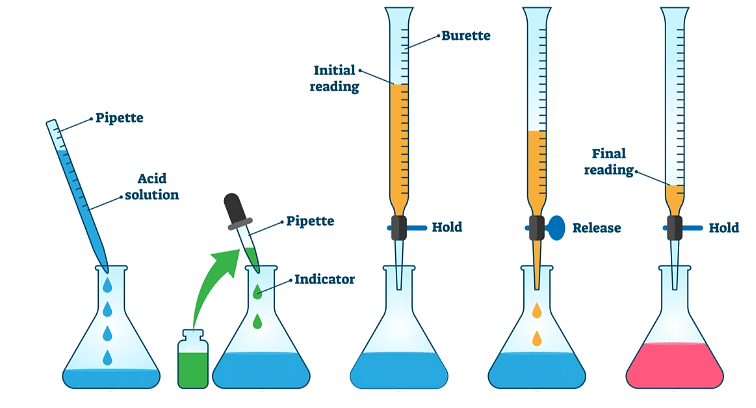
Titration Process
During neutralisation, a hydrogen ion from acid and a hydroxide ion from the base are combined to form water. The uniformity of the pH must be maintained throughout the process. The titrate should be equal to the analyte concentration. To achieve this, the analyte should be dilute or strong. Titrate is the solution of known concentration and analyte is the solution whose concentration needs to be identified.
Also Read:
Process of Titration
[Click Here for Sample Questions]
First, the analyte should be measured and filled in a beaker. Add a few drops of acid base indicator like phenolphthalein or methyl orange to the analyte. Phenolphthalein turns pink in the presence of a base but remains colourless in acid. Methyl orange turns dark red in acid and turns into yellow in base.
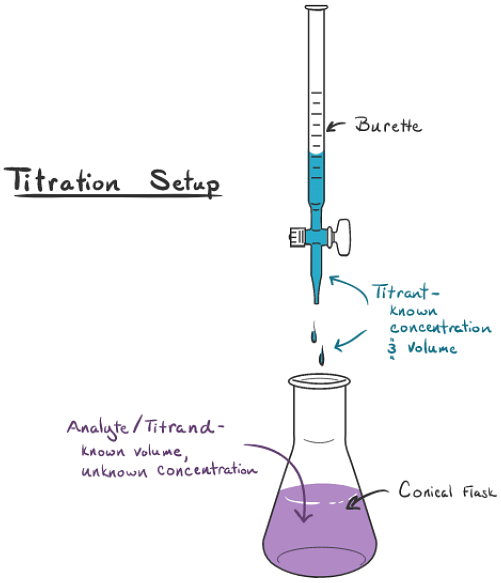
Titration Setup
To start the process, take a standard solution in a burette. Drip it slowly into the beaker containing the analyte. Continue the process until the colour of the analyte changes. This finally confirms that the base/ acid in the analyte has been successfully neutralised by the titrate. Note the volume change of the standard solution at which the end point occurred. That volume indicates how much titrant is used to neutralise the analyte.
Titration Formula
[Click Here for Sample Questions]
Titration uses a standard formula in order to determine the unknown concentration. The titration formula which is generally being used is as follows:
Volume of titrate x molarity of titrant = volume of analyte x molarity of analyte
→ MA VA = MB VB
- MA → Molarity of titrate (H+)
- VA → Volume of titrate
- MB → Molarity of analyte (OH-)
- VB → Volume of analyte
Types of Titration
[Click Here for Sample Questions]
Titration works well when the conditions like emergence of reaction happens quickly. It is necessary to use a catalyst in order to bring rapid reaction. So that the reaction will be simple and the stoichiometric equation will be clear. Knowing the four types of titration will help to learn the titration formula.
Acid-Base Titration
Acid-Base titration is made based on the acid-base reaction. This is a quantitative analysis method. This type of titration is also used to calculate the concentration of acid by titrating an alkaline solution whose concentration is known and vice versa. There are two acid-base titration formulas namely monovalent acid-base and polyvalent acid-base titration.
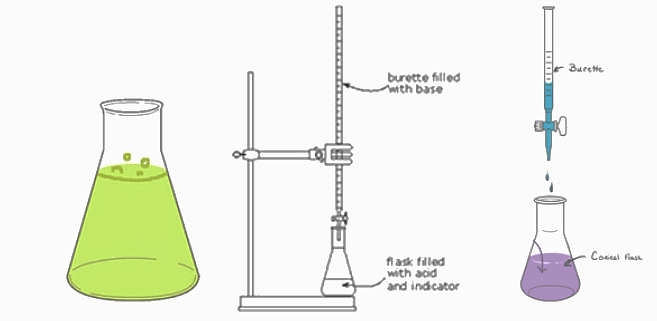
Acid Base Titration
Complexation Titration
This titration uses a complex ion formation reaction. The analysis of metal content in simple solutions can be analysed using complexation titration.
Argentometric Titration
Argentometric titration is used for precipitation reactions. This titration makes an insoluble precipitate when the two reacting substances are in contact. Argentometric titration has another three sub types namely Fajans method, volhard method, and Mohr method.
Redox Titration
Redox titration is a process where the electrons are transferred from oxidising agents to reducing agents. Oxidation is the releasing of electrons where reduction is the reaction to gain an electron. Based on the reagent, redox titration is further classified into three as follows.
Permanganate: MnO4- + 2H2O + 3e- → MnO2 (s) + 4HO-
Dichromate: K2Cr2O7(aq) + 3H2S(aq) + 4H2SO4(aq) → Cr2(SO4)3(aq) + 3S(s)\(\Box\)\(\Box\)↓ + K2SO4(aq) + 7H2O(l)
Iodimetric and Iodometric: I2+ 2e → 2I¯
Things to Remember
- Titration is a chemical technique used to determine the concentration of an unknown substance using a known concentration or titration formula.
- The generally used formula for titration is MA VA = MB VB.
- There are four different types of titrations namely redox titration, Argentometric titration, complexation titration, and acid-base titration.
- Titration is a quantitative method. In this method, the acid/ base of a known concentration can neutralise the acid/ base of the unknown concentration.
Also Read:
Sample Questions
Question: Define autotitrator? (2 marks)
Ans: These are the microprocessor-controlled equipment which allow the automation of all operations in the titration. They are data storage, recognition of the endpoint, signal acquisition, titrant addition, calculation, transfer of data, and results storage.
Question: What are the advantages of titration? (2 marks)
Ans: Titration is a well-known analytical technique. It is fast, accurate and precise. Through titration, a high degree of automation is possible. Titration can be made using low skilled and trained operators. Also, it does not require any specialised chemical knowledge.
Question: What is acid-base titration? (2 marks)
Ans: It is a quantitative chemical method or analysis used to determine the concentration of an unknown base/ acid solution using measured volumes of known acid/ base titrant which neutralises the analyte.
Question: What are the different types of chemical reactions used in titration? (2 marks)
Ans: The various reactions used in titration are redox reaction, precipitation reaction, acid-base reaction, complexometric reaction, colloidal precipitation reaction.
Question: Calculate the titratable acidity if 17.5ml of 0.085N is required to titrate a 15ml juice, the sum titratable acidity of the sample juice, articulated as the percentage of citric acid (The molecular weight = 192 and equivalent weight = 64) (3 marks)
Ans: Use the equation
% acid = \(\frac{N \times V \times Eq.wt}{W \times 1000} \times 100\)
The % of acid is 0.085 x 17.5 x 64/ 15 x 10 = 0.635%. The equivalent weight of anhydrous citric acid is used to calculate and report the results of titration.
Question: What is the titration curve? (3 marks)
Ans: These are the curves used to illustrate the quantitative progress of titration. These curves help for the rapid assessment of the method. There is a distinction between linear and logarithmic titration curves. The four different forms of titration curve are symmetric, asymmetric, segmented, and minimum/ maximum curve.
Question: How often do we need to standardise the titrant? (3 marks)
Ans: It is made on the basis of the stability and other factors causing the reduction in concentration. The common example of titrant protection is the storage of light sensitive titrants in dark. Some of the examples are the protection of Karl Fischer titration from moisture, iodine solutions, and the protection of some strong bases.
Question: What is titration? (3 marks)
Ans: It is a chemical technique used for the quantitative determination of a substance/ analyte dissolved in a sample. Titration is done based on chemical reactions between the reagent/ titrant and analyte.
Analyte + reagent/ titrant = reaction products.
A common example is chromium and sulphur.
K2Cr2O7(aq)+ 3H2S(aq)+ 4H2SO4(aq) → Cr2(SO4)3(aq) + 3S(s)||↓ + K2SO4(aq) + 7H2O(l)
Question: How to compute the molarity equation? (5 marks)
Ans: The quantity of substance concentration in a solution of an entity X (Symbol c(X)) is the quantity of substance n divided by the volume V of the solution.
The amount-of-substance concentration of a solution of an entity X (symbol c(X)) is the amount of substance n divided by the volume V of the solution.
N = Number of molecules present in the volume
V = Volume (In litres)
The ratio N/ V is the number concentration C
NA= Avogadro constant (6.02214 x 10²³ mol-1)
C= n/ v = N/ NAV = C/ NA
The usual units for analysis are mol/ L and mmol/ L.
For Latest Updates on Upcoming Board Exams, Click Here: https://t.me/class_10_12_board_updates
Check-Out:



Comments