



Content Curator
Adolescence and Puberty might seem like the same thing. But there is world of difference between the two. The distinction between adolescence and puberty is simple.
Adolescence is described as the time between the onset of puberty and the beginning of adulthood whereas puberty is described as the maturation of a child's physical and sexual features.
| Table of Content |
Keyterms: Adolescence, Puberty, pre-adolescent stages, gonadotropin-releasing hormone, FSH, LH, hormone
Read Also: Reaching the age of Adolescence
What Is Adolescence & Puberty?
[Click Here for Sample Questions]
Adolescence is the transitory period between childhood and maturity. It generally starts with the onset of puberty, although it can also start in the pre-adolescent stages (mostly 11-12 years of age.) It also causes substantial psychological and cognitive changes.

Adolescence- A transitory period
Puberty occurs when the brain begins to produce a hormone known as a gonadotropin-releasing hormone. This causes the pituitary gland to release a few additional hormones, including luteinizing hormone (LH) and follicle-stimulating hormone (FSH). LH and FSH work together to promote gonad production of sex hormones.
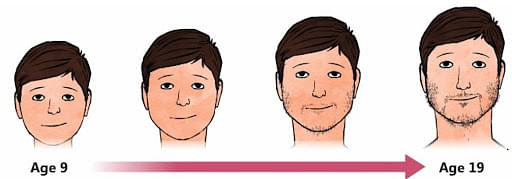
The majority of the other changes noticed throughout puberty are caused by these sex hormones. Puberty generally begins between the ages of 11 and 12 in males, and between the ages of 9 and 10 in girls.
Rapid bursts of development known as adolescent growth spurts begin to occur throughout this age. This is the time when children's height and weight rapidly rise, as well as a slew of other sex-specific changes. The brain's complexity grows as well, with the cerebral cortex being more tightly folded and unneeded connections being eliminated. The prefrontal cortex, which is important for decision making, impulse control, abstract thinking, and other functions, undergoes significant alterations.

Also Read:
Changes at Puberty
[Click Here for Sample Questions]
The following are the changes that occur during puberty.
Height Enlargement: When a child approaches puberty, his or her height suddenly increases. Long bones develop quickly, resulting in an increase in height. By the age of 18, a person has reached his or her maximum height.
Body Shape Alteration: Boys develop muscle mass. Their shoulders broaden and their waists shrink. The females' waists expand and their shoulders shrink.
Voice Alteration: The guys' voices become thick and harsh. This occurs as the voice box grows bigger. The females' voices are often high-pitched.

Sweat and Sebaceous Gland: During this period, sweat and sebaceous gland secretions rise, causing acne in many teens.
Sex Organ Development: The testes and penis grow in boys, and sperm production begins. In females, the ovaries expand and begin to release developed eggs which result in the process of menstruation.
Hair growth: During puberty, boys usually experience growth of hair on the face, chest, beneath the armpits and genital region whereas, in females, hair growth occurs beneath armpits and pubic areas.
These characteristics aid in differentiating between a man and a female.
Read Also: Rules for the Inheritance of Traits
Changes in Hormones
[Click Here for Sample Questions]
Hormones are chemical compounds released by the endocrine glands that help various organs operate properly. Hormones influence the changes that occur during adolescence.

- The testes begin to release testosterone in men. This causes the development of facial hair, pubic hair, chest hair, a deep voice, and so on.
- The hormone estrogen is produced by the ovaries in females, resulting in breast augmentation and menstruation. When a child reaches puberty, the mammary glands begin to grow.
Menstruation
During adolescence, the thicker uterine lining sheds along with the egg, resulting in menstruation, or menstrual bleeding. Every 28 to 30 days, the menstrual cycle occurs. Menarche is the first menstrual flow. Menopause occurs when the menstrual cycle ceases after the age of 50.

Reproductive Health
[Click Here for Sample Questions]
A teenager's reproductive health should be supported by a well-balanced diet that contains carbs, proteins, fats, vitamins, and minerals.
- For the production of RBCs, girls should consume a lot of iron-rich foods.
- Because of the increased activity of perspiration and sebaceous glands, teens must maintain adequate hygiene or there is a risk of developing a variety of skin diseases.
- During menstruation, girls should use extra caution with their cleanliness.
- Physical activity is essential for being fit and robust.
- Drugs should be avoided at this age since it is the age when one is most vulnerable to such unpleasant stimuli.
- Prevention is preferable to cure. HIV is transmitted by sexual contact or infected needles, and there is currently no treatment.
Also Read:
| Related Articles | ||
|---|---|---|
| Pleiotropy | Chromosomal Theory of Inheritance | |
| Chromosomes and Genes | Colour Blindness | |
| Biology MCQs | Human body | |
Things to Remember
- Adolescence is the period of a child's life when he or she achieves reproductive maturity. This is indicated by a variety of alterations in the body.
- Puberty refers to the process by which these changes occur. It starts at the age of 10 and lasts until the age of 19.
- Humans become capable of reproduction after puberty sets in.
- The onset of puberty brings about the growth of the reproductive organs. Hair grows at various places on the body. Breasts develop in girls and facial hair (moustache and beard) appear in boys.
- Hormones are secretions of endocrine glands which pour them directly into the bloodstream.
- Testosterone is the male hormone and estrogen, the female hormone. The uterine wall in females prepares itself to receive the developing fertilized egg. In case there is no fertilization, the thickened lining of the uterine wall breaks down and goes out of the body along with blood. This is called menstruation.
- It is important to eat balanced food and maintain personal hygiene during adolescence.
Read Also: Heredity and Evolution Important Question
Sample Questions
Ques. What is an adolescent growth spurt? (2 marks)
Ans. The era during which large spurts of growth occur is referred to as an adolescent growth spurt. During this period, children grow rapidly in height and weight, as well as undergo a slew of other sex-specific changes.
Ques. What is puberty? (2 marks)
Ans. Puberty is the process by which a child's body develops into an adult body and reaches sexual maturity. It happens in the majority of youngsters between the ages of 10 and 12.
Ques. What is Adam's apple? (2 marks)
Ans. At puberty, a bigger voice box develops in boys, which can be seen as a projecting region of the throat. This is referred to as Adam's apple.
Ques. Define adolescence. (2 marks)
Ans. Adolescence is the stage of life when the body experiences changes that lead to reproductive maturity. Adolescence begins around the age of eleven and lasts until the age of eighteen or nineteen.
Ques. What does it mean to have secondary sexual characters? (2 marks)
Ans. Secondary sexual features are characteristics that allow a man and a woman to be distinguished. For example, male moustaches and beards, as well as female breast growth.
Ques. Write a short note on the reproduction phase in humans. (2 marks)
Ans. When adolescents’ testes and ovaries begin to create gametes in males and females respectively, they are able to reproduce. Males have a substantially longer capability for maturation and the creation of gametes than females. The reproductive period of females begins in puberty at the age of 10 to 12 years and lasts until about 45 to 50 years of age. The reproductive phase of males begins in puberty at the age of 11 to 13 years and lasts a lifetime.
Ques. What do you mean by menstruation? (2 marks)
Ans. Normal vaginal bleeding that happens as part of a woman's monthly cycle is known as menstruation or period. Your body prepares for pregnancy every month. The uterus or womb removes its lining if no pregnancy develops. Menstrual blood is a mixture of blood and tissue from the uterus.
Ques. What are sex chromosomes and how do they work? (2 marks)
Ans. A sex hormone is a chemical substance that influences an organism's sexual traits and is generated by a sex gland or other organ. There are 23 pairs of chromosomes in the nucleus of every human cell. Two of these chromosomes are the sex chromosomes, X and Y. Females have two X chromosomes, whereas men have one X and one Y chromosome.
Ques. Why is it important for teenagers to have a well-balanced diet? (2 marks)
Ans. Adolescence is a time of tremendous growth and development. To attain maximum physical, mental, emotional, and psychological wellness, a balanced diet must be followed on a regular basis. As a result, the nutrition of a teenager must be carefully planned. Proteins, carbs, fats, and vitamins all need to be present in the right amounts in a balanced diet.
Ques. Which hormones contribute to the growth of secondary sexual characters? (2 marks)
Ans. Testosterone and estrogen, in males and females, respectively, help in the development of secondary sexual traits.
Also Read:



Comments