



Education Journalist | Study Abroad Lead
Cytosine is a nitrogenous base obtained from pyrimidine which is found in nucleic acids. It is one of the bases present in DNA and RNA and pairs with guanine, also a base. Cytosine is a form of pyrimidine and has a nucleoside named cytidine. It also forms three hydrogen bonds with guanine. It is also known as complementary base pairing. It also has an amine group at C4 and a C2 position in a keto group. Cytosine has a heterocyclic aromatic ring.
Key Terms: Cytosine, Nitrogenous Bases, Amines, Aromatic Ring, DNA, RNA, Guanine, Pyrimidine, Cytidine, Nucleic Acids, Hydrogen Bonds, Keto Group
Structure of Cytosine
[Click Here for Sample Questions]
The structure of cytidine is made of ribonucleic acid which contains cytosine and sugar ribose. It is an aminopyrimidine that has amino at position 4 and has pyrimidine at 2. It molecule forms a planar shape and is in a DNA double helix. Cytosine is forming three hydrogen bonds with guanine and RNA which is built with cytosine and ribose has nucleoside cytidine. It is also known as deoxycytidine which is inside DNA. Moreover, the deoxycytidylate nucleotide inside of cytosine is made of cytosine, phosphate, and ribose.
In other words, an aromatic ring, a keto group at C2, and a group of amine at C4 make up the cytosine structure.

Structure of Cytosine
Read More: Difference between Deoxyribose and Ribose
Chemical Representation of Cytosine
[Click Here for Sample Questions]
The chemical formula of cytosine is represented as C4H5N3O
It is a heterocyclic ring, a group called amine at C4 along with a keto group at C2. This three make up cytosine. It forms nucleoside cytidine after binding with ribose.
C4H5N3O is the molecular formula for cytosine.
The nucleoside cytidine is formed by Cytosine when it binds to ribose, and deoxyribose forms deoxycytidine when it binds to deoxyribose. A heterocyclic aromatic ring, an amine group at C-4, and a keto group at C-2 make up cytosine.
Properties of Cytosine
[Click Here for Sample Questions]
Cytosine is one of the four bases found in DNA and has various properties such as;
- The chemical formula of cytosine is C4H5N3O
- Its molecular weight is 111.01 g/mol
- Cytosine’s melting point is high between 320-325 oC
- It has two substituents and an aromatic ring which is heterocyclic
- It combines with guanine in the DNA and RNA
- It is unstable and can also be deaminated to form uracil
- It also acts as an acceptor of hydrogen from acids
Read More: Difference Between Nucleotide and Nucleoside
Functions of Cytosine
[Click Here for Sample Questions]
Cytosine is one of the five nitrogenous bases found in DNA and RNA and these five bases form them. These nucleic acids help in functioning like heredity, biological reactions, and cellular functions. It can be methylated with the addition of methyl at position C5. It plays an important role in epigenetics in this form.
In this form, cytosine plays a vital role in detecting changes in human cells like the detection of tumours. Furthermore, cytosine when deaminated can be converted into uracil. It can also convert into a molecule that carries energy known as cytidine triphosphate (CTP). CTP act as a cofactor for the enzymes.
Chemical Activity of Cytosine
[Click Here for Sample Questions]
The figure below shows the conversion of cytosine to uracil after deaminating it. It also shows how cytosine is methylated by mixing it with methyl as well.
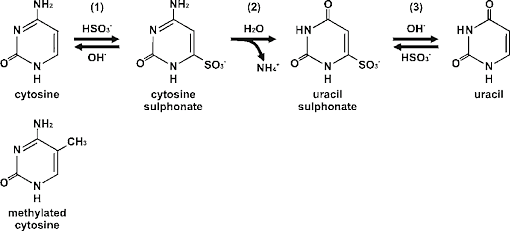
Figure 1
Other chemical activities of cytosine involve the bonding with guanine. Both are bound together by a non-covalent bonding that includes hydrogen from different sides(as shown in the above figure). IN the DNA and RNA, it forms three bonds of hydrogen with guanine. Cytidine triphosphate is derived after nucleoside binds with three CTPs.
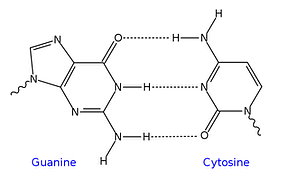
Figure 2
Nitrogenous Bases
[Click Here for Sample Questions]
There are five bases of DNA namely Adenine, Guanine, Thymine, Cytosine, and Uracil.

Nitrogenous Bases
Nitrogenous Bases Mutation
Mutation occurs due to any changes in the nucleotide and the sequence which makes up the DNA. This is an unusual type of alteration in the cell and caused due to different factors. There are different types of mutation levels.
- Point Mutation: It is a type of mutation which occurs due to a change in a single nitrogen base in the DNA sequence. It is usually the least harmful type of mutation.
- Frameshift Mutation: It is more dangerous and more serious and deadly than point mutation. In frameshift, one nitrogen base is affected but here either the base is removed completely or an extra base is inserted which causes the frame to shift.
Read More: Principles of Inheritance and Variation
Things to Remember
- Cytosine is referred to as an aminopyrimidine with the amino group at position 4 and is pyrimidine-2-one.
- The chemical name of cytosine is C4H5N3O.
- The IUPAC name or chemical name of cytosine is 4-aminopyridine-2(1H)-one.
- DNA and RNA have five major bases namely Adenine, Guanine, Thymine, Cytosine, and Uracil.
- Cytosine has a molecular mass of 111.4 g/mol.
- Cytosine can be combined with guanine in the DNA.
- Cytosine is an unstable base so it can be deaminated to form uracil.
Sample Questions
Ques. What do you know about nitrogenous bases? (3 Marks)
Ans. The DNA in the human body is formed by four nitrogenous bases named Adenine, Cytosine, Thymine, and Guanine. However, Uracil is found in RNA instead of thymine. These five nitrogenous bases are held by bonds of hydrogen. It is the basic components of DNA and RNA that result in the formation of nucleosides.
Ques. What does Cytosine do? Give three functions. (3 Marks)
Ans. Cytosine is one of the five bases found in DNA and RNA and is derived from pyrimidine. It is found in nucleic acids. It plays a vital role in the functioning of the human body including;
- It regulates the components of the living cells and also perform heredity functions.
- It behaves like a controlling agent in some types of coenzymes.
- Helps and coordinates with other enzymes to carry out the chemical reaction in the body.
Ques. Define Complementary base pairing. (3 Marks)
Ans. The pairing taking palace between all nucleobases is called base pairing. These nucleobases pair with one another to form DNA and RNA. Adenine pairs with Thymine or Uracil, whereas the paining of cytosine takes place with Guanine.
Ques. What do you mean by Cytidine? (3 Marks)
Ans. The cytosine is joined to a ring called the ribose ring through a glycosidic or sugar bond and then forms a nucleoside molecule. This molecule is named Cytidine and it's a component of RNA. And if the cytosine is joined by a deoxyribose ring, this ring is called deoxycytidine.
Ques. Provide an explanation of the Cytosine structure with a diagram. (3 Marks)
Ans. The cytosine chemical formula is C4H5N3O. It is formed by two substitutes of pyrimidine and an aromatic ring that is heterocyclic. As the chemical formula shows cytosine is formed by four atoms of carbon, five atoms of hydrogen, three of nitrogen, and one oxygen atom. The ring has an amine group at position 4 and at position 2 it has a keto group. Below is the given diagram of Cytisine formation;

Structure of Cytosine
Ques. Group these nitrogenous bases and nucleosides,
Cytidine, Cytosine, Adenine, Thymine, Uracil, and Guanosine. (2 Marks)
Ans. Among the above-given bases, Nitrogenous bases are Uracil, adenine, cytosine, and thymine. Where else, nucleosides are present in cytidine and guanosine.
Ques. When the DNA of an organism is analyzed, the number of nucleotides found was 5386. It has different bases mentioned as below, (CBSE 5 marks)
Adenine- 29%, Cytosine- 32%, Guanine- 17% and Thymine- 17%. Consider the Chargaffas rule and choose one of the following options that are true,
(1) The DNA is single-stranded
(2) The DNA is circular and double-stranded
(3) The DNA is linear and double-stranded
(4) Nothing can be drawn
Ans. The correct answer is option (1). The reasons are,
- Adenine is always found equal to thymine and guanine is equal to cytosine.
- Adenine is attached to thymine through two bonds of hydrogen and guanine to cytosine via three bonds of hydrogen.
- The ratio between adenine to thymine and also of guanine to cytosine is concluded as always one.
Hence, this organism is not following Chargaff’s rule so it is concluded that the DNA is single-stranded.
Ques. If a DNA is double-stranded and has 20% of cytosine, find the percentage of adenine present in the DNA. (3 Marks)
Ans. Following the principles of the Chargaff, DNA molecules have qual cytosine and thymine and also equal adenine and guanine.
Therefore adenine molecules = thymine molecules and guanine molecules = cytosine molecules.
Hence, % of T= % of A , %C = % G
So cytosine = 20%, also guanine = 20%
Therefore, % of G+%of C = 40%
So 60% is A+T molecules.
Science guanine = adenine, so the % of adenine molecule is 30%.
Ques. Depending on the chemical nature and the nature of nucleus acids of DNA and RNA, name the types of nucleic acid polymerases. (2 Marks)
Ans. There are two forms of nucleic acid polymerases.
- DNA-dependent DNA polymerases.
- DNA-dependent RNA polymerases.
Ques. Differentiate between the satellite DNA and repetitive DNA. (2 Marks)
Ans. The differences are as follows:
- Satellite DNA: This DNA sequence has high repetitive DNA.
- Repetitive DNA: This DNA sequence contains small segments which are repeated many times.
Ques. What do you mean by purines and pyrimidines? (3 Marks)
Ans. Purines and pyrimidines are forms of nitrogenous bases. Purines have a ring that is pyrimidine in nature with imidazole. And pyrimidines have two atoms of nitrogen. Adenine and guanine are also called purines whereas, thymine and uracil are called pyrimidines.
For Latest Updates on Upcoming Board Exams, Click Here: https://t.me/class_10_12_board_updates
Read Also:



Comments