



Education Journalist | Study Abroad Lead
Phosphate (PO43-) refers to an anion, functional group, salt, or ester derived from orthophosphoric acid. It is obtained from the removal of three hydrogen atoms from orthophosphoric acid. Phosphates have a lot of applications. They are often used in the manufacturing of complex fertilizers, additionally, they are also used to make animal feeds, dishwashers, rust removers, and corrosion preventers. Phosphates are naturally found as phosphate ions in rocks formed by sedimentation, ocean sediments as phosphate salts and in most of the foods we consume. Phosphates also play an important role in our body, they are found in bones, teeth and even in our genes.
| Table of Contents |
Key Terms: Phosphates, Orthophosphoric Acid, Phosphate Ions, Hydrogen Phosphates, Sodium Phosphates, Calcium Superphosphate, Ferric Phosphate
Structure of Phosphates
[Click Here for Sample Questions]
Phosphates are formed by removing three H atoms from Orthophosphoric acid. To do so it acquires a negative charge, which makes it a conjugate ion or anion. The molar mass of phosphate ions is 94.97 g/mol. The structure is simple, It has a Phosphorous atom surrounded by 4 oxygen atoms in a tetrahedral model.
- The first removal of hydrogen produces dihydrogen phosphate (H2O4P−1).
- The continuous removal of hydrogen gives out hydrogen phosphate as a product.
- This way we can produce a variety of phosphates like diammonium phosphate, sodium phosphate, etc for various applications.

Phosphate
Given below is the pictorial representation of the structure of a phosphate molecule.

Structure of Phosphate Molecule
Read More: Oxoacids of Phosphorus
Different Types of Phosphates
[Click Here for Sample Questions]
Here are the different types of Phosphates:
- Hydrogen Phosphate ([HPO4]2–)

Hydrogen Phosphate
Hydrogen phosphates are formed by the removal of two hydrogen atoms from phosphoric acid. It is also called monohydrogen phosphate. The central atom in this molecule is phosphorous, surrounded by three oxygen atoms and a hydroxide molecule.
- Magnesium Phosphate ([Mg3(PO4)2])

Magnesium Phosphate
Magnesium Phosphates consist of two phosphate ions and three magnesium ions.
They can be prepared by reacting magnesium metal or magnesium chloride or magnesium hydroxide to phosphoric acid.
- magnesium reacts with the acid to form magnesium phosphate to give,
Mg + H3PO4 → Mg3(PO4)2 + H2
- magnesium chloride reacts with the acid to give,
MgCl2 + H3PO4 → Mg3(PO4)2 + HCl
- Magnesium hydroxide reacts with phosphoric acid to give,
H3PO4 + Mg(OH)2 → Mg3(PO4)2 + H2O
All three of them react with the orthophosphoric acid and produce magnesium phosphate.
Read More: Magnesium Bicarbonate
- Ammonium Phosphate ([(NH4)3PO4])
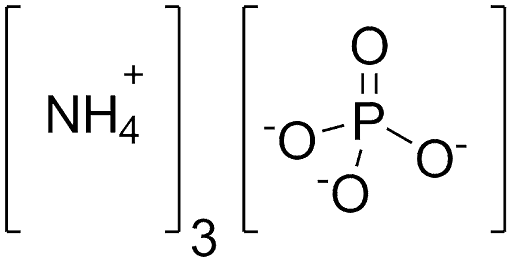
Ammonium Phosphate
Ammonium phosphate consists of three ammonium ions and a phosphate ion. It can be prepared by reacting concentrated. Phosphoric acid with ammonia solution.
H3PO4 + 3NH3 → (NH4)3PO4
-
Ferric Phosphate ([FePO4])

Ferric Phosphate
Ferric phosphate consists of one ferrous ion and a phosphate ion. It can be prepared by reacting sodium phosphate with ferric chloride.
FeCl3 + Na3PO4 → FePO4+3NaCl
-
Calcium Superphosphate ([Ca(H2PO4)2])

Calcium Superphosphate
Calcium superphosphate consists of two phosphoric acid ions and one calcium ion. They can be prepared by reacting calcium hydroxide with phosphoric acid.
Ca(OH)2 + 2H3PO4 → Ca(H2PO4)2 + 2H2O
Read More: Calcium Oxide
-
Disodium Hydrogen Phosphate ([Na2HPO4])

Disodium Hydrogen Phosphate
Disodium hydrogen phosphate consists of two sodium ions and a hydrogen phosphate ion. It can be prepared by reacting phosphoric acid with sodium hydroxide,
H3PO4 + 2NaOH→ +2O
The mass manufacturing of this phosphate takes two steps,
- First dicalcium phosphate is treated with sodium bisulphate, which results in monosodium phosphate and calcium sulphate.
CaHPO4+→+CaSO4
- Next, the solution of monosodium phosphate is neutralized partially which results in disodium hydrogen phosphate and water.
NaH2PO4+NaOH → 2HPO4+2O
Chemical and Physical Properties of Phosphates
[Click Here for Sample Questions]
The properties of phosphates strictly vary depending on what type of phosphate it is.
Listed below are the chemical properties of a few phosphates,
Magnesium Phosphate
- Physical Properties
- They appear in powder form.
- They are white in colour.
- They cannot be dissolved in water but are soluble in salt solutions.
- Chemical Properties
- Magnesium phosphate reacts with HCL to form magnesium chloride and phosphoric acid.
- Magnesium phosphate reacts with water to form magnesium hydroxide and phosphoric acid.
- They have a molar mass of 262.858 g/mol
Ammonium Phosphate
- Physical Properties
- It is a crystalline solid
- It is colourless
- It is highly unstable
- it is soluble in water
- Chemical Properties
- Ammonium phosphate reacts with lead nitrate to form ammonium nitrate and lead phosphate.
- Ammonium phosphate is highly unstable and decomposes rapidly emitting toxic fumes, this leads to the formation of ammonia and phosphoric acid.
- They have a molar mass of 149.086 g/mol
Ferric Phosphate
- Physical Properties
- It is solid in nature
- It is found in a yellow-brown colour
- It is not soluble in water but is highly soluble in acids
- They have a molar mass of 150.82 g/mol
Calcium Superphosphate
- Physical Properties
- It is mostly found in powder form
- It is found in white colour
- It is rarely soluble in water and is insoluble in alcohol
- They have a molar mass of 234.05 g/mol
Disodium Hydrogen Phosphate
- Physical Properties
- It appears as crystalline solid in nature
- It is found in white colour
- It is hygroscopic in nature.
- It is soluble in water but not soluble in alcohol
- Chemical Properties
- When heated it yields tetrasodium pyrophosphate
- They have a molar mass of 141.96 g/mol
Read More: Pyrophosphoric Acid
Applications of Phosphates
[Click Here for Sample Questions]
Phosphates have various applications,
- Phosphates are widely used in the healthcare industry. Phosphates are present naturally in our teeth and bones, that being said it is used in the manufacturing of medicines for teeth and bones. They are also used in toothpaste as a polishing agent and to enable the free flow of the paste through a tube.
- Magnesium phosphate is used in the treatment of Vitamin E deficiency. Disodium hydrogen phosphate is used to treat constipation. Phosphates are also used to inhibit the growth of kidney stones.
- They are commonly used in fire extinguishers.
- It is used in the manufacturing of industrial cleaners
- Phosphates are widely used in agriculture. They are used in the manufacturing of fertilizers. Phosphates obtained from rocks are the main ingredient in making fertilizers. Calcium phosphate is now gaining a special interest in agriculture due to its properties as a nano growth promoter. Some phosphates like magnesium phosphate are also used as soil conditioners. Some phosphates like ferric phosphate are used in the manufacture of pesticides.
- Phosphates are really important for our body. Regular intake of phosphates from various food sources is really necessary for our body. We commonly get phosphates from dairy products, meat, whole grains, fish, beans etc.
- Phosphates like magnesium phosphates are used in making antacids.
- Many phosphates are used in producing nutritional supplements.
Read More: Ammonium Bicarbonate
Things to Remember
- Phosphates are derived from phosphoric acid (H3PO4).
- Phosphates are obtained when three hydrogen atoms are removed from phosphoric acid.
- They contain one central P atom surrounded by 4 O atoms in a tetrahedral fashion.
- Most of them are soluble in water.
- Phosphates are commonly found as phosphate ions in rocks and ocean sediments and in the foods we consume.
- They are also found in biological organisms.
- They have various applications ranging from agriculture to healthcare to convenience products.
- Phosphates are really crucial for the human body. Phosphates are crucial for maintaining our bones and teeth.
Sample Questions
Ques. Describe the structure of phosphates. (3 Marks)
Ans. Phosphates contain one phosphorous atom in the centre with 4 oxygen atoms around it in a tetrahedral manner. This will have variations depending on the phosphate. Some phosphates like Calcium Superphosphate contain two hydroxide molecules along with two oxygen atoms.
Ques. Explain the physical and chemical properties of a few phosphates. (5 Marks)
Ans. Here are a few phosphates along with their chemical and physical properties:
- Magnesium Phosphate
- They usually appear in a white powder form. They are not soluble in water but are soluble in salt solutions. They have a molar mass of 262.858 g/mol
- Magnesium phosphate reacts with HCL to form magnesium chloride and phosphoric acid. Magnesium phosphate reacts with water to form magnesium hydroxide and phosphoric acid.
- Ammonium Phosphate
- It is a crystalline colourless solid which is highly unstable, it is soluble in water. It has a molar mass of 149.086 g/mol
- Ammonium phosphate reacts with lead nitrate to form ammonium nitrate and lead phosphate. Ammonium phosphate is highly unstable and decomposes rapidly emitting toxic fumes, this leads to the formation of ammonia and phosphoric acid.
- Ferric Phosphate
- It is solid in nature and is found in a yellow-brown colour. It is not soluble in water but is highly soluble in acids. It has a molar mass of 150.82 g/mol
- Calcium Superphosphate
- It is mostly found in a white powder form. It is sparsely soluble in water and is insoluble in alcohol. It has a molar mass of 234.05 g/mol
- Disodium Hydrogen Phosphate
- It appears in a white crystalline solid in nature. It is hygroscopic in nature. It is soluble in water but not soluble in alcohol. It has a molar mass of 141.96 g/mol
- When heated it yields tetrasodium pyrophosphate
Ques. Show a diagram of the general structure of a phosphate. (3 Marks)
Ans. The structure of phosphate is as follows:

Ques. What are the applications of phosphates? (3 Marks)
Ans. Phosphates have various applications ranging from agriculture to healthcare to industrial use.
- Phosphates are used in toothpaste as a polishing agent and to provide a free flow of paste in a tube.
- Magnesium phosphate is used for the treatment of Vitamin E deficiency.
- Phosphates are also useful in order to inhibit the growth of kidney stones.
- Regular intake of phosphates is really necessary for our body.
- Phosphates like magnesium phosphates are used in making antacids.
Ques. What all foods contain phosphates? (2 Marks)
Ans. The intake of phosphates is really necessary for our body. Phosphates are mainly found in dairy products and other protein-rich foods like milk, cheese, egg, fish, meat etc.
Ques. What is the formula for the following? (3 Marks)
a) Calcium Superphosphate
b) Ferric Phosphate
c) Magnesium Phosphate
d) Ammonium Phosphate
e) Di-Sodium Hydrogen Phosphate
Ans. The chemical formula for the following is as follows:
- Calcium Superphosphate: [Ca(H2PO4)2]
- Ferric Phosphate: [FePO4]
- Magnesium Phosphate: [Mg3(PO4)2]
- Ammonium Phosphate: [(NH4)3PO4]
- Di-Sodium Hydrogen Phosphate: [Na2HPO4]
Ques. Describe the industrial production of Di-sodium hydrogen phosphate. (3 Marks)
Ans. The mass manufacturing of disodium hydrogen phosphate takes two steps,
- First dicalcium phosphate is treated with sodium bisulphate, which results in monosodium phosphate and calcium sulphate.
CaHPO4 + NaHSO4 → NaH2PO4 + CaSO4
- Next the solution of monosodium phosphate is neutralized partially which results in disodium hydrogen phosphate and water.
NaH2PO4 + NaOH→Na2HPO4 + H2O
Check-Out:



Comments