



Education Content Expert
Emulsification is the process of creating phases in a liquid-liquid mixture that results in the creation of Emulsions. Emulsification occurs when an immiscible liquid is combined with another immiscible liquid.
- Emulsification is basically the process of creating Emulsions.
- Emulsion is a type of Colloid in which the dispersed phase and dispersion medium both are liquids.
- The term ‘Emulsion’ is derived from the Latin word ‘emulgere’ meaning ‘to milk out’.
- Examples of Emulsions include Milk, Mayonnaise, Hand Creams, Latex, Vinaigrettes, etc.
| Table of Content |
Key Terms: Emulsification, Emulsions, Emulsifier, Immiscible Liquids, Mayonnaise, Emulgent, Water in Oil Emulsion
What is Emulsification?
[Click Here for Sample Questions]
Emulsifying is the process of combining two liquids that ordinarily do not mix well, such as oil and vinegar.
- It is the process in which one immiscible liquid is dispersed in another immiscible liquid.
- It is defined as the process of creating Emulsions.
- Emulsion is a mixture of one or more liquids that are typically unmixable and unblendable.
- Emulsions are used in a variety of food products.
- Milk, a complex mixture of fat floating in an aqueous solution, is the most prevalent natural example of an emulsion.
- Various types of mixers are employed in industries to mechanically blend the components of emulsions.
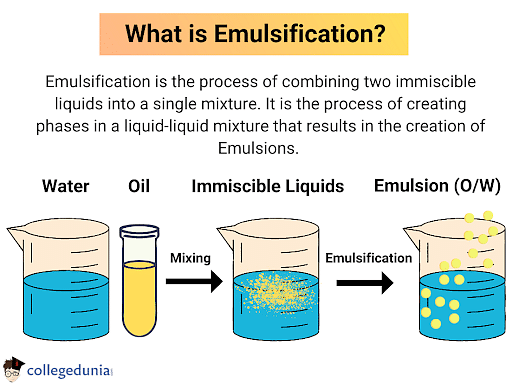
Emulsification
Aim of Emulsification
Emulsification is a process with certain aims as follows:
- It has to ensure the physicochemical stability of the product.
- It determines the characteristic structure of the batter that influences the fat and moisture separation from the product during cooking.
- It also creates a typical sensory property such as texture, flavor, appearance, or noise.
- Finely comminuted products are represented by their smooth surface.
What is Emulsifier?
- Emulsifier is a material that stabilizes an emulsion.
- It is also referred to as an Emulgent.
- Detergents and other surfactants are a form of emulsifier.
- Surfactants are also known as Surface-active agents.
- Some examples of emulsifiers include Lecithin, Soy Lecithin, Mustard, Sodium Stearoyl Lactylate, and Sodium Phosphates.
Read More:
Examples of Emulsions
[Click Here for Previous Year Questions]
Here are a few common examples of Emulsions:
- Mayonnaise: Mayonnaise is essentially an emulsion of oil drops suspended in egg yolk, lemon juice, or vinegar base that provides flavor as well as stabilizing particles and carbs.
- Butter: Butter is a water-in-oil emulsion obtained from an inversion of the cream, where the milk proteins are the emulsifiers. In butter, water is in the dispersed phase and oil is in the dispersion medium.
- Cold Cream: Cold cream is an emulsion of water and certain lipids that is used to smooth skin and remove makeup. It typically contains beeswax and other fragrances.
- Emulsion Paints: The pigment, binder, and solvent are the three major ingredients included in most paints. The pigments of emulsion paint are held in place by small polymer particles. Instead of a liquid polymer binder dissolving in water, they are comprised of tiny droplets that are scattered out.
Emulsification Process
[Click Here for Sample Questions]
Emulsification can be influenced by a variety of distinct chemical, physical, and biological processes, and mechanisms. The mechanism of emulsification is based on three theories as follows:
- Surface Tension Theory: It states that emulsification occurs when the interfacial tension between two phases is reduced.
- Repulsion Theory: It states that the emulsifying agent forms globules of film over one phase that repels one another. They are kept suspended in the dispersion medium by this repelling force.
- Viscosity Modification: Emulgents like acacia, tragacanth, carboxymethylcellulose and polyethylene glycol help establish and maintain the suspension of globules.
Properties of Emulsions
[Click Here for Previous Year Questions]
The properties of Emulsions are listed as follows:
- Emulsions have both a dispersed phase and a dispersion medium.
- The boundary between the dispersion phase and the dispersed medium is referred to as the “Interface”.
- Emulsions have a cloudy appearance.
- They depict numerous colors depending on the dilution.
- Emulsions also show the Tyndall Effect.
- The particle size of a dispersed phase in emulsions varies in each type.
- Emulsions are inherently unstable.
- In order to form a stable emulsion, exposure to energy and power ultrasound is needed.
- Their particles form dynamic inhomogeneous structures on a small length scale.
- The phases of emulsion may get separated if kept undisturbed for a longer period of time or without an emulsifying agent.
Types of Emulsions
[Click Here for Sample Questions]
Emulsions are divided into two types majorly:
- Simple Emulsions
- Complex Emulsions
Simple Emulsions
Simple Emulsions are the emulsions formed by either dispersing oil in water or water in oil. It has two major types:
- Water in Oil Emulsion: In this emulsion, the dispersed phase is water and the dispersion medium is oil. It is also referred to as a W/O type of emulsion. Cold cream, and butter, are examples of water in oil emulsions.
- Oil in Water Emulsion: In this emulsion, the dispersed phase is oil and the dispersion medium is water in the emulsion. It is also referred to as an O/W type of emulsion.
Complex Emulsions
Complex emulsions are also referred to as Multiple Emulsions. Both the water-in-oil emulsion and the oil-in-water emulsion coexist in these kinds of emulsions, which are stabilized by surfactants. It is also divided into two types:
- Water-in-Oil-in-Water Emulsion: They are also called W/O/W emulsions. In these emulsions, oil droplets enclosing water droplets are dispersed in water. These are basically double emulsions of O/W emulsion and W/O emulsion.
- Oil-in-Water-in-Oil Emulsion: They are also called O/W/O emulsions. In these emulsions, water droplets enclosing oil droplets are dispersed in the oil phase. These are simply double emulsions of O/W emulsion and W/O emulsion.
Uses of Emulsions
[Click Here for Previous Year Questions]
The important uses of Emulsions are listed below:
- Emulsions are the foundation for many paints and inks.
- Emulsions are frequently used as the delivery method for hair and skin conditioning ingredients in cosmetics.
- Cutting Fluid is a lubricant that is also an emulsion and is used in metalworking processes.
- Mayonnaise, various sauces, etc are examples of oil-in-water emulsions stabilized by lecithin.
- Margarine is an emulsion that is used in baking, flavoring, and cooking.
- Emulsions are also used to make creams, ointments, balms, and various other pharmaceutical products.
- They are also utilized for personal hygiene.
Check More:
Things to Remember
- Emulsification is the process of separating liquids into phases, which leads to the formation of emulsions.
- Emulsification always takes place when two immiscible liquids are mixed together.
- Emulsion is a colloid consisting of two or more immiscible liquids.
- Egg Yolk, Butter, Mayonnaise, etc are all examples of Emulsions.
- According to the surface tension theory, the interfacial tension between the two phases is lowered during emulsification.
- Emulsions are widely used in cosmetics, pharmaceuticals, and personal hygiene.
Previous Years’ Questions
- Emulsifier is an agent which… (JIPMER - 1996)
- Which of the following is not an emulsion…
- The colloidal solution of two immiscible liquids is called…
- Fats are emulsified by the bile juice because… (Manipal - 2005)
- The physical states of dispersed phase and dispersion medium… (WBJEE - 2015)
- Purification of colloids is done by… (AIIMS - 2014)
- Disperse phase and dispersion medium in butter are respectively… (Punjab PMET - 2008)
- The colloidal system of a solid dispersed in liquid medium… (JKCET - 2007)
- When dispersed phase is liquid and the dispersion medium is gas…
- The continuous phase contains the dispersed phase throughout… (VITEEE - 2008)
Sample Questions
Ques. What is Emulsification? (2 Marks)
Ans. Emulsification is the process of combining two immiscible liquids into a single mixture. Soaps and detergents are common emulsifiers. Emulsification is frequently used in the industrial sector and involves mechanically combining the components of the emulsion in different types of mixers.
Ques. State a few examples of Emulsions. (3 Marks)
Ans. Some examples of Emulsions are as follows:
- Egg Yolk: It has the emulsifying agent lecithin.
- Butter: It is water in the fat emulsion.
- Mayonnaise: It is an emulsion of oil in water.
- Crema on Espresso: It is an emulsion of water and coffee oil.
Ques. What is the role of Emulsification in Food Processing? (1 Mark)
Ans. Several food items have special functional qualities due to the nature of emulsions, including appealing looks, textures, mouthfeels, and flavor profiles.
Ques. What are the Uses of Emulsions? (3 Marks)
Ans. Here are some important uses of Emulsions:
- Emulsions are used in cosmetics, pharmaceuticals, and personal hygiene.
- Microemulsions are used to deliver vaccines that are used to kill various microbes.
- Emulsions are also used in chemical synthesis and firefighting.
- Nanoemulsions such as soybean oil is also used in order to kill microbes.
Ques. What is the difference between Emulsification and Digestion? (1 Mark)
Ans. Emulsification reduces the number of fat molecules in a large clump to fewer fat molecules. Emulsification, or the breaking up of fat globules into much smaller emulsion droplets, considerably aids digestion.
Ques. What are the different types of Emulsion? (3 Marks)
Ans. Emulsions are divided into two groups based on the characteristics of the dispersion medium and the dispersed phase. Thus, there are two types of Emulsions namely:
- Simple Emulsions: They are formed by either dispersing oil in water or water in oil.
- Complex Emulsions: In these emulsions, a complex system exists in which both oils in water and water in oil emulsion exist together and are stabilized by surfactants.
Ques. What are the applications of Emulsions? (1 Mark)
Ans. Emulsion is a mixture that has a liquid-dispersed phase and a liquid-dispersed medium. They are largely employed in firefighting, medicines, cosmetics, and chemical synthesis.
Ques. Describe the Process of Emulsification. (3 Marks)
Ans. The process of Emulsification is described as follows:
- The interfacial tension between the two phases is reduced during emulsification, in accordance with the surface tension theory.
- According to the repulsion theory, the emulsifying agent produces a film over a single phase. The globules of the film repel one another. Their suspension in the dispersion medium is a result of this.
- Emulgents that increase the viscosity of the media include acacia, glycerine, and carboxymethyl cellulose. This helps to maintain and create the globule suspension in the scattered phase.
Ques. What is the significance of the Emulsification of Fat? (1 Mark)
Ans. Emulsification is the process of dissolving fat into smaller globules so that food can be more easily digested and so that digestive enzymes can work.
Ques. What is the emulsifier present in milk that makes it stable? (1 Mark)
Ans. Milk contains casein, an emulsifying substance that holds two immiscible layers of fat and water together.
Ques. What is an Emulsifier? (3 Marks)
Ans. An emulsifier is a substance that stabilizes an emulsion.
- It is also known as emulgent.
- Surfactants are emulsifiers that are often referred to as surface-active agents.
- Lecithin, soy lecithin, mustard, sodium stearoyl lactylate, diacetyl tartaric acid ester of monoglyceride, and sodium phosphates are all examples of emulsifiers.
Ques. What is the function of an emulsifier? (1 Mark)
Ans. Emulsifier, also known as an emulgent, is a surface-active substance that forms a boundary between two immiscible liquids, such as oil and water, to enable the blending of the two to form stable emulsions.
For Latest Updates on Upcoming Board Exams, Click Here: https://t.me/class_10_12_board_updates
Check-Out:



Comments