



Education Journalist | Study Abroad Lead
Preparation of Colloidal solutions can take place due to their strong affinity for the dispersion medium. Lyophilic colloids rapidly form a solid when brought into contact or warmed with it. For example, simply heating with water is sufficient for making starch, gelatin, and gum arabic sols. However, because lyophobic colloids have no affinity for the dispersion medium, it is difficult to create these sols in practice. The manufacture of lyophobic sols necessitates the use of certain techniques. There are several different methods for preparation of lyophilic colloids, which can be classified into the groups: Dispersion methods and Condensation or aggregation methods
| Table of Contents |
Key Takeaways: Dispersion medium, colloidal particles, dispersed, colloidal, colloidal solutions, lyophilic sols, lyophobic, Colloids
Dispersion Methods
[Click Here for Sample Questions]
The larger particles of any substance are broken down into minute colloidal particles via dispersion processes. The resulting tiny particles are stabilised by the addition of stabilising agents. The following are some of the dispersion methods:
- Mechanical dispersion method: The big particles of the material whose sol is to be created are broken down in a machine called a colloid mill in the mechanical dispersion procedure. Two hefty steel discs are separated by a small space in a colloid mill. The particle size can be modified to suit your needs. The two discs spin in opposite directions at a fast rate (about 8000 revolutions per minute). The material is suspended in water and added to the mill. The particles in the suspension are ground to form colloidal particles, which are then dispersed in water to form a sol.
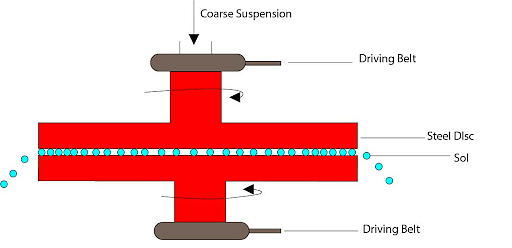
Preparation of Colloidal Solution
- The electrical dispersion method (Bredig's arc method): It is used to prepare sols metals such as gold, silver, platinum, and other precious metals. Two electrodes of the metals whose sol is to be made are immersed in the dispersion medium in this process, and an electric arc is created by flowing high voltage current through them. By enclosing the dispersion medium in a freezing liquid, it is kept chilly. The metal begins to vaporise due to the heat created by the electric arc, and the vapour condenses into the cold dispersion media, forming colloidal particles upon cooling.
- Ultrasonic dispersion: High-frequency sound waves are commonly referred to as ultrasonic waves. When quartz crystal discs are coupled to a high frequency generator, these waves can be generated. With the use of ultrasonic waves, many compounds such as oils, mercury, sulphides, and metal oxides can be easily dispersed into colloidal conditions.
- Peptization: It refers to the process of breaking down freshly formed precipitate particles into colloidal-sized particles. This is accomplished by incorporating appropriate electrolytes. Peptizing agent is the name for the electrolyte that is added. By adding ferric chloride solution to recently precipitated ferric hydroxide, a brown-colored colloidal solution is formed.

Peptization
Also Read:
| Related Articles | ||
|---|---|---|
| Integrated Rate Equations | Double time formula | Surface Chemistry |
| Electrophoresis | Inversion chemical reaction | Second Order Reactions |
Condensation method
[Click Here for Sample Questions]
Some chemical reactions can be utilised to clump together smaller atomic or ionic particles to generate giant colloidal particles. In these reactions, the dispersed phase is formed as an insoluble reaction product. The following are some of the most important reactions involved in the creation of hydrophobic sols.
- By Exchange of Solvents: Due to the limited solubility of sulphur or phosphorus in water, a colloidal solution of sulphur or phosphorus is formed when a solution of sulphur or phosphorus made in alcohol is put into water. As a result, a variety of substances can be made into colloidal solutions by taking a solution of the substance in one solvent and pouring it into another solvent in which the substance is less soluble.
- By a change in physical state: Certain elements, such as mercury and sulphur, are colloidally dissolved by passing their vapours through cold water containing a stabiliser ( an ammonium salt or a citrate).
- Oxidation: Sol sulphur is made by oxidising an aqueous solution of hydrogen sulphide with bromine water, nitric acid, SO2, or any other suitable oxidising agent.
- Reduction: Sols of gold, silver, platinum, and other metals are made by reducing dilute salt solutions with an appropriate reducing agent. Gold sol, for example, can be made by reducing a dilute aqueous gold solution with stannous chloride.
- Hydrolysis: Ferric and aluminium hydroxide sols are made by boiling the aqueous solution of the appropriate chlorides.

Hydrolysis
- Double decomposition: It can be used to make sols of inorganic insoluble salts such as arsenous sulphide, silver halides, and other insoluble salts. Arsenous sulphide sol, for example, can be made by passing hydrogen sulphide (H2S) gas through a dilute aqueous solution of arsenous oxide.
Purification of Colloidal Solution
[Click Here for Sample Questions]
To keep colloidal solutions stable, impurities, particularly electrolytes, that can destabilise the sols must be removed. The methods listed below are routinely used to purify colloidal solutions.
- Dialysis: Dialysis is the technique of removing ions from a solution via the phenomena of diffusion through a permeable membrane. A sol containing ions or molecules is filled into a permeable membrane bag and dipped in water in this method. The permeable membrane allows the ion from the solution to diffuse. The concentration of electrolyte outside the membrane is neutralised by the constant flow of water. This process, for example, is used to purify ferric hydroxide sol.

Dialysis
- Electrodialysis: Electrodialysis is a method that involves dialysis of colloidal solution under the influence of an electric field. Between the metal screens that support the membranes, some potential is applied. The speed of ions travelling in the direction of opposite electrodes is increased as a result of this potential. As a result, the dialysis rate is raised. This approach is ineffective for non-electrolyte contaminants such as urea.
- Ultrafiltration: The size of the holes is reduced when filter paper is manufactured using colloidal or regenerated cellulose, such as cellophane. Ultrafilter is a special type of filter paper that has been modified. Ultrafiltration is the process of removing solution particles from a liquid medium using electrolysis and an ultrafilter. It's a long and winding road. External gas pressure must be provided to speed up the process.
- Electro Decantation: This technique can be used for both purification and concentration of the sol. When this process is carried out without stirring the solution, the bottom layer settles, leaving a layer of pure and concentrated colloids that can be decanted on top.
Things to Remember
- Colloids can be classified as:
- Aerosol (air as the dispersion medium), Gels (solid dispersion medium), and Emulsion are the three physical states (liquid-liquid solutions in which the dispersed phase is liquid)
- Hydrosol (water functions as a dispersion medium), Alcosol (alcohol works as a dispersion medium), and Acrosol (alcohol acts as a dispersion medium) are their dispersion medium (contains a dispersed phase particle in the air).
- Lyophilic colloids, Lyophobic colloids, and Association colloids are all examples of interaction forces.
- Colloids are mixtures in which the suspended particles do not settle at the button and are equally disseminated in another substance. Blood, whipped cream, colours, and perfume are all examples of colloidal solutions.
- The lyophilic colloidal sols are typically made by dissolving the needed ingredient (for which the sol is to be prepared) in the solvent. The most typical way for sols to generate is by dissolving acacia in water.
- The following chemical processes are used to prepare colloidal solution using the condensation method: Excessive cooling, oxidation, double decomposition, hydrolysis, solvent exchange, and physical state change.
Also Read:
Sample Questions
Ques. Describe the difference between Lyophilic and Lyophobic colloids? (3 marks)
Ans: Reversible lyophilic colloids have a high interaction between the dispersed phase and the dispersion medium. They have a high degree of stability and are coagulation resistant.
Lyophobic colloids, on the other hand, are irreversible solutions. They are unstable, and the attraction between the dispersed phase and the dispersion medium is weak. As a result, coagulation is simple.
Ques. What is the definition of peptization? (3 marks)
Ans: Peptization is the process of shaking a precipitate with dispersion medium in the presence of a little amount of electrolyte to turn it into colloidal sol. Peptizing agent is the electrolyte utilised for this. This causes the precipitate to generate a positive or negative charge, which eventually breaks up into small colloid-sized particles.
Ques: Describe the condensation procedure using solvent exchange. (5 marks)
Ans: Some chemical reactions can be utilised to clump together smaller atomic or ionic particles to generate giant colloidal particles. In these reactions, the dispersed phase is formed as an insoluble reaction product. Due to the limited solubility of sulphur or phosphorus in water, a colloidal solution of sulphur or phosphorus is formed when a solution of sulphur or phosphorus made in alcohol is put into water.
As a result, a variety of substances can be made into colloidal solutions by taking a solution of the substance in one solvent and pouring it into another solvent in which the substance is less soluble.
Ques: Describe some non-chemical alternatives to chemical condensation. (3 marks)
Ans: Some non-chemical condensation procedures include the following:
- Solvent exchange: A solution of one chemical in one solvent is transferred to a solvent in which the substance is less soluble.
It's utilised for compounds that are extremely soluble in alcohol but not so much in water. To make colloidal sulphur sol, for example, the alcoholic sulphur solution is mixed with water.
- Vapour condensation: The colloidal sol is made by condensing the vapours of a substance in this technique. When sulphur vapours and a stabilising agent like NH4NO3 are combined in cold water, a colloid of sulphur is created.
Ques: Explain how to purify a colloidal solution using ultrafiltration. (3 marks)
Ans: Ultrafiltration is the method of isolating colloidal particles from soluble solutes (impurities) using specially constructed filters that are impermeable to everything but the colloid. As the holes of filter sheets are too big, colloidal particles can usually pass through. Because this is a sluggish process, it is sped up by applying pressure or suction. To make a pure colloid, the colloidal particles left on the ultra-filter paper are mixed with fresh dispersion media (solvent).
Ques: For the preparation of metallic sols, whatever physical method is used? (2 marks)
Ans: Bredig's dispersion process is used to prepare metallic sols, such as gold sol, in which the gold particles are broken down to the size of sol particles. For the creation of sols, these particles are subsequently immersed in the necessary dispersion medium.
Ques: What is the best way to make a brown-colored colloidal solution? (3 marks)
Ans: By adding ferric chloride solution to recently precipitated ferric hydroxide, a brown-colored colloidal solution is formed. The adsorption of ferric ions on the surface of the precipitate caused this. The formation of positively chafed ferric ions on the surface generates repulsion between them, resulting in the breakdown of large precipitate particles into small colloidal particles.
Ques: Describe the two main methods for colloidal preparation. (3 marks)
Ans: Colloids can be prepared in one of two ways:
- Milling, spraying, or applying shear to disperse big particles or droplets to colloidal dimensions (e.g. shaking, mixing, or high shear mixing).
- Precipitation, condensation, or redox processes convert small dissolved molecules into bigger colloidal particles. Processes like these are used to make colloidal silica and gold.
For Latest Updates on Upcoming Board Exams, Click Here: https://t.me/class_10_12_board_updates
Check-Out:



Comments