



Education Content Expert
Dispersed Phase is a kind of discontinuous phase that is distributed throughout the dispersion medium. Dispersed Phase refers to tiny particles dispersed in a medium.
- The medium can be a liquid, gas, or solid, while the dispersed phase can be a solid, liquid, or gas.
- The size of the dispersed phase particles can range from nanometers to micrometres.
- Dispersed phases can be homogeneously or heterogeneously distributed.
- Applications of dispersed phase systems include emulsions, suspensions, and foams.
- The stability of dispersed systems depends on factors such as particle size, surface properties, and the properties of the medium.
- Understanding the behaviour of dispersed phases is important for industries such as food, cosmetics, and pharmaceuticals.
Read More: NCERT Solutions For Class 12 Chemistry Chapter 5: Surface Chemistry
| Table of Content |
Key Terms: Dispersed Phase, Dispersed Medium, Dispersion, Colloid, Prism, Emulsion, Solution, Heterogenous Mixture
What is Colloid?
[Click Here for Sample Questions]
Colloid is a mixture that contains at least two medium sized particles in solid, liquid, or gas form. Understanding Colloids is necessary to understand the concept of Dispersed Phase.
- Colloid is a kind of heterogeneous solution in which the dispersed phase is suspended in the dispersed medium.
- Colloid solution is not a kind of uniform mixture as its composition varies to a large extent.
- For example, water in ink can be considered a heterogeneous mixture or a colloid solution.
- In this mixture of water in ink, water is considered a dispersed medium, and the ink is the dispersed phase.
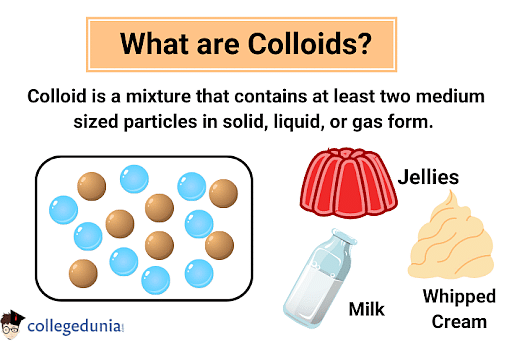
Colloid
Types of Colloids
[Click Here for Previous Year Questions]
Based on the nature of the dispersed phase, the colloids are classified into the following three types:
Multimolecular Colloids
- It is a kind of substance that gets dissolved in a dispersion medium and gets separated into various smaller molecules of various sizes.
- The size of the dispersed phase particles varies from 1 nm to 1000 nm.
- As soon as it gets dissolved, the separation of its particles occurs leading to the formation of colloids that constitute various atoms and are hence known as multimolecular colloids.
- Examples of multimolecular colloids are hundreds of sulphur molecules that are held together by the Van-Der-Waal force and form the sulphur solution.
Macromolecular Colloids
- The size of the particles of the dispersed phase is larger in this type of colloid.
- In the suitable solvent, its size varies largely and does not remain in the colloidal range.
- This type of colloid is known as the Macromolecular colloid.
- Some of the well-known examples of Macromolecular Colloids are cellulose, enzymes, proteins, etc.
Associated Colloids
- These types of Colloids behave like strong electrolytes.
- On finding a suitable condition like the higher concentration, these colloids show the behaviour of the colloidal particles.
- Due to this nature of the difference in the behaviour of the colloidal particles, it is known as the Associated Colloids.
- Soaps and Detergents are well-known examples of the Associated Colloids.
Read More:
What is Dispersed Phase?
[Click Here for Sample Questions]
Dispersed Phase is a kind of liquid that is suspended in the form of various fine droplets in a continuous phase. It is present in the shape of colloidal particles in the heterogeneous mixture known as colloids.
- In chemistry, colloids are classified based on the dispersion medium and dispersed phase.
- It is classified based on the interaction between the dispersed phase and dispersion medium. i.e. Lyophilic and lyophobic colloids.

Dispersed Phase
Types of Dispersed Phase
[Click Here for Previous Year Questions]
Dispersed Phase is closely related to the heterogeneous mixture i.e. colloid. There are various types of Dispersed Phases and it also leads to the classification of Colloids into various types. Some of the well-known categories of colloids are Solid sol, sol, aerosol, foam, gel, etc.
- Sol: Sol is considered as a colloidal suspension of solid particles in a liquid. An example of Sol is Ruby Glass.
- Emulsion: The colloidal suspension of two drinks is known as an emulsion. Example of emulsion is Milk.
- Foam: When gas particles get trapped in between the solid or liquid, then it leads to the formation of Foam. Soap in water is an example of Foam.
- Aerosols: When small particles of solid or liquid get dispersed in a gas, then it is known as Aerosols. E.g. Fog, mist, smoke, etc.
Read More: Surface Chemistry Important Questions
How does Dispersion Occur?
[Click Here for Sample Questions]
Dispersion is a kind of process in which all the agglomerated particles get separated from each other. In the process of Dispersion, a new line of interaction starts between the outer surface of the dispersed particles and the inner surface of the dispersed medium.
- All this process is combined by the process of molecular convection and diffusion.
- The dispersion that occurs through different concentrations of the media in the bulk medium is known as the molecular diffusion phenomenon.
- The difference in the way of interaction between the bulk medium and the dispersed medium creates a kind of concentration gradient and leads to the medium’s dispersion.
- This process leads to the equal dispersion of the particles in the medium.
On the other hand, in the process of molecular conversion, the difference in the velocity between the paths of flow in the bulk medium facilitates the equal distribution of the dispersed phase in the dispersion medium. In most cases of dispersion, diffusion is the primary mechanism. But, in some cases of dispersion, the molecular conversion also accelerates the process.
What is Dispersion Medium?
[Click Here for Previous Year Questions]
Dispersion Medium is like a continuous medium in which a kind of solvent on which the dispersed phase is distributed. There are different types of Dispersion Mediums. Some of them are as follows:
- Foam: Foam is a kind of colloidal system in which the particles are gas bubbles and the medium is a liquid. It can be easily classified as something rigid in form and light in weight. Some of the well-known examples of Foam are Fire fighting.
- Aerosol: Aerosol is defined as the chemistry of solid, liquid, and gas particles. An example of Aerosol is Fog.
- Solid suspension: A solid suspension is a mixture in which the solute particles do not dissolve. An example of Solid Suspension is the mixture of chalk water.
- Gels: Gels are solid in the medium and it is formed by the process of Gelation.
- Colloidal Suspension: The particles present in the Colloidal Suspension have a larger size. An example of Colloidal Suspension is Muddy water.
- Emulsion: Emulsion is defined as a mixture of more than one liquid or more that cannot be mixed. It belongs to the general class. Water and oil are examples of emulsions. If stirred together, it will mix for a while but soon it will be separated.
Dispersed Phase Vs Dispersed Medium
[Click Here for Sample Questions]
The difference between the Dispersed Phase and the Dispersion Medium is as follows:
| Dispersed Phase | Dispersion Medium |
|---|---|
| Dispersed Phase of dispersion is the discontinuous phase that distributes throughout the dispersion medium. | Dispersion Medium is the continuous phase of a colloid. |
| It is known as the Internal phase. | It is known as the External phase. |
| Example: Dust in Air | Example: Water in Milk |
Read More: Surface Chemistry MCQs
Working of Dispersion System
[Click Here for Previous Year Questions]
Dispersion system is defined as a kind of system which is two-sided. This system is made up of microscopic particles along with a medium that helps them to be suspended. It works on a most basic principle:
- It separates the collection of particles from each other.
- The common examples of dispersion are Light, rainbow, etc.
- The speed of the light ray results in light dispersion.
Types of Dispersion Systems
Dispersion Systems are mainly divided into two types namely:
- Molecular Dispersions: Molecular dispersions are dedicated solutions to a solute phase in the solvent.
- Coarse Dispersions: Coarse Dispersion is the second type of dispersion system. It is also known as heterogeneous dispersed systems.
What is a Solution?
[Click Here for Sample Questions]
In Chemistry, a Solution is defined as a similar mixture of two or more substances in equal amounts. But, it is seen that the Solutions of gas and solid are possible. Air is a well-known example of a solution. It is a mixture of several gases but the major classes of air are oxygen and nitrogen.
There are mainly two parts to the Solution. The name of those parts are as follows:
- Solvent: The solvent is a liquid in which various materials can be mixed to make a solution. For example, water is a solvent.
- Solute: The solute can be a substance or a material that has been dissolved in a solvent to create a mixture. For example, in salt water, salt is a solute mixed with water, and water is solvent to produce a mixture called a solution.
Check More:
Things to Remember
- Dispersed Phase is defined as a liquid that is suspended in the form of fine droplets in a continuous phase in a colloidal particle shape.
- Colloid is a mixture of very tiny particles of one substance into another substance. Examples are ink, milk, fog, etc.
- Colloids are classified into three types, namely Multimolecular Colloids, Macromolecular Colloids, and Associated Colloids.
- There are various types of dispersion mediums namely, gel, sol, emulsion, foam, etc.
- There are two types of Dispersion Systems, namely, Molecular and Coarse Dispersion.
Previous Years’ Questions
- The dispersed phase and dispersion medium in soap lather… (KEAM)
- The physical states of dispersed phase and dispersion medium… (WBJEE - 2015)
- When dispersed phase is liquid and dispersion medium is gas…
- The continuous phase contains the dispersed phase throughout… (VITEEE - 2008)
- The disperse phase, dispersion medium and nature of colloidal solution… (AFMC - 2008)
- The colloidal system in which the disperse phase and dispersion… (Rajasthan PMT - 2010)
- The colloidal solution in which both the dispersed phase and dispersion… (KCET - 2009)
- Disperse phase and dispersion medium in butter are respectively… (Punjab PMET - 2008)
- The disperse phase in colloidal iron (III) hydroxide and colloidal gold… (AIEEE - 2005)
- The colloidal system of a solid dispersed in liquid medium… (JKCET - 2007)
Sample Questions
Ques. How are the following colloids different from each other concerning their dispersion medium and dispersed phase? Give one example of each.
(i) Aerosol
(ii) Emulsion
(iii) Hydrosol (Delhi 2010) (3 Marks)
Ans. (i) Aerosol: Aerosol is a type of colloidal solution in which the dispersed phase is a solid and the dispersion medium is a gas. Examples of aerosols are Smoke and haze.
(ii) Emulsion: Emulsion is a kind of colloidal solution in which both the dispersed phase and medium are in a liquid state. Examples of emulsions are Milk, cream, etc.
(iii) Hydrosol: Hydrosol is a kind of colloidal solution where water is used as the dispersion medium is called hydrosol or aqua sol. An example of Hydrosol is Starch sol.
Ques. Write the dispersed phase and dispersion medium of the following colloidal systems:
(i) Smoke
(ii) Milk (Delhi 2013) (2 Marks)
Ans. (i) Smoke: Dispersed Phase → Solid;
Dispersed Medium → Gas;
(ii) Milk: Dispersed Phase → Fat (Liquid);
Dispersed Medium → Liquid
Ques. What are Lyophobic Colloids? (2 Marks)
Ans. Lyophobic Colloids are the type of colloids that do not form the colloidal sol on simply mixing with the dispersion medium. For the preparation of their colloidal sols, one has to use specific methods. Lyophobic colloids are not very hydrated and are irreversible. They are also called extrinsic colloids.
Ques. What is Peptization? (All India 2012) (2 Marks)
Ans. Peptization is defined as the process in which conversion is done by shaking the precipitate with a dispersion medium in the presence of a small amount of electrolyte. The conversion of freshly prepared ppt into colloidal solution by shaking with a dispersion medium containing a small amount of electrolyte.
Ques. How can a Colloidal Solution and a True Solution of the same colour be distinguished from each other? (Comp. Delhi 2012) (2 Marks)
Ans. A colloidal solution and a true solution of the same colour can be distinguished with the help of light. They are mainly distinguished due to the fact that the Colloidal Solution scatters a beam of light but a true solution does not.
Ques. How is a sol different from an emulsion? (Comp. All India 2012) (2 Marks)
Ans. A colloidal sol contains solid as the dispersed phase and liquid as the dispersion medium e.g. paint, gold sol, etc. On the other hand, Emulsion is a kind of colloidal dispersion in which the dispersed- phase and the dispersion medium are immiscible liquids, e.g. milk, butter, etc.
Ques. To which colloidal system does milk belong? (Comp. All India 2013) (1 Mark)
Ans. Milk belongs to the emulsion colloidal system.
Ques. Give one example of each of the oil in water emulsion, water in oil emulsion, sol, gel, lyophobic sol, and lyophilic sol. (Delhi 2014) (2 Marks)
Ans. Here are the examples:
- Oil in Water → Milk, Vanishing Cream
- Water in Oil → Butter, Cold Cream
- Sol → Smoke, Dust
- Gel → Cheese
- Lyophobic Sol → Metal Sulfides
- Lyophilic Sol → Starch
Ques. What is the difference between lyophobic sol and lyophilic sol? (Comp. Delhi 2014) ( 5 Marks)
Ans. The difference between lyophobic sol and lyophilic sol are as follows:
| Lyophobic Sol | Lyophilic Sol |
|---|---|
| Lyophobic solutions are liquid (dispersion medium)hating type colloids. | Lyophilic Sol are liquid (dispersion medium) loving colloids. |
| When simply mixed with the dispersion medium, they do not form the colloidal sol. | Liquid loving colloids in which there is affinity between dispersed phase and dispersion medium. |
| Their colloidal sols can only be prepared by specific methods. | Their colloidal sols are easily prepared without any specific method. |
| They are not much hydrated and are irreversible in nature. | They are hydrated and are reversible in nature. |
| They are also called extrinsic colloids. | They are also called intrinsic colloids. |
Ques. What are Emulsions? Name an emulsion in which water is a dispersed phase. (Comp. All India 2014) (1 Mark)
Ans. An emulsion is a kind of colloidal dispersion in which both the dispersed phase and dispersion medium are liquids. Examples of Water in oil emulsion are Butter and cold creams.
Ques. What are associated colloids? Give an example. (Comp. All India 2016) (1 Mark)
Ans. Colloids that act as electrolytes at low concentrations and show colloidal behaviour at high concentrations are called Associated colloids. Example: Soap solution, Detergents.
Ques. What is a Colloid, and How does it differ from a Solution? (5 Marks)
Ans. The main difference between a colloid and a solution is the size of the dispersed particles and the ability to separate the components through physical means. Colloids contain larger dispersed particles and can be separated, while solutions are homogeneous mixtures with smaller dispersed particles that cannot be separated.
| Colloids | Solutions |
|---|---|
| A colloid is a mixture in which one substance is dispersed throughout another substance in small particle form, creating a heterogeneous mixture. | A solution is a homogeneous mixture in which the components are fully mixed and evenly distributed throughout the mixture. |
| The dispersed particles in a colloid are larger than those in a solution, typically ranging from 1 nm to 1 µm in size. | The particles in a solution are smaller than those in a colloid, typically less than 1 nm. |
| The two substances in a colloid do not fully mix and can be separated through physical means such as centrifugation or filtration. | In a solution, the components are not separable through physical means and remain evenly distributed. |
| Both the dispersed and continuous phases in a colloid can be either a solid, liquid, or gas, whereas in a solution, both phases are typically the same. | In a solution, both the dispersed and continuous phases are typically the same. |
| Some examples of colloids include milk, fog, paint, and blood. | Examples of solutions include salt water, sugar water, vinegar, and gasoline. |
Ques. What are the various types of the Dispersion Medium? (5 Marks)
Ans. The various types of Dispersion Medium are as follows:
- Solid Dispersion Medium: A solid material that is used to distribute particles evenly throughout a substance. Examples include polymers, waxes, and resins.
- Liquid Dispersion Medium: A liquid material that is used to distribute particles evenly throughout a substance. Examples include water, oil, and alcohol.
- Gas Dispersion Medium: A gas that is used to distribute particles evenly throughout a substance. Examples include air and nitrogen.
- Supercritical Fluid Dispersion Medium: A fluid that exists at a temperature and pressure above its critical point, where it behaves as both a liquid and a gas. Examples include carbon dioxide and ethanol.
- Nanoparticle Dispersion Medium: A dispersion medium that is composed of nanoparticles, which are particles with a size less than 100 nanometers. Examples include liposomes, polymeric nanoparticles, and dendrimers.
- Microemulsion Dispersion Medium: A type of emulsion where the droplets are very small, typically in the range of tens of nanometers. Examples include reverse and normal microemulsions.
- Colloidal Dispersion Medium: A type of dispersion where particles are dispersed throughout a medium, but are not dissolved. Examples include suspensions, gels, and sols.
Ques. What are Solvent and Solute? (3 Marks)
Ans. Solute and Solvent are two components of a Solution:
- Solvent: A solvent is a substance that dissolves another substance, known as a solute, to form a solution. The solvent acts as the medium in which the solute is dissolved.
- Solute: A solute is a substance that is dissolved in a solvent to form a solution. The solute is the substance that is present in smaller amounts compared to the solvent.
Check-Out:



Comments