



Education Journalist | Study Abroad Lead
Application of colloids are the various uses of these microscopic particles dispersed in a medium. Colloids are a heterogeneous mixture where fine particles of one substance are dispersed in another substance called the dispersion medium. The colloidal phase stands between the two extreme phases of solutions and suspensions.
- The applications of colloids are observed in diverse fields such as medicine, engineering, cosmetics, and food industries.
- In the medical field, colloids are used for drug delivery, as they transport drugs to specific areas of the body.
- Colloids are used in engineering to create films with improved adhesion, durability, and resistance to wear and tear.
- In cosmetics, colloids are used to stabilize emulsions and create unique textures.
- They are used in food as thickeners and stabilizers.
| Table of Content |
Key Terms: Colloids, Application of colloids, solution, suspension, colloidal dispersion, molecules
What are Colloids?
[Click Here for Sample Questions]
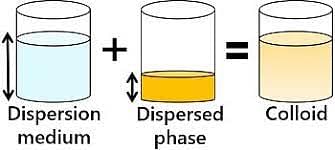
A Colloid is referred to as a heterogeneous mixture where minute particles of one substance get dispersed in another substance, the dispersion medium.
- Colloids stand between the two extreme phases of solutions and suspensions.
- It is the particle size that differentiates between a solution and a colloidal dispersion.
- Unlike a solution that consists of ions or small molecules, colloidal particles are large with diameters ranging between 1 to 1000 nanometres (10–9 to 10–6 m).
- These particles are tiny enough to get dispersed and remain suspended in the medium.
- Particles in colloidal dispersions have a large surface area per unit mass due to their small size.
- This characteristic stands responsible for some unique properties of colloids.
- The dispersed phase in colloids can be solid, liquid, or gas, whereas the continuous phase is generally a liquid.
Colloids have unique properties, such as the ability to exhibit the Tyndall effect (the scattering of light in a colloid), and they have important applications in industries such as food, medicine, and cosmetics.
Also Read:
| Related Articles | ||
|---|---|---|
| Heterogeneous Reaction | Fischer Projection | Acid Base Catalysis |
| Latex chemical compound | Flocculation | Fischer Esterification Mechanism |
Applications of Colloids
[Click Here for Sample Questions]
There are numerous applications of colloids which include:
- Colloids are widely used in the food industry. Most food items that we consume are colloidal in nature. They include milk, cheese, ice cream, and mayonnaise.
- They are used as thickening agents in industries for manufacturing products such as lotions, toothpaste, lubricants, coatings etc.
- Colloids are used for manufacturing inks and paints. The ink used in the ball-point pen is an example of a liquid-solid colloid.
- Colloids are used for purifying water by removing suspended impurities. Sulfates of aluminium (alum) and iron are used, which coagulate the impurities in water.
- Sewage water and smoke, both represent a colloidal system and can be purified via the process of electrophoresis.
- Antibiotics like streptomycin and penicillin are given to patients in the form of colloids as it helps the body to absorb the medication easily.
- For maintaining muscle vitality, colloidal calcium and gold can be prescribed, which is often injected into the patient’s body.
- Argyrol which is a silver sol is used as an eye lotion. Dextran, Hetastarch and Albumin are some other colloidal mediums used in the medical field.
- In fertile soil, colloids are present in the form of humus and clay and they play a vital role in the storage and exchange of essential minerals.
- The micelles formed during the cleansing action of soaps are colloidal in nature.
- Rubber is obtained as a result of the coagulation of a colloidal solution called latex.
- They are used in the preparation of anti-syphilis antibodies.
- Colloids like copper colloids are used as anti-cancer medications.
- Colloids have got large-scale usage in dentistry, the cosmetic industry, and plastic surgery. They are even used for wound dressing.
- Colloids are used in the process of tanning, where the skin of animals is treated to obtain leather.
- Colloids are used to prepare many nanoparticles and materials.
- They are often used as pesticides and fungicides.
- Colloids are used in metallurgy during froth floatation.
- Colloids are used in many cosmetics products to soothe and moisturize skin.
- They are used in water treatment, soil remediation, and air purification.
Natural Applications of Colloids
Some of the natural applications of colloids include –
Blue sky
The blue color of the sky is a result of the scattering of sunlight by atmospheric particles. These include colloidal particles such as water droplets and air molecules. These colloidal particles scatter short-wavelength blue light more than longer-wavelength red light, giving the sky its blue color.
Rain, fog, and mist
Rain, fog, and mist are examples of colloidal suspensions of water droplets in the air. These colloidal suspensions play an important role in the water cycle, as they help to transport water vapor from the atmosphere to the ground.
Blue color of sea
The blue color of the sea is also due to the scattering of light by colloidal particles in the water, including dissolved organic matter, plankton, and other microscopic particles. The scattering of blue light by these colloidal particles gives the sea its blue color, while the absorption of other colors by the water can give rise to green, red, or other hues in different parts of the ocean.
Examples of Colloids
[Click Here for Sample Questions]
Given below are a few examples of colloids among many:
- Most of the food items that we consume are colloidal in nature. They include bread, cake, butter, cream, margarine, ice cream, whipped cream, fruit juices etc.
- Certain natural phenomena like mist, clouds, fog, rain etc are instances of colloids.
- Dust and smoke are also colloidal in nature.
- The blue colouration of the sea and that of the sky is a result of suspended colloidal impurities present in water and air that scatter blue light.
- Sewage, humus, and clay are also examples of colloids.
- Milk is a colloid with fat droplets suspended in water. The fat droplets are the dispersed phase, while water is the continuous phase.
- Blood is a colloid consisting of red and white blood cells, as well as other particles, suspended in plasma.
Things to Remember
- Colloids are heterogeneous mixtures where fine particles of one substance get dispersed in the dispersion medium.
- It is the particle size that distinguishes between a solution and a colloid (particle size ranging between 1 to 1000 nm.)
- Colloids exhibit many properties like the Tyndall effect, Brownian movement etc.
- Food materials like bread, cake, milk, butter, cream, margarine, ice cream, whipped cream, and fruit juices; clay, mud, humus, mist, cloud etc are some examples of colloids.
- Colloids can be used to create stable suspensions, emulsions, and gels with enhanced stability, improved texture, and controlled release of active ingredients.
- Colloids also have important environmental applications, such as in water treatment and soil remediation
Also Read:
Sample Questions
Ques. What is a colloid? (3 marks)
Ans: Colloids are tiny mixtures in which insoluble particles of one substance are suspended in another. They are also often called colloidal solutions or colloidal systems. Colloids are made up of chemical molecules that are evenly scattered within each other.
- Colloids are mixes in which one or more chemicals are scattered throughout a solid, liquid, or gaseous medium as relatively large solid particles or liquid droplets.
- A colloid’s particles are generally electrically charged and remain scattered and do not settle owing to gravity.
- They are mixtures in which one or more chemicals are dispersed as relatively large solid particles or liquid droplets throughout a solid, liquid, or gaseous media.
- The particles in a colloid are usually electrically charged, and they remain distributed and do not settle due to gravity.
Ques. How can we identify a substance as a colloid? (2 marks)
Ans: A colloid mixture can be distinguished from a solution using the Tyndall effect. This is the point when a light is shone through the mixture. Light shows through when it bounces off the particles, suggesting that you have a colloid mixture.
Ques. Are colloids homogeneous mixtures? (2 marks)
Ans: Colloidal particles are light-scattering big molecules or groups of smaller species. Colloids are homogeneous on a macroscopic or visual scale, whereas solutions are homogeneous on a microscopic or molecular scale.
Ques. Define the following: (3 marks)
(1) Peptization
(2) Shape-selective catalysis
(3) Tyndall effect
Ans:1. Peptization: it is the process of shaking a new precipitate with the dispersion medium in the presence of a little amount of a suitable electrolyte to convert it into colloidal particles.
- Shape-selective catalysis: is a catalytic reaction that occurs when tiny molecules are absorbed in the pores and cavities of selective adsorbents such as zeolites.
- Tyndall Effect: When a beam of light passes through a colloidal solution and is seen perpendicular to the path of the incident light, the route of the light appears as a bright streak. Tyndall cone is the name of the illuminated or lit route, and the Tyndall effect is the name of the phenomena.
Ques. What do you mean by emulsions? Mention any two applications of it. (3 marks)
Ans: Emulsion refers to a colloidal solution where both the dispersed phase and dispersion medium are in the liquid state. An emulsion is a liquid-liquid colloidal system. For example, Milk is an emulsion of liquid fat in water (dispersion medium), and cod liver oil is an emulsion where water is the dispersed phase and oil is the dispersion medium.
Two applications of emulsions are:
- Many oily drugs and medications are prepared in the form of emulsions.
- Emulsification is the process by which the digestion of fats takes place in the intestines.
Ques. What is adsorption? List two applications of it. (3 marks)
Ans: Sorption refers to a physical and chemical process by the means of which one substance gets attached to another. Sorption is the common term used to distinguish between absorption and adsorption. Adsorption refers to a surface phenomenon that only occurs at the adsorbent’s surface.
Applications include:
- Decolourisation of sugar: Sugar is decolourized by adding charcoal powder to the sugar solution, which eventually adsorbs any unwanted colours.
- All gas devices have an appropriate adsorbent, which adsorbs dangerous gasses in the atmosphere and purifies the air for breathing.
Ques. Differentiate between physisorption and chemisorption? (4 marks)
Ans: The differences between physisorption and chemisorption are:
| Chemisorption | Physisorption |
|---|---|
| Initially, chemisorption increases with the increase in temperature, but it decreases after adsorption. | Physisorption decreases with the increase in temperature. It is independent of temperature. |
| The process requires high activation energy | Requires low or no activation energy. |
| Chemisorption is highly specific in nature as it only occurs when there is any possibility of the formation of compounds. | Physisorption is not specific in nature. |
| Irreversible in nature, since the formation of compounds takes place. | Reversible in nature. |
For Latest Updates on Upcoming Board Exams, Click Here: https://t.me/class_10_12_board_updates
Check-Out:



Comments