


Explain why hot air is lighter than cold air.

Collegedunia Team logo

Collegedunia Team

Content Curator

The density of air is related to the refractive index of the medium. The refractive index is the ratio of the speed of light in a vacuum to the speed of light in a given medium. It is well-known that the speed of light in air increases with temperature, i.e., the refractive index of air decreases with increasing temperature.

  • When air is heated, it expands and becomes less dense than the surrounding cool air.
  • The molecules of hot air move faster and farther apart, which reduces the density of the hot air.
  • The hot air, being less dense, rises above the cooler air, which creates convection currents.
  • These convection currents are responsible for the movement of heat from the earth's surface to the upper atmosphere, where it can be radiated away into space.
  • The refractive index of the hot air is lower than that of the cold air, so the hot air rises above the cold air, which is why hot air balloons rise.

In summary, hot air is lighter than cold air due to its lower density, which is caused by the faster movement and further apart of the molecules of hot air. This leads to a lower refractive index of hot air than that of cold air, which causes the hot air to rise above the cold air.
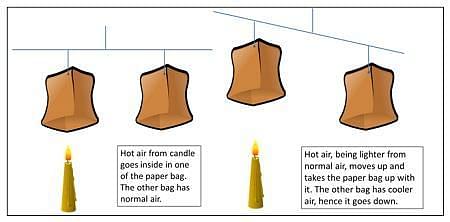
Hot air is lighter than cold air

Hot Air is Lighter than Cold Air

Also check:

CBSE CLASS XII Related Questions

  • 1.
    Derive an expression for the capacitance of a parallel plate capacitor of plate area A and plate separation d with air present between the plates.


      • 2.
        Two air-filled capacitors of capacitances $C_1$ and $C_2$ are connected in parallel with a dc battery. After the capacitors are fully charged, a slab of dielectric constant K is inserted between the plates of each capacitor. How will the (i) charge on each capacitor and (ii) energy stored in the capacitor affected after the slab is introduced.


          • 3.
            A charged particle $+q$ in an electric field $\vec{E}$ experiences a force in the direction of the electric field. As a result, its kinetic energy changes. Similarly, the charged particle also experiences a force when it moves in a magnetic field $\vec{B}$. But this magnetic force is perpendicular to both velocity $\vec{v}$ of the charged particle and the magnetic field $\vec{B}$, so it cannot change the kinetic energy of the charged particle. Consider two charged particles 1 and 2 of masses $m$ and $\frac{m}{2}$ having charges $-q$ and $+2q$ respectively. They are accelerated from rest through the same potential difference $V$ and acquire kinetic energy $K_1$ and $K_2$. Then they enter in a region of uniform magnetic field $\vec{B}$ perpendicular to their velocities.


              • 4.
                Read the following paragraph and answer the questions that follow.
                In an experiment with convex lens of focal length f, the screen is fixed at a distance D from the object. A student slowly moves the lens away from the object towards the screen and finds that she is able to form sharp image of the object for two positions of the lens. The distance between these two positions of the lens is d.


                  • 5.
                    With the help of a labelled diagram, explain the principle, construction and working of an a.c. generator.


                      • 6.
                        This ‘average velocity’ is found be few mm/s for currents in range of a few amperes. How then is current established almost the instant a circuit is closed ?

                          CBSE CLASS XII Previous Year Papers

                          Comments


                          No Comments To Show
