



Education Content Expert
Ferric Chloride is an inorganic compound with the chemical formula FeCl3. It is an iron coordination compound that functions as an astringent as well as a Lewis acid.
- Ferric Chloride is a pale greenish-yellow solid soluble in water.
- It is often used as a coagulant in water treatment.
- It is used in the production of pigments, dyes, and other industrial chemicals.
- Ferric chloride is highly corrosive and can cause irritation to the skin and eyes.
- It has numerous commercial, medical, and laboratory applications.
- Ingestion of ferric chloride can lead to nausea, vomiting, and diarrhoea.
- Handling of ferric chloride should be done with caution, and appropriate protective equipment should be worn.
Key Terms: Ferric Chloride, Iron, Molysite, Iron (III) Chloride, Crystalline Solid, Chlorine, Ferric Chloride Test
What is Ferric Chloride?
[Click Here for Sample Questions]
Ferric chloride is a dark colour crystal iron compound with the +3 oxidation state of iron.
- Ferric Chloride has the chemical formula FeCl3.
- It is also referred to as Iron (III) Chloride or Molysite.
- It is soluble in water and is not flammable.
- The anhydrous compound has a melting point of 307.6 °C and is a crystalline solid.
- Its crystals appear dark green when reflected but purple-red when transmitted.
Nature of Ferric Chloride
[Click Here for Previous Year Questions]
Ferric chloride (FeCl3) is a common iron and chlorine compound in which the iron has a +3-oxidation state.
- It is also known as Iron (III) chloride or Iron trichloride.
- Apart from ferric chloride, it is also known as molysite and flores martis.
- It comes in a variety of colours, including black-green or purple in its anhydrous form and yellow solid in its hydrous form.
- Molysite solution is colourless to light brown with a mild odour of hydrochloric acid (HCl).
- It is non-combustible and is commonly used in water and sewage treatment.
- Even though iron is a metal and chlorine is a nonmetal, it is a covalent combination.
- Because chlorine is more electronegative than iron, it pulls a shared electron pair towards itself in ferric chloride, while iron receives a partial positive charge.
- It is deliquescent in its anhydrous state.
- In addition, partial hydrolysis occurs as it collects water from the air and releases hydrogen chloride (HCl), which creates mists in the damp air. It is a powerful Lewis acid.
Read More:
Properties of Ferric Chloride
[Click Here for Sample Questions]
The properties of ferric chloride are as follows:
- Chemical Formula of Ferric Chloride: FeCl3
- Molar Mass of Ferric Chloride: 162.2 g/mol
- Melting Point of Ferric Chloride: 307.6oC
- Boiling Point of Ferric Chloride: 316oC
- Density of Ferric Chloride: 2.90g/cm3 (Anhydrous Form)
Structure of Ferric Chloride
[Click Here for Previous Year Questions]
Ferric Chloride forms four hydrates. All forms of Iron (III) Chloride have two or more chlorides as ligands, and three hydrates have FeCl4.
The structure of Ferric Chloride is as follows:
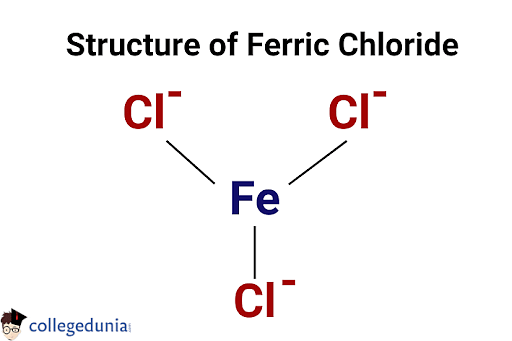
The structure of Ferric Chloride
Reactions of Ferric Chloride
[Click Here for Sample Questions]
The important reactions of Ferric Chloride are as follows:
- With Iron (III) Oxide: FeCl3+Fe2O3 \(\to\) 3FeOCl
- With Copper (I) Chloride: FeCl3 +CuCl \(\to\) FeCl2+CuCl
- With Chlorobenzene: 2FeCl3+C6H5Cl \(\to\) 2FeCl2+C6H4Cl2+HCl
- Reaction with Organometallic Compound (LiCH3): 2FeCl3 + LiCH3 \(\to\) FeCl2 + LiFeCl4 + CH3
Preparation of Ferric Chloride
[Click Here for Previous Year Questions]
The preparation of anhydrous ferric chloride takes place by the reaction of iron and chlorine.
The reaction for the Preparation of Ferric Chloride is as follows:
| 2Fe(s) + 3Cl2(g) \(\to\) 2FeCl3(s) |
Preparation of Aqueous Ferric Chloride
Aqueous ferric chloride can be made by the following three methods
(I) By Dissolving Iron Ore In HCl
Fe3O4(s) + 8HCl(aq) \(\to\) FeCl2(aq) + 2FeCl3(aq) + 4H2O(l)
(II) By Oxidation of Ferrous Chloride With Chlorine
2FeCl2(aq) + Cl2(g) \(\to\) 2FeCl3(aq)
(III) By Oxidation of Ferrous Chloride With Oxygen
4FeCl2(aq) + O2 + 4HCl \(\to\) 4FeCl3(aq) + 2H2O(l)
Ferric Chloride Test
[Click Here for Sample Questions]
Ferric Chloride Test is used to determine the presence or absence of phenol in a sample. It is a conventional phenol colorimetric test. It is carried out in the following manner:
- Neutralise 1 percent ferric chloride solution with sodium hydroxide until a small precipitate of FeO (OH) forms. It is filtered before being used.
- The organic sample or substance is dissolved in ethanol, methanol, or water.
- The above-mentioned neutralised ferric chloride solution is now introduced to the test containing the sample solution.
- If there is a transient or permanent purple, green, or blue colouring in the sample, it suggests the presence of a phenol or enol group.
- If the sample is insoluble in water, it can be dissolved in dichloromethane (CH2Cl2) along with a small quantity of pyridine (C5H5N).
Uses of Ferric Chloride
[Click Here for Previous Year Questions]
Ferric Chloride is widely used in industrial and laboratory settings. Its main uses are explained as follows:
Industrial Uses of Ferric Chloride
The industrial uses of the Ferric Chloride are as follows:
- Iron (III) chloride is utilised as a coagulant and flocculant in sewage treatment and drinking water production.
- It's also used as a bleaching agent in chloride hydrometallurgy, such as for making Si from FeSi (Silgrain process).
- In the manufacture of printed circuit boards, another key application of iron(III) chloride is etching copper in a two-step redox reaction to copper(I) chloride and then to copper(II) chloride.
- Iron(III) chloride is employed as a catalyst in the reaction of ethylene with chlorine, resulting in ethylene dichloride (1,2-dichloroethane), a valuable commodity chemical primarily used in industrial manufacturing of vinyl chloride, the monomer needed to make PVC.
Laboratory Uses of Ferric Chloride
The uses of Ferric Chloride in Laboratory are as follows:
- Iron(III) chloride is extensively implemented in the laboratory as a Lewis acid to catalyse processes such as aromatic chlorination and the Friedel–Crafts reaction.
- It can also be used to test for gamma-hydroxybutyric acid and gamma-butyrolactone.
- It is a drying reagent in a variety of procedures. It's used to get rid of the aluminium coating on mirrors.
- It is used in veterinary medicine to treat overcropping of an animal's claws, especially when the overcropping causes bleeding.
- Used to evaluate the resistance of stainless steel and other alloys to pitting and crevice corrosion.
Check More:
Things to Remember
- Ferric Chloride is an inorganic chemical with the chemical formula of FeCl3.
- It is a covalent compound, even though iron is a metal and chlorine is a nonmetal.
- The reaction for preparation of Ferric Chloride is 2Fe(s) + 3Cl2(g) \(\to\) 2FeCl3(s).
- Ferric Chloride Test is used to determine the presence or absence of phenol in a given sample.
- Ferric Chloride has a variety of uses in laboratories and industries.
Previous Years’ Questions
- Anhydrous ferric chloride is prepared by… (JEE Advanced - 2002)
- Iron exhibits +2 and + 3 oxidation states. Which of the following… (AIEEE - 2012)
- Iron carbonyl, Fe(CO)5 is… (NEET - 2018)
- Why is ferric hydroxide colloid positively charged when…
- What is the net charge on ferrous ion…
- The number of unpaired electrons in ferrous ion… (MP PMT - 1995)
- Cold ferrous sulphate solution on absorption of… (WBJEE - 2015)
- 3.92g of ferrous ammonium sulphate react completely… (BITSAT - 2014)
- Iron can be obtained by reduction of iron oxide…
- Chemical formula for iron(III) hexacyanoferrate(II) is…
Sample Questions
Ques. What is Ferric Chloride? (1 Mark)
Ans. Ferric chloride is an inorganic compound with the formula FeCl3. It is a common iron chemical in the +3 oxidation state. The anhydrous compound has a melting point of 307.6 °C and is a crystalline solid. It has numerous commercial, medical, and laboratory applications.
Ques. How can one obtain Ferric Chloride from Ferrous Sulphate? (3 Marks)
Ans. Ferric Chloride can be obtained from Ferrous Sulphate by the chemical reaction. This reaction is a redox reaction where reduction and oxidation are carried out simultaneously.
- 3Cl2 + 6FeSO4 \(\to\) 2Fe2(SO4)3 + 2FeCl3
- 6Cl + 6e- \(\to\) 6Cl-1 (Reduction)
- 6Fe+2 – 6e- \(\to\) 6Fe+3 (Oxidation)
Cl2 is an oxidising agent, whereas FeSO4 is a reducing agent. Thus ferrous sulphate gives FeCl3 on reaction with Cl2
Ques. List two industrial uses of ferric chloride. (2 Marks)
Ans: Ferric chloride is a chemical compound with a variety of industrial uses. Some of the most common industrial uses of ferric chloride include:
- Pigment Production: Ferric chloride is used in the production of pigments, such as iron oxide pigments, which are used in a wide range of products including paints, plastics, and construction materials.
- Dye Production: Ferric chloride is used in the production of dyes, such as vat dyes, which are used in the textile industry.
Ques. What are the properties of ferric chloride? (3 Marks)
Ans. The properties of ferric chloride are as follows:
- Molar Mass: 162.2 g/mol
- Melting Point: 307.6 oC (Anhydrous Form)
- Boiling Point: 316 oC (Anhydrous Form)
- Density: 2.90g/cm3 (Anhydrous Form)
Ques. Why is ferric chloride favoured over potassium chloride in the case of a bleeding cut? (2 Marks)
Ans. When compared to potassium chloride, ferric chloride is a more potent coagulant. This is because the valency of iron in ferric chloride is 3+, whereas potassium in KCl is 1+. The higher the valency, the better the compound's coagulation efficiency. Furthermore, ferric chloride is more skin-friendly than KCl. As a result, when applied to a wound, FeCl3 causes no irritation.
Ques. Identify the presence of Phenol with the Ferric Chloride Test. (5 Marks)
Ans. Ferric Chloride test is based on the fact that phenols produce a colourful complex when combined with a neutral ferric chloride solution. Phenol group reacts with the ferric ion of ferric chloride and forms a coloured complex such as C6H5OH (simplest phenol) reacts with ferric chloride and forms a violet-coloured complex [Fe(C6H5O)6]3-
Procedure
- To make a neutral ferric chloride solution, steadily add diluted NaOH solution to the ferric chloride solution until a permanent brown precipitate is formed.
- Filter it now to remove the precipitate. The resulting clear filtrate is used to test for phenols. It should be freshly prepared for the test.
- Fill a test tube with 3 ml of the provided solution and add newly made neutral ferric chloride solution dropwise. Take note of the hue shift.
Observation
If the colour of the solution changes to blue, green, violet, or red, this indicates the existence of a phenol group. The colour violet or blue is produced by ortho, meta, para – cresol, or resorcinol. - naphthol produces green colour while - naphthol produces pink colour. Formic acid with acetic acid provides a deep red colour.
Result: The proposed solution contains phenol as a result.
Precautions: Use a freshly made, dilute, and neutral ferric chloride solution.
Ques. List five laboratory uses of ferric chloride. (5 Marks)
Ans. Ferric chloride is a chemical compound with a variety of uses in the laboratory. Some of the most common laboratory uses of ferric chloride include:
- Water Treatment: Ferric chloride is often used as a coagulant in water treatment, as it can help to remove impurities and contaminants from water.
- Staining: Ferric chloride can be used as a staining agent in histology, as it can help to visualise the presence of certain tissues or cells.
- Electroplating: Ferric chloride can be used as an electrolyte in electroplating, allowing for the deposition of a thin layer of metal onto a surface.
- Etching: Ferric chloride can be used to etch metal surfaces, such as copper or brass, allowing for the creation of patterns or designs.
- Synthesis: Ferric chloride can be used as a catalyst or reagent in the synthesis of a wide range of chemicals, including pigments, dyes, and other industrial chemicals.
Ferric chloride is a versatile compound with a wide range of uses in the laboratory. It is important to handle ferric chloride with caution, as it is highly corrosive and can cause irritation to the skin and eyes.
Ques. How is aqueous ferric chloride prepared? (5 Marks)
Ans. Aqueous ferric chloride can be prepared by dissolving ferric chloride crystals in water. The following is a general procedure for preparing aqueous ferric chloride:
- Obtain ferric chloride crystals and water.
- Wear protective goggles and gloves, as ferric chloride is a corrosive substance.
- Measure out the desired amount of ferric chloride crystals.
- Slowly add the ferric chloride crystals to a container of water, stirring constantly.
- Continue stirring until the ferric chloride crystals are fully dissolved. The resulting solution will be a pale greenish-yellow colour.
- If necessary, adjust the concentration of the solution by adding more water or ferric chloride crystals.
- Store the aqueous ferric chloride solution in a sealed container, in a cool, dry place.
Ques. How is ferric chloride made by oxidation of ferric chloride with chlorine? (2 Marks)
Ans: Ferric chloride is made by oxidation of Ferrous Chloride with Chlorine through the following reaction:
2FeCl2(aq) + Cl2(g) \(\to\) 2FeCl3(aq)
Ques. What is a ferric chloride test and how is it done? (3 Marks)
Ans. Ferric Chloride Test is used to determine the presence or absence of phenol in a sample. It is a conventional phenol colorimetric test. It is carried out in the following manner:
- Neutralise a 1 percent ferric chloride solution with sodium hydroxide until a small precipitate of FeO(OH) forms. It is filtered before being used.
- The above-mentioned neutralised ferric chloride solution is now introduced to the test containing the sample solution.
- If there is a transient or permanent purple, green, or blue colouring in the sample, it suggests the presence of a phenol or enol group.
Check-Out:



Comments