



Content Curator
Diarrhea is a common problem in which an individual faces continuous passing of loose, watery stool. Some possible causes of diarrhea include food poisoning, infections, food allergies or intolerances, and medication.
Also Read: Human Bacterial Diseases
| Table of Contents |
Key Terms: Diarrhea, Digestive Disorder, Stool, Food Allergy, Dehydration, Digestive System, Chronic Disease, Acute Disease
What Is Diarrhea?
[Click Here for Previous Year Questions]
Diarrhea is termed as a condition where a person experiences more loose and watery stools. It is a common sign of gastrointestinal disease, but also may be the primary disorder outside of the digestive system.
The primary cause of diarrhea is when there is either in reduction of absorption of fluid by the intestines or an increase in the secretion of fluid or speedy passage of stool.
When diarrhea lasts more than a few days to weeks, it usually indicates another problem - such as irritable bowel syndrome (IBS) or persistent infection, celiac disease, or inflammatory bowel disease (IBD).
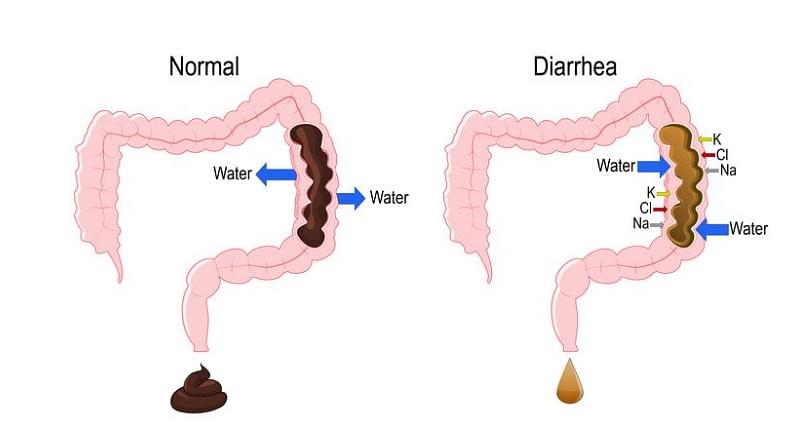
Diarrhea
Read More:
Symptoms Of Diarrhea
[Click Here for Sample Questions]
Symptoms of diarrhea are:
- Loose or watery stools
- Vomiting
- Nausea
- Cramps
- The feeling of a bowel movement
- Abdominal pain
- Fever
- Bloody stools (rare cases)
Also Read: Antacids
Types Of Diarrhea
[Click Here for Previous Year Questions]
There are two types of diarrhea, specified below:
Acute Diarrhea
In actual diarrhea there is three to four watery and explosive stool per day. It can be caused by infections. Diarrhea begins 12 hours to four days after exposure and resolves within three to seven days, but sometimes, the cause is not known. Children are most likely at risk for diarrhea.
This can be bacterial, viral, or parasitic and include:
- Food poisoning: Which basically occurs when you eat food that is contaminated with bacteria
- Traveler's diarrhea: It is caused by eating contaminated food or drinking contaminated or non-drinkable water
- Stomach flu: Stomach flu is typically spread by contact with an infected person or through contaminated food or water
- Other symptoms: Abdominal cramps, fever, vomiting, weakness
Chronic Diarrhea
Diarrhea that lasts for weeks or months & is caused by either an infection or caused by an underlying medical condition or one of many other causes, such as;
- Celiac Disease
Celiac diarrhea is large, greasy, and bad-smelling stools. It also includes constipation and smelly feces. People with celiac disease experience inflammation in the small intestine after eating gluten. It lasts for more than 4 weeks.
Symptoms of celiac diarrhea are: Unintended weight loss, lack of energy, and lack of growth in children.

Celiac Disease
- Food Allergy
A food allergy is when the body's immune system reacts vigorously to specific foods. The reactions are mild but can be very serious. Symptoms are seen within 2 hours after consumption. Symptoms of a food allergy can affect different areas of the body
The symptoms of food allergy are: hives, itchy skin, congestion, vomiting, swelling of the face, tongue, or throat watery or bloody stole.
- Food Intolerance
Food intolerance is caused by a lack of enzymes needed to digest a specific food. Symptoms are abdominal cramps, pain, or gas and appear within two to twelve hours. The stool appears to be watery and sometimes contains mucus. Food intolerance lasts for more than 4 weeks.
Also Read: Disorders of the Excretory System
Causes Of Diarrhea
[Click Here for Sample Questions]
The main causes of diarrhea are:
- Viruses: Viruses such as; norovirus, astrovirus, cytomegalovirus, and viral hepatitis, Rotavirus & coronavirus disease 2019 (COVID-19).
- Bacteria and parasites: Exposure to bacteria, or parasites through contaminated food or water, leads to diarrhea.
- Medications: Many antibiotics can cause diarrhea. As antibiotics treat infections by killing bad bacteria, but they also kill good bacteria.
- Lactose intolerance: People who have difficulty digesting lactose have diarrhea after eating dairy products.
- Fructose: Fructose is a sugar found naturally in fruits and honey. Fructose can lead to diarrhea in people who have trouble digesting it.
- Artificial sweeteners: Artificial sweeteners are non-absorbable sugars that can cause diarrhea in some otherwise healthy people.
- Other: Some other causes such as IBS, Crohn's disease, ulcerative colitis, celiac disease, microscopic colitis, and small intestinal bacterial overgrowth (SIBO).
When To See A Doctor:-
1) Adult should visit a doctor in the below-mentioned cases:
- When diarrhea takes more than two days with no improvement to recover
- When the body becomes dehydrated
- When have severe abdominal pain
- When have bloody or black stools
- Fever above 102 F (39 C)
Also Read: Difference Between Secretion and Excretion
2) Children need a doctor in the following case:
- When diarrhea doesn't improve within 24 hours
- Body is dehydrated
- Fever above 102 F (39 C)
- Bloody or black stools.
Indications Of Dehydration In Adults:-
Indications of dehydration in adults are:
- Excessive thirst
- Dry mouth or dry skin
- Little urination or no urination
- Weakness, dizziness, or lightheadedness
- Fatigue
- Dark-colored urine.
Indications Of Dehydration In Infants And Young Children:-
Indications of dehydration in infants and children are as specified:
- Not having a wet diaper for three or more hours
- Dry mouth and tongue
- Fever above 102 F (39 C)
- Crying without tears
Treatment Of Diarrhea
[Click Here for Previous Year Questions]
Generally, acute diarrhea will recover on its own, within 2 to 3 days without any treatment. Antibiotics may be helpful if the symptoms are caused by bacterial or parasitic infections.
Consult a gastroenterologist if the problem persists for more than a week.
Mostly, self-care to relieve symptoms is usually sufficient for treatment:
- Avoid caffeine, dairy products, and greasy, high fiber, or sugary foods,
- Placing a hot water bottle or wheat pack on your stomach,
- Avoid taking non-steroidal anti-inflammatory drugs (NSAIDs), such as aspirin, ibuprofen, or diclofenac,
- To avoid dehydration, drink plenty of liquid every day, taking small, frequent sips.
Things To Remember
- The primary cause of diarrhea is when there is either in reduction of absorption of fluid by the intestines.
- Diarrhea is of two types: (i) Actual Diarrhea (ii) Chronic Diarrhea
- BRAT diet can cure diarrhea in a few days.
- Food allergies can also cause diarrhea, with symptoms such as hives, itchy skin, and congestion.
- Celiac diarrhea is large, greasy, and bad-smelling stools. It includes constipation and smelly feces.
Read More:
Previous Year Questions
- The characteristic that is shared by urea... [KCET 2009]
- The primary dentition in humans differs from... [NEET 2015]
- Stool of a person contain whitish grey colour due to... [NEET 2002]
- Food is moved along the alimentary canal by the contraction known as... [JIPMER 2003]
- A baby boy aged two years is admitted to play school and passes through a dental check - up. The dentist observed that the boy had twenty teeth. Which teeth were absent?… [NEET 2017]
- Which cells of "Crypts of Lieberkuhn" secrete antibacterial lysozyme?... [NEET 2017]
- Secretin and cholecystokinin are digestive hormones. They are secreted in….[NEET 2005]
- Which of the following statements is not correct?... [NEET 2015]
- If for some reason the parietal cells of the gut epithelium become partially non-functional, what is likely to happen?... [NEET 2010]
- Jaundice is a disorder of... [NEET 2010]
- Duodenum has characteristic Brunner's gland which secrete two hormones called...[NEET 2004]
- A healthy person eats the following diet-5 gm raw sugar,. 4 gm albumin, 10 gm pure buffalo ghee adultrated with 2 gm vegetable ghee (hydrogenated vegetable oil) and 5 gm lignin. How many calories he is likely to get?...[NEET 2013]
- A person who is eating boiled potato, his food contains the component...[NEET 2000]
- Anxiety and eating spicy food together in an otherwise normal human, may lead to...[NEET 2012]
- Calcium deficiency in the body occurs in the absence of...[NEET 1994]
- Choose the correct enzyme - substrate pair... [NEET 1996]
- Continuous bleeding from an injured part of body is due to deficiency of...[NEET 2002]
- Duct leading from parotid gland and opening into vestibule is...[NEET 1998]
- During prolonged fastings, in what sequence are the following organic compounds used up by the body...[NEET 2003]
- Emulsification of fat is carried out by...[NEET 1990]
Sample Questions
Ques. Is diarrhea a symptom of Covid-19? (1 Mark)
Ans. No, not always. Diarrhea along with other symptoms of the virus may be an early sign of COVID-19.
Ques. How long should we allow diarrhea? (1 Mark)
Ans. Acute diarrhea can last anywhere from 2 days to 2 weeks with in-home medication.
Ques. What are the indications of dehydration in infants or children? (3 Marks)
Ans. Indications of dehydration in infants and children are as specified:
- Not having a wet diaper for three or more hours
- Dry mouth and tongue
- Fever above 102 F (39 C)
- Crying without tears
Ques. Is drinking water considered safe for diarrhea? (1 Mark)
Ans. Yes as water is best. Drink at least 1 cup of liquid every time you have a loose bowel movement
Ques. What is diarrhea? Explain. (3 Marks)
Ans. Diarrhea is termed as a condition where a person experiences loose and watery stools. It is a common sign of gastrointestinal disease. The primary cause of diarrhea is when there is either in reduction of absorption of fluid by the intestines or an increase in the secretion of fluid or speedy passage of stool.
Diarrhea has two types:
- Acute Diarrhea
- Chronic Diarrhea
Ques. Do people lose weight during diarrhea? (1 Mark)
Ans. People with diarrhea can lose a lot of weight if they've been sick for a while, but they're losing mostly water weight.
Ques. When is an adult with diarrhea is advised to visit a doctor? (4 Marks)
Ans. Adults should visit a doctor in the below-mentioned cases:
- When diarrhea takes more than two days with no improvement to recover
- When the body becomes dehydrated
- When have severe abdominal pain
- When have bloody or black stools
- Fever above 102 F (39 C)
Ques. Discuss acute diarrhea. (4 Marks)
Ans. In actual diarrhea, there is three to four watery and explosive stools per day. It can be caused by infections. Diarrhea begins 12 hours to four days after exposure and resolves within three to seven days, but sometimes, the cause is not known. Children are most likely at risk for diarrhea.
Acute diarrhea includes:
- Food poisoning: Which basically occurs when you eat food that is contaminated with bacteria,
- Traveler's diarrhea: It is caused by eating contaminated food or drinking contaminated or non-drinkable water,
- Stomach flu: Stomach flu is typically spread by contact with an infected person or through contaminated food or water.
- Other symptoms: Abdominal cramps, fever, vomiting, weakness.
- It can also be fungal, bacteria, or parasite.
Ques. Is diarrhea during or before periods is to be considered normal? (2 Marks)
Ans. Hormonal changes taking place during your period may be the cause of menstrual-related diarrhea.
Ques. Which diet help in the fast recovery of diarrhea? (1 Marks)
Ans. The BRAT diet (Bananas, rice, applesauce, and toast) helps in fast & effective recovery of diarrhea. The diet helps in hardening the stool.
Ques. State the cause of diarrhea? (5 Marks)
Ans. Following can be the cause of diarrhea:
- Viruses: Viruses such as; norovirus, astrovirus, cytomegalovirus, and viral hepatitis, Rotavirus & coronavirus disease 2019 (COVID-19).
- Bacteria and parasites: Exposure to bacteria, or parasites through contaminated food or water, leads to diarrhea.
- Medications: Many antibiotics can cause diarrhea. As antibiotics treat infections by killing bad bacteria, but they also kill good bacteria.
- Lactose intolerance: People who have difficulty digesting lactose have diarrhea after eating dairy products.
- Fructose: Fructose is a sugar found naturally in fruits and honey. Fructose can lead to diarrhea in people who have trouble digesting it.
- Artificial sweeteners: Artificial sweeteners are non-absorbable sugars that can cause diarrhea in some otherwise healthy people.
- Other: Some other causes such as IBS, Crohn's disease, ulcerative colitis, celiac disease, microscopic colitis, and small intestinal bacterial overgrowth (SIBO).



Comments