



Content Curator
The Heat of Reaction is also known as the Enthalpy of Reaction. The change in the enthalpy value of a chemical reaction at constant pressure is referred to as the Heat of Reaction or Enthalpy of Reaction.
- It is also a thermodynamic unit of measurement that is used to quantify the amount of energy per mole.
- This energy may be emitted or produced as a result of a reaction.
- The difference between total reactant and total product molar enthalpies estimated for substances in their standard states is the standard enthalpy of reaction for a chemical process.
Read Also: Mole Fraction
| Table of Content |
Key Terms: Thermodynamics, Law of Thermodynamics, Heat of Reaction, Enthalpy Change, Born-Haber Cycle, Spontaneity, Heat
Heat of Reaction
[Click Here for Sample Questions]
Reaction Enthalpy is another name for the heat of a reaction. At constant pressure, the difference in the enthalpy of a certain chemical process is defined. It is the thermodynamic unit of measurement used to calculate the total amount of energy produced or released per mole in a process.
- The heat of a chemical reaction may thus be defined as the heat evolved or absorbed in the surroundings when the reaction occurs at constant pressure and temperature.
- The joule is the unit used to measure the total amount of heat absorbed in a reaction.
- In chemical reactions, heat transmission occurs primarily between the reacting system as one medium and the surrounding media as the other.
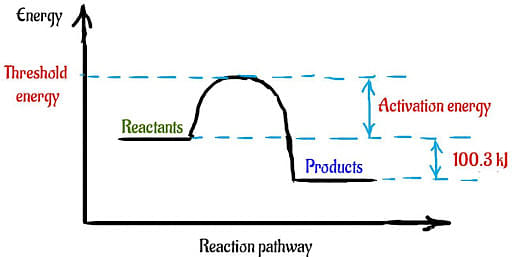
Reaction Enthalpy
Check Also: Atomic And Molecular Masses
The amount of heat energy before and after the chemical process remains constant. In other words, the heat lost or gained in a responding system equals heat lost or gained in the surrounding environment.
Heat of Reaction Formula
[Click Here for Sample Questions]
Therefore, the heat of reaction formula is given by:
\(Q = m \times c \times \triangle T\)
Where,
- m denotes the mass of the medium,
- c denotes the specific heat capacity of the medium,
- ΔT denotes the difference in temperature of the medium.
Also, we have the equation as
\(\text{Heat of reaction} = \triangle H(products) - \triangle H(reactants)\)
Here ΔH represents the change in heat value.
Check Important Notes for Unsaturated Hydrocarbons
Enthalpy Change of Reaction: Reaction Enthalpy
[Click Here for Sample Questions]
Enthalpy change occurs in a system when the matter is converted by a specific chemical reaction when all reactants and products are in their standard states. The change in enthalpy is a highly valuable quantity.
- When planning the heating or cooling it is necessary to keep the enthalpy change during an industrial chemical reaction at a consistent temperature.
- It is also necessary to determine the temperature dependence of the equilibrium constant.
Standard Enthalpy of Reactions
The enthalpy change that occurs in a system when a chemical reaction converts one mole of matter under normal circumstances is referred to as the standard enthalpy of reaction.
To determine the standard enthalpy of the reaction, add the standard enthalpies of formation of the reactants and subtract the value from the sum of the standard enthalpies of formation of the products.
Check More: Carbocation Stability
Enthalpy Changes During Phase Transformations
The change in Enthalpy during phase transformation is given below:
- Enthalpy of fusion: The enthalpy change associated with the transition of one mole of solid material into its liquid state at its melting point.
- Enthalpy of vaporization: Amount of heat required to change 1 mole of liquid into the vapor state.
- Enthalpy of sublimation: The enthalpy change associated with the transition of one mole of solid material into its vapor state at its boiling point.
- Enthalpy of freezing: The enthalpy change associated with the transition of one mole of liquid material into its solid state at its freezing point.

Enthalpy and Phase Transformations
Read More: Cathode Ray Experiment(JJ Thomas)
Standard Enthalpy of Formation
The enthalpy change that happens when 1 mole of a substance is created from its component elements in their standard states is referred to as the standard enthalpy of formation. The standard enthalpy of the formation of a pure element in its standard state is zero.
Thermochemical Equation
A thermochemical equation is a stoichiometric balanced chemical equation that contains the enthalpy change, H. In other words, a thermochemical equation is an equation that includes information on heat change.
Example: (i) C(s) + O2(g) →CO2(g) ; ΔH = -393.5 kJ.
Hess’s Law of Constant Heat
Heat change in a chemical reaction is the same regardless of how many phases the reaction goes through.
- This law is used for Calculating the heat of formation, combustion, neutralization, ionization, and other processes.
- Determine the enthalpies of the reactants and products. Calculating the bond enthalpies and determining the lattice energies of crystalline solids.

Hess’s Law of Constant Heat
Also Read: Cis Trans Isomerism
Born-Haber Cycle
[Click Here for Sample Questions]
Born Haber cycle is a cycle of process enthalpy change that leads to the synthesis of a solid crystalline ionic compound from elemental atoms in their standard state and of the enthalpy of formation of the solid compound so that the net enthalpy becomes zero.

Born Haber cycle
Also Check: Column Chromatography Principle
Born – Haber Cycle Equation
Born-Haber cycle equation is given by
Heat of formation = Dissociation Energy + Sublimation Energy + Ionisation Energies – Electronic Affinities + Lattice Energy

Born – Haber Cycle Equation
Read important: Difference Between Atom and Molecule
Spontaneity
[Click Here for Sample Questions]
A spontaneous process in thermodynamics happens without the introduction of matter or electrical energy into the system.
- A rise in entropy characterizes a spontaneous process in a perfectly isolated system.
- A spontaneous process in a closed system at constant temperature is followed by a drop in the system's free energy and a temporal progression towards a more thermodynamically stable state (closer to thermodynamic equilibrium).
Solved Examples
[Click Here for Sample Questions]
Ques. If Sodium chloride is dissolved in 80g of water at 20 degrees Celsius, the solution obtained after proper stirring has a temperature of 17 degrees Celsius. Determine the heat change during the process of dissolution if a specific heat capacity of the solution is assumed to be 4.18 Jg-1K-1.
Ans. Given parameters are,
- m= 80 g
- c= 4.18 J g-1K-1
- ΔT = 20 – 17 = 3 K
The process entails a temperature drop, which shows that the salt dissolution absorbed heat from the system.
Since heat absorbed by the salt is equal to the heat lost by water,
We have the formula,
Q=mcT
Q = 80 × 4.18 × 3
Therefore, Q = 1003.2 J
Ques. Calculate the heat change which accompanies the combustion of ethanol when a certain mass of a substance is burnt in air to raise the temperature of 100g of water initially at 27-degree Celsius to 40-degree Celsius, given that the specific heat capacity of water is 4.2Jg-1K-1.
Ans. Given parameters are
m = 100g
c = 4.2 Jg-1K-1
ΔT = 40 – 27
ΔT = 13 degrees Celsius or 13 K
According to the question, a particular amount of ethanol is burned to raise the temperature of the water, implying that heat absorbed by water is produced by the ethanol combustion process.
Heat gained by water equals heat lost in the combustion process.
The quantity of heat change can be given by
Q=mcT
Q = 100 × 4.2 × 13
Therefore, Q = 5460 J
Things to Remember
[Click Here for Sample Questions]
- When an exothermic reaction releases heat, the temperature of the reaction mixture rises. In contrast, the temperature of the reaction mixture falls as an endothermic reaction absorbs heat.
- The amount of heat energy available before and after the chemical reaction stays constant. As a result, the heat lost or gained in a reacting system equals the heat lost or gained in the surrounding environment.
- Any spontaneous process that happens at constant pressure and temperature results in a drop in Gibbs free energy, whereas any spontaneous process that occurs at constant volume and temperature results in a decrease in Helmholtz free energy.
- The enthalpy change for a reaction is independent of the number of ways a product can be obtained if the initial and final conditions are the same.
- The negative enthalpy change for a reaction indicates an exothermic process, while positive enthalpy change corresponds to an endothermic process.
Sample Questions
Ques. What are the two factors that favor a spontaneous reaction? [1 mark]
Ans. Enthalpy- Reactions that emit energy are usually spontaneous. Entropy- Entropy is a measure of a system's random or disorder. In general, spontaneous reactions enhance the randomness of the system.
Ques. Explain the laws of Thermodynamics. [3 marks]
Ans. Thermodynamics has three laws:
According to the first law of thermodynamics, energy cannot be generated or destroyed; it can only be transferred or converted from one form to another. It is also known as the Law of Conservation of Energy.
According to the second law of thermodynamics, the entropy of every isolated system always rises. Isolated systems naturally grow towards thermal equilibrium—the system's state of maximum entropy. Simply said, the universe's entropy (the ultimate isolated system) only rises and never decreases.
The third law of thermodynamics says that when the temperature approaches absolute zero, the entropy of a system approaches a constant value. At absolute zero, a system's entropy is normally zero, and its entropy is controlled only by the number of possible ground states it possesses. At absolute zero temperature, the entropy of a pure crystalline solid (perfect order) is zero. This assertion is valid if the perfect crystal has just one state with the least amount of energy.
Ques. Explain lattice energy. [1 mark]
Ans. Lattice Energy is a sort of potential energy that may be described in two ways. The first is the amount of energy necessary to shatter an ionic solid while transforming its atoms into ions (gaseous). Because the reaction is endothermic, this formulation assigns a value to the lattice energy, which is always positive. Second, it is the energy consumed in the reverse process of gaseous ions binding to create atoms of an ionic solid.
Ques. Why is it impossible to convert heat into work without a sink at a lower temperature? [2 marks]
Ans. A portion of the heat energy absorbed from the source must be rejected in order to constantly transform heat energy into work. Because heat energy can only be rejected to a body with a lower temperature, which is a sink, we need a sink to transform heat into work.
If there is a sink at a temperature lower than the temperature of the seawater, the heat engine can transform the internal energy of the seawater. Because there is no such sink, a ship cannot use the internal energy of seawater to power the engine.
Ques. Write down the application of Hess’s law. [2 marks]
Ans: Hess’s law is used in the following ways:
- Hess's law is used to determine the heat of formation, combustion, neutralization, ionization, and other processes.
- It is used to determine the enthalpies of the reactants and products.
- For calculating the bond enthalpies.
- To calculate the lattice energies of crystalline solids.
Ques. If Sodium chloride is dissolved in 100g of water at 25 degrees Celsius, the solution obtained after proper stirring has a temperature of 21 degrees Celsius. Determine the heat change during the process of dissolution if a specific heat capacity of the solution is assumed to be 4.18 Jg-1K-1. [5 marks]
Ans. Given parameters are,
m= 100g
c= 4.18 J g-1K-1
ΔT = 25 – 21 = 4 K
The process entails a temperature drop, which shows that the salt dissolution absorbed heat from the system.
Since heat absorbed by the salt is equal to the heat lost by water,
We have the formula,
Q=mcT
Q = 100 × 4.18 × 4
Therefore, Q = -1672J
Ques. Calculate the heat change which accompanies the combustion of ethanol when a certain mass of a substance is burnt in air to raise the temperature of 200g of water initially at 28-degree Celsius to 42-degree Celsius, given that the specific heat capacity of water is 4.2Jg-1K-1. [5 marks]
Ans. Given parameters are
m = 200g
c = 4.2 Jg-1K-1
ΔT = 42 – 28
ΔT = 14-degree Celsius or 14 K
According to the question, a particular amount of ethanol is burned to raise the temperature of the water, implying that heat absorbed by water is produced by the ethanol combustion process.
Heat gained by water equals heat lost in the combustion process.
Quantity of heat change can be given by
Q=mcT
Q = 200 × 4.2 × 14
Therefore, Q = 11760 J
Ques. Calculate the amount of heat necessary to raise the temperature of 2 moles of HE gas from 200C to 500C using:-
1.) Constant–Volume Process
2.) Constant Pressure Process
Here for, He; CV = 1.5 R and CP = 2.49R [5 marks]
Ans.
- The amount of heat required for constant – volume process is:-
Here, n = 2 moles, CV = 1.5 R = 1.5 X 8.314 J | mol | 0C
T2 = final Temperature
T1 = Initial Temperature
- The amount of heat required for the constant – pressure process is:-
Here, n = 2 moles,
Because the temperature rise is the same in both circumstances, the change in internal energy is also the same, 748J. In a constant–pressure process, however, extra heat is given, which is used in the gas expansion.
Ques. An electric heater provides 100W of heat to a system. If the system works at a rate of 75 Joules per second. At what rate is the internal energy increasing? [5 marks]
Ans. Heat is supplied to the system at a rate of 100 W.
∴Heat supplied, Q = 100 J/s
The system performs at a rate of 75 J/s.
∴Work done, W = 75 J/s
From the first law of thermodynamics, we have
Q = U + W
Where,
U = Internal energy
∴U = Q–W
= 100 –75
= 25 J/s
= 25 W
Therefore, the internal energy of the given electric heater increases at a rate of 25 W.
Ques. In changing the state of a gas adiabatically from an equilibrium state A to another equilibrium state B, an amount of work equal to 22.3 J is done on the system. If the gas is taken from state A to B via a process in which the net heat absorbed by the system is 9.35 cal, how much is the net work done by the system in the latter case? (Take 1 cal = 4.19 J). [5 marks]
Ans. The work done (W) on the system while the gas changes from state A to state B is 22.3 J.
This is an adiabatic process. Hence, the change in heat is zero.
∴ ΔQ = 0
ΔW = –22.3 J (Since the work is done on the system)
From the first law of thermodynamics, we have
ΔQ = ΔU + ΔW
Where
ΔU signifies a change in the internal energy of the gas
∴ ΔU = ΔQ– ΔW = –(–22.3 J)
ΔU = + 22.3 J
When the gas goes from state A to state B via a process, the net heat absorbed by the system is:
ΔQ = 9.35 cal = 9.35 x 4.19 = 39.1765 J
Heat absorbed, ΔQ = ΔU + ΔQ
∴ΔW = ΔQ – ΔU
= 39.1765 – 22.3
= 16.8765 J
Therefore, 16.88 J of work is done by the system.
Also Read:



Comments