


In an astronomical telescope of refracting type, objective has greater focal length. Explain.

Collegedunia Team logo

Collegedunia Team

Content Curator

In an astronomical telescope of refracting type, the objective has a greater focal length because the objective's function is to form a real image of a distant object at its focus. In an astronomical telescope, the objective lens is used to gather the light from distant celestial objects and form a real image at its focus. This real image is then magnified by the eyepiece to form a virtual image.

For a telescope to have a high magnification, the eyepiece must have a short focal length. The magnification of a telescope is given by the ratio of the focal length of the objective to the focal length of the eyepiece. Therefore, to achieve high magnification, the objective should have a greater focal length than the eyepiece.

In addition to this, having a greater focal length also allows for a larger aperture, which means that more light can be gathered by the objective lens. This results in a brighter and sharper image, which is crucial when observing distant celestial objects.

Therefore, to achieve a high magnification and a brighter, sharper image, the objective lens of an astronomical telescope must have a greater focal length.
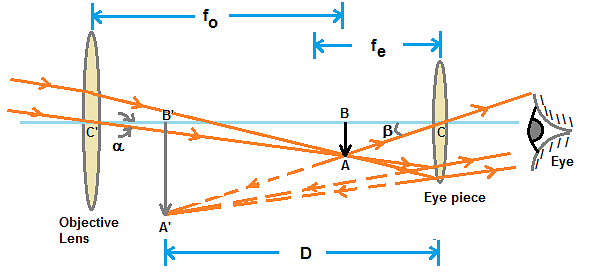
Refracting Astronomical Telescope

Refracting Astronomical Telescope

Also check:

CBSE CLASS XII Related Questions

  • 1.
    Read the following paragraph and answer the questions that follow.
    In an experiment with convex lens of focal length f, the screen is fixed at a distance D from the object. A student slowly moves the lens away from the object towards the screen and finds that she is able to form sharp image of the object for two positions of the lens. The distance between these two positions of the lens is d.


      • 2.
        The resistance of a metal wire at \( 20^\circ \text{C} \) is \( 1.05 \, \Omega \) and at \( 100^\circ \text{C} \) is \( 1.38 \, \Omega \). Determine the temperature coefficient of resistivity of this metal.


          • 3.
            A student sets up the circuit as shown in the figure to find the value of unknown resistance X and records a set of readings of the voltmeter and the ammeter by using the rheostat.


              • 4.
                Read the following paragraph and answer the questions that follow.
                A p-type or n-type semiconductor can be converted into a p-n junction by doping it with suitable impurity. The motion of majority charge carriers causes diffusion current across the junction while the barrier electric field causes motion of minority carriers for drift current. In case of unbiased diode, the diffusion and drift currents are equal. This equilibrium is disturbed by the biasing batteries. Diodes, therefore, allow currents in one direction. This property of diode is used in making rectifiers.


                  • 5.
                    Two air-filled capacitors of capacitances $C_1$ and $C_2$ are connected in parallel with a dc battery. After the capacitors are fully charged, a slab of dielectric constant K is inserted between the plates of each capacitor. How will the (i) charge on each capacitor and (ii) energy stored in the capacitor affected after the slab is introduced.


                      • 6.
                        Derive an expression for the capacitance of a parallel plate capacitor of plate area A and plate separation d with air present between the plates.

                          CBSE CLASS XII Previous Year Papers

                          Comments


                          No Comments To Show
