



Education Journalist | Study Abroad Lead
Optics is the branch of physics that deals with light, its behavioral pattern, and its interaction with matter. The term ‘light’ refers to a form of electromagnetic radiation that enables the human eye to see or make things visible. It is also defined as radiation that is visible to the human eye. Optics is used to describe the behavior of ultraviolet light, visible light, and infrared light.
| Table of Content |
Key Terms: Optics, Wavelength, Reflection, refraction, Electromagnetic waves, Radiation, Light, Human eye, ultraviolet light, visible light, infrared light.
What is Optics?
[Click Here for Sample Questions]
Optics deals with the determination of behavior and the properties of light when it interacts with matter. Optics also studies the instruments used to detect the behavior of light.
- Imaging in science is possible due to an image-forming optical system.
- Optics describes the visibility of matter and its behavior with the help of light.
- The field of optics has a lot of uses in our day to day life.
Read More:
| Optics – Related Topics | ||
|---|---|---|
| Snell’s Law | Toric Lens | Specular diffuse reflection |
| Macro lens | Fermats Principle | Aberration of lens |
Light and its Optical Properties
[Click Here for Previous Year Questions]
Light is a form of an electromagnetic wave existing everywhere around us. Visible light has wavelengths between 400–700 Nanometres. The Sun is the primary source of light utilized by plants to produce their food and energy. Light in physics also refers to electromagnetic radiation that exists in different wavelengths, whether it is visible or invisible to the naked eye. Some radiations which are invisible to the naked are Gamma rays, Microwaves, X-rays, and Radio waves. The optical properties of light are as given below –
Reflection
When an object is placed in front of a mirror, its image is seen in it in the form of reflection in optics.
- The reflection of the object in the mirror is caused by the light.
- Reflection is one of the main properties of light.
- Reflection is defined as the change in the direction of light that strikes at the interface between different mediums.
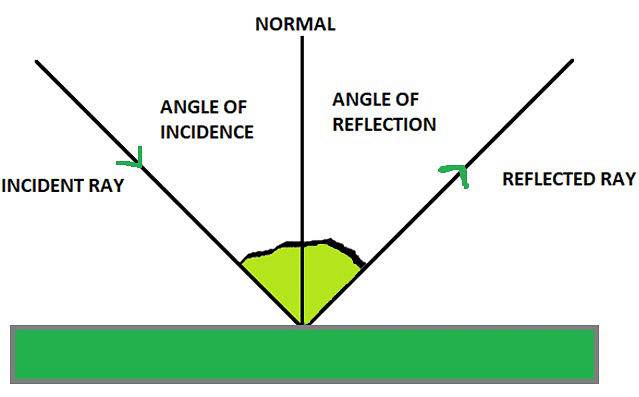
Reflection of Light
Refraction
Refraction refers to the bending of light when it passes from one medium to another.
- This property of refraction of optics is used in a number of devices like corrective lenses, microscopes, magnifying glasses, and so on.
- When the light is passed through a medium its direction is changed because of electron polarization which results in the reduction of the speed of light.
Total Internal Reflection (TIR)
Total Internal Reflection is an optical phenomenon that occurs when the light rays travel from a more optically denser medium to a less optically denser medium.
- For example, light rays when passed through water medium to that of air medium, get refracted at the junction separating the two media.
- The refracted light ray bends away from the normal direction because it passes from a medium with a higher refractive index to that having a lower refractive index.
- The incident ray of light, at a specific angle of incidence (critical angle), is refracted at 90 degrees, passing through the surface of the water.
- The incident ray is reflected back to the medium when the angle of incidence is greater than the critical angle.

Total Internal Reflection
Speed of Light
Speed of light is the speed at which the light waves travel through different mediums.
- The speed of light in a vacuum is 1,86,282 miles per second (2,99,792 kilometers per second).
- In water, the speed of light is 30% lower than compared in Vacuum.
Dispersion
Dispersion is a property of light, where the white light splits into its constituent colors when passed through a certain medium.
- Dispersion in optics can be observed in the form of a prism.
- The rainbow formation is the result of the dispersion of light through raindrops, which acts as a prism.
- Dispersion is also observed when petrol or oil is poured on water, light falls on CDs, soap bubbles, and plastic scales.
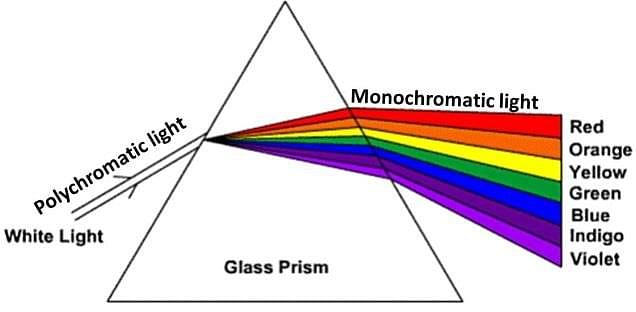
Dispersion in Optics
Wave-Particle Duality in Optics
[Click Here for Sample Questions]
The spectrum of visible light is absorbed and emitted in the form of tiny packets of energy called photons. These photons have both the properties of the wave as well as a particle. This property of light is known as wave-particle duality, and it is studied under Optics.
Wave
A wave is a disturbance or oscillation that travels through space-time, accompanied by a transfer of energy. Wave motion transfers energy from one point to another, often with no permanent displacement of the particles of the medium.
Wavelength
The wavelength of light is defined as the distance between the two successive crests or troughs of the light wave. The highest surface part of a wave is called the crest, and the lowest part is the trough.
Electromagnetic Waves
Electromagnetic waves or EM waves are waves that are created as a result of vibrations between an electric field and a magnetic field.
Applications of Optics
[Click Here for Previous Year Questions]
The study of optics has several applications. The properties of optics are applied in various fields of Physics. The applications of optics are-
- The phenomenon of refraction is applied in the case of convex and concave lenses for the purpose of forming an image of the object.
- Geometrical optics is a branch of optics where light is described by rays. It is used in studies of how the images form in an optical system.
- In medical applications, it is used in the optical diagnosis of the defects and mysteries of the human body.
- Optics is also used in therapeutical surgeries of human tissues.
- The correction of some vision disorders by eyeglasses and contact lenses.
- For the study of distant universes through telescopes.
- The discovery of microorganisms through microscopes.
- Lenses, mirrors, lasers, and optical fibers are used in data transmission, storage, and retrieval, in surgery, and in weapons targeting.
Classification of Optics
[Click Here for Sample Questions]
Optics can mainly be classified into 2 groups as follows –
Geometrical optics
Light mostly travels in straight lines. The light is postulated to travel along with rays. Rays are the line segments that are straight in free space but might change direction with the encounter of the matter.
- The two main laws of ray optics are – the law of reflection and the law of refraction.
- From these laws, we can understand the behavior of optical devices such as telescopes and microscopes.
Physical optics
The wave nature of light came into existence to explain the other properties of light such as diffraction and interference.
- Physical optics is the study of the wave properties of light.
- It is roughly grouped into three categories that are polarization, interference, and diffraction.
Relatable Links:
Things to Remember
- Optics deals with light, its behavioral pattern, and its interaction with matter.
- The spectrum of visible light is absorbed and emitted in the form of tiny packets of energy called photons.
- Photons have the properties of a wave as well as a particle.
- Visible light in optics has wavelengths between 400–700 Nanometres.
- The Speed of light is defined as the speed at which the light waves travel through different mediums.
- Dispersion is a property of light in which the white light splits into its constituent colors when passed through a certain medium.
Previous Year Questions
- Limit of resolution of a telescope is 4.88 x 10… [COMEDK UGET 2005]
- Light rays from a luminous (bright point) object in a denser medium of… [COMEDK UGET 2010]
- Lateral shift produced by a glass slab is X. When the slab is immersed in a liquid… [COMEDK UGET 2006]
- If A is the angle of prism, r is angle of refraction, then the condition for minimum… [COMEDK UGET 2014]
- All lights are switched off, except for a bright point-light source kept at the… [COMEDK UGET 2015]
- A prism with a refracting angle 30 degrees, made of material of refractive index 1.732… [COMEDK UGET 2011]
- A plano-convex lens (f=20cm) is silvered at plane surface… [COMEDK UGET 2010]
- A person inside water nw=4/3 sees the 'setting sun' at about… [COMEDK UGET 2008]
- A equiangular glass prism of refractive index 1.6 is kept fully immersed in water… [COMEDK UGET 2015]
- A concave mirror gives an image three times as large as its object placed at a… [COMEDK UGET 2015]
- A concave mirror forms an enlarged, erect, virtual image of an object, only… [COMEDK UGET 2014]
- A bulb is kept at a depth h inside water of refractive index n… [COMEDK UGET 2007]
- A glass hemisphere of radius 0.1 cm and refractive index 1.5 is placed over… [COMEDK UGET 2012]
- The limit of resolution of an optical instrument arises on account of… [GUJCET 2007]
- A critical angle for a medium is 60∘. Then the refractive index of the medium… [GUJCET 2006]
- A telescope has an objective of focal length 100cm and an eye-piece of focal… [BCECE 2009]
- An object is placed at the focus of a convex mirror. If its focal length is… [BCECE 2009]
- A person sees clearly at a distance of 100 cm, then power of lens used… [JCECE 2006]
- A plano-convex lens of refractive index 1.5 and radius of curvature 30cm… [BCECE 2004]
- The twinkling effect of star light is due to… [JCECE 2009]
Sample Questions
Ques: State the conditions for the phenomenon of total internal reflection to occur. (Delhi 2010, 1 Mark)
Ans: Two important conditions for total internal reflection are :
- The light should travel from an optically denser medium to an optically rarer medium.
- The angle of incidence in the denser medium must be greater than the critical angle for both media.
Ques: When light travels from a rarer to a denser medium, the speed decreases. Does this decrease in speed imply a decrease in the energy carried by the light wave? Justify your answer. (All India 2010, 1 Mark)
Ans: No, the energy carried by the lightwave remains the same when the speed of light decreases.
Reason: we know that energy E = hv
Where,
h- Planck's constant
V- Frequency that does not change when light travels from medium to another.
Here, the frequency remains the same and h is a constant. So, there will be no change in the energy.
Ques: What is the dispersion of light? What is its cause? (All India 2011, 1 Mark)
Ans: Dispersion of light is a property by which the white light gets dispersed when passed through a prism. The reason behind this phenomenon is that the refractive index of the glass of the prism is different for different wavelengths (colors). Hence, different colors get bent in different directions.
Ques: When monochromatic light travels from one medium to another its wavelength changes but its frequency remains the same. Explain. (Delhi 2011, 2 Marks)
Ans: Let,
v1 and v2 = velocity of light in medium 1 and medium 2 respectively
λ1 and λ2 = wavelength of light in medium 1 and medium 2.
Thus,
\(\frac{\lambda_1}{\lambda_2} = \frac{v_1}{v_2}\) or \(\frac{v_1}{\lambda_1} = \frac{v_2}{\lambda_2}\)
The above equation implies that when a wave gets refracted into a denser medium (v1 > v2) the wavelength and the speed of propagation decrease but the frequency v (=v/λ) remains the same.
Ques: (i) Why does the Sun appear reddish at sunset or sunrise?
(ii) For which color the refractive index of prism material is maximum and minimum? (Delhi 2009, 2 Marks).
Ans: (i) During Sunrise or sunset, the Sun is near the horizon. Sunlight has to travel a large distance to reach the observer. So shorter waves of the blue region are scattered away by the atmosphere. Red waves of longer wavelength are least scattered and reach the observer. So the Sun appears reddish at the time of sunset and sunrise.
(ii) Refractive index of prism material is maximum for violet color and the refractive index of prism material is minimum for red color.
Ques: Why does white light disperse when passed through a glass prism? Using the lens maker’s formula, show how the focal length of a given lens depends upon the color of light incident on it. (Comptt. Delhi 2014, 2 Marks)
Ans: (i) The white light dispersed when passed through a prism because the refractive index of the prism is different for different wavelengths of the colors. So, the colors get bent in different directions.
(ii) Using the lens maker’s formula,
\(\frac{1}{f} = (n_{21} - 1) (\frac{1}{R_2} -\frac{1}{R_2}) \)
…..where \([n_{21} = \frac{n_2}{n_1}\)
As the refractive index of the medium n2 (glass) with respect to air (n1) depends on the wavelength or color of light, therefore the focal length of the lens would change with color.
Ques: Answer the following:
(i) Do the frequency and wavelength change when light passes from a rarer to a denser medium?
(ii) Why is the value of the angle of deviation for a ray of light undergoing refraction through a glass prism different for different colors of light? (Comptt. Delhi 2012, 2 Marks)
Ans: (i) When the light passes from a rarer medium to a denser medium, the frequency of the light remains the same, and the wavelength changes by λ/m
(ii) Deviation produced by small angles prism can be expressed as:
δ = (μ – 1)A, δr = (μr – 1)A, δv = (μv – 1)A
hence δr < δr
Ques: Write the conditions for observing a rainbow. Show, by drawing suitable diagrams, how one understands the formation of a rainbow. (Comptt. All India 2014, 2 Marks)
Ans: The conditions for observing a rainbow are:
- The sun must come out after a rainfall.
- The observer must stand in such a way that his/her back is facing toward the sun.
Formation of a rainbow

- The rays of light reach the observer through refraction, followed by a reflection, and again followed by refraction.
- In the figure, the red light from drop 1 and violet light from drop 2 is reaching the observer’s eye.
Ques: A ray of light is incident on a glass prism of refractive index and refractive angle A. If it just suffers total internal reflection at the other face, obtain an expression relating the angle of incidence, angle of prism, and critical angle. (Comptt. Delhi 2017, 2 Marks)
Ans:

Ques: Explain the following, giving reasons :
(i) When monochromatic light is incident on a surface separating two media, the reflected and refracted light both have the same frequency as the incident frequency.
(ii) When light travels from a rarer to a denser medium, the speed decreases. Does this decrease in speed imply a reduction in the energy carried by the wave?
(iii) In the wave picture of light, the intensity of light is determined by the square of the amplitude of the wave. What determines the intensity in the photon picture of light? (All India 2016, 3 Marks)
Ans: (i) Reflection and refraction arise through the interaction of incident light with atomic constituents of matter which vibrate with the same frequency as that of the incident light. Hence the frequency of reflected and refracted light both have the same frequency as the incident frequency.
(ii) No, the energy of light will not decrease. This is because the energy carried by a wave depends on the amplitude of the wave and not on the speed of wave propagation.
(iii) For a given frequency, the intensity of light in the photon picture is determined by the number of photons incident normally on crossing a unit area per unit time.
For Latest Updates on Upcoming Board Exams, Click Here: https://t.me/class_10_12_board_updates
Read More:



Comments