



Education Journalist | Study Abroad Lead
Inner transition metals are in the f-block and have valence electrons in the f-orbital's. Inner transition metals consist of Lanthanides and Lanthanides . The Actinides are radioactive and mostly synthetic whereas Actinides are soft metals. Elements with atomic numbers 59, 95, and 102 are inner transition elements.
Inner Transition Elements are basically the f-block elements. Inner transition metals reside at the bottom of the periodic table. These elements are also known as rare earth elements since their natural occurrence is very low. Lanthanides are placed inperiod 6 whereas Actinides are located inperiod 7.
| Table of Content |
Keyterms: Inner tranition metal, Transition metal, Valence electrons, Lanthanides, Lanthanides, metals, periodic table, rare earth elements
What are inner transition elements?
[Click Here for Sample Questions]
The elements in which the final electron enters the f-orbital are known as inner transition elements. The f-block consists of elements in which the 4f and 5f orbitals are gradually filled. These elements are technically members of group 3, although they are represented independently in the periodic table as the f-block. Inner transition elements are also known as f-block elements.
The lanthanides and actinides are two groups of elements that make up the inner transition elements. They are belonging to periods 6 and 7. The 14 elements cerium through lutetium (atomic numbers 58–71) make up the lanthanide series. The actinide series includes the 14 elements thorium through lawrencium (atomic numbers 90–103).
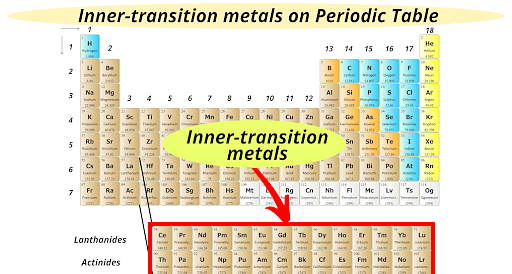
Inner Transition Elements
Also Read:
| Chapter Related Topics | ||
|---|---|---|
| Lanthanide Contraction | Ammonium Persulfate | Difference between Elements and Compounds |
| Ammonium Acetate | Hydrogen Chloride | Actinoids |
Characteristics of Lanthanides and Actinides
[Click Here for Sample Questions]
Lanthanides
- Lanthanides are soft metals that can be cut with a knife.
- They are lustrous and have a silvery appearance
- Depending on their basicity, the elements have distinct response tendencies. Some people are quick to react, while others take their time.
- On combining with other metals or non-metals, lanthanides can corrode or become brittle.
- They almost all combine to produce a trivalent compound. They can also produce divalent or tetravalent compounds on occasionally.
- They are magnetic in nature.
Actinides
- Actinides are radioactive.
- They have strong electropositive potential.
- Metals tarnish quickly in the presence of air.
- Actinides are metals that have a unique structure and are highly dense.
- They produce hydrogen gas when they react with hot water or dilute acid.
- Actinide metals are often soft.
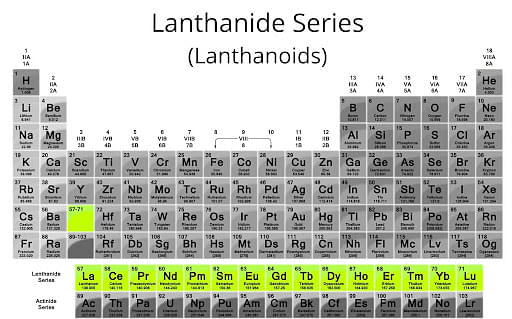
Lanthanide Series
Electronic configuration of lanthanides and actinides
[Click Here for Sample Questions]
Lanthanide: [ Xe ] 4f1-14 5d0-1 6s2
Actinide: [Rn] 5f1-14 6d0-1 7s2
Difference between lanthanides and actinides
[Click Here for Sample Questions]
| Lanthanides | Actinides |
|---|---|
| States of oxidation: +3 is the most frequent oxidation state. Other oxidation states are +2, +4 | States of oxidation: +3 is the most frequent oxidation state. Other oxidation states are +4, +5, +6 |
| The last electron enters a 4f orbital. | The last electron enters a 5f orbital. |
| The decline in atomic size is not regular since the size of tri-positive ions (Ln3+) decreases on a regular basis. | There is a progressive reduction in atomic and ionic (tri-positive ion) size. |
| Their compounds have a lower level of basicity. | Their compounds have a higher level of basicity. |
| There are fewer tendencies towards the complex formation. | They have a far higher tendency for forming complexes. |
| Except for promethium, these elements are non-radioactive. | All the elements are radioactive. |
| Electronic configuration : [ Xe ] 4f1-14 5d0-1 6s2 | Electronic configuration : [Rn] 5f1-14 6d0-1 7s2 |
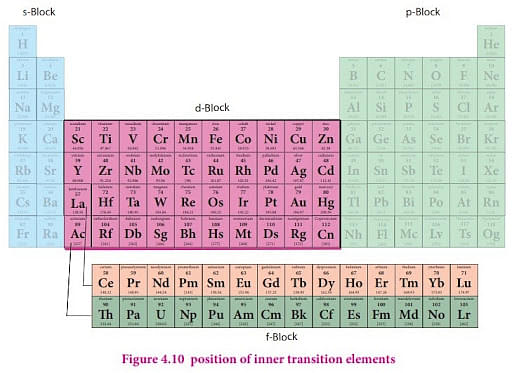
Position of Inner Transition Elements
Lanthanides
[Click Here for Sample Questions]
Lanthanides are found in Period 6, in Group 3 of the periodic table.
Lanthanides are the 14 elements that come after lanthanum, from Cerium (58) to Lutetium (71). They are part of the first series of inner transitions. Lanthanum (57) possesses characteristics that are comparable to those of lanthanum.
The electrons in the sixth period after lanthanum are preferentially filled in the inner 4f sub-shell, thus the chemical characteristics of the fourteen elements after lanthanum are identical. As a result, these elements are positioned at the bottom of the periodic table, grouped together.
Electronic configuration of Lanthanides: [ Xe ] 4f1-14 5d0-1 6s2
Lanthanides' oxidation state:
lanthanides have a common oxidation state of +3. In addition, certain lanthanides have oxidation states of +2 or +4 in select cases.
Atomic and ionic radii: Lanthanide elements have the lowest shielding effect because their electrons have the 'f' subshell. As a result, the atomic and ionic charge decreases. Due to lanthanoid contraction, the size of the atoms of the lanthanoid series decreases with the increase of atomic number.
Uses of lanthanides
- The majority of lanthanides are utilized in lasers.
- They are widely used in sunglass lenses because they can deflect UV and infrared radiation.
- Many lanthanides, including cerium, neodymium, and samarium, may be alloyed with other metals to create powerful permanent magnets.
- Furthermore, two of the lanthanides (Sm and Lu) contain long-lived radioactive isotopes (147Sm and 176Lu), which are used to date minerals and rocks from the Earth, Moon, and meteorites.
Actinides
[Click Here for Sample Questions]
Actinides are the fourteen elements that follow actinium, from thorium (Th) to lawrencium (Lr). Unlike lanthanides, all actinides are radioactive, with the majority of them having short half-lives. Only thorium and uranium (U) are found in substantial quantities in nature, with traces of Plutonium (Pu) present in Uranium ores. Neptunium (Np) and subsequent heavier elements are synthesized by using nuclear processes to artificially alter naturally occurring elements. They are placed at the bottom of the periodic table.
Electronic configuration: [Rn] 5f1-14 6d0-1 7s2
Actinides oxidation state:
Like lanthanides, actinides' most frequent oxidation state is +3. Furthermore, actinides have a variety of oxidation states, including +2, +3, +4, +5, +6, and +7.
Atomic and ionic radii: Actinides decrease due to the poor screening effect of the nuclear charge by the f electrons, resulting in a reduction in ionic radius. As the atomic number increases from Th to Lr, the size of the atoms decreases in a regular pattern. This gradual decrease in the size with an increasing atomic number is called actinide contraction.
Uses of actinide
- Isotopes of uranium and plutonium are used as fuel in nuclear weapons and reactors,
- Thorium is employed in some nuclear reactor designs. In electrical equipment, thorium is also used to coat tungsten wire.
- Americium, which generates ionizing radiation, is present in one type of smoke detector.
- Nuclear weapons and nuclear power facilities have both used uranium and plutonium.
Things to Remember
- The elements in which the final electron enters the f-orbital are known as inner transition elements. The f-block consists of elements in which the 4f and 5f orbitals are gradually filled.
- Lanthanides are soft metals that can be cut with a knife. They are lustrous and have a silvery appearance.
- Actinides are radioactive. They have strong electropositive potential.
- Lanthanides have a common oxidation state of +3. In addition, certain lanthanides have oxidation states of +2 or +4 in select cases.
- Actinides' most frequent oxidation state is +3. Furthermore, actinides have a variety of oxidation states, including +2, +3, +4, +5, +6, and +7.
Also Read:
Sample Questions
Ques. Name the most common Lanthanides. Also, state the reason behind it. (2 Marks)
Ans. Cerium is the most common Lanthanides. Since there are in total four naturally occurring isotopes of cerium, i.e. 136Ce, 138Ce, 140Ce, and 142Ce. About 88.48% of the cerium in nature is 140Ce. Hence, it is the most common Lanthanides present.
Ques. What are the various Characteristics of f-block elements? (3 Marks)
Ans. Characteristics of f-block element are as follows:
- These elements are heavy metals.
- They generally have high melting and boiling points.
- They exhibit different oxidation states.
- They form colored ions.
- They have the tendency to form complex compounds.
Ques. Why f-block elements are also called Inner transition elements? (2 Marks)
Ans. f-block elements have a unique electronic configuration. The valence electrons of these elements transit into the (n-2) f block which is the "anti-penultimate energy level" and resides in the f-orbital. This is the reason why 'inner transition elements' are also known as f-block elements.
Ques. Why does lanthanide contract? (1 mark)
Ans. Lanthanide contracts due to the less effective or poor shielding effect of 4f-electron.
Ques. Which elements show the maximum number of different oxidation states in their compounds and why? (2 Marks)
Ans. Element ‘Am’ shows +2, +3, +4, +5, +6, +7 oxidation states which is maximum amongst all other elements. No other element has this number of oxidation states in their compound.
For Latest Updates on Upcoming Board Exams, Click Here: https://t.me/class_10_12_board_updates
Check-Out:



Comments