



Content Curator
Internal Fertilization is the first stage of sexual reproduction in which the male gametes are fused with female gametes inside the female body. It takes place when the male organism introduces the sperm into the reproductive tract of the female. The sperm fuses with the egg in the ampulla of the fallopian tube to form a zygote. In this article, we will learn about Internal Fertilization, Internal Fertilization in Humans, its advantages and disadvantages.
Also Read: Reproduction and its types
| Table of Content |
Keyterms: Fertilization, Sexual reproduction, gametes, fallopian tube, zygote, organism, Oviparity, Ovoviviparity, Viviparity
What is Fertilization?
[Click Here for Sample Questions]
Fertilization refers to the fusion of male and female gametes to produce new offspring. In this process, the male gamete fuses with the female gamete to form a single nucleus. The nucleus evolves into a zygote which in turn, develops into a new individual. The fertilization can be both internal and external.
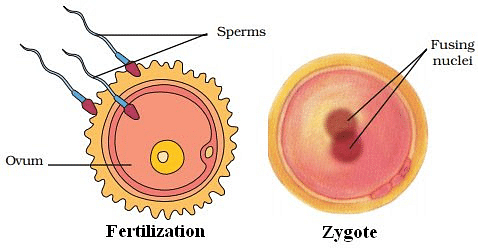
Fertilization and Formation of Zygote
Also Read:
Internal Fertilization
[Click Here for Sample Questions]
Internal Fertilization is the type of fertilization that takes place inside the female body. Internal Fertilization takes place when the male organism introduces the sperm into the reproductive tract of the female.
The transfer of male sperm into the female’s reproductive tract takes place in different ways. These different ways are the types of Internal Fertilization and are listed as follows:
- Oviparity
- Ovoviviparity
- Viviparity
Some other examples of Internal Fertilization are copulation in reptiles and mammals, cloacal kiss in birds, transfer of spermatophore (bundle of sperms) in salamanders, spiders, and some insects, etc.
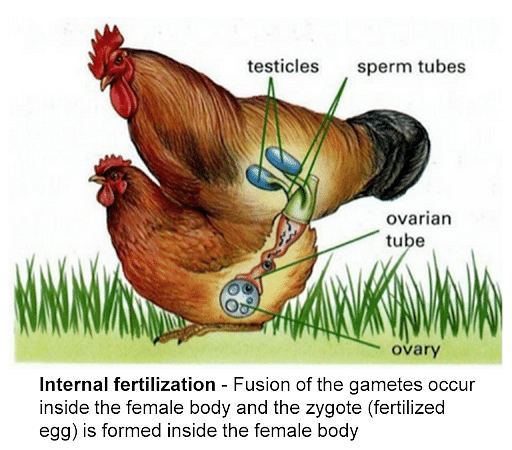
Internal Fertilization
Oviparity
Oviparity is the type of Internal Fertilization in which the eggs are laid outside the body by the female organism. There is little to no embryonic development within the female body. Nourishment is received by the egg through the yolk.
Examples of Oviparous animals are fish, amphibians, most reptiles, birds and many more.
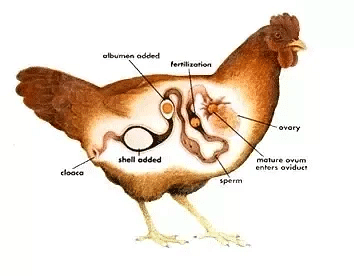
Oviparity
Ovoviviparity
Ovoviviparity is the type of Internal Fertilization in which the embryo develops inside the egg and stays in the female body. Nourishment is received by the embryo through the yolk. The eggs are laid when they are ready to hatch and the young ones are fully developed.
Examples of Ovoviviparous animals are sharks, snakes, lizards, and many more.

Ovoviviparity
Viviparity
Viviparity is the type of Internal Fertilization in which the development of the embryo takes place inside the body of the female organism. Nourishment is received by the embryo through the placenta.
Examples of Viviparous animals include all mammals, some reptiles, cartilaginous fishes, and many more.

Viviparity
Internal Fertilization in Humans
[Click Here for Sample Questions]
Human Beings give birth to their offspring through the process of Internal Fertilization. The male sperm is introduced to the female reproductive tract where it fuses with the female egg in the ampulla of the fallopian tube.
This fusion gives rise to a zygote which transforms into an embryo through mitosis. The embryo is implanted into the uterus where it spends the next 9 months and develops into an infant. When the development period is over, the female gives birth to the baby.
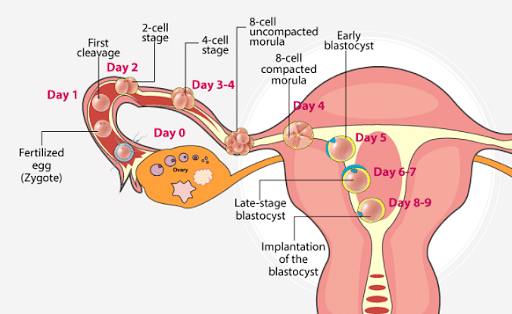
Internal Fertilization in Humans
Also Read: Human Reproductive System
Advantages of Internal Fertilization
[Click Here for Sample Questions]
The advantages of internal Fertilization are as follows:
- Increased chance of survival due to protection against predators and outside environment.
- Protection of fertilized egg from dehydration on land
- Higher probability of successful fertilization
- Females can choose their partner before and after mating
- The chances of fusion of the gametes drastically increase
Disadvantages of Internal Fertilization
[Click Here for Sample Questions]
The disadvantages of Internal Fertilization are as follows:
- An additional risk for the mothers due to gestation (period of carrying the embryo inside)
- Risk of STDs in humans during copulation due to unprotected sexual intercourse
- Production of fewer offspring as compared to external fertilization.
Also Read: Binary Fission and Asexual Reproduction
Things to Remember
- Fertilization is the process of fusion of male and female gametes to produce a new offspring.
- Fertilization is of two types: Internal Fertilization and External Fertilization.
- Internal Fertilization is the type of fertilization that takes place inside the female body.
- In internal Fertilization, male organism introduces the sperm into the reproductive tract of the female.
- Oviparity is the type of Internal Fertilization in which the eggs are laid outside the body by the female organism.
- In ovoviviparity, the embryo develops inside the egg and stays in the female body.
- Viviparity is the type of Internal Fertilization in which the development of the embryo takes place inside the body of the female organism.
Also Read: Spore Formation
Important Questions
Ques: What is Internal Fertilization? What are the different types of Internal Fertilization? (2 Marks)
Ans: Internal Fertilization refers to the fusion of male and female gamete inside the female body. The types of Internal Fertilization are as follows:
- Oviparity
- Ovoviviparity
- Viviparity
Ques: How is Ovoviviparity different from Viviparity? (2 Marks)
Ans: Ovoviviparous animals produce eggs and keep them inside until the egg is ready to hatch. On the other hand, viviparous animals directly give birth to a fully developed young one.
Ques: Give examples of oviparous and viviparous organisms. (2 Marks)
Ans: Oviparous organisms include fishes, amphibians, reptiles, birds, etc.
Most of the mammals, some reptiles and cartilaginous fishes are examples of viviparous organisms.
Ques: What do you mean by Fertilization? Give examples. (2 Marks)
Ans: Fertilization refers to the process of the fusion of male and female gametes to give birth to new offspring. It can be internal or external. Examples of fertilization are copulation in reptiles and mammals, cloacal kiss in birds, transfer of spermatophore (bundle of sperms) in salamanders, spiders, and some insects, etc.
Ques: What are the advantages of Internal Fertilization? (3 Marks)
Ans: The advantages of Internal Fertilization are as follows:
- Mates are selective
- Protection from predators and the external environment
- Higher chance of fertilization
- Protection of egg from dehydration on ground
Ques: (i) What is fertilization? Distinguish between external fertilization and internal fertilization.
(ii) What is the site of fertilization in human beings? (All India 2007, 3 Marks)
Ans: (i) Fertilization is a stage of sexual reproduction in which the fusion of a male gamete (sperm) with a female gamete (an ovum or egg) takes place to form a zygote.
| External Fertilization | Internal Fertilization |
|---|---|
| Takes place outside the female’s body. | Takes place inside the female’s body. |
| A large number of gametes are released. | Male gametes are released inside the body of the female by a copulatory organ. |
| Fusion of gametes takes place outside the body. | Fusion of gametes takes place inside the body. |
| Examples: Fish, Amphibians, etc. | Examples: Reptiles, Birds, Mammals, etc. |
(ii) The fertilization takes place in the fallopian tube of the female reproductive system.
Ques: (a) Explain the terms:
(i) Implantation (ii) Placenta
(b) What is the average duration of human pregnancy? (All India 2009, 3 Marks)
Ans: (a) (i) Implantation: Implantation is the process of embedding a fertilised egg (embryo) into the inner thick wall of the uterus (womb) where it will continue its development.
(ii) Placenta: It is a complex double-layered spongy vascular tissue in human females. It is formed by the maternal and foetal tissues in the wall of the uterus. Placenta is responsible for the attachment, nourishment and waste disposal for the foetus.
(b) The average duration of human pregnancy is 280 days or 40 weeks.
Ques: List any three differences between pollination and fertilization. (All India 2010, 3 Marks)
Ans:
| Pollination | Fertilization |
|---|---|
| Pollination is the process of transfer of pollen grains from the anther to the stigma of a flower. | Fertilization is the process of fusion of male and female gametes to form an embryo. |
| It is a physical process. | It is a genetic and biochemical process. |
| External factors are required. | External factors are not required. |
| Pollination precedes fertilization. | Fertilization occurs only after pollination. |
Ques: State in brief the changes that take place in a fertilised egg (zygote) till birth of the child in the human female reproductive system. What happens to the egg when it is not fertilised? (All India 2012, 5 Marks)
Ans: The egg is fertilized in the fallopian tubes. The fertilized egg (zygote) implants itself into the lining of the uterus and begins to divide. The uterus prepares itself each month to receive and prepare the embryo. The lining thickens and plenty of blood is supplied to nourish the growing embryo.
The embryo is nourished by the mother's blood with the help of a special tissue known as placenta. The process of development of the child in the mother's body takes about nine months. After 9 months, the child is born through rhythmic contractions of the muscles of the uterus.
If the egg is not fertilized, the thick, nourishing lining of the uterus opens and exits the vagina as blood and mucus.
Check-Out:



Comments