



Exams Prep Master
Life on Earth is sustained through the continuous process of reproduction and evolution. Every living being reproduces its offspring; be it animals or plants. Plants reproduce both sexually and asexually, while there are several methods of asexual reproduction like fragmentation, budding, etc. Sexual reproduction involves the method of Pollination, which is the primary process of sexual reproduction in flowering plants. Both pollination and fertilization take place in plants during sexual reproduction. These are the main and natural processes of producing offspring, and both processes occur in all bisexual flowers, in which both the male and female reproductive structure (anther and stigma) are involved. Thus flowers are considered the reproductive organs of all flowering plants. Let’s discuss the difference between pollination and fertilization in depth along with some important questions.
| Table of Content |
Key takeaways: Pollination, pistil, stigma, fertilization, Diploid Zygote, Ovule, Asexual reproduction, Zygote, Reproduction, Flower
Read More: What are Tissues
What is Pollination?
[Click Here for Sample Questions]
The process of transferring the pollen grain of the male reproductive organ i.e. the Stamen to the female reproductive organ i.e. the Pistil in flowering plants is referred to as Pollination. In this process the Stamen is transferred from Anther to Stigma of the flower through various means like winds, birds, and insects like moths, bees, butterflies, etc. After the pollen grains are transferred the pollen grain starts germinating on Stigma and goes on to enter the Ovule fertilizing it.
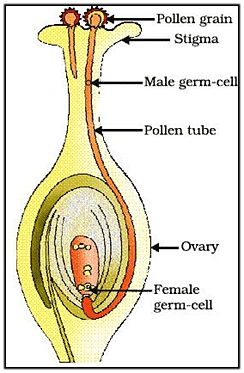
Pollination is of two types-
- Self-Pollination- It involves the transfer of pollen grain from anther of a flower to the stigma of the same flower or another flower of the same kind.
- Cross-Pollination- It involves transfer of pollen grain from anther of a flower to the stigma of different flower.
Also Read:
What is Fertilization?
[Click Here for Sample Questions]
The fusion of male gametes with that of female gametes is called fertilization. In this process, the pollen grain fuses with the Ovule to form a Diploid Zygote. The male gametes i.e. the Pollen grain from the Stamen goes on to penetrate the Ovule which is produced by the Pistil; therefore fertilizing the Ovule. After the fertilization occurs each Ovule starts developing into a seed that contains an embryo which is an underdeveloped plant cell. The mature ovary surrounds the ovule and develops into a fruit that contain one or more seeds.
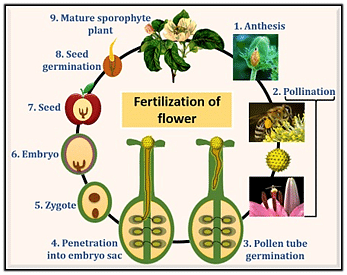
The process of Fertilization is mainly of three types-
- Porogamy- It is a standard type of fertilization it mainly occurs in flowering plants or the angiosperms, where the pollen tube enters the ovule through the micropyle.
- Chalazogamy- In this process of fertilization the pollen tube enters the Ovule through chalazal tissue.
- Monogamy- In this type of fertilization the pollen tube enters the Ovule through integuments of the ovule; it can be mainly seen in Cucurbit plants like pumpkin, bitter gourd, etc.
Also Read:
| Related Articles | ||
|---|---|---|
| Pollination by Insects | Binary Fission | Budding |
| Flower Structure | Metabolites | Nuclear Membrane |
Difference between Pollination and Fertilization
[Click Here for Sample Questions]
Pollination and Fertilization are the main stages in reproduction in plants, the main points of difference between the two are as follows:
| Pollination | Fertilization |
|---|---|
| It is an external process | It can be either external or internal |
| It is the first stage of reproduction in plants i.e. it occurs before fertilization. | It occurs after the process of pollination |
| Pollination needs pollinating agents like wind, insects etc. to transfer the pollen grains. | It does not need any external agent. |
| It is a physical process. | It is a biochemical process. |
| Pollination occurs in flowering plants | Fertilization occurs in flowering and non- flowering plants and other living organisms like insects animals etc. |
| Pollination leads to the transfer of pollen grains to stigma | Fertilization results in the fusion of male and female gametes. |
| It needs external factors to occur. | No external factors are needed in fertilization. |
Also Read: Seed Definition
Things to Remember
- The process of pollination is an external process and relies on external pollinating agents like birds, insects- butterflies; bees, etc. that transfer the sticky pollen grain from the stigma to the Ovule in the pistil while they suck out the nectar from the plants.
- 2- 3 Lakhs of invertebrate species like the bees, butterflies, moths, beetles, etc. help in spreading the pollen in the process of pollination.
- Pollination is one of the primal sources of genetic diversity in the plants and it helps in reproducing and producing enough seed for dispersal and propagation in plants.
- Pollination is the first stage of reproduction in plants, the transfer of pollen grain can also occur through the wind. After the pollen grains have been transferred then occurs the process of fertilization in plants and resulting in seed and fruit formation.
Also Read:
Sample Questions
Ques: What is Stamen and what are its sub parts? (2 marks)
Ans: Stamen is the male reproductive part of the flower in plants, that produces the pollen grains. The pollen grains are transferred to the stigma to fertilize the ovule in order to reproduce.
The sub parts of stamen are-
- The anther
- The supporting Filament
Ques: Where the fertilization of Ovule does take place? (2 marks)
Ans: The fertilization ovule takes place in the Ovary of the plants. The fertilized ovule goes on to transform and become the seed and the ovary becomes the fruit that contains the seed.
Ques: Explain the Germination of Pollen on Stigma. (3 marks)
Ans: The Germination of pollen grains on the female reproductive part of the initial process of fertilization in plants. It occurs in ‘IN- VIVO’ condition, i.e. the germination of pollen begins with the absorption of water and nutrients in order to produce the Pollen Tube that goes on to penetrate the ovule to divide into male gamete and fuse with the egg.
Ques: Where are the seeds formed in atypical flowering plant? (2 marks)
Ans: In an angiosperm or a typical flowering plant seeds are formed from the ovary that is contained in the ovule, the ovary goes on to transform into fruit and contains the ovary now seed inside it.
Ques: Explain the structure of Pistil. (3 marks)
Ans: The Pistil is the female reproductive part of the flower in a flowering plant. It is centrally located and contains the ovary in the form of a swollen base that contains the ovule. The ovary has a narrow tube arising from it called the style which carries a receptive tip i.e. the stigma.

Ques: What is meant by pollination? (3 marks)
Ans: Pollination is the process of transferring the pollen grain of the male reproductive organ i.e. the Stamen to the female reproductive organ i.e. the Pistil in flowering plants. In this process, the Stamen is transferred from Anther to Stigma of the flower through various means like winds, birds, and insects like moths, bees, butterflies, etc. After the pollen grains are transferred the pollen grain starts germinating on Stigma and goes on to enter the Ovule fertilizing it.
Ques: What is plant fertilization? (4 marks)
Ans: The fusion of male gametes with that of female gametes is called fertilization. In this process, the pollen grain fuses with the Ovule to form a Diploid Zygote. The male gametes i.e. the Pollen grain from the Stamen goes on to penetrate the Ovule which is produced by the Pistil; therefore fertilizing the Ovule. After the fertilization occurs each Ovule starts developing into a seed that contains an embryo which is an underdeveloped plant cell. The mature ovary surrounds the ovule and develops into a fruit that contains one or more seeds.
Ques: What are the types of plant fertilization? (3 marks)
Ans: The process of Fertilization is mainly of three types-
- Porogamy- It is a standard type of fertilization it mainly occurs in flowering plants or the angiosperms, where the pollen tube enters the ovule through the micropyle.
- Chalazogamy- In this process of fertilization the pollen tube enters the Ovule through chalazal tissue.
- Monogamy- In this type of fertilization the pollen tube enters the Ovule through integuments of the ovule; it can be mainly seen in Cucurbit plants like pumpkin, bitter gourd, etc.
Ques: Differentiate between pollination and fertilization. (5 marks)
Ans:
| Parameters | Pollination | Fertilization |
|---|---|---|
| Role of Pollen tube | The pollen tube is not present | Male gametes are transferred to the ovum through the pollen tube |
| Function | The first step to fertilization where pollens reach from Anther to Stigma | Zygote formation divides to form an embryo |
| Process | External mechanism of transfer of pollen grains takes place | Internal mechanism of male gamete and female ovum fusion takes place |
| Types | Self-Pollination and Cross-Pollination | Not applicable |
| Role of external agents | External pollination agents consist of bees, birds, wind, etc. | External agents have no role in fertilization. |
For Latest Updates on Upcoming Board Exams, Click Here: https://t.me/class_10_12_board_updates
Check-Out:



Comments