



Content Curator
Spring force is a type of elastic force that is exerted by a spring when it is stretched or compressed. The definition of force in physics is an externally imposed stress (either a push or a pull) to an object.
- A common component known as a "Spring" is utilised in a variety of machines due to its simple construction, which enables the machine to perform its function repeatedly.
- Hooke's law, which states that the force exerted is directly proportional to the inverse of the elongation, is utilised by these springs.
- Valve Springs (a key component of an automobile's engine), lawnmowers (found in backyards, parks, and stadiums), Medical Devices, Electrical Appliances, Firearm Springs, and many others are instances of Spring Force.
| Table of Content |
Key Terms: Spring Force, Hooke’s Law, Motion, Spring Constant, Displacement of Spring, Force, Equilibrium, Linear Spring
What is Spring Force?
[Click Here for Sample Questions]
Spring force is the force exerted by a spring to recover its relaxed state. In physics, this type of force is usually modeled as a linear spring, meaning that the force is proportional to the displacement of the spring from its equilibrium position.
- The relationship between the force and the displacement can also be represented mathematically as F = – kx, (where F is the spring force, k is the spring constant, and x is the displacement).
- The spring constant, k, can be defined as the measure of the stiffness of the spring, determining the amount of force required to produce a given amount of displacement.
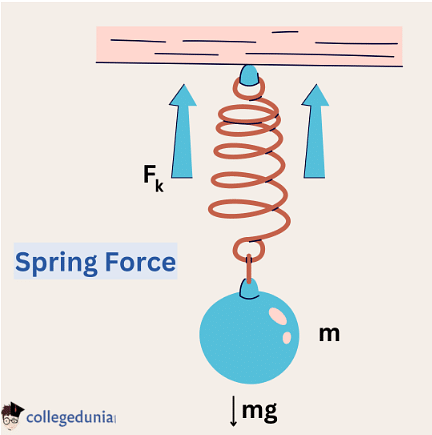
Spring Force Meaning
- A large spring constant means that the spring is stiff and requires a large force to produce a small amount of displacement.
- However, a small spring constant means that the spring is more flexible and requires a small force to produce a large amount of displacement.
- If we lengthen the spring by dragging the block to the right, the spring will exert a leftward force on the block. Because a spring force restores the condition of relaxation.
- If we compress the spring by moving the block to the left, the spring now exerts a rightward force on the block.
Because spring force restores the state of relaxation, it is frequently referred to as a “Restoring Force”.
Hooke's law
[Click Here for Sample Questions]
The spring force is proportional to the displacement of the free end from its relaxed state, according to Hooke's law.
| Fs ∝ d → Fs = -k x d |
Here,
- k = Spring constant and
- d = free end displacement from its relaxed position
The direction of spring force, which is always opposite to the direction of spring displacement, is denoted by a negative sign. Because spring force is a function of x, it is a variable force (the position of the free end).
Also Read:
Concept of Spring Force
[Click Here for Sample Questions]
The force that is exerted by a spring in order for it to return to its relaxed state is referred to as the “Spring Force”. Consider a circumstance when the springs are at rest.
- However, whether they are stretched or compressed, a restoring force always points in the direction of balance.
- When suspended horizontally, pendulums are stable. When a pendulum's equilibrium position is disturbed, tensile tension and gravity cause it to swing back and forth.
- Spring is a popular tool, but its inertia is often neglected because of its low mass.
- It is a rare event for a stretched spring to experience displacement when it is compressed, leading it to become compressed.
- The equilibrium position is then reached. Thus, a spring exerts an equal and opposite force on a body that is being compressed or stretched.
- Consider a vertically hanging spring with one end attached to a hook and the other end attached to an object of mass m.
- The object will therefore be subject to two forces. One force will be the spring's upward-directed restoring force.
- The other force acting on the mass will be the downward-directed force of gravity.
- If the mass is not in motion, it will be suspended in an equilibrium position in which the net force is zero.
Check out:
| Important Related Concepts | ||
|---|---|---|
| Kinetic energy | Heat | Principle of Conservation of Energy |
| Elastic and Inelastic Collisions | Pulley | Unit of Power |
| Types of Energy | Elastic Collision | Unit of Work |
Spring Force Formula
[Click Here for Sample Questions]
Simple Harmonic Periodic motion comprises motion. The restoring force Fx is directly proportional to the displacement x in SHM. The sign of this restorative force and the displacement are always opposite. A proportionality constant, k, enables the formation of the force equation, i.e.
Fx = – k x
This relationship is Hooke's Law for springs, where k is the spring constant. k is measured in SI units as Newton per metre.
Thus, the formula of Spring Force is:
| F = k(x – x0) |
Where,
- x = distance by which the spring is displaced from its equilibrium
- k = the spring constant
- F = spring force
- x0 = equilibrium position
Also Read:
| Related Articles | ||
|---|---|---|
| Wave Function | LC Oscillation | Alternating Current |
| Transformers | Power in Alternating Current | Electromagnetic Waves |
Things to Remember
- The "Spring Force" is the effort put forth by a spring to recover its original, relaxed shape, also referred to as Restoring Force.
- Hooke's law states that spring force is proportional to free end displacement from relaxed condition.
- Spring forces are used in a variety of engineering applications, including mechanical systems, electrical systems, and biological systems.
- A Newton per metre is the SI unit that is used to measure k in the formula of spring force.
- Spring Constant, k, is a measure of the stiffness of the spring and is a key parameter that determines the behavior of the spring force.
Sample Questions
Ques. Consider a spring with a given length of 22 cm/s. It stretches by 38 cm/s when loaded with 2 kg. Figure out how much tension it has. (4 marks)
Ans. Assume m = 2 kg (Mass) (initial length) displacement (xo) = 22 cm width (x) = 38 cm
The final movement is equal to x - xo, or 38 - 22, or 16 centimetres, or 0.16 metres.
The formula for the spring's force is F = ma.
F = 2 kg × 0.16 m
F = 0.32 N
The formula for the spring constant, k = -[F/(x - xo)], is as follows:
K = - [0.32 N/0.16 m]
k = – 2 N/m
Hence, the spring constant is -2 N/m.
Ques. Assume a force of 100 N is applied in order to stretch a body by 2 metres. Find out the spring constant. (2 marks)
Ans. As given,
(displacement) x = 2m (force) F = 100 N
K = -[F/x] K = - [100 N/ 2 m] are two expressions for the spring constant.
k = – 50 N/m
The spring constant is therefore -50 N/m.
Ques. Calculate the spring constant for a 10 cm long spring that is loaded with 2 kgs and extended by 20 centimetres. (3 marks)
Ans. We hold, m = 2
x = 20
xo = 10
F = ma … [the spring's force formula]
= 2 (20 - 10)
= 2 (10)
= 20 N
Using the formula for spring constant, k = F/(x - xo),
We obtain = – 20/(20 - 10) = – 20/10
The constant of the spring is -2 N/m.
Ques. Calculate the spring constant for a 5 cm long spring that is loaded with 3 kilogrammes and extended by 10 centimetres. (3 marks)
Ans. m = 3
x = 10
xo = 5
The spring force is equal to F = ma
= 3 (10 - 5)
= 3 (5)
= 15 N.
Using the spring constant formula, we obtain k = - F/(x - xo)
= - 15/(10 - 5)
= - 15/5
= -3 N/m
Ques. Calculate the spring constant for a 7 cm long spring that is loaded with 2.5 kg and extended by 15 centimetres. (2 marks)
Ans. We have,
m = 2.5
x = 15
xo = 7
The spring force is equal to F = ma = 2.5 (15 - 7) = 2.5 (8) = 20 N.
Using the spring constant formula, we obtain k = -F/(x - xo)
= - 20/(15 - 7)
= - 20/8
= -2.5 N/m.
Ques. Calculate the spring force for a 2 cm long spring that is extended by 5 centimetres. The spring constant has a value of 6 N/m. (2 marks)
Ans. We have, k = 6
x = 5
xo = 2
Using the spring force formula, we obtain F = - k(x - xo)
= - 6 (5 - 2)
= -6 (3)
= -18 N.
Ques. Calculate the spring force for a 4-cm long spring that is extended by 12 centimetres. The spring constant has a value of 2 N/m. (2 marks)
Ans. We have,
k = 2
x = 12
xo = 4
Using the spring force formula, we obtain F = – k(x – xo)
= – 2 (12 – 4)
= – 2 (8)
= – 16 N.
Ques. Calculate the spring constant for a 6-cm long spring that stretches by 18 centimetres and regains a 30 N force. (2 marks)
Ans. F = 30
x = 18
xo = 6
Using the formula for spring force, we obtain k = - F/(x - xo)
= - 30/(18 - 6)
= -30/14
= -2.14 N/m.
Ques. Determine the original length of the spring if it is extended by 5 centimetres and regains a force of 25 Newtons. The spring constant is 5 N/m. (2 marks)
Ans. We have, F = 25 x = 5 k = 5
Using the formula, (x - xo) = -F/k
⇒ 5 - xo = -25/5
⇒ xo - 5 = 5
⇒ xo = 5
xo = 10 cm
Ques. A spring with a spring constant of 150 N/m is pressed by 5.0 cm. How much force is the spring exerting at this moment? (5 marks)
Ans. Determine the spring constant, k, in the first step.
We are provided the spring constant in the problem: k = 150 N/m.
Identify or compute the distance the spring has been extended or compressed relative to its equilibrium length.
The distance the spring has been compressed is 5 centimetres, which must be translated to metres to match the units specified in the spring constant.
Δx = 5.0 cm × [1 m / 100 cm] = 0.050 m.
Using Hooke's law, calculate the force exerted by the spring, Fs = − k Δ x.
The spring must exert a force equal to the product of the distance of compression and spring constant:
Fs = −k Δ x = −(150 N/m) (0.050 m) = −7.5 N.
The spring exerts 7.5 Newtons of force in the reverse direction of compression.
For Latest Updates on Upcoming Board Exams, Click Here: https://t.me/class_10_12_board_updates
Check-Out:



Comments