



Education Content Expert
Mechanical Energy is the total amount of kinetic energy and potential energy stored by an object required to do work.
- It describes the energy of an object due to its motion or position, or both.
- The SI unit of Mechanical Energy is Joules (J).
- Mechanical energy of a system is conserved i.e. it can neither be created nor be destroyed.
Mechanical Energy Formula is given as
M.E = K.E + P.E
| M.E = \(\frac{1}{2}\)mv2 + mgh |
Here, m is the mass of an object, v is the velocity, g is acceleration due to gravity, and h is the height of an object.
Read More: NCERT Solutions for Class 11 Physics Work, Energy, and Power
Key Terms: Mechanical Energy, Kinetic Energy, Potential Energy, Mass, Velocity, Acceleration, Mechanical Energy Formula
What is Mechanical Energy?
[Click Here for Sample Questions]
Mechanical Energy is the combination of kinetic and potential energy that an object possesses as a result of its motion or position. It can be defined as the energy that an object has due to its movement or location in space.
- An object at rest has potential energy, which is the energy it possesses as a result of its position.
- When an object is in motion, it has kinetic energy, which is the energy it possesses as a result of its motion.
- An object will possess mechanical energy when it is in motion or when it is in a position relative to the surface.
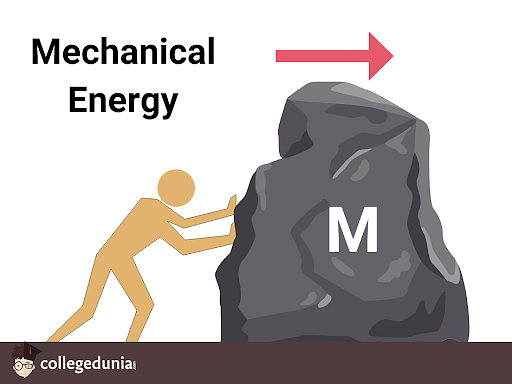
Mechanical Energy
- For example, a ball held vertically has only potential energy, while a moving car has both kinetic and potential energy.
- Mechanical energy originates from the work and energy theorem, which states that work and energy are interchangeable.
Read More:
Mechanical Energy Formula
[Click Here for Previous Year Questions]
Mechanical Energy is the sum total of Kinetic Energy and Potential Energy. Thus,
Mechanical Energy = Kinetic Energy + Potential Energy
We know that,
- Kinetic Energy Formula = \(\frac{1}{2}\)mv2
- Potential Energy Formula = mgh
Thus, Mechanical Energy Formula is given as
M.E. = \(\frac{1}{2}\)mv2 + mgh
Where
- m: Mass of Object
- v: Velocity of Object
- g: Acceleration due to Gravity
- h: Height of Object
Read More: Work, Energy and Power Formula
| Solved Example Example: If a man is sitting on a tree of height 25 m and his mass is 90 kg. Calculate the mechanical energy. Solution: Given that,
The man is not moving (static), thus, Kinetic energy (K.E) = 0 Using Mechanical Energy Formula, M.E = K.E + P.E M.E = \(\frac{1}{2}\)mv2 + mgh M.E = 0 + 90 x 9.81 x 25 M.E = 22,072.5 J Therefore, Mechanical Energy will be 22,072.5 J. |
Mechanical Energy Formula Derivation
[Click Here for Sample Questions]
Mechanical Energy Formula is expressed as
M.E = K.E + P.E
Where
- K.E (Kinetic Energy) = \(\frac{1}{2}\)mv2
- P.E (Potential Energy) = mgh
Therefore, Mechanical Energy can be also written as,
M.E = \(\frac{1}{2}\)mv2 + mgh
Here
- m = Mass of Object
- v = Velocity of Object
- g = Acceleration due to Gravity
- h = Height of Object
Read More: Work, Energy and Power Important Questions
Law of Conservation of Mechanical Energy
[Click Here for Previous Year Questions]
According to the Law of Conservation of Mechanical Energy, the total mechanical energy of the system is conserved.
- According to Newton’s third Law of Conservation of Energy, ‘Energy cannot be created nor be destroyed, it can only be transferred from one form to another form’.
- For example, Steam engines convert the mechanical energy into heat energy and Turbines can convert the kinetic energy of steam into mechanical energy.
- In the absence of friction, Mechanical energy is conserved.
Check More:
Things to Remember
- Mechanical Energy is the energy possessed by an object due to its motion or due to its position.
- It is the total sum of Kinetic Energy and Potential Energy.
- Mechanical Energy Formula is M.E = K.E + P.E.
- It can also be written as M.E = (\(\frac{1}{2}\)mv2 + mgh).
- The SI unit of mechanical energy is Joule (J).
Previous Years’ Questions
- The potential energy of a 1 kg particle free to move along the… (AIEEE - 2006)
- In which case the potential energy decrease on…
- If the kinetic energy of a body becomes four times its initial value… (AIIMS 1998)
- A ball whose kinetic energy is E is projected at an angle… (AIEEE 2002)
- The kinetic energy of a particle executing simple harmonic… (JKCET 2006)
- The unit of potential energy is…
- The kinetic energy of a body of mass 4 kg and momentum… (KCET 2015)
- A running man has half the kinetic energy of that a boy of half… (Punjab PMET 2001)
- The dimensions of kinetic energy are… (KEAM)
- If the kinetic energy of a body is increased by 300% then the percentage… (JKCET 2017)
Sample Questions
Ques. A person is sitting on a building of height 12m and the mass of the person is 110kg. What will be the mechanical energy? (3 Marks)
Ans. Given that,
- Mass (m) = 110 kg
- Height (h) = 12 m
The person is in a motionless state, hence,
Kinetic Energy (K.E.) = 0
Using the Mechanical Energy Formula,
M.E = K.E + P.E
M.E = \(\frac{1}{2}\)mv2 + mgh
M.E = 0 + 110 × 9.81 × 12
M.E = 12949 J
Therefore, Mechanical Energy will be 12949 J.
Ques. A man is sitting on a 10 m height tree and his mass is 100 kg. Calculate the mechanical energy? (3 Marks)
Ans. Given that,
- Mass (m) = 100 kg
- Height (h) = 10 m
The man is not moving (static), thus, Kinetic energy (K.E) = 0
Using Mechanical Energy Formula
M.E = K.E + P.E
M.E = \(\frac{1}{2}\)mv2 + mgh
M.E = 0 + 100 x 9.81 x 10
M.E = 9810 J
Therefore, Mechanical Energy will be 9810 J.
Ques. A person is sitting on a building of height 20m and the mass of the person is 400kg. Determine the mechanical energy. (3 Marks)
Ans. Given parameters are
- m = 400 kg
- h = 20m
Since the person is in a static state, therefore,
K.E. = 0
Using Mechanical Energy Formula
M.E. = K.E. + P.E.
M.E. = 0+ m × g × h
= 400 × 9.81 × 20
M.E. = 78,480 J
Therefore, mechanical energy will be 78,480 J.
Ques. Find out the mechanical energy of a 50 kg object which is moving with a speed of 20 ms−1. (3 Marks)
Ans. Given values are:
- m = 50 kg
- v = 20 ms−1
Since the person is moving, therefore
P.E. = 0
Using Mechanical Energy Formula
M.E. = K.E. + P.E.
M.E. = (\(\frac{1}{2}\)mv2 + mgh)
=(\(\frac{1}{2}\)x 50 x 202 + 0)
=10,000
Therefore, the mechanical energy will be 10,000 J.
Ques. An object of mass 300 g is raised to a height 10m above the ground. Calculate its potential energy at this height. If the object is made to fall, what will be its kinetic energy halfway down? Take g=10m/s2. (3 Marks)
Ans. Given that,
- m = 300 g = 0.3 kg
- h = 10 m
- g = 10m/s2
The potential energy of the object at the height (h=10 m) is
Ep = m x g x h = 0.3 × 10 × 10 = 30 J
Kinetic energy of the body can be calculated using the law of conservation of mechanical energy. At this position, the kinetic energy gained will be equal to the potential energy lost which will be half of 30J. Therefore, the kinetic energy of the object will be
Ek = Ep/2 = 30/2 = 15 J
Henceforth, the potential energy of the object at the highest point will be 30J and its kinetic energy halfway down will be 15J.
Ques. Can an object have mechanical energy when the momentum is zero ? (3 Marks)
Ans. Due to the following reasons Mechanical energy of the object can not be zero, even if the momentum is zero:
- Mechanical energy has two types of energy that is Kinetic energy and potential energy.
- Therefore, if the object has zero momentum, it means that it is not moving and may have potential energy.
- For example, if an object is thrown vertically into the gravitational field when it reaches maximum altitude, its velocity will be zero and its momentum will be zero. But at that moment, it has the maximum potential energy. Therefore, the momentum is zero, but the object has mechanical energy.
Ques. Write the differences between the Kinetic and Potential Energy. (5 Marks)
Ans. The difference between kinetic and potential energy are as follows:
| Kinetic Energy | Potential Energy |
|---|---|
| The energy an object possesses as a result of its motion is called Kinetic Energy. | The energy an object possesses as a result of its position or configuration is called Potential Energy. |
| Kinetic Energy is calculated using the formula KE = \(\frac{1}{2}\)mv2, where m is the mass of the object and v is its velocity | Potential Energy can take various forms such as gravitational potential energy, elastic potential energy, and chemical potential energy. |
| An object in motion, such as a moving car or a spinning wheel, has kinetic energy. | An object at rest, such as a ball held vertically, has potential energy. |
| Kinetic Energy depends on an object's mass and velocity | Potential Energy depends on an object's mass, height, and the strength of the force acting on it |
Ques. An apple with 30.5 joules of kinetic energy and 12.5 joules of gravitational potential energy at one point during its fall from a tree to the ground. Immediately before striking the ground, how much mechanical energy does the apple have? (Ignore air resistance). (2 Marks)
Ans. We know that,
ME = K.E + P.E
ME = K.E + g + 0 = 30.5 + 12.5 (J)
Hence, ME = 43 J
Explanation: An apple’s total mechanical energy is the total of the kinetic energy and its potential energy. As mentioned in the problem, the apple has no air resistance, thus, this amount stays constant throughout the fall. Although the potential energy is 0 on the ground, and therefore all the mechanical energy is in the form of kinetic energy, the particle’s total mechanical energy remains 43 joules.
Ques. If a man is 90 kg carries a load of 30 kg upto a height 20 min 40 secs. (g = 10 m/s2). Find
a. Change in Potential energy.
b. Power of man and work done by him . (5 Marks)
Ans. A man of mass 90 kg carries a load of 30 kg upto a height 20 m in 40 s.
Thus,
- Mass = 90 + 30 = 110 kg
- h = 20 m
- s = 40 s
- g = 10 m/s2
If the person is at ground level then the potential energy at that point is zero.
When man carries load upto a certain height the, Potential energy becomes
Work Done = mgh
Potential energy at height of 20 m = Work done = mgh = 110 x 10 x 20 = 22000 J
Change in Potential Energy = 22000 Joules
Power = Work done/ time
So, P = 22000/40 = 550 W
Thus power required by man to carry away the load upto 20 m in 40 s was 550 Watt.
Ques. Engineers should design the playground slides so that the speed at which the child can reach down does not exceed 3.0 m/s. Find the maximum height that the slide can have.(g = 9.8 m/s2) (2 Marks)
Ans. Potential energy is converted into Kinetic energy when the child reaches the ground.
Therefore, K.E = P.E
\(\frac{1}{2}\)mv2 = mgh
H = V2/2g = 9/2 × 9.8 = 0.459 m
Check-Out:



Comments