



Content Curator
The law of conservation of mass states that for any closed system, the mass of the system must remain constant throughout time.
- Here closed system refers to a system in which neither the transfer of matter nor energy takes place.
- Since the mass of the system cannot change, hence the quantity cannot be added or removed.
- Hence the mass of the system remains conserved over time.
- It is also known as the principle of mass conservation.
- Antoine Laurent Lavoisier developed the law of conservation of mass in 1789.
| Table of Content |
Key Terms: Mass, Energy, Thermodynamics, Quantum Physics, Molecules, Combustion, Velocity, Density, Conservation of mass
What is the Law of Conservation of Mass?
[Click Here for Sample Questions]
The law of conservation of mass states that
In an isolated system, mass cannot be created nor be destroyed but it can change from one form to another.
- Within an isolated system, mass cannot be changed over time.
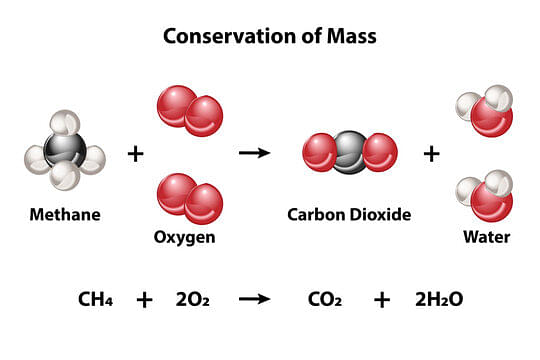
- According to this law, the total mass of the reactants must be equal to the mass of the products throughout any chemical reaction and low-energy thermodynamic processes in an isolated system.
- The concept of mass conservation in chemical reactions was first demonstrated in the 17th century.
- Later, it was confirmed by Antoine Lavoisier in the late 18th century.
- The conservation of mass is only approximate and is one of several assumptions in classical mechanics.
- Under the concept of mass-energy equivalence, which states that energy and mass include one conserved quantity, the law must be adjusted by the principles of quantum mechanics and special relativity.
Read more:
The Formula of the Law of Conservation of Mass
[Click Here for Sample Questions]
The continuity equation in fluid mechanics and continuum mechanics can be used to express the law of conservation of mass in differential form as follows:
| \(\frac {\partial \rho }{\partial t}+\nabla .(\rho v)\) |
Where
- ρ is the density
- t is the time
- v is the flow velocity field
- ▽ is divergence
Examples of Law of Conservation of Mass
[Click Here for Sample Questions]
The examples of the law of conservation of mass are:
- Combustion process: The burning of wood is an example of conservation of mass as the burning of wood involves Oxygen, Carbon dioxide, water vapor, and ashes.
- Chemical reactions: To get one molecule of water with a molecular weight of 10, Hydrogen with a molecular weight of 2 is added with Oxygen whose molecular weight is 8, thereby conserving the mass.
Also read:
Things to Remember
- The amount of matter in an object is known as its mass.
- According to the law of conservation of mass, in an isolated system mass can be transformed from one form to another but cannot be created or destroyed.
- According to the law, the mass of the products of a chemical reaction equals the mass of the reactants.
- The law of conservation of mass requires that the reactant and product masses line up for a low-energy thermodynamic process.
- The law can be explained through various chemical reactions and even the combustion process. Wood is broken down into ashes, water vapor, and carbon dioxide when it is burned.
- There will not be any difference in the mass of the piece of wood before and after the reaction if we weigh it before burning it and after ashes, water vapors, and CO2 are heated.
Sample Questions
Ques. Why does mass not change because of chemical reactions? (2 marks)
Ans. Atoms neither originate nor dissipate during a chemical process. To create the products, the atoms of the reactants are only rearranged. Therefore, in a chemical reaction, there is no change in mass.
Ques. Carbon dioxide (CO2) and calcium oxide (CaO) are both produced in equal amounts by 10 g of calcium carbonate (CaCO3). Explain this reaction using the mass conservation law. (3 marks)
Ans. In accordance with the law of conservation of mass:
Reactant mass equals product mass. 10 g of CaCO3 is equal to 6.2 g of CaO and 3.8 g of CO2.
Products are equal to 10 g of reactant.
Thus, it is demonstrated that the reaction adheres to the rule of conservation of mass.
Ques. 10.0 g of sodium carbonate, 4.4 g of carbon dioxide, and 5.6 g of sodium oxide are formed during heating. Show that the law of conservation of mass is being followed by this reaction. (5 marks)
Ans. Carbon dioxide with sodium oxide yields sodium carbonate.
CO2 + Na2O → Na2CO3
Carbon dioxide is supplied as 4.4 g, sodium carbonate is specified as 10 g and sodium oxide is 5.6 g
The Law of Conservation of Mass states that Mass of Reactants = Mass of Products.
10 g is the reactant's mass.
Product mass equals 4.4 + 5.6 →10 g.
This reaction, therefore, complies with the rules of conservation of mass.
Ques. Why is the conservation of mass believed to be a part of the conservation of energy? (3 marks)
Ans. It has been found that in nuclear reactions, the mass of the reactants is greater than the mass of the products. The mass defect sometimes referred to as the mass difference, is transformed into energy by vibration E=âmc2. We should call it the law of conservation of mass and energy as a result.
Ques. Considering that energy cannot be generated or destroyed, what is its ultimate source? (3 marks)
Ans. The primary source of energy in the cosmos as it exists now is the Big Bang. All energy was created at the beginning of time, and as the cosmos grew, distinct phases of particulate matter evolved. Energy had been dispersed by the time of the Modern Universe as mass, kinetic energy, chemical energy inside matter lumps, or radiant energy. Galaxies and stars are differentiated within the masses. One of those stars is the sun, which got its energy from the Big Bang.
Ques. When 0.0976 g of magnesium was heated in the air, 0.1618 g of magnesium oxide (MgO) was created. How much oxygen is needed to make 0.1618 g of magnesium oxide? (3 marks)
Ans. Magnesium Oxide is created when magnesium and oxygen combine.
Magnesium is 0.0976 g and magnesium oxide is 0.1618 g in its stated mass.
Let x g of oxygen by the mass.
The bylaw of Conservation of Mass states that Mass of Reactants = Mass of Products.
0.0976 g + x g→ 0.1618 g
x g → 0.0642 g
Ques. What role does the law of mass conservation play? (3 marks)
Ans. The role law of conservation of mass plays is as follows:
The study of and the production of chemical reactions.
This law may be used to determine the amounts of reactants and products.
Manufacturers can improve productivity by enforcing the law in their laboratory procedures.
Ques. Why does not mass change when chemicals react? (2 marks)
Ans. A chemical process neither creates nor destroys atoms. The atoms of the reactants are only rearranged to create products. Therefore, throughout a chemical reaction, mass does not change.
Ques. 36 g of water is created when hydrogen and some oxygen combine. Determine the amount of oxygen that must have been used using the law of conservation of mass. (3 marks)
Ans. Water is created when hydrogen and oxygen are combined.
Given in grams are hydrogen (4 g), oxygen (x g), and water (36 g).
The Law of Conservation of Mass states that Mass of Reactants = Mass of Products.
4 g+ x g = 32 g
36 g - 4 g = x g
x g = 32 g
Thus, we might conclude that 32 g of oxygen was used.
Ques. was the mass conservation law disrupted? (2 marks)
Ans. Nuclear reactions go against the rule of conservation of mass since mass is transformed into energy.
Also Read:



Comments