



Education Journalist | Study Abroad Lead
Lawrencium is an actinide metal and a transferee element which has no application or viable economic role. It behaves as a heavier homolog to lutetium and is a trivalent element that chemistry experiments have confirmed. It can be classified as the first of the 7th period of transition metals. Its electron configuration is anomalous for its position in the periodic table, having an s2p configuration instead of the s2d configuration of its homolog lutetium. This means that lawrencium may be more volatile than expected for its position in the periodic table and have a volatility comparable to that of lead.
The discovery and naming of the element cannot be pinpointed for sure, since it is disputed to have been found by either Soviet or American scientists. The International Union of Pure and Applied Chemistry (IUPAC) named the element as Lawrencium and the discovery’s credit has been given to both American and Soviet scientists. Lawrencium is actually synthesized from California.
| Table of Content |
Keyterms: Lawrencium, Lutetium, Metals, Transition metals, Electron, Periodic table, Atomic number
What is Lawrencium?
[Click Here for Sample Questions]
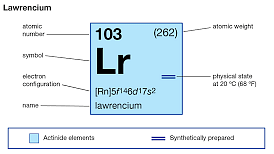
Lawrencium is a synthetic chemical element in the periodic table belonging to period 7 and the group Actinides. It has the symbol of Lr and an atomic number of 103. Lawrencium has radioactive properties, and it is the eleventh transuranic element of the table. Since it has an atomic number over 100, it can be produced in particle accelerators by bombarding lighter elements with charged particles. Lawrencium does not exist as a free element in nature, and it is created by accelerating subatomic particles that have been surrounded by a circle. Currently, fourteen isotopes of Lawrencium are known and the most stable one is 266Lr with a half-life of 11 hours, but the shorter lived 260Lr with a half-life of 2.7 minutes is most commonly used since it can be produced on a larger scale.
Also Read:
| Chapter Related Topics | ||
|---|---|---|
| Lanthanide Contraction | Ammonium Persulfate | Difference between Elements and Compounds |
| Ammonium Acetate | Hydrogen Chloride | Actinoids |
Chemical Properties of Lawrencium
[Click Here for Sample Questions]
The chemical properties of Lawrencium can be summarized as follows:
- Lawrencium belongs to the group Actinides of the periodic table.
- It belongs to period 7.
- It belongs to the block f.
- It has an atomic number of 103.
- Its state at 20 degrees Celsius is solid.
- It has an electronic configuration of [Rn]5f147s27p1.
- It has a melting point of 1627 degree Celsius/2961-degree Fahrenheit/1900 K.
- Its boiling point and density is unknown.
- Its relative atomic mass is [262].
- Its key isotope is 262Lr.
- Its oxidation state is +3.
- Its ChemSpider ID is 28934. (ChemSpider is a free chemical structural database).
Physical Properties of Lawrencium
[Click Here for Sample Questions]
Some physical properties of Lawrencium are also noted below:
- Isotopes of Lawrencium are radioactive, and they have a half-life of eleven hours.
- Lawrencium has no notable usable properties, and it is mostly used in scientific research.
- It is silver-white, metallic, or grey in colour.
- It falls under the meal category in the periodic table.
- It is the heaviest element in the actinide series.
- The electronic configuration of Lawrencium is anomalous.
- It has a very short life therefore it does not exist in free elemental nature outside of laboratories.
- Lawrencium behaves as a heavier homolog to lutetium which chemistry procedures have confirmed.
- It exists as a trivalent ion in aqueous solution.
- It is a synthetic metal.
- Lawrencium has 13 isotopes within which 266Lr is the most stable and has a half-life of 11 hours. 260 Lr, another isotope has a much shorter half-life of 2.7 minutes.
Applications of Lawrencium
[Click Here for Sample Questions]
Lawrencium is a radioactive element for which it does not really have much use outside the laboratory. It is purely used for scientific research and purposes and does not exist in a free elemental state outside. Only a few atoms of Lawrencium have been produced, therefore it is used in technical purposes of harvesting projects only. The isotope of Lawrencium, 260Lr is used for scientific studies because it can be produced in a large scale.
Health effects of Lawrencium
[Click Here for Sample Questions]
There are no known health effects of Lawrencium since it does not exist in nature as a free element due to its short half-life. It does not occur naturally on earth and even if it is produced, it will turn into another element almost instantly. Also, it has no environmental effects due to its short life. Therefore, it can be inferred that as an element that is purely used for scientific purposes, it poses no harm in general.
Things to Remember
Some of the interesting facts about Lawrencium can be summarized as follows:
- Lawrencium is a member of the rare earth metals and does not exist freely in nature.
- Lawrencium was discovered by a team of researchers made up of Albert Ghiorso, Almon Larsh, Robert Latimer and Torbjorn Sikkeland.
- It was discovered on February 14, 1961.
- At UC Berkeley, the team bombarded three milligrams of californium with boron ions to produce Lawrencium. The first experiment used nitrogen bombardment which resulted in the californium sample being destroyed. A Lawrencium sample of 2 milligrams was produced as a result.
- A Russian team synthesized Lawrencium in 1965 by bombarding an isotope of Americium with an isotope of oxygen. IUPAC initially credited the 1961 team for the discovery owing to inefficiency data in the next experiment.
- IUPAC recognized the name ‘Lawrencium’ for the element in 1997 after the inventor of the cyclotron, Ernest Lawrence.
- Lawrencium is radioactive and toxic.
- It does not occur naturally and can only be produced artificially in very small quantities.
- There are no immediate health or environmental effects known. It can only be harmful if mishandled in the laboratory.
- Lawrencium is a solid element at room temperature and a synthetic metal.
- It is the final and heaviest member of the actinide series and the eleventh transuranic element.
- It is chemically similar to other actinides and homologous to lutetium.
- There are fourteen isotopes of Lawrencium and one isomer. All the isotopes are radioactive. Lr 262 is the most stable isotope, and it has a half-life of 3.6 hours.
- Most Lawrencium isotopes have a half-life of less than a minute.
- Lawrencium is located in group 3 of elements of the periodic table and in the 6th and 7th periods.
- Lawrencium is supposed to be a transition element but is actually an actinide despite its position in the periodic table.
- Lawrencium does not offer any commercial or domestic use.
- Lawrencium can be produced in particle accelerators by bombarding lighter elements with charged particles among all elements with atomic number over 100.
Also Read:
Sample Questions
Ques: Can Lawrencium be used in everyday life? (2 Marks)
Ans: Lawrencium does not exist freely in nature, and it does not have a long half-life. Therefore, it is mainly used for scientific research and purposes. It is used for technical work and harvesting energy. It has no known commercial or domestic use.
Ques: What are some notable properties of Lawrencium? (2 Marks)
Ans: Lawrencium belongs to the actinides group, period 7 and block f. It has an atomic number of 103, its state is solid at room temperature and its melting point is 1627 degree Celsius. Its relative atomic mass is 262 and it is silver-white or metallic in appearance.
Ques: How did the name Lawrencium come? (2 Marks)
Ans: A group of scientists discovered the element in 1961 and named it Lawrencium to honour Ernest Lawrence who was the inventor of cyclotron, a device used to discover artificial radioactive elements.
Ques: Where can we use Lawrencium? (2 Marks)
Ans: Lawrencium is a radioactive element therefore it does not have any use in everyday life. It is purely used for scientific research and only a few atoms have been made. 260 Lr, its isotope is mainly used in the laboratory because of its comparatively longer half-life.
Ques: Which family does Lawrencium belong to? (2 Marks)
Ans: Lawrencium belongs to the Actinide series which is located in group 3 of the periodic table.
Ques: What is the electronic configuration of Lawrencium? (2 Marks)
Ans: The electronic configuration of Lawrencium is [Rn]5f147s27p1.
Ques: Is Lawrencium a radioactive metal? (2 Marks)
Ans: Yes, Lawrencium is a radioactive metal.
For Latest Updates on Upcoming Board Exams, Click Here: https://t.me/class_10_12_board_updates
Check-Out:



Comments