



Content Writer-SME
Work and energy are two fundamental concepts of Physics class 9. Work is defined as the displacement of an object when a force (push or pull) is applied to it. On the other hand, Energy is referred to as the ability to perform work. Energy can be found in a variety of forms, including potential energy, kinetic energy, chemical energy, thermal energy, nuclear energy, electrical energy, and so forth.
In this article, we will learn more about work and energy as mentioned in Chapter 11 of Physics Class 9 book. Here we have also listed some important formulas which are used to solve numerical based questions of work and energy.
What is Work?
[Click Here for Sample Questions]
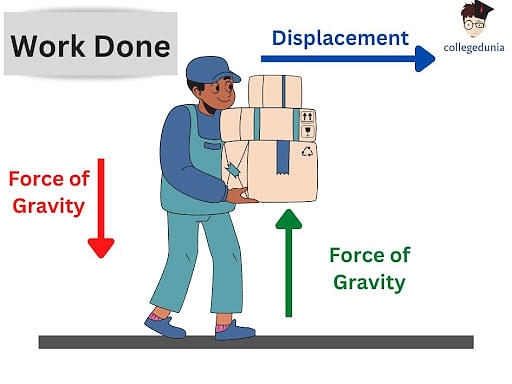
When an object is moved by the use of force, work is said to be done. Joules is the SI unit used to measure work. Work is characterized as a scalar quantity because it has simply magnitude and no directions.
Work
Properties of Work
- Work is independent of the body's path and the amount of time.
- It is referred to as positive work when the displacement and force are directed in the same direction.
- Negative work occurs when the force and displacement are directed in opposite directions.
- A conservative force is acting on a body if the effort required to move it between two points is independent of the path taken.
- A conservative force does nothing when returning to the same point in a closed loop.
- A force operating on a body is referred to as a non-conservative force if the amount of work required to move it between two points depends on the path chosen.
- Work performed by a non-conservative force is equal to force times distance, i.e., it is not equal to zero when the force is applied in a closed loop and returns to the same spot.
Read More:
What is Energy?
[Click Here for Sample Questions]
The ability to perform tasks is referred to as energy. Energy is, in other words, the capacity to perform work. Energy can be changed from one form to another, but it cannot be created or destroyed.
It just has magnitude and direction, making it a scalar quantity. The Joule is the SI unit for energy. Every object in the cosmos, whether it is a living entity or not, contains energy. In nature, energy is invisible, but it can be seen as light or wind.
Properties of Energy
- Energy can only be transferred from one form to another; it cannot be created or destroyed.
- The most abundant sources of energy are the sun and stars.
- Energy in the universe is constant and finite.
- Primary energy is a type of energy that occurs spontaneously in nature.
- As an illustration, consider the energy that both human and animal muscles emit.
- Humans use main energy sources to transform secondary energy into an energy carrier.
- Consider the secondary energy of electricity, which is produced from coal, wind, and water.
- Position, mass, speed, shape, and other variables can all affect the energy in different ways.
Read More: Work, Energy and Power
Types of Energy
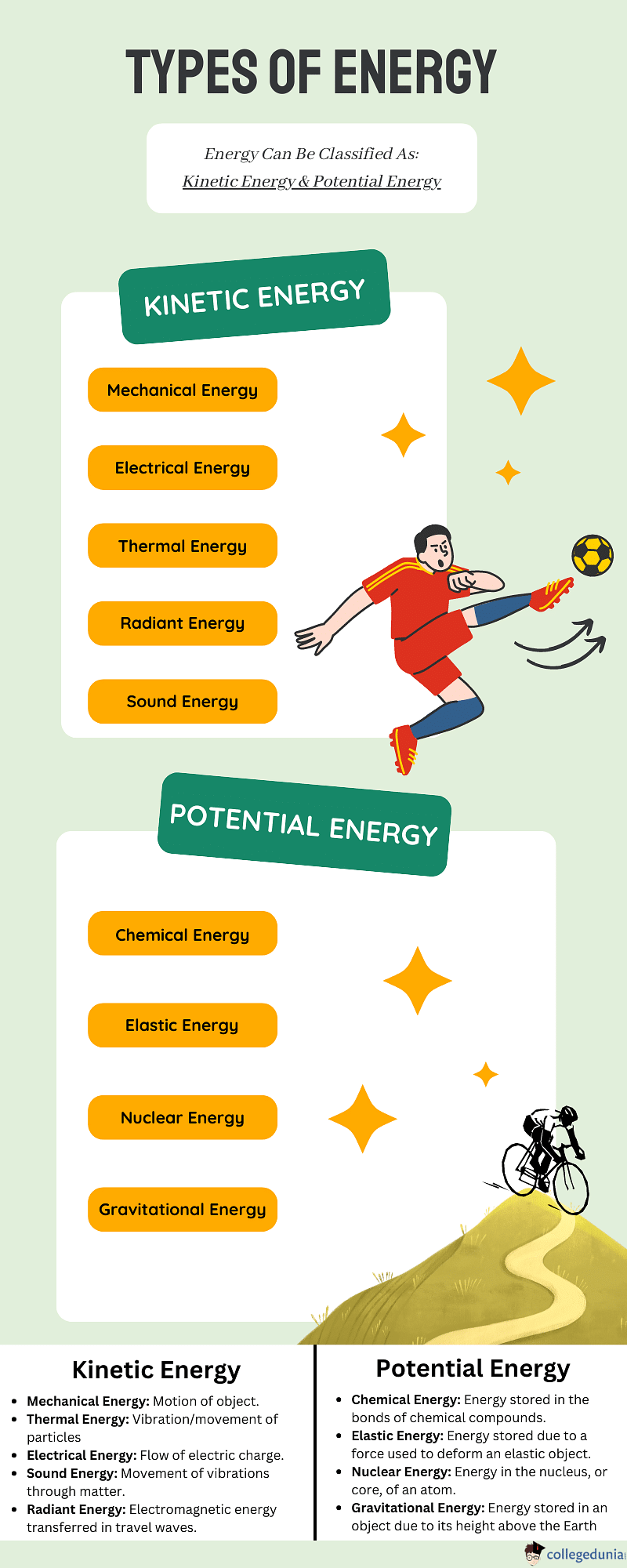
Kinetic energy and potential energy are two main types of energy.
- Kinetic Energy: It is a type of motion-related energy. An object's kinetic energy is determined by multiplying its mass by the square of its velocity.
- Potential Energy: Potential energy is the energy that results from being at rest. It is a type of energy that can be applied to labor. Gravitational force is one of the most prevalent forms of potential energy.
Work, Energy and Power Formulas
[Click Here for Sample Questions]
Here are a few important formulas related to the concepts of Work, Energy and Power.
1. Work Done by Constant Force
If a force F acts on a body at an angle θ and displaces the body through a distance ‘S’ work done,
W = F x d
W = (F cos θ) d
2. Work Done by Multiple Forces
Work done on the particle is the sum of the individual work done by all the forces acting on the particles.
\(W = [\sum \overrightarrow{F}] . \overrightarrow{S}\)W = W1 + W2 + W3 +….
3. Potential Energy Formula
Potential Energy is described as energy that a body produces as a result of its location or state.
Potential Energy = mgh
4. Kinetic Energy Formula
A scalar quantity is kinetic energy. An object's kinetic energy serves as a gauge for how much work it can accomplish just by moving. For a very long time, this idea has been instinctively understood.
K = ½ mv2= p2/2m
5. Power Formula
The rate at which work is performed is defined as power.
P = W/t
Where
- P = Power
- W = Work done
- T = Time taken
6. Work-Energy Theorem
This means a particle's change in kinetic energy is equal to the work that the net force does on it.
W= ∆K
7. Mechanical Energy Formula
Kinetic energy K and potential energy U add up to mechanical energy E of an object or system.
E= K + U
Solved ExamplesExample 1: A 100 N force acting parallel to the surface horizontally pulls an object across the surface. Calculate the amount of work done by the force in the moving object over an 8-meter distance. Solution: Given that,
F and d are in the same direction therefore, W = F x d W = 100 x 8 = 800 J Thus, the work done is 800 J. Example 2: How much electrical energy is consumed in Joules if a 60 W toaster is used for 30 minutes? Solution: Given parameters are
Energy = P x T Energy = 60 x 1800 = 108 KJ Thus, the electrical energy consumed is 108 KJ. |
Read More:
| Related Links | ||
|---|---|---|
| Gravitational Force Formula | Electric Power Formula | Geothermal Energy |
| Derivations of Kinetic Energy | Force and Laws of Motion | Displacement Vector |
Law of Conservation of Energy
[Click Here for Sample Questions]
Understanding energy conservation forms the basis for sustaining renewable energy for a sustainable future. For this there is a law in physics governing energy conservation. According to the law of conservation of energy,
| “Energy can neither be created nor destroyed, it can only be transferred from one form of energy to another”. |
- The law of conservation of energy also tells about the total energy produced before and after any physical process.
- Thus, during energy change, the total energy which is the combination of potential and kinetic energy remains constant or unchanged.
- The law of conservation of energy is valid in every situations. Mathematically, formula for total energy is given by:
mgh+\(\frac{1}{2}\)mv2= Constant
Rate of Doing Work
[Click Here for Sample Questions]
The rate at which work is performed is defined by the physics definition of power. It is calculated by dividing the amount of work measured in joules by the amount of time, measured in seconds.
- When the speed of vehicles like motorbikes or cars is measured in terms of their work done in a unit second, it is called power.
- In terms of energy in physics, the rate of transfer of energy is also called power.
Mathematically, the formula for rate of doing work or power is given by:
\(Power = \frac{Work}{Time}\)
or,
\(P = \frac{W}{T}\)
- Power is measured in joules per second or Watts and it is also a scalar quantity like work and energy.
- 1 Watt power is defined as work done of 1joule in 1 sec. Watt is the SI unit of power whereas erg per second is its CGS unit.
- 1 Kilowatts (KW) is equals to 1000 Watts (W) or, 1000 Joules-per-second (J/s)
- In Physics, the formula for average power is given by:
\(Average Power = \frac{Total Energy Consumed}{Total Time Taken}\)
Things to Remember
- Work refers to the displacement of an object when a force is applied to it.
- The work done by a non-conservative force is equal to force multiplied by distance.
- The ability to perform work is referred to as Energy.
- Energy can be transformed into different forms, but it cannot be created or destroyed.
- Energy is classified into two main types namely kinetic energy and potential energy.
- Power is defined as the rate of doing work.
Previous Years’ Questions (PYQs)
- A particle of mass M, starting from rest, undergoes uniform acceleration… (NEET 2010)
- A batsman hits back a ball straight in the direction of the… (NEET 1989)
- A vertical spring with force constant k is fixed on a table. A ball… (NEET 2007)
- Two bodies of masses m and 4m are moving with equal kinetic… (NEET 1998)
- A body, constrained to move in y-direction, is subjected to a… (NEET 1994)
- A block of mass M is attached to the lower end of a vertical spring. The… (NEET 2009)
- Consider a drop of rainwater having a mass of 1g falling from a… (NEET 2017)
- An engine pumps water through a hose pipe. Water passes… (NEET 2010)
- Force F on a particle moving in a straight line varies with distance… (NEET 2011)
- A gun fires a small bullet with kinetic energy… (KCET 2013)
- During inelastic collision between two bodies, which of the following… (KCET 2019)
- A car of mass 1500kg is lifted up a distance of… (KEAM)
- A spring stores 1J of energy for compression of… (KEAM)
- Two particles A and B of equal mass M are moving with the same… (JEE Main 2017)
- A person trying to lose weight by burning at lifts a mass… (JEE Main 2016)
Sample Questions
Ques. An object weighing 100 N is raised to a height of 15m. Determine the object's potential energy at that height. Find the new potential energy as well:
(a) When the same object is raised to half its original height.
(b) What happens if the same object is raised three times its original height? (With g = 10m/s2) (3 Marks)
Ans. Given that,
- Mg = 100
- h= 15 m
Using the potential energy formula,
P.E= mgh
P.E = 100 x 15 = 1500 J
(a) h = 15/2= 7.5m
P.E = 100 x 7.5 = 750 J
(b) h = 15 x 3 = 45m
P.E = 100 x 45 = 4500 J
Ques. Calculate the kinetic energy of a 500kg car moving at a speed of 36km/h. Find the kinetic energy if the velocity of the car doubles. (3 Marks)
Ans. Given parameters are:
- M = 500 kg
- v = 36km/hr = 10m/s
Using the Kinetic Energy Formula,
K = ½ mv2
K = ½ x 500 x 10 x 10 = 25000 J (25 KJ)
When velocity doubles, v = 20m/s
K = ½ x 500 x 20 x 20 = 100000 J (100KJ)
Ques. What is the difference between Energy and Power? (5 Marks)
Ans. The difference between Energy and Power is as follows:
| Energy | Power |
|---|---|
| The ability to perform work is the definition of energy. The power is what gradually integrates. | Power is described as the speed at which a certain amount of work is completed or energy is delivered. |
| The watt-second or joule is the unit used to measure energy. | Watts or joules per second are the units used to measure this. |
| Energy can take on different forms. | Power cannot be changed into another type. |
| It is well known that energy can be stored for later use. | Power quantity cannot be stored or is not storable. |
| Moving a car, heating a house, providing night-time illumination, flying an airplane, etc. all require energy. | Heat, electricity, and mechanical applications are all places where power is used. |
Ques. What is the difference between Work and Energy? (5 Marks)
Ans. The difference between work and energy is as follows:
| Work | Energy |
|---|---|
| It is defined as an action carried out on an object that results in some displacement. | It is stated as a property of a system or the ability to conduct work |
| Work = Force x Distance | Various equations exist based on the forms of energy. |
| The force's components align with the displacement in a parallel fashion. | Energy is the end product of work. |
| Work is positive if the applied force is in the same direction as displacement, and is negative if the applied force is in the opposite direction of displacement. | Energy doesn't have a component for direction. |
Ques. What role does energy play in our lives? (3 Marks)
Ans. Our human-made structures are not only heated by energy but also cooled by it. To lift your finger, get out of bed, or even stroll down the street, you need energy. Additionally, it is essential for a wide range of contemporary comforts, including lightbulbs, appliances, and automobiles.
Ques. What are the top five energy sources? (3 Marks)
Ans. There are five main types of renewable energy.
- Sunlight energy is solar energy.
- Heat from deep within the ground is geothermal energy.
- Wind power.
- Plant-based biomass.
- Water-powered hydroelectricity.
Ques. Does mass affect work? (3 Marks)
Ans. The amount of force applied to an object and the distance the object travels determine how much work is done on it. The net force on an object depends on its mass and its rate of acceleration during motion, according to Newton's Second Law of Motion.
Ques. What are the factors affecting work? (2 Marks)
Ans. The work done by the force on a body depends on two factors.
- Magnitude of the force and.
- Distance that the body moves.
Ques. Why is work done in space considered zero? (2 Marks)
Ans. An object in space loses its force when it is accelerated to a particular speed. However, because there is no air resistance in space, the object keeps its speed. Therefore, the work performed by things in space is similarly zero.
Check-Out:



Comments