



Content Curator
Oxidation is a process when an atom, molecule, or an ion gains Oxygen or loses one or more number of electrons in a chemical reaction. Reduction is defined as the process when an atom, molecule, or an ion loses Oxygen or gains one or more electrons in a chemical reaction. When both Oxidation and Reduction occur simultaneously in a chemical reaction, then that reaction is known as a Redox reaction.
| Table of Content |
Key Terms: Oxidation, Reduction, Redox reaction, Difference between Oxidation and Reduction.
Read More: Number of Moles Formula
Oxidation
[Click Here for Sample Questions]
When in a chemical reaction, one molecule loses electrons or gains Oxygen, then this type of chemical reaction is known as oxidation. If there is loss of electrons, removal of hydrogen group, or Addition of oxygen group in a reaction, then the reaction is called Oxidation. In oxidation reaction, energy is released and electrons are released in the surrounding. Oxidation state also increases in an oxidation reaction.
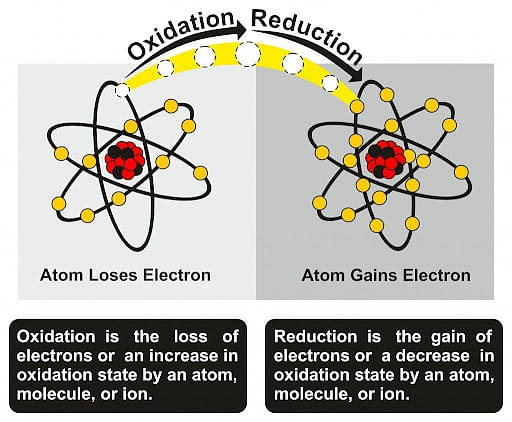
Oxidation and Reduction
Reduction
[Click Here for Sample Questions]
When in a chemical reaction, one molecule gains electrons or loses Oxygen, then this type of chemical reaction is known as reduction. If there is gain of electrons, addition of hydrogen group, or removal of oxygen group in a reaction, then the reaction is called Reduction. In oxidation reaction, energy is absorbed and electrons are taken from the surrounding. Oxidation state also decreases in a Reduction reaction.
Read More: Cathode Ray Discharge Tubes
Redox Reaction
[Click Here for Sample Questions]
Redox reaction are chemical reactions in which oxidation and reduction of the reactants occurs simultaneously. ‘Redox’ is a short form of reduction-oxidation. Every redox reaction can be broken down into two separate processes – a reduction process and an oxidation process.
Oxidation and Reduction reactions always occur at the same time in a redox reaction or Oxidation-Reduction reaction. The substance that gets reduced in a chemical reaction is called an oxidizing agent, while a substance that gets oxidized is called a Reducing Agent. The loss of electrons and the corresponding increase in the oxidation state of a given reactant is referred to as oxidation. The gain of electrons and the corresponding decrease in the oxidation state of a reactant is referred to as reduction.

Redox Reaction Explanation
There are different types of redox reactions: Decomposition Reaction, Combination Reaction, Displacement Reaction and Disproportionation Reactions.
Read More: Ionic Bond (Electrovalent Bond)
Oxidizing and Reducing Agents
[Click Here for Sample Questions]
The substance that gets reduced in a chemical reaction is called an oxidizing agent, while a substance that gets oxidized is called a reducing agent.
- An atom, ion, or molecule that gains electrons and is thereby reduced to a low valency state is an Oxidising agent.
- An atom, ion, or molecule that loses electrons and is thereby oxidised to a higher valency state is a reducing agent.
Examples of Oxidising Agents
- Electronegative elements like O2, O3, and X2
- Compounds containing higher oxidized state elements like KMnO4, K2Cv2O7, HNO3, KClO3
- Metallic and non-Metallic oxides like MgO, CuO, CrO3, P4O10
- The strongest oxidizing agent is Fluorine.
Examples of Reducing Agents
- All the metals are examples of Reducing agents.
- Some non-metals like Carbon, Hydrogen, etc.
- Hydracids like HCl, HBr, HI, H2S
- Few compounds containing lower oxidation state elements like FeCl2, FeSO4, SnCl2, Hg2Cl2
- Metallic hydrides such as NaH, LiH, CaH2.
- Few organic compounds like HCOOH
- Lithium is the strongest reducing agent in a solution.
- Cesium is the strongest reducing agent in absence of water
Read More: Combined Gas Law
Difference Between Oxidation and Reduction
[Click Here for Sample Questions]
The following table depicts the difference between the Oxidation and Reduction:
| OXIDATION | REDUCTION |
|---|---|
| Loss of electrons or Addition of Oxygen | Gain of electrons or Removal of Oxygen |
| Increasing oxidation number | Decreasing oxidation number |
| Compound loses Hydrogen | Compound gains Hydrogen |
| Release of energy in the surrounding | Absorption of energy from the surrounding |
| Strongest OA: Fluorine | Strongest RA: Cesium, Lithium |
Read More: Critical temperature
Things to Remember
- Oxidation is addition of Oxygen group, loss of Hydrogen group or loss of electrons.
- Reduction is loss of Oxygen group, gain of Hydrogen group, or gain of electrons.
- When Oxidation and Reduction occur simultaneously in a reaction, it is known as a Reduction reaction.
- The substance that loses electrons is called a reducing agent.
- The substance that gains electrons is called an oxidising agent.
- Substances which gain electrons and are reduced to a low valency state are known as Oxidising agents. Electronegative elements, Compounds containing higher oxidized state elements, and Metallic and non-Metallic oxides are all good oxidising agents.
- Fluorine is the strongest oxidizing agent. Substances which lose electrons and are oxidised to a higher valency state are known as reducing agent.
- All the metals, some non-metals like Carbon and Hydrogen, Hydracids, Metallic hydrides, few organic compounds like HCOOH and few compounds containing lower oxidation state elements are all good reducing agents. Lithium and Cesium are the strongest reducing agents in presence and absence of water respectively.
Read More: VSEPR Theory
Sample Questions
Ques. In formation of magnesium oxide reaction, Magnesium ________. (2 Marks)
a) Reduces
b) Oxidises
c) Hydrogenates
d) Decomposes
Ans. B is the correct answer.
Explanation: When in a chemical reaction, one molecule loses electron or gains Oxygen, then this type of chemical reaction is known as oxidation, an example is of this is the formation of magnesium oxide from magnesium.
Ques. Formation of zinc ion is an example of oxidation. (2 Marks)
a) True
b) False
Ans. A is the correct answer.
Explanation: When in a chemical reaction, one molecule loses electron or gains Oxygen, then this type of chemical reaction is known as oxidation. The formation of zinc i.e. loss of electrons from zinc is an example of oxidation.
Ques. Removing Oxygen from a compound or molecule results in________. (2 Marks)
a) Oxidation
b) Reduction
c) Oxygenation
d) Dehydrogenation
Ans. B is the correct answer
Explanation: When in a chemical reaction, one molecule gains electron or loses Oxygen, then this type of chemical reaction is known as reduction. One such reduction example is - H2 + F2 → 2HF.
Ques. Identify the reactant that has been oxidized and reduced respectively in the following reaction. (2 Marks)
Cr+ + Sn4+ Cr3+ + Sn2+
Ans. In the given reaction Cr+ loses electron and becomes Cr3+, hence it is oxidized. On the other hand, Sn4+ gains electron and becomes Sn2+, hence it is reduced.
Ques. Identify the type of reaction that follows: (2 Marks)
SnCl2 + 2FeCl2 → SnCl4 + 2FeCl2
a) Oxidation
b) Reduction
c) Redox
d) neither Oxidation nor Reduction
Ans. C is the correct answer
Explanation: Chemical reactions involving both oxidation and reduction processes at the same time are known as redox reactions. This given reaction involves both oxidation and reduction reactions and hence is a Redox reaction.
Ques. Identify the correct statement out of the following statements? (2 Marks)
a) Oxidation can be caused by a reducing agent
b) Oxidation reaction is also known as Redox reaction
c) Addition of electropositive elements is a type of oxidation reaction
d) reduction is the addition of hydrogen
Ans. D is the correct answer
Explanation: Oxidation is caused by an oxidizing agent, both oxidation and reduction reaction is combined together to form a Redox reaction and the addition of electropositive element is a type of reduction so the correct statement is that reduction as the addition of hydrogen.
Ques. Identify the oxising agent in the following reaction. (2 Marks)
Cu+2 + Zn → Cu + Zn+2
a) Copper
b) Hydrogen
c) Zinc
d) Oxygen
Ans. A is the correct answer
Explanation: Oxidizing agent can accept one or more electrons and causes oxidation of some other compound. In the given reaction, Copper accepts electrons from zinc, so copper is an oxidizing agent.
Ques. Identify the reducing agent in the following reaction: (2 Marks)
Cu+2 + Zn → Cu + Zn+2
a) copper
b) zinc
c) hydrogen
d) oxygen
Ans. B is the correct answer.
Explanation: Reducing agent can give one or more electrons and causes reduction of some other species in a chemical reaction. Hence, Zinc is the reducing agent in the given reaction.
Ques. Identify which of the following is not an oxidizing agent? (2 Marks)
a) Magnesium oxide
b) Ozone
c) Carbon dioxide
d) Sodium hydride
Ans. D is the correct answer.
Explanation: Most electronegative elements and compounds have an element in the highest oxidation state and oxides of metals and nonmetals are examples of oxidising agents whereas Sodium hydride is a metallic hydride, hence, not an oxidizing agent.
Ques. Hydrogen peroxide is an example of a/an ______________. (2 Marks)
a) oxidising agent
b) reducing agent
c) both reducing and oxidizing agent
d) neither reducing nor an oxidizing agent
Ans. C is the correct answer.
Explanation: Hydrogen peroxide is written as H2O2 and is a strong oxidizer as well as reducer because it contains 2 hydrogen and 2 oxygen elements and loses hydrogen or oxygen easily and hence oxidizes and reduces respectively.
Read More:



Comments