



Content Writer
Permutations and Combinations are the ways to express a group of objects by arranging them in a certain order or forming their subsets. It defines the techniques for changing the linear order of the set.
- Permutation and combinations are basic methods of counting in Mathematics.
- Combinations refer to the way of selecting the numbers or objects from a group.
- The process of adding water, milk, sugar and coffee is a real-life example of a combinations.
- Permutations are defined as the way of arranging numbers or objects in order.
- In calculating permutations, the order of sequence is given preference.
- License plates of cars are real-life examples of permutations.
- The concept of factorials is used to understand permutations and combinations.
- Formula for permutations is given as:
P(n,r) = n!/(n-r)!, where [n>= r]
- Formula for Combination is given as:
C(n,r) = n!/[r !(n-r)!], where [n>= r].
Read More: NCERT Solutions for Class 11 Mathematics Permutations and Combinations
Key Terms: Permutations and Combinations, Permutations, Combinations, Factorial, Permutation Formula, Combination Formula, Linear Order, Subset, Set, Data
What is Permutation?
[Click Here for Sample Questions]
Permutation is a method or act of arranging members of a set into an order or a sequence. In this process, subsets of sets are created to determine all possible arrangement sequences of a single data point.
- Permutation is used for a list of data where the order of data matters.
- It is used in almost every sector and branch of mathematics.
- They are used in sorting algorithms for analyzing the data set.
- It is an important topics to study about finite sets in group theory and combinatorics.
- Permutation for a set A is known as bijection of A which can be represented as:
f: A------->A
Example of PermutationExample: If you have three shirts and two pairs of trousers, you can arrange your limited items into subsets for a fresh look every day.
|

Permutations and Combinations Detailed Video Explanation
Read More:
What is Combination?
[Click Here for Previous Years’ Questions]
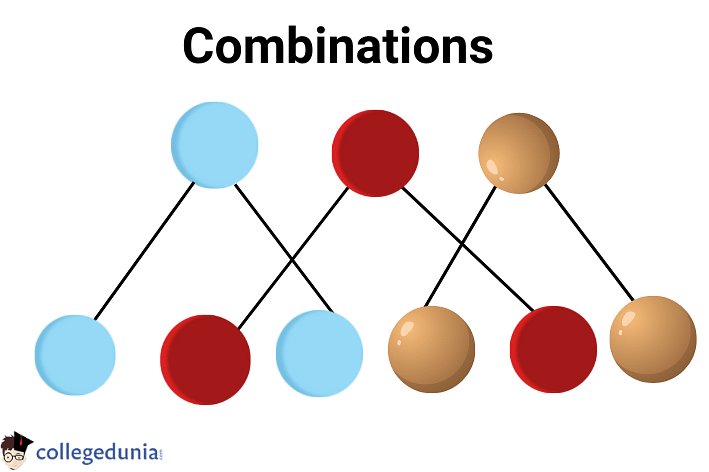
Combination is the method of forming subsets by selecting data from a larger set in a way that the selection order does not matter.
- Combination refers to the combination of n things taken k at a time without any repetition.
- It is used for a group of data where the order of data does not matter.
- The method is evident by the use of the binomial function.
- Terms like k-combination or k-selection refer to a set of combinations in which repetition takes place.
- In this method, the order of the set is not considered important.
Example of What is Combination?Example: Imagine you go to a restaurant and order soup.
|
Combination
Read More: Permutations and Combinations Formulas: Derivation, Example
Permutation and Combination Formulas
[Click Here for Sample Questions]
Permutation and Combination Formulas are used to find out the permutation and combination of r items taken from n items. Permutations are used to find the different arrangements while combinations are used to find the different groups. Permutations are always greater than the combinations for any given values of n and r.
Factorial Formula
Factorials are important for the understanding of permutation and combination.
- Factorial is the assigned multiplication of all positive integers less than the given positive integer.
- It is denoted by an exclamation point (!).
Factorial of a natural number n is given by the formula,
n! = 1 × 2 × 3 × 4 × .......× n
Solved Example of Factorial FormulaExample: The factorial of 7! is 1 x 2 x 3 x 4 x 5 x 6 x 7. |
Permutation Formula
Permutation is used to arrange data in sequences without any repetition or disruption of order. Permutation Formula is given as
\({^nP_r} = \frac{n!}{(n-r)!} \)
- where n: Total number of objects in a given set.
- r: Number of objects to be chosen from the set.
Solved Example of Permutation FormulaExample: Find the number of permutations if n is given as 12 and r as 2. Solution: Given that
Using the Permutation and Combination Formulas, we get Permutation \({^nP_r} = \frac{n!}{(n-r)!} \)= \(\frac{12!}{(12-2)!} = \frac{12!}{10!} = \frac{12 \times11\times 10!}{10!} \)= 132 Thus, the permutations is 132 respectively. |
Combination Formula
Combination refers to the process of choosing a subset from a larger set of things where the order doesn't matter. Combination Formula is given as
\({^nC_r} = \frac{{^nP_r}}{r!} = \frac{n!}{r!(n-r)!} \)
- where n: Total number of objects in a given set.
- r: Number of objects to be chosen from the set.
Read More: Important Questions For Class 11 Maths Permutations and Combinations
Solved Example of Combination FormulaExample: Find the number of combinations if n is given as 12 and r as 2. Solution: Given that
Using the Permutation and Combination Formulas, we get Combination \(\begin{array}{l}_{n}C_{r} = \frac{n!}{r!(n-r)!}\end{array} = \begin{array}{l}\frac{12!}{2!(12-2)!} = \frac{12!}{2!(10)!} = \frac{12\times 11\times 10!}{2!(10)!} = 66\end{array}\) Thus, the combinations are 66 respectively. |
Read More:
| Chapter Relevant Concepts | ||
|---|---|---|
| Types of Sets | T distribution formula | Stirling Formula |
| Set Theory in Maths | Involute | Sets Formula |
Derivation of Permutation and Combination Formulas
[Click Here for Previous Years’ Questions]
Permutation and Combination Formulas are used in all aspects of practical counting situations, from setting your phone password to picking three finalists for a competition.
- Permutations Formula is given as P(n,r) = n!/(n-r)!, where [n>= r].
- Combinations Formula is given as C(n,r) = n!/[r !(n-r)!], where [n>= r].
The derivation of both formulas in explained in detail below.
Derivation of Permutations Formula
Permutation is a way of selecting r distinct items without replacement from n items. In permutations, the order is important. According to the fundamental counting principle, we have
- P (n, r) = n . (n-1) . (n-2) . (n-3)…… (n-(r-1)) … Ways.
- It can be written as
- P (n, r) = n . (n-1) . (n-2) . (n-3) …. (n-r+1) …….. (1)
- On multiplying and dividing (1) by (n-r) (n-r-1) (n-r-2)........... 3.2.1,
\(P (n, r) =\frac{n.(n-1).(n-2).…. (n-r+1)[(n-r) (n-r-1) (n-r-2)... 3. 2. 1]}{[(n-r) (n-r-1) (n-r-2)....3. 2. 1]}\)
\(p (n, r)= \frac{n!}{(n-r)!}\)
Solved Example of Derivation of Permutations FormulaExample: How many three-letter words with or without meaning can be formed out of the letters of the word WHIRL with no repetition of letters? Solution: Given that,
Using the Permutation Formula, nPr=n!(n−r)! Substituting the values, we get 5P3 = (5!) / (5 - 3)! = 5! / 2! = 120/2 = 60 So, there is a possibility of 60 different permutations to form a 3-letter word from the word WHIRL |
Derivation of Combinations Formula
Combination is a way of choosing r objects out of n objects where the order doesn't matter. According to the fundamental counting principle, the number of ways to arrange r objects in r ways = r!.
- C(n,r) = P (n, r)/ r!
\(C(n,r) =\dfrac{\frac{n!}{(n-r)!}}{r!}\)
- Thus, the Combination Formula can be derived as
\(C(n, r) = \dfrac{n!}{r!.(n - r)!}\)
Solved Example of Derivation of Combinations FormulaExample: A man asks his nephew to choose 5 items from a container. If the container holds 10 items to choose from, how many different answers could the nephew possibly give? Ans: The given information mentions,
Hence, we have to determine “10 Choose 5” As we know, Combination = C(n, r) = n!/r!(n–r)! Thus, calculating combinations, we get: ⇒ 10! / 5!(10−5)! =10!/ 5!×5! = 252 possible answers can be given by the nephew. |
Read More: Probability and Statistics
Difference between Permutation and Combination
[Click Here for Sample Questions]
Permutations and Combinations are two interrelated terms in the principle of counting, however, both of them are two different concepts. The difference between permutation and combination is as given below:
| Point of Difference | Permutation | Combination |
|---|---|---|
| Definition | Permutation is a method to ascertain how many times can data be arranged in different sequences. | Combination is a method to ascertain how many subsets can be possibly made from a larger set. |
| Order | The arrangements are made in order in permutations. | The subsets are made irrespective of the order in combinations. |
| Denotation | It is denoted by the symbol nPr. | It is denoted by the symbol nCr. |
| Examples | Arranging alphabets, numbers, or books. | Selecting a menu, or forming a team. |
| Usage | When the solution is to be derived by selection based on their ordering, the formula of permutation must be used. | When the solution is to be derived by selection irrespective of order, the formula of combination must be used. |
Read More:
| Class 11 Mathematics Related Concept | ||
|---|---|---|
| Algebra | Fundamental Theorem of Arithmetic | Calculus |
| Geometry | Union of Sets | Number Systems |
Important Topics for JEE MainAs per JEE Main 2024 Session 1, important topics included in the chapter permutations and combinations are as follows:
Some memory based important questions asked in JEE Main 2024 Session 1 include:
|
Things to Remember
- Permutation is a process of finding ways to pick b things out of x.
- Combinations are a set of components that are selected one by one or all at the same time.
- Selecting a combination of clothes to wear for a particular function indicates combinations.
- Playing the keys of a piano is a process of permutations.
- Order is important in permutations but is not necessary for Combinations.
- Factorial is the multiplication of all the integers below the assigned value of the integer.
- Permutation Formula is given as \({^nP_r} = \frac{n!}{(n-r)!} \).
- Combination Formula is given as \({^nC_r} = \frac{{^nP_r}}{r!} = \frac{n!}{r!(n-r)!} \).
Read More: Mean of Grouped Data
Previous Years’ Questions
- If nCr−1 = 28, nCr = 56, and nCr+1 = 70, then the value of r is equal to…? [KEAM]
- The number of words that can be formed by using all the letters of the word PROBLEM only one is…? [KEAM]
- How many four-digit numbers abcd exist such that a is odd, b is divisible by 3, c is even…? [KEAM]
- Let Tn be the number of all possible triangles formed by joining vertices of an n-sided regular…? [JEE 2013]
- Let A and B be two sets containing four and two elements respectively. Then the number of subsets…? [JEE 2015]
- If all the words (with or without meaning) have five letters, formed using the letters…? [JEE 2016]
- All possible numbers are formed using the digit 1,1,2,2,2,2,3,4,4 taken all at a time…? [JEE 2019]
- An eight-digit number divisible by 9 is to be formed using digits from 0 to 9 without repeating…? [JEE 2014]
- If a, b and c are the greatest values of 19Cp, 20Cq, and 21Cr respectively, then…? [JEE 2020]
- Consider a class of 5 girls and 7 boys. The number of different teams consisting of 2 girls and…? [JEE 2019]
- Consider three boxes, each containing 10 balls labeled 1,2,....,10. Suppose one ball is…? [JEE 2019]
- If in a regular polygon the number of diagonals is 54, then the number of sides of this polygon is…? [JEE 2015]
- If the four-letter words (need not be meaningful ) are to be formed using the letters from the word…? [JEE 2016]
- In a collage of 300 students, every student reads 5 newspapers and every newspaper…? [JEE 1998]
- Number of divisors of the form (4n+2), n≥0 of the integer 240 is…? [JEE 1998]
- The number of 4-digit numbers without repetition that can be formed using the digits…? [KCET 2020]
- If nC12 = nC8 then n is equal to…? [KCET 2017]
- A simple graph contains 24 edges. Degree of each vertex is 3. The number of vertices is…? [KCET 2010]
- How many 5-digit telephone numbers can be constructed using the digits 0 to 9, if each number…? [KCET 2014]
- There are 10 persons including 3 ladies. A committee of 4 persons including at least one…? [KEAM]
Sample Questions
Ques. How many four-letter words, with or without any coherent meaning, can be formed from the word CALM, where any letter should not be repeated? (3 Marks)
Ans. To create four words with four letters without any repetition, we have to use permutation.
- Starting with the first position, the first place can be filled in four different ways by four different letters: C, A, L, and M.
- As the first place takes a letter, there are only three ways in which the second position can be filled.
- Likewise, when the first and second slots are occupied, there are only two ways in which the third slot can be filled.
- When the third one is done, there is only one way, with one remaining letter, can the fourth spot be filled.
Therefore, the number of ways in which we can arrange the four-letter word can be decided by the factorial of 4: 4 X 3 X 2 X 1 = 24.
Hence, we can make 24 words from the four-letter word CALM.
Ques. How many ways can a committee be formed of 5 men and 3 women picked from a pool of 9 men and 12 women? (3 Marks)
Ans. Splitting the men and women, the committee has to be a combination of 5 men and 3 women. Here, in the formula, nCp, with n being the total number of men to choose from and p is the number of men to be chosen.
Hence, 9C5 = 126 ways.
Thus, we can choose 5 men out of 9 men in 126 ways.
Similarly, nCp, with n being the total number of women and p being the number of women to be chosen.
Hence, 12C3 = 220 ways.
Finally, 126 x 220 = 27720.
Thus, we can choose 3 women out of 12 women in 220 ways.
Ques. How many 4-digit numbers can be formed with the digits 1 to 9 with no repetition allowed? (1 Mark)
Ans. To fill nine digits in the place of a four-digit number, the order must be relevant. Here, the 4-digit numbers can be as many as there are permutations of 9 digits picked 4 at a time. Therefore, the four-digit number will be 9! / 4! x 2! = 7560.
Ques. The word 'OPTICAL' needs to be re-arranged so that the vowels always come together. In how many ways can this be done? (3 Marks)
Ans. Our given word, ‘OPTICAL’ has 3 vowels: O, I, and A. These vowels can be grouped together to form a single letter, something like CLTP(OIA).
Assuming this to be 5 different letters (with each letter being unique),
Number of ways = 5! = 5 × 4 × 3 × 2 × 1 = 120
The remaining 3 vowels (OIA) can be arranged among themselves as well.
Number of ways to arrange these vowels among themselves = 3! = 3 × 2 × 1 = 6
Hence, the number of ways of arranging the word according to the question = 120 × 6 = 720.
Ques. Find the number of ways in which the word 'DETAIL' can be arranged so that vowels only occupy the odd positions? (4 Marks)
Ans. 'DETAIL' has 6 letters, out of which there are 3 vowels (EAI) and 3 consonants (DTL).
The 3 vowels(EAI) must occupy only the odd positions.
Let the positions be 1, 2, 3, 4, 5, 6.
The remaining 3 vowels should only occupy positions marked 1/3/5 only.
Hence, number of ways to arrange these vowels = 3P3 = 3! = 3 × 2 × 1 = 6
There are 3 consonants(DTL) that can be arranged in any order.
Hence, number of ways to arrange these consonants = 3P3 = 3! = 3 × 2 × 1 = 6
So, the total number of ways is 6 x 6 = 36
Ques. A bag has 2 white, 3 black, and 4 red balls. How many ways are there to draw 3 balls, if at least one black ball is mandatory to be picked? (5 Marks)
Ans. According to the question, there arise 3 cases, as given below:
- Case 1: 3 black balls
- Case 2: 2 black balls and 1 ball which is not black
- Case 3: 1 black ball and 2 balls which are not black
Thus,
- There are 3C3 ways to select 3 black balls.
- There are 3C2 × 6C1 ways to select 2 black balls and 1 ball which isn’t black.
- There are 3C1 × 6C2 ways to select 1 black ball and 2 balls which are not black.
Total number of ways = 3C3 + 3C2 × 6C1 + 3C1 × 6C2
= 1 + 3 × 6 + 3 × 6 × 52 × 1 = 1 + 18 + 45 = 64
Ques. A question paper is divided into 2 parts: Part P and Part Q. Each part contains 10 questions. A student has to attempt 8 questions from part P and 4 questions from part Q. How many ways of doing this exist? (3 Marks)
Ans. This question is an example of selection. We will be selecting 8 questions from 10 (part A) and 4 questions from 10 (part B)
- Ways to select 8 questions from part P = 10C8
- Ways to select 4 questions from part Q = 10C4
Hence, the total no. of ways are
= 10C8 × 10C4
= (10×9)/(2×1)(10×9×8×7)/(4×3×2×1) = 45 × 210 = 9450
Ques. There are 6 different colored flags. Find out the number of signals which can be made from these flags, if any number of them can be hoisted at a time? (5 Marks)
Ans. There can be any number of flags in the signal. Hence, we will consider 6 cases: 1 flag, 2 flags, 3 flags, 4 flags, 5 flags, and 6 flags. Each of these cases is described below:
- Case 1: Using 1 flag = 6P1 = 6
- Case 2: Using 2 flags = 6P2 = 6 × 5 = 30
- Case 3: Using 3 flags = 6P3 = 6 × 5 × 4 = 120
- Case 4: Using 4 flags = 6P4 = 6 × 5 × 4 × 3 = 360
- Case 5: Using 5 flags = 6P5 = 6 × 5 × 4 × 3 × 2 = 720
- Case 6: Using 6 flags = 6P6 = 6 × 5 × 4 × 3 × 2 × 1 = 720
Hence, the total number of signals = 6 + 30 + 120 + 360 + 720 + 720 = 1956
Ques. In a chess competition involving both men and women, each player needs to play exactly one game against the other player. In 45 games, both players were women and in 190 games, both players were men. What is the number of games in which one person was a man and another person was a woman? (5 Marks)
Ans. Let total us assume the total number of women = w, and men = m.
Since it is given that the number of games in which both players were women = 45
⇒wC2=45
⇒w(w−1)/2=45
⇒w(w−1)=90
⇒w=10
Also, it is given that the no. of games in which both players were men =190
⇒mC2=190
⇒m(m−1)/2=190
⇒m(m−1)=380
⇒m=20
Hence,
- No. of women = 10
- No. of men = 20
Number of games in which one person was a man and the other person was a woman = 20C1 × 10C1 = 20×10 = 200.
Ques. In Ramesh Nagar, there are 10 houses in one row. One day, a thief decided to steal from the 3 houses of Ramesh Nagar. In how many ways can he do so, such that no two houses are next to each other? (3 Marks)
Ans. Initially, let's remove the 3 houses where the thief planned to steal from. Then we are left with 10−3 = 7 houses as numbered below.
Now there are 8 positions as marked as * above to place the 3 houses (from where the thief steals) such that no two such houses are next to each other. This can be done in 8C3 ways.
| * | 1 | * | 2 | * | 3 | * | 4 | * | 5 | * | 6 | * | 7 | * |
Therefore, the number of ways in which he can steal is:
= 8C3 = (8×7×6)/(3×2×1) = 56 = 8×7×63×2×1 =56
Ques. 30 identical toys have to be divided into 10 boys. Each boy gets at least one toy. In how many ways can this be done? (3 Marks)
Ans. Since the toys are identical and the boys are distinct,
Here, we will apply a formula similar to the one in the case of identical boxes.
n = 10 and k = 30.
Hence, the required number of ways
= (k-1)C(n-1) = 29C9
Ques. Find the number of permutations and combinations of n = 8 and r = 3? (3 Marks)
Ans. Given, n = 8, r = 3
- Using the formula given above:
- For Permutation:
- nPr = (n!) / (n – r)!
- nPr = (8!) / (8 – 3)!
- nPr = 8! / 5!
- nPr = 336
- For Combination:
- nCr = n!/r!(n − r)!
- nCr = 8!/3!(8 − 3)!
- nCr = 8!/3!(5)!
- nCr = 8 × 7 × 6 x 5!/3!(5)!
- nCr = 112
Ques. 20 identical toys have to be divided into 10 boys. Each boy gets at least one toy. In how many ways can this be done? (3 Marks)
Ans. Since the toys are identical and the boys are distinct,
Here, we will apply a formula similar to the one in the case of identical boxes.
n = 10 and k = 20.
Hence, the required number of ways
= (k-1)C(n-1) = 19C9
Ques. In how many ways a committee consisting of 3 men and 2 women, can be chosen from 5 men and 5 women? (3 Marks)
Ans. Choose 3 men out of 5 men = 5C3 ways = 10 ways
- Choose 2 women out of 5 women = 5C2 ways = 10 ways
- The committee can be chosen in 5C3 × 5C2 = 100 ways.
Ques. In how many ways can 7 different books be arranged on a shelf? (2 Marks)
Ans. This is a permutation problem because the order of the books matters.
- Using the permutation formula, we get:
- 7P7 = 7! / (7 – 7)! = 7! / 0!
- 7 x 6 x 5 x 4 x 3 x 2 x 1 =
- Therefore, there are 5040 ways to arrange 7 different books on a shelf.
Check Out:



Comments