



Content Curator
Protochordates are an informal category of animals named mainly for convenience to describe invertebrate animals that closely resemble vertebrates. The organisms of this phylum are generally found in marine environments. In Biology the word Phylum is used to indicate the level of classification or rank of taxonomy (a science of classifying organisms including plants, animals, micro-organisms, etc) below the kingdom and above class. Although Protochordata does not form part of a proper taxonomic group, these organisms occupy a major part of Chordata.
| Table of Content |
Keyterms: Protochordates, invertebrate, vertebrates, marine environments, Phylum, plants, animals, micro-organisms, Chordata
Phylum Protochordata
[Click Here for Sample Questions]
Phylum Protochordata (also known as lower chordates) is an informal (improper) group of organisms to describe the invertebrates that are closely related to vertebrates. Although Protochordata does not form part of a proper taxonomic group, these organisms occupy a major part of Chordata.
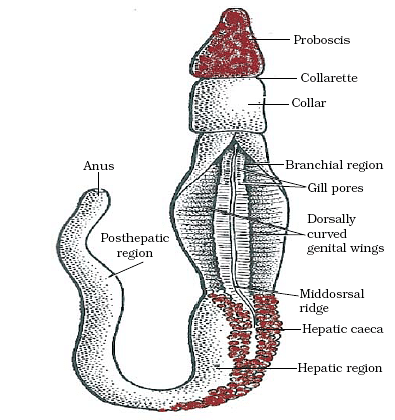
Protochordate examples
Protochordate does have a notochord (a structure that supports the body) for a certain period during their lifetime or all throughout. These organisms, also known as Acraniata, meaning, they do not have a proper skull and a cranium.
Protochordata is grouped into three types of sub-phyla based on the type of notochord they have. They are:
- Hemichordata
- Urochordata
- Cephalochordata
Also Read:
| Related Articles | ||
|---|---|---|
| Animal Kingdom | Multicellular Organism | Animal Tissues |
| Deltoid Muscle | Moth and Butterfly | Living Fossil |
| Prokaryotic and Eukaryotic cells | Reptiles and Amphibians | Vestigial Organs |
Characteristics of Protochordata
[Click Here for Sample Questions]
Some of the most commonly identified characteristics of Protochordata are as follows.
- A notochord, a set of vacuolated turgid cells that appear like a solid, elasticated and unsheathed structure like a rod, is found throughout the life of protochordata or only during the stages of early embryonic development.
- Protochordata mostly thrives in marine water.
- The Central Nervous System of protochordata is found to be hollow, single, and dorsal, which is entirely different from the CNS of non-Chordata organisms.
- Bodies of protochordata are triploblastic (having three primary germ layers, particularly ectoderm, mesoderm, and endoderm), bilaterally symmetrical in synchronization with the organ system level of organization.
- A post-anal tail to ensure the balance is found across most protochordata.

Post Anal Tail
- The pharynx, a hollow tube that starts behind the nose, goes down the neck, in the protochordata is perforated by gill slits to enable water circulation for respiration.
- The heart of these organisms is ventral (frontal) with a closed circulatory system.
- The gut (stomach) in protochordata is ventral to the nerve cord.
- The best examples of protochordata are Salpa, Doliolum, Amphioxus, and Saccoglossus.
Read More: Catabolism and Anabolism
Classifications of Protochordata
[Click Here for Sample Questions]
Protochordata can be classified into three sub-categories based on the types of notochord they possess. The sub-categories are as follows.
- Hemichordata
- Urochordata
- Cephalochordata
Hemichordata
All hemichordata are basically marine organisms. While some live in solitary confinement, others live in colonies. Their bodies are unsegmented, cylindrical, and stout often looking like a worm. They are bilaterally symmetrical and triploblastic. The wall of the body has a single layer epidermis with smooth longitudinal fibers. The collars of hemichordata often have arms or tentacles, however, locomotory appendages are found to be missing.
The bodies of hemichordata have a general surface that facilitates breathing. Alternatively, respiration happens through a pair or multiple pairs of gill slits. Their circulatory systems of Hemichordata include a dorsal heart including a longitudinal dorsal and ventral vessel. The blood of hemichordata is colourless and has no corpuscles.

Hemichordates
They possess a complete digestive tract. To feed on microorganisms and other debris, all hemichordata use a ciliary mechanism or use filtering. The excretory system of Hemichordata is made of the glomerulus or proboscis gland. The nervous system of hemichordata is found to have an epidermal plexus or nerve cells along with nerve fibres.
Sexes of hemichordata are found to be separated or united, and gonads (reproductive organs) may exist in multiple pairs or one. Asexual reproduction is found to be common. Other reproductive traits include internal or external fertilization. Examples of hemichordata include Balanoglossus, Cephalodiscus, Rhabdopeura.
Urochordata
Urochordata are marine organisms, filter-feeders and are mostly sessile (attached directly by its base without a stalk or peduncle) in nature. The body or Urochordata is enclosed in a leathery sheath, which is also called tunicates since it is composed of a kind of substance called tunicin.
The notochord only appears in the larva tail of urochords but disappears in adults due to retrogressive metamorphosis.
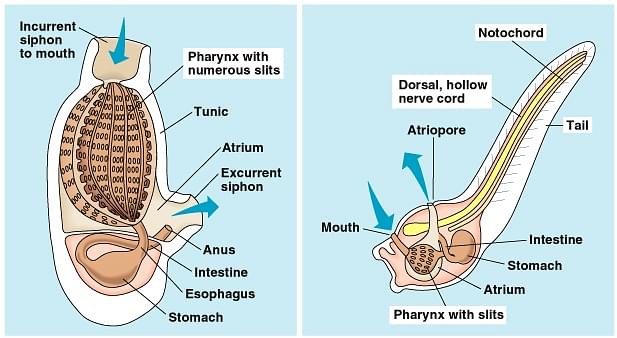
Urochordata
The excretory system is not present. The blood of Urochordates consists of venadocytes.
Their circulation system of Urochordata is of the open kind. They reproduce asexually by the budding process. Urochordata organisms breathe through their gill slits or stigma, which are found in numerous numbers. They open into the atrium, instead of opening into the exterior.
The nerve cord (also known as the neural tube in the larva) is replaced by one dorsal ganglion in adults. Examples of Urochordata include Salpa, Herdmania, Doliolum
Read More: Symptoms of Liver problems
Cephalochordata
[Click Here for Sample Questions]
Like the above two, Cephalochordata are also marine organisms and found to be filter-feeders. In Cephalochordata, the tails remain throughout their lives. The body wall of the Cephalochordata is made up of myotomes (muscle served by the spinal nerve) often giving a fish-like resemblance. Cephalochordata do not have a nerve cord, and hence have no formation of a brain. Their notochord remains throughout their lives, extending up to the cephalic region or the head.
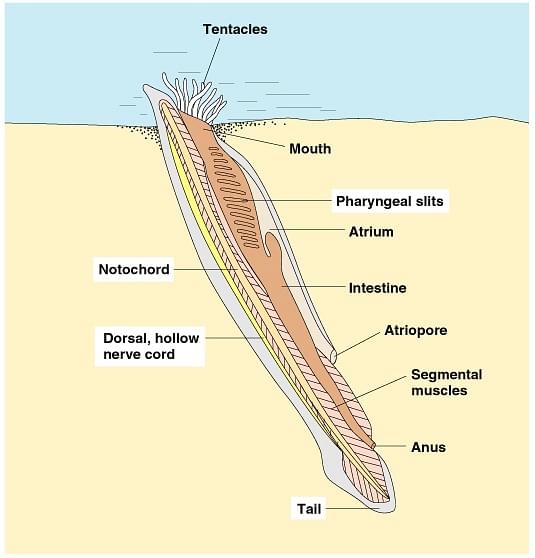
Cephalochordata
Excretion in Cephalochordata happens through paired protonephridia (a network of dead-end tubules without internal openings) with solenocytes (a type of flagellated cells). They have many gill stilts (open in the atrium) which also remain while they are in the adult stage. Cephalochordata lives by burrowing and they are free swimmers. One of the best examples of Cephalochordata includes Amphioxus.
Things to Remember
- Protochordate is an informal category of animals named mainly for convenience to describe invertebrate animals that closely resemble vertebrates.
- The organisms of this phylum are generally found in marine environments.
- Protochordata are grouped into three types of sub-phyla based on the type of notochord they have. They are Hemichordata, Urochordata and Cephalochordata.
- Examples of hemichordata include Balanoglossus, Cephalodiscus, Rhabdopeura.
- Examples of Urochordata include Salpa, Herdmania, Doliolum
- The best example of Cephalochordata includes Amphioxus.
Also Read:
Sample Questions
Ques. What are Protochordates? (2 marks)
Ans. Protochordate is an informal category of organisms in the invertebrates that are closely related to vertebrates.
Ques. What are the subphyla of Protochordata? (2 marks)
Ans. Protochordata is classified into the following three subphyla:
- Urochordata
- Hemichordata
- Cephalochordata
Ques. What is the difference between Protochordates and Chordates? (2 marks)
Ans. Chordates group comprises vertebrates also, whereas Protochordates group comprises only invertebrate chordates.
Ques. Do humans have a notochord? (2 marks)
Ans. A notochord is a proto backbone found at the embryonic stage. These are only found in the organisms of Phylum Chordata. Human beings belong to this phylum, but possess a notochord only at their embryonic stage.
Ques. What are the major differences between a notochord and a vertebral column? (2 marks)
Ans. There are two major striking differences between a notochord and a vertebral column.
A notochord is a cartilaginous skeletal rod that is found at embryonic stages of chordates or in some adult invertebrate chordates.
Whereas a vertebral column is found in higher chordates, having the protection of the spinal cord. In adult vertebrates, the notochord is replaced by the vertebral column.
Ques. Differentiate between a diploblastic and a triploblastic animal. (2 marks)
Ans:
Diploblastic: Animals in which the cells are arranged in two embryonic layers, an external ectoderm and an internal endoderm, are called diploblastic animals, e.g. Porifera, coelenterates and ctenophores.
Triploblastic: Those animals in which the developing embryo has a third germinal layer, mesoderm, in between the ectoderm and endoderm, are called triploblastic animals. E.g.: Platyhelminthes to Chordates.
Ques. Endoparasites are found inside the host body. Mention the special structure, possessed by these and which enables them to survive in those conditions. (2 marks)
Ans: The life cycles of endoparasites are more complex because of their extreme specialisation. Their morphological and anatomical features are greatly simplified while emphasizing their reproductive potential.
In accordance with their lifestyle parasites evolve special adaptations such as:
- Loss of unnecessary sense organs.
- Loss of digestive system.
- High reproductive capacity.
- Presence of adhesive organs or suckers to cling on to the host.
Ques. Give the characteristic features of the following citing one example of each Urochordata and cephalochordata. (2 marks)
Ans: Subphylum Urochordata and Cephalochordata are often referred to as protochordates and are exclusively marine. In Urochordata, notochord is present only in larval tail, while in Cephalochordata, it extends from head to tail region and is persistent throughout their life.
Examples: Urochordata—Ascidia, Salpa, Doliolum; Cephalochordata— Branchiostoma (Amphioxus or Lancelet).
Ques. What is the relationship between germinal layers and the formation of body cavity in case of coelomates, acoelomates and pseudocoelomates? (2 marks)
Ans: The presence or absence of a cavity between the body wall and the gut wall is very important in classification. The body cavity, which is lined by mesoderm, is called coelom. Animals possessing coelom are called coelomates, e.g., annelids, molluscs, arthropods, echinoderms, hemichordates and chordates. In some animals, the body cavity is not lined by mesoderm, instead, the mesoderm is present as scattered pouches in between the ectoderm and endoderm. Such a body cavity is called pseudocoelom and the animals possessing them are called pseudocoelomates, e.g., aschelminthes. The animals in which the body cavity is absent are called acoelomates, e.g., platyhelminthes.
Ques. Mammals are most adapted among the vertebrates. Elaborate. (2 marks)
Ans: Mammals are most adapted among the vertebrates as they are found in a variety of habitats – polar ice caps, deserts, mountains, forests, grasslands and dark caves. Some of them have adapted to fly or live in water. They have two pairs of limbs, adapted for walking, running, climbing, burrowing, swimming or flying. The skin of mammals is unique in possessing hair. External ears or pinnae are present. Different types of teeth are present in the jaw. The heart is four-chambered. Respiration is by lungs. Sexes are separate and fertilisation is internal. They are viviparous with few exceptions and development is direct.
For Latest Updates on Upcoming Board Exams, Click Here: https://t.me/class_10_12_board_updates
Check-Out:



Comments