



Content Curator
Plants classification based on growth habit can be done in many categories according to their height, stem, and branch pliability, life cycle, and other characteristics. Even though they are living creatures (or living beings), plants grow in the soil and rely on their roots to anchor them to a certain location.
- Animals can move around, but plants cannot.
- Furthermore, unlike mammals, plants do not consume food.
- The process of photosynthesis allows plants to produce their own food.
- Plants come in a variety of sizes and shapes.
- Some plants are really large, some are medium-sized, yet others are small, and still, more are simply green material patches on the earth.
Read More: Basic Internal Anatomy of Leaf
| Table of Content |
Key Terms: Plants, Growth, Lifecycle, Herbs, Shrubs, Trees, Climbers, Creepers, Photosynthesis, Oxygen.
What is a Growth Habit?
[Click Here for Sample Questions]
The phrase "growth habits" in horticulture refers to how a plant grows and develops as well as any alterations to the plant's height, form, and type of growth over the course of its existence. Their growth habits are influenced by both genetic and environmental variables, and both have a significant impact.
- Interactions between plants and diverse animals have an impact on how well they can adapt to their surroundings.
- According to evolutionary theory, a plant's growth patterns serve to ensure its survival and adaption to a variety of habitats.
- This increases the possibility that genes will be successfully passed on to the following generation.
Read More: Fertilization in Plants
Classification of Plants Based on Growth Habits
[Click Here for Sample Questions]
Different classifications, such as shrubs, herbs, and trees, are used to categorize plants according to their size. Their physical traits and growth habits are revealed by this classification. Additionally, it emphasizes their growth trends, job descriptions, and ecosystem-wide contributions.
There are two more plant types, in addition to these three, that require assistance to grow. Particular names for them include climbers and creepers.
Read More: Double Fertilization in Angiosperms
Herbs
[Click Here for Sample Questions]
Small plants known as herbs have stems that are soft, green, and fragile, devoid of woody fibers. In clusters, they develop. In just one or two seasons, they can complete their life cycle.

Herbs
- They often only have a few branches, if any at all.
- These plants' underground roots are simple to remove.
- Herbs include enough vitamins and minerals and other nutritional advantages to be part of a nutritious, well-balanced diet. Bananas, grass, wheat, and tomatoes are examples of herbs.
Read More: Difference between bryophytes and pteridophytes
Shrubs
[Click Here for Sample Questions]
Medium-sized woody plants called shrubs are shorter than trees and taller than herbs. They often stand between 6 and 10 meters tall. They have many branches and strong, woody stems that are bushy in appearance.

Shrubs
- Despite being tough, stems are flexible but not easily broken.
- These plants' lifespans often vary by species.
- Some of the common shrubs found nearby are rose, jasmine, lemon, tulsi, and henna.
Read More: Difference Between Xylem And Phloem
Trees
[Click Here for Sample Questions]
Large and tall plants are trees. Their "trunks" are solid, strong, and made of wood. Numerous branches that contain leaves, flowers, and fruits are sprouted from this one main stem, also known as the trunk.
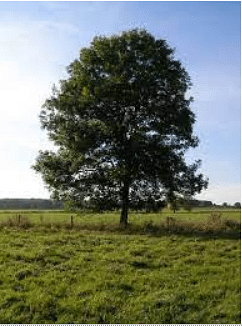
Trees
- Some trees, like coconut trees, have no branches at all; instead, they have a single primary stem that produces leaves, flowers, and fruits all on its own.
- A tree has an extremely long life span. i.e., for a long time.
- Trees include banyan, mango, neem, cashew, teak and oak.
Read More: Difference Between Dicotyledons and Monocotyledons
Climbers
[Click Here for Sample Questions]
Climbers are significantly more advanced than creepers. Climbers can't stand on their own because of their weak, lengthy, and extremely thin stem.

Climbers
- They can use external support to grow vertically and carry their weight when necessary.
- These kinds of plants use distinctive parts called tendrils to accomplish climbing.
- Some common names for these plants are pea plant, grapevine, sweet gourd, money plant, jasmine, runner beans, green peas, and various climbers.
Read More: What is Triple Fusion?
Creepers
[Click Here for Sample Questions]
Creepers are plants that creep across the earth, as their name suggests.

Creepers
- They have incredibly brittle, long, thin stems that are unable to sustain their entire weight or stand upright.
- Watermelon, strawberries, pumpkin, and sweet potatoes are some examples.
Things to Remember
- Life on Earth would not be possible without the existence of plants and trees in our environment.
- This is so that they may simultaneously generate food for both people and animals and produce oxygen.
- These plants are also responsible for removing carbon dioxide from the air and providing clean air for human use.
- In horticulture, the term "growth habits" describes the growth and development of a plant as well as any changes to the plant's height, form, and kind of growth over the course of its life.
- Plants are divided into various groups based on their size, including shrubs, herbs, and trees.
- In addition to these three plant types, there are two more that require aid to grow. They go by the specific labels climbers and creepers.
Also Read:
Sample Questions
Ques. What is the importance of classifying plants? (1 Mark)
Ans. In order to examine the links between various plant species, analyze their distinctive traits, and create conservation plans for endangered species, it is necessary to classify plants correctly.
Ques. How to tell whether a plant is a tree, shrub, or herb? (1 Mark)
Ans. The classification is mostly determined by the physical traits and development habits of the plant. Herbs are non-woody and have soft stems, while trees have a dominating trunk and raised canopy. Shrubs often have many stems and a bushy look.
Ques. Define herbs, shrubs, and trees. (3 Marks)
Ans. Herbs: Herbs are non-woody plants with supple, green stalks, commonly referred to as herbaceous plants. After each growth season, they often pass away due to their short lifespans. A vast variety of plants are classified as herbs and are utilized for culinary, medicinal, and aromatic purposes. Lavender, mint, and basil are a few examples.
Shrubs: Woody plants with short stature are known as shrubs. They have a bushy appearance due to the numerous stems and branches that grow from the base. The height of a shrub can range from a few inches to several meters. Rosies, azaleas, and junipers are examples of shrubs.
Trees: A single main trunk and an elevated canopy of branches and leaves define trees as big, woody plants. They are the most enduring and tall plants. Shade, soil stabilization, and providing a habitat for a wide variety of species are all important functions performed by trees.
Ques. What is the lifespan of a tree? (1 Mark)
Ans. Depending on the species, trees have different life spans. While some trees can survive for hundreds of years or even millennia, others only live for a few decades.
Ques. What is meant by Growth habit? (1 Mark)
Ans. Growth habits primarily refer to a plant species' outward appearance, shape, height, and form of growth. Specific genetic patterns that control growth are what determine a plant's growth habits.
Ques. How are climbers different from creepers? (2 Marks)
Ans. The primary distinction between climbers and creepers is that creepers bear both flowers and fruit on the ground, whereas climbers stretch their stems and leave horizontally along with the earth. The creepers' leaves create fiber-like roots that anchor the plant to the ground and give it external support as it grows.
Plants that climb use external support to grow since their stems are delicate. In order to climb, these plants create thread or hooks from their leaves. Some plants create unique roots that act as holdfasts for climbing over or around particular objects.
Ques. Give examples of climbers and creepers. (2 Marks)
Ans. Climbers include, among other things, beans, cucumbers, grapevines, gourds, jasmine, and money plants.
Creepers commonly take the form of pumpkins, passion flowers, and sweet potatoes.
Ques. Which pigment is responsible for Photosynthesis in Plants? (1 Mark)
Ans. The pigment that drives photosynthesis in plants is called chlorophyll.
Ques. Define Plantae. (1 Mark)
Ans. The Plant Kingdom is another name for Plantae. The kingdom Plantae encompasses all living things. They are eukaryotic multicellular autotrophic creatures. Plant cells are shielded from hazardous substances from the outside by stiff cell walls.
For Latest Updates on Upcoming Board Exams, Click Here: https://t.me/class_10_12_board_updates
Check-Out:



Comments