



Education Journalist | Study Abroad Lead
The difference between monocotyledons and dicotyledons is that a monocot has a single cotyledon while a dicot has two cotyledons in its embryo. The main difference between monocotyledons and dicotyledons can be observed in their roots, stems, flowers, leaves, and seeds. Cotyledon refers to the ‘first seed leaf’ in the embryo. If it is a single seed leaf, then the plant is categorised as a monocot and with a pair of leaves, it is categorised as a dicot.
Plants are classified into two types: flowering plants and non-flowering plants. Angiosperms are flowering plants, whereas gymnosperms are non-flowering plants. Based on the presence of the embryo in the seed, angiosperms are further classified as monocotyledons and dicotyledons plants. Monocotyledons (Liliopsida) are a flowering plant class with over 75,000 species. They are mostly herbaceous in nature. Monocotyledons have one cotyledon with a terminal position. Dicotyledons (Magnoliopsida) are a flowering plant class that includes over 1,75,000 plant species ranging from annuals to trees. The presence of two lateral cotyledons in each seed distinguishes the Dicotyledons.
| Table of Content |
Key Terms: Monocotyledons, Dicotyledons, Flowers, Embryo, Endosperm, Leaf, flowering plants, Angiosperms, Liliopsida, Seed, Magnoliopsida
What are Monocotyledons?
[Click Here for Sample Questions]
Monocotyledons are flowering plants with well-developed endosperm. It typically stores starch and proteins, both of which are required for the plant's initial growth.
- The germination of monocotyledon seeds is typically hypogeal.
- Monocotyledons are grass-like angiosperms, the seeds of which have one embryonic leaf or cotyledon.
- The leaves of monocotyledons are simple and have isobilateral symmetry. They have straight veins, smooth edges, and a long sheath that mostly covers the stem.
- Stomata are distributed evenly across both leaf surfaces.
- Examples of monocots – Palm trees, bananas, grasses, and orchids.
- As the main root has not developed, the root system is adventitious. The stem can be solid or hollow.
- The vascular bundles are strewn about the stem. Because the stems and roots lack cambium, they are unable to grow in diameter.
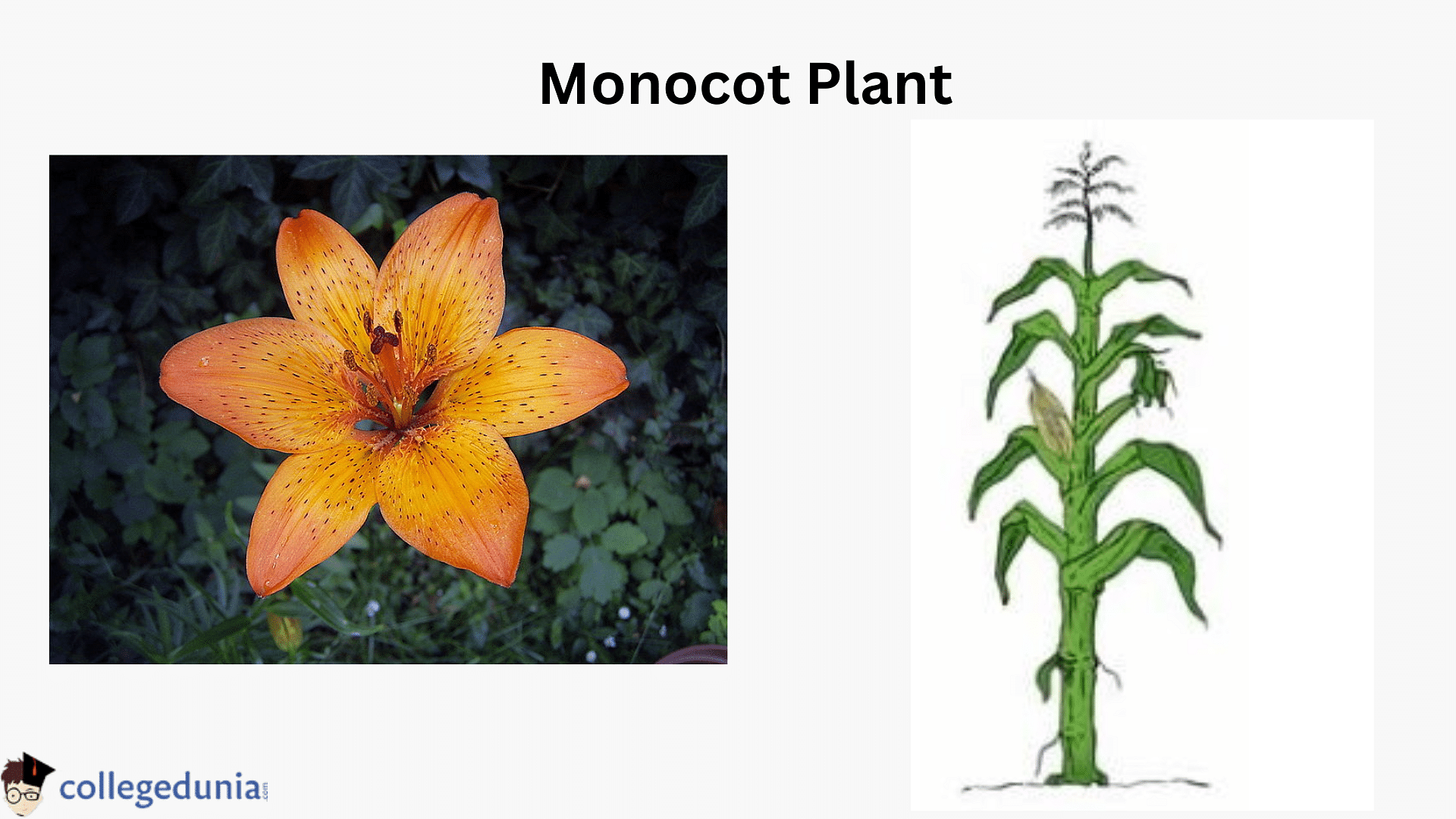
Monocot Plants
Also Read:
What are Dicotyledons?
[Click Here for Previous Year Questions]
Dicotyledons (Magnoliopsida) are a class of flowering plants with two lateral cotyledons in each seed. Before photosynthesis begins, starch, fats, or proteins are stored in the cotyledons and used for plant growth.
- The germination of dicotyledon seeds can be hypogeal or epigeal.
- The leaves, whether simple or complex, have dorsiventral symmetry.
- They have a net or reticulate venation, and their edges are frequently jagged or dissected.
- Stomata can be found on the undersides of leaves. Dicotyledons have the Taproot system.
- The stems are strong. Vascular bundles are smaller than monocotyledons and are arranged in rings.
- Carrots, almonds, peas, radishes, bell peppers, and other dicot plants are examples.

Dicot Plant
Also Read: Productivity in Ecosystem
Difference Between Monocotyledons and Dicotyledons
[Click Here for Sample Questions]
There are several characteristics that distinguish dicotyledon from monocotyledon. The main difference between monocotyledons and dicotyledons are as follows:
| Monocotyledons | Dicotyledons |
|---|---|
| Plants with seeds having just one cotyledon are monocotyledons. | Plants with seeds having two cotyledons are dicotyledons. |
| Monocot leaves are isobilateral. | Dicot leaves are dorsiventral. |
| They are Herbaceous. | They can be Herbaceous or Arboraceous. |
| Pollen tubes in monocots have a single pore or furrow. | Dicotyledons have three or more pores or furrows in the pollen tube. |
| Hypogeal seed germination | Epigeal or hypogeal seed germination. |
| Leaves of monocots have parallel veins, smooth edges, and long sheaths, always covering the stem. They have stomata on both surfaces. | Leaves of dicot are complex with a net or reticulate venation, often with uneven edges, and jagged or dissected. They have stomata on the down surface. |
| Monocotyledons have hollow or solid stems without a cambium. The Vascular bundles are scattered throughout the stem. | Dicotyledons have solid stems with a cambium. The vascular bundles are located in rings (concentrically). |
| Monocots have an adventitious root system. | Dicots have a tap root system. |
| The number of individual parts of the flowers is equal to or multiple of three. | The number of individual parts of the flower is equal to or is multiple of four or five. |
| Monocotyledons just have one endosperm | Dicotyledons have two endosperms. |
| A few examples of monocotyledons are onions, wheat, garlic, corn and grass. | A few examples of dicots are cauliflower, beans, apples and pears. |
Things to Remember
- Monocotyledons have one terminal cotyledon in each seed. They are mostly herbaceous in nature.
- Dicotyledons (Magnoliopsida) are flowering plants with two lateral cotyledons in each seed.
- Seed germination is typically hypogeal in Monocotyledons and epigeal or hypogeal in Dicotyledons.
- The leaves of monocotyledons are simple, with isobilateral symmetry.
- Dicotyledon leaves can be simple or complex, with dorsiventral symmetry.
- The difference between monocotyledons and dicotyledons is that stomata are found on both surfaces of the leaves in Monocotyledons, but on the down surface in Dicotyledons.
- Monocotyledon roots and stems lack a cambium and cannot enlarge in diameter, whereas Dicotyledon roots and stems do have a cambium and can enlarge in diameter.
- The hollow stems of the Monocotyledons are dotted with vascular bundles. The stems of Dicotyledons are solid, with vascular bundles arranged in rings.
Read More:
Previous Year Questions
- In the monocotyledonous seeds the endosperm is separated … [KEAM]
- Why are vascular bundles termed …
- In a woody dicotyledonous tree … [NEET 2005]
- Collenchyma occurs in the stem and petioles of … [NEET 1990]
- As compared to a dicot root, a monocot root has … (NEET 2012)
- Vascular bundles in monocotyledons are considered closed … (NEET 2015)
- Conjunctive tissue is present between...(KCET 2008)
- Organs of aquatic plants are made of a...(KCET 2012)
- Passage cells help in…. (WBJEE 2015)
Sample Questions
Ques: What are the similarities and differences between monocots and dicots? (2 marks)
Ans: Despite the fact that the plant kingdom is vast, it can be divided into two groups based on flowering characteristics: angiosperms and gymnosperms. Angiosperms are flowering plants that are further classified into monocots and dicots based on the pattern of their seed leaves. Monocots have long, narrow leaves with parallel veins (similar to grasses), and the parts of monocot flowers are arranged in threes or multiples of three. Broad leaves are characteristic of dicots with branched veins. Dicot flower parts are arranged in fours and fives or fours and fives multiples.
Ques: What characteristics do monocotyledons have? (2 marks)
Ans: Monocot plants have single-cotyledon seeds and parallel-veined leaves, as well as widespread vascular bundles in the stem, no cambium, and an adventitious root system. Monocot plants include bananas, wheat, grass, daffodils, garlic, and others.
Ques: How do you tell if a plant is a monocot? (2 marks)
Ans: If you have a plant that is flowering, you can tell whether it is a monocot or a dicot by the number of petals and other parts of the flora. Monocots have flower sections in threes or multiples of threes, as seen in the flowers to the left. Monocot plants have a fibrous root system. Monocots have only one seed leaf. With all of these characteristics, it is possible to determine whether a plant is a monocot or a dicot.
Ques: What characteristics do dicotyledons have? (3 marks)
Ans: Dicot plants are distinguished by the following characteristics:
From the embryo stage, they have two seeded leaves.
They have a taproot system as well as reticulate or net venation, which gives the leaf the appearance of a woven net.
Cambium is an important plant tissue found in the stem of a plant. Dicots, unlike monocots, have cambium tissue, which aids in the growth of the plant's diameter in the stem and root system.
Ques: Give some examples of dicot plants and monocot plants. (3 marks)
Ans: Here is a list of examples of dicotyledons and monocotyledons.
Examples of dicotyledon plants are mentioned - Mint, tomato, beans, lentils, pea lettuce, pea and peanuts. Roses, oak trees, daisies, peas, beans, and cactus are some more examples of dicotyledons.
Examples of monocotyledon plants are mentioned - Sugarcane, ginger, wheat, banana tree, daffodils, palm grass, rice, and corn. Bamboos, bananas, asparagus, ginger, tulips, lilies, and palms are some more examples of monocotyledons.
Ques: Describe the vascular bundles and stem in Dicotyledons. (2 marks)
Ans: The root of a Dicotyledon has 2-4 vascular bundles. Dicot stems are either herbaceous or arboraceous. The vascular bundles of dicots are arranged in concentric circles within the stem. The stems of dicot plants contain a lateral meristem or cambium. The cambium is divided into two regions: the cortex and the stellar regions. There are epidermal hairs present.
Ques: Describe the vascular bundles and stem in monocotyledons. (2 marks)
Ans: The root of a monocot has 8-10 vascular bundles. Most monocots have herbaceous stems. Some plants, however, have arboraceous stems. The Monocot stem is fleshy and unbranched. The vascular bundles of monocots are dispersed in a random pattern within the stem. A lateral meristem or cambium is absent in the majority of monocot stems. If present, the cambium is not differentiated into cortex or stellar regions. There are no epidermal hairs.
Ques: How are the flowers in monocotyledons? (2 marks)
Ans: Monocot flowers are typically trimerous, which means that the number of parts in the flower is either three or multiple. In some monocot plants, the calyx and corolla are undifferentiated, and a perianth replaces them. Monocot flowers are usually pollinated by the wind.
Ques: How are the flowers in Dicotyledons? (2 marks)
Ans: Dicot flowers are typically tetramerous or pentamerous, which means that the number of flower parts is either five or four, or multiple. In dicot plants, the calyx and corolla are completely distinct. Dicot plants' flowers are typically pollinated by insects.
Ques: Summarize the difference between Dicotyledons and Monocotyledons. (3 marks)
Ans: The summary of the difference between Dicotyledons and Monocotyledons is tabulated as points below -
- Monocots have a single seed leaf, whereas dicots have two embryonic leaves.
- Monocots produce petals and flower parts that are divisible by threes, whereas dicots produce petals and flower parts that are divisible by four to five.
- Monocot stems are dispersed, whereas dicot stems form a ring.
- Monocot plants do not produce wood or bark, whereas dicot plants do.
For Latest Updates on Upcoming Board Exams, Click Here: https://t.me/class_10_12_board_updates
Check-Out:



Comments