



Education Journalist | Study Abroad Lead
Polonium is a dangerous radioactive element which was discovered by Pierre and Marie Curie in 1898. It is 400 times more active than uranium and can be found in nature or can also be produced artificially. Polonium is relatively free of other types of radiation and decays directly to a stable isotope. Polonium is found in the 6th period and 16th group of the periodic table. It is considered to be a metalloid, with physical and chemical characteristics that are intermediate between those of metals and non-metals. Even in extremely small amounts, polonium is extremely toxic in nature. In this article, we will learn more about polonium by understanding its properties and uses.
| Table of Content |
Keyterms: Radiation, Decays, Isotope, Metals, Non-Metals, Periodic Table, Uranium, Radioactivity
What is Polonium?
[Click Here for Sample Questions]
Polonium is a radioactive metal that emits only alpha particles with its full energy. It is a silver-gray or black metallic element of the oxygen group which is the 16th group in the periodic table. Polonium is extracted from pitchblende (uranium-rich ore), an ore of uranium, and is characterized by its high level of radioactivity.

Polonium Element
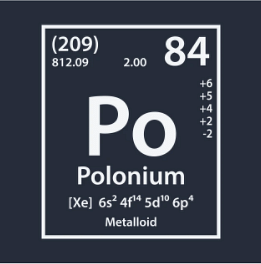
Polonium has an atomic number of 84 and has the symbol, Po. Bismuth is irradiated with neutrons to produce this very rare element in milligram quantities. Humans are extremely vulnerable to this substance. In fact, it can easily destroy the cells of human beings if it comes in contact with them and can also lead to the failure of your kidney and cause cancer.
Also Read:
| Related Articles | ||
|---|---|---|
| Atomic Mass of Elements | Function Nucleic Acids | Nucleic Acids |
| Cyanide | Positron | Cadmium |
Discovery of Polonium
[Click Here for Sample Questions]
The year 1898 marked the discovery of Polonium by Marie Curie and Pierre Curie. In honor of Marie Curie's homeland of Poland, it was named Polonium. It was the first radioactive element to be named to emphasize a political controversy. A worsening situation in a country i.e. its lack of independence was highlighted for the first time using an element. Polonium had previously been used to design the fat-man bomb that was dropped on Nagasaki in 1945. In uranium ore, it is found at a concentration of 0.1 milligrams per metric ton of the mineral.

Atomic Structure of Polonium
Properties of Polonium
[Click Here for Sample Questions]
| Type | Radioactive Element |
| Symbol | Po |
| Atomic number | 84 |
| Weight | 210 |
| Melting point | 254 °C (489.2 degree Fahrenheit) |
| Boiling Point | 962 °C (1763.6 degree Fahrenheit) |
| Density | 9.4 g/cm3 |
| Common Isotope | Po-210 |
Properties of Polonium
Uses of Polonium
[Click Here for Sample Questions]
The uses of polonium are as follows:
- To remove static electricity from machinery and dust from photographic film, polonium is used in textile mills on brushes.
- Researchers use it to study alpha-radiation and alloy.
- Neutrons are also produced by polonium in nuclear weapons.
- Thermoelectric power can also be generated with it on satellites in space.
- Polonium is also used as tobacco in cigarettes.
- Its isotope Po210 when combined with a low-atomic-weight element, is used as a static eliminator, heat/energy source, and neutron source.

Polonium used in brushes to remove dust
Facts about Polonium
[Click Here for Sample Questions]
- The element polonium is a chemical compound of chalcogen. There are four oxidation states of this element: -2, +2, +3 and +4, +6, and its electronic configuration is 1s22s22p63s23p63d104s24p64d104f145s.
- A solid polonium solution is first colored pink by the PO2+ ions, but then rapidly becomes yellow because alpha radiation from polonium ionizes the alkaline waters.
- Most metal is currently created by bombarding Bi with neutrons or protons. The largest amount of polonium ever extracted from natural products was from the refinement of 37 tons of radium residue.
- In the lunar rovers, Lunokhod 1 and Lunokhod 2, as well as in other satellites, polonium was used as a thermoelectric generator to keep components sufficiently warm.
- Polonium has 33 radioactive isotopes whose atomic masses range from 186 to 227u.
- An isotope, polonium -210 is a dangerous radioactive element even from the hydrogen cyanide. It has a life of 138.4 days.
Things to Remember
- Polonium is the most dangerous radioactive element invented by Pierre and Marie Curie in 1898. Its symbol is Po with an atomic number of 84.
- Polonium is an extremely rare element due to the extremely short half-life of its isotopes.
- There are also applications for polonium in an industry where static electricity needs to be eliminated.
- Polonium is present in uranium ore, which has a concentration of 0.1 milligrams per metric ton of ore. It can also be found in Earth’s crust but its toxicity isn’t considered severe and extracting it from natural sources is challenging.
- A total of 33 isotopes of polonium are known. During decay, all of these isotopes become radioactive and all of them have very short lives, which makes it extremely rare.
- These isotopes are detected in polonium through Gamma spectroscopy.
- There are only 138 days to the half-life of Po210, which is the most abundant radioisotope.
- As an alpha electrode, Po-210 can impromptu heat up to a temperature of over 500 degrees uranologist once in-tune with air. This reaction will generate over a hundred and forty watts of power, creating polonium helpful for thermoelectric generators.
Also Read:
Sample Questions
Ques. What is Polonium? (2 marks)
Ans. Polonium is an extensive radioactive element discovered by Pierre and Marie Curie.
- Its symbol is Po whose atomic number is 84.
- It is a black-metallic element with no-stable isotopes which is 16th in the group of oxygen.
- Humans are extremely vulnerable to polonium.
Ques. Is polonium the most dangerous radioactive element? (1 mark)
Ans. Yes, polonium is the most dangerous radioactive element. Even 1g of its quantity can end 10 million people.
Ques. What is the nature of Polonium? (2 marks)
Ans. Polonium is a rare semi-metal radioactive element.
- It is volatile i.e. will easily evaporate if kept in the air and get easily dissolved in dilute acids with a little solubility in alkalis.
- Chemically, it is similar to tellurium and bismuth.
Ques. What is Po210 and what are its key points? (3 marks)
Ans. The late 19th century was the era of the discovery of Polonium-210 by Marie Curie. The radioactive isotope of polonium 210 is among 25 known isotopes. It is the common and best-known polonium isotope which is one of the most toxic substances. Following are the key points of polonium:
- In addition to emitting high-energy radiation, it decays very quickly because the atoms don't travel that far.
- Polonium-210 can be fatal if inhaled, swallowed, or absorbed through broken skin.
- Polonium-210, measured by mass, is one of the most toxic toxins, approximately 250 billion times as toxic as hydrogen cyanide.
Ques. What are the uses of polonium? (3 marks)
Ans. The uses of Polonium are:
- Polonium has an excellent decay half-life that makes it ideal for research purposes as well as for commercial applications.
- It has a high relative volatility which assures ease in partial purification of the element by volatilization as well as permitting ease in the preparation-by-volatilization of neutron sources and alpha sources.
- To remove static electricity from machinery and dust from photographic film, it is used in textile mills.
- Researchers use it to study alpha-radiation and alloy it.
- It is also used as tobacco in cigarettes.
Ques. What is formed when the radioisotope Po214 undergoes alpha decay? State the mass number and the atomic number of the element. (2 marks)
Ans. The decay of radon into polonium 218 is followed by further alpha decay into lead 214. Through the emission of a third alpha particle, lead 214 emits beta electrons to transform into bismuth 214 and polonium 214, which produce lead 210.
For Latest Updates on Upcoming Board Exams, Click Here: https://t.me/class_10_12_board_updates
Check-Out:



Comments