



Education Journalist | Study Abroad Lead
Radium is the heaviest alkaline earth metal known. It is extracted the radium compound from the uraninite which is found in the uranium ores at one part per three million parts of uranium.
Radium is more than a million times more radioactive than the same mass as that uranium.
| Table of Content |
Key Terms: Alkaline, Earth, Compound, Uraninite, Uranium, Element, Metal
What Is Radium?
[Click Here for Sample Questions]
Radium is a chemical element and is denoted with “Ra”. It is the sixth element in group II of the periodic table. Radium is a silvery-whitish, lustrous and soft, intensely radioactive element, and readily combines with nitrogen.
On exposure to air, it forms a surface of radium nitride which is black in colour. All the isotopes of radium are stable. The naturally occurring and most commonly found isotopes of radium are radium 226 and radium 228 mostly found in groundwater.

Radium
Also Check:
| Concept Related To Radium | ||
|---|---|---|
| Unit of Radioactivity | Group 2 Elements | Types of Radiation |
Physical Properties of Radium
[Click Here for Previous Year Questions]
The physical properties of radium are:
- Radium is the only radioactive member in its group.
- It is the heaviest alkaline earth metal known.
- Radium’s physical and chemical properties reassemble the lighter congener barium.
- It is a highly reactive metal and consistently exhibits a group oxidation state.
- Radium forms a colourless cation Ra2+ in the aqueous solution which is highly basic and does not form any complexes.
- Most of the radium compounds are simple ionic compounds.
- Radium emits alpha, beta, and gamma rays with beryllium and produces neutrons.
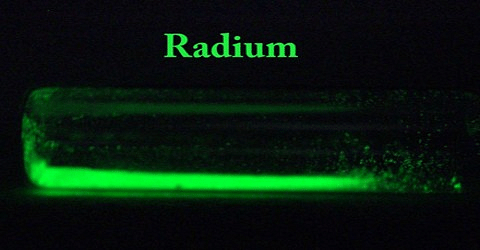
Radium
Chemical Properties of Radium
[Click Here for Sample Questions]
The distinguished chemical properties of radium are:
- The atomic number of radium is 88
- The group of radium is 2
- The relative atomic mass of radium is 226
- Radium state at 20°C is solid
- The melting point of radium is 696 °C, 1285 °F, 969 K
- The boiling point of radium is 1500 °C, 2732 °F, 1773 K
- Density (in g cm−3) of radium is 5 g cm−3
- Key isotopes of radium is [Rn] 7s2
Applications of Radium
[Click Here for Previous Year Questions]
The applications of radium are:
- The applications are due to its radioactive properties.
- Radium is used for self-luminous paints in aircraft switches, clocks, watches, instrument dials and nuclear panels.
- Radium is used as an additive in a product such as toothpaste, hair cream, and even food items.
- Radium and beryllium were used as portable sources of neutrons.
- Radium is used to sterilize medical instruments.
Medicinal effects of Radium
[Click Here for Sample Questions]
The medicinal effect of radium are:
- Radium is a highly radioactive and carcinogenic element.
- Radium is inhaled, ingested, or exposed when it is used in the treatment of cancer and several other body disorders.
- Radium is used in medicine to produce radon gas.
Also Check:
Things to Remember
- The element curium is named for the discoverers of the radium.
- Radium was discovered by ‘’Marie Sklodowska Curie’’ and ‘’Perre Curie’’ in 1898.
- Radium forms a colourless cation Ra 2+ in the aqueous solution.
- It is the sixth element in group II of the periodic table.
- It is the heaviest alkaline earth metal known.
- Radium emits alpha, beta, and gamma rays with beryllium and produces neutrons.
- The melting point of Radium is 696 °C, 1285 °F or 969 K.
- The boiling point of Radium is 1500 °C, 2732 °F or 1773 K.
Previous Year Questions
- Choose The Correct Alternative Same As Radium…
- The Half-Life Of Radium Is 1620 Yr And Its Atomic… [AMUEEE 2004]
- The Age Of Most Ancient Geological Formation Is…. [NEET 1989]
- In A Sample Of Radioactive Material What Fraction… [BHU UET 2010]
- An Artificial Radioactive Isotope Gave 14 7 N Afte… [JEE Main 2004]
- Half Lives Of Two Radioactive Substances A And B A…. [JIPMER 2000]
- Beta Rays Emitted By A Radioactive Material Are… [JIPMER 1983]
- A Radioactive Isotope Has A Half Life Of 10 Days… [KCET 2005]
- In A Sample Of Radioactive Material What Percentage… [KCET 2002]
- Mean Life Of A Radioactive Element Is One Year The…. [KCET 1999]
- The Masses Of Two Radioactive Substances Are Same…. [KCET 2008]
- A Radioactive Substance Contains 10 000 Nuclei And… [KCET 2007]
- A Radioactive Substance Emits 100 Beta Particles… [KCET 2013]
- A Radioactive Sample At Any Instant Has Its Disint… [KEAM]
- If 10 Of A Radioactive Material Decays In 10 Days… [KEAM]
- If 25 Of A Radioactive Element Is Left After 40….
- In Which Plant Calvin Experimented By Radioactive… [MU OET 2010]
- A Freshly Prepared Radioactive Source Of Half Life… [JEE Advanced 1988]
- Beta Rays Emitted By A Radioactive Material Are.... [JIPMER 1983]
- For A Radioactive Material Half Life Is 10 Minutes…. [NEET 2018]
Sample Questions
Ques. What is radium? (2 Marks)
Ans. Radium is a chemical element and is denoted with “Ra”. It has an atomic number of 88 and an atomic mass of 226 g. mol −1. It is the sixth element in group II of the periodic table, also called alkaline earth metals.
Ques. What are the isotopes of Radium? (2 Marks)
Ans. The naturally occurring and most commonly found isotopes of radium are radium 226 and radium 228 mostly found in groundwater. All the isotopes of radium elements are stable and the most stable isotope among them is radium - 226.
Ques. List five chemical properties of radium. (3 Marks)
Ans. The distinguished chemical properties of radium are:
- The atomic number of radium is 88
- The group of radium is 2
- The relative atomic mass of radium is 226
- Radium state at 20°C is solid
- The melting point of radium is 696 °C, 1285 °F, 969 K
Ques. What is radioactivity? (2 Marks)
Ans. Radioactive substances are unstable and they release energy in a process called radioactive decay. The energy can be in the form of a wave such as gamma rays, or a particle such as alpha or beta particles, or both.
Ques. How is radioactivity measured? (2 Marks)
Ans. Usually, Radioactivity is measured in the units called "curies." The levels of radioactivity in water are very low and are measured in pico-curies. One picocurie is equal to one-trillionth of a curie per litre, which is written as pCi/L.
Ques. What are the uses of Radium? (3 Marks)
Ans. The following are the few uses of radium, some of the uses of radium are due to its radioactive properties.
- It is used for self-luminous paints in aircraft switches, clocks, watches, instrument dials and nuclear panels.
- It is used as an additive in a product such as toothpaste, hair cream, and even food items.
- Radium and beryllium were used as portable sources of neutrons.
Ques. What is the number of neurons and protons in radium? (1 Mark)
Ans. The nucleus of the radium consists of 88 protons and 138 neutrons. All the 88 electrons successively occupy the available electron shells.
Ques. State five physical properties of radium. (3 Marks)
Ans. The physical properties of radium are:
- Radium is the only radioactive member in its group.
- It is the heaviest alkaline earth metal known.
- Radium’s physical and chemical properties reassemble the lighter congener barium.
- It is a highly reactive metal and consistently exhibits a group oxidation state.
- Radium forms a colourless cation Ra2+ in the aqueous solution which is highly basic and does not form any complexes.
Ques. What is the chemical formula for Radium? (1 Mark)
Ans. Ra is the chemical formula for Radium.
Ques. Describe the texture of radium? (2 Marks)
Ans. Radium is a silvery-whitish, lustrous and soft, intensely radioactive element. Radium readily oxidizes on exposure to air, turning from white to black.
Ques. Illustrate radium. (3 Marks)
Ans. Radium is a chemical element and is denoted with “Ra”. It is the sixth element in group II of the periodic table. Radium is a silvery-whitish, lustrous and soft, intensely radioactive element, and readily combines with nitrogen. Radium is the heaviest alkaline earth metal known. It is extracted the radium compound from the uraninite which is found in the uranium ores at one part per three million parts of uranium.
Radium is more than a million times more radioactive than the same mass as that uranium.
On exposure to air, it forms a surface of Radium Nitride which is black in colour. All the isotopes of radium are stable. The naturally occurring and most commonly found isotopes of radium are radium 226 and radium 228 mostly found in groundwater.
Ques. What are the medicinal effects of radium? (2 Marks)
Ans. The medicinal effects of radium are:
- Radium is a highly radioactive and carcinogenic element.
- Radium is inhaled, ingested, or exposed when it is used in the treatment of cancer and several other body disorders.
- Radium is used in medicine to produce radon gas.
Ques. What are the Boiling points and Melting points of radium? (2 Marks)
Ans. The Boiling point of Radium is 1500 °C, 2732 °F or 1773 K and the Melting point of Radium is 696 °C, 1285 °F or 969 K.
Ques. How many isotopes does radium have? (2 Marks)
Ans. Radium (Ra) has a total of 33 isotopes, out of which four are found in nature, with 226 Ra being the most common. Ra, 224 Ra, 226 Ra, and 228 Ra are naturally generated with the decay of Uranium (U) or Thorium (Th).
For Latest Updates on Upcoming Board Exams, Click Here: https://t.me/class_10_12_board_updates
Check-Out:



Comments