



Content Curator
Dibenzalacetone is an organic compound formed through a reaction known as the Claisen Schmidt condensation reaction. It is widely used as a component in sunscreens because of its ability to absorb UV rays. The formula for dibenzal acetone is C17H12O and also known as Dibenzylideneacetone.
| Table of Content |
Key Takeaways: dibenzal acetone, benzaldehyde, Aldehydes, condensation, ketone, Aldol condensation reaction
Read More: Number of Moles Formula
Aim of Preparation of Dibenzalacetone
[Click Here for Sample Questions]
Preparation of dibenzal acetone from acetone and benzaldehyde.
Theory
[Click Here for Sample Questions]
Aldehydes and ketones that contain at least one alpha hydrogen undergo self-condensation in presence of dilute alkali or acid to form β -hydroxyaldehyde and ketones respectively. The initial product undergoes dehydration to form α,β unsaturated aldehydes and ketones respectively. This whole reaction is termed as aldol condensation reaction/ Claisen Schmidt condensation reaction.

According to Claisen Schmidt condensation reaction in the presence of sodium hydroxide, the aldehyde can condense with another aldehyde by replacing a water molecule. Thus benzaldehyde condenses with one mole of acetone to give dibenzalacetone.
Read More: Dalton’s atomic theory
Chemical Reaction of Dibenzalacetone
[Click Here for Sample Questions]
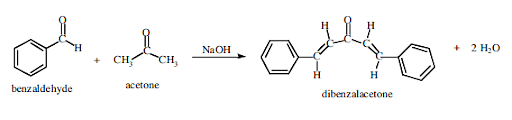
Similarly, to get cinnamic aldehyde, benzaldehyde condenses with acetaldehyde and acetone to give benzalacetone. Dibenzalacetone is also known as Dibenzylideneacetone, 1,5-Diphenylpenta-1, 4-dien-3-one, trans,trans-Dibenzylideneacetone.
Materials Required for Preparation of Dibenzalacetone
[Click Here for Sample Questions]
- Conical flask
- Beaker
- Funnel
- Filter paper and measuring cylinder
- Sodium hydroxide
- Benzaldehyde
- Acetone
- Ethanol
- Methylated spirit
- Dilute hydrochloric acid
- Ether etc.
Read More: Relation between Molarity and Molality
Preparation of Dibenzalacetone Procedure
[Click Here for Sample Questions]
Steps to get dibenzalacetone from acetone and benzaldehyde in the presence of sodium hydroxide-
- Take 10ml of freshly distilled benzaldehyde and 20ml of acetone and add it to a conical flask.
- Place the conical flask in cooling condition and then add sodium hydroxide dropwise with constant stirring.
- Make sure the temperature is at 30o Celsius.
- Keep stirring the solution until sodium hydroxide is completely soluble.
- Add hydrochloric acid to the reaction and transfer it to a 250ml separating funnel.
- Add 20ml of ether/chloroform and stir nicely.
- Remove the obtained organic layer and repeat the process twice.
- Keep the mixture in cooling condition, preferably ice water, as a result of which dibenzal acetone will separate as a fine emulsion and will form yellow crystals.
- Filter and dry the crystals using filter paper.
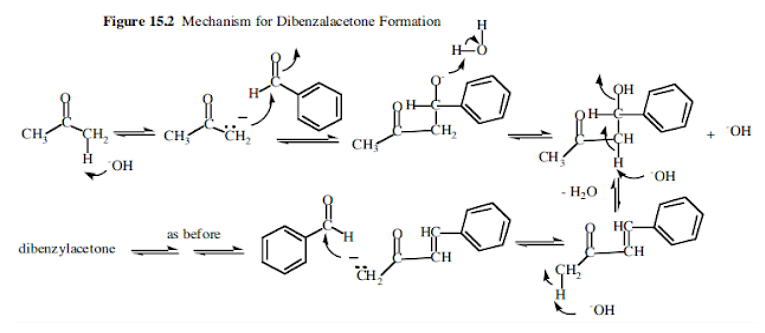
Mechanism for Preparation of Dibenzalacetone
Observations of Preparation of Dibenzalacetone
| Colour of the crystals | Yellow |
| Expected yield | 4 gm |
| Melting point | 112oC |
Results for Preparation of Dibenzalacetone
The yield of dibenzal acetone is 1.5 gm.
And the melting point of dibenzal acetone is 112o C.
Discussion on Preparation of Dibenzalacetone
The amalgamation of a pure sample of dibenzalacetone from excessive benzaldehyde and acetone in the presence of sodium hydroxide and ethanol is a perfect example of Claisen Schmidt condensation reaction.
Read More: Significant Figures
Precautions during Preparation of Dibenzalacetone
[Click Here for Sample Questions]
- Do not come in direct contact with benzalacetone as it acts as an irritant for the skin.
- Ensure that the temperature does not exceed 30o Celsius.
- Incase of vigorous reaction inside the flask, remove the cork to release pressure.
- Remember to keep ethanol and acetone away from the flame.
Points to Remember
Following are some important points:
- 1,5-Diphenylpenta-1,4-dien-3-one is the IUPAC name of benzalacetone.
- Dibenzalacetone is prepared through the Claisen Schmidt condensation reaction.
- Dibenzalacetone is an organic compound and is widely used as a component in sunscreen as it absorbs ultraviolet radiation from the sun and protects the skin from harmful radiation.
- Since dibenzalacetone is an aromatic compound and consists of a conjugated pi system that absorbs light in the visible region, so it absorbs by maximum up to 380 nm and thus gives off yellow colour.
Read More: Law of Multiple Proportions
Sample Questions
Ques: Explain the process through which dibenzalacetone is prepared from acetone and benzaldehyde. (2 Marks)
Ans: Dibenzal acetone is prepared from acetone and benzaldehyde through the process of Claisen Schmidt condensation reaction. The Claisen Schmidt condensation reaction, unlike self-aldol condensation reaction, requires a ketone enolate such as acetone or an aldehyde to act as an electrophile. The acetone enolate binds with the benzaldehyde molecule which is an excellent electrophile and gives dibenzalacetone.
Ques: Write the chemical equation of the mechanism involved in the preparation of dibenzal acetone from acetone and benzaldehyde in the presence of sodium hydroxide. (3 Marks)
Ans: Chemical Equation is as follows:

Ques: State three differences between aldehydes and ketones. (2 Marks)
Ans: Following are the differences:
| Aldehydes | Ketones |
|---|---|
| The suffix ‘al’ is used in aldehyde nomenclature. | The suffix ‘one’ is used in ketone nomenclature. |
| Aldehydes are more reactive as compared to ketones. | Ketones are less reactive. |
| Aldehydes are found in volatile compounds. | Ketones are found in sugar. |
Ques: State some uses of dibenzalacetone. (2 Marks)
Ans: Following are the uses of dibenzalacetone:
- Dibenzalacetone is a vital component used in sunscreens.
- In organometallic chemistry, It is also used as a ligand.
Ques: Explain Claisen Schmidt reaction and its origin? (2 Marks)
Ans: The reaction between an aldehyde or ketone and an aromatic compound lacking an alpha hydrogen compound is known as the Claisen Schmidt condensation reaction. The name of the reaction is named after Rainer Ludwig Claisen and J. G. Schmidt, the two pioneers who published on this topic in the year 1880 and 1881.
Ques: Explain the mechanism of Claisen Schmidt condensation reaction? (2 Marks)
Ans: The mechanism of Claisen Schmidt reaction:
The reaction starts with an aldol reaction followed by dehydration accompanied by decarboxylation.

Dehydration is also known as the elimination process involves the removal of a water molecule or alcohol molecule. It is accompanied by decarboxylation in presence of an activated carboxyl group.
Ques: State some properties of dibenzalacetone. (2 Marks)
Ans: Following are the properties of dibenzalacetone:
- Physical appearance: It is yellow in colour.
- Molar mass: The molar mass of dibenzalacetone is 234.29 g/mol
- Water solubility: It is insoluble in water.
- Isomers: Dibenzalacetone occurs as trans-trans, trans-cis and cis-cis in three geometric isomers. However, trans-trans is considered as the most stable form of isomer and occurs mostly during the reaction.
Also Read:



Comments