



Education Journalist | Study Abroad Lead
Purification of compounds is necessary as the chemical compounds should be pure, and free from any type of impurity to be part of a chemical reaction or for other purposes. Some of the purification methods used to purify the compounds from impurities are filtration, crystallization, segmentation, evaporation, distillation, and decantation. All these methods have different procedures. Purification through crystallization involves the process of purification of a compound by removing unwanted bi-products yielded.
| Table of Contents |
Key Terms: Crystallization, Crystals, Impurities, Concentrated Solution, Filtrate, Purification, Impure Compound, Copper Sulphate, Benzoic Acid, Iron Sulphate, Alum
Aim
[Click Here for Sample Questions]
Purification of impure compounds such as Copper Sulphate, Benzoic Acid, Alum, and Iron Sulphate by using the crystallization process.
Read More: Classification of Crystalline Solids
Materials Required
[Click Here for Sample Questions]
Beaker (with 50 mL capacity), Filtration unit, Kerosene burner, watch glass, Pentahydrate Copper Sulphate (CuSO4.5H2O).
| Topics Related to Purification of Organic Compound | ||
|---|---|---|
| Steam Distillation | Adsorption Chromatography | Paper chromatography |
Theory
[Click Here for Sample Questions]
Process of Crystallization
The process of crystallization follows five steps explained below:
- Preparation of Solution of Impure Compound
- Filtration of Hot Water
- The concentration of Filtrate
- Cooling Concentrated Solution
- Drying and Separation of Crystals
Read More: Concentration of a Solution
Procedure
[Click Here for Sample Questions]
Crystallization of Copper Sulphate (CuSO4)
- Make a clear copper sulphate solution.
- Take 0.8 g of pentahydrate copper sulphate (CuSO4.5H2O) and dissolve it in 8 mL of water. Add 1-2 drops of H2SO4 to the solution.
- Heat the solution with the help of a kerosene burner for a while. Filter the solution using a filtration unit.
- Pour the filtered solution into another beaker and keep it cool at room temperature.
- Crystals will start appearing in the solution.
- Wash these crystals with alcohol or cold water and let them dry.
- Take the weight of the crystal and calculate the yield percentage.
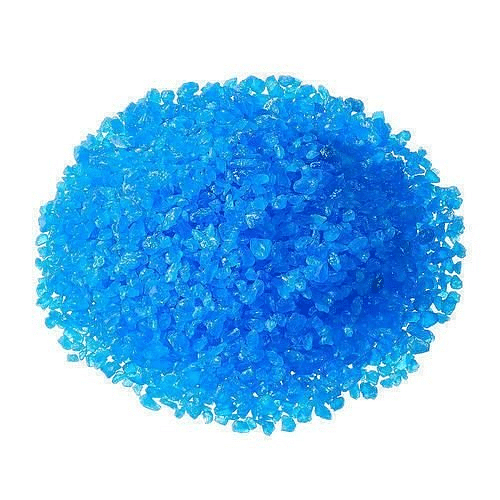
Copper Sulphate Crystals
Read More: Saturated and Colloidal, Electrolytes, Solute & Solvent
Crystallization of Benzoic Acid
- Prepare a clear solution of Benzoic acid. The solution is made by dissolving about 0.5 g of benzoic acid in 8 mL of water.
- Heat the solution using a burner for a while. Filter out the solution through a filtration unit.
- Pour the filtered solution into another beaker and keep it cool at room temperature.
- Benzoic acid crystals will start appearing in the solution.
- Filter and wash the crystal and allow it to get dry.
- Take the weight of the crystal and calculate the yield percentage.

Benzoic Acid Crystals
Read More: Organic Compounds
Crystallization of Alum
- Prepare a clear solution of alum. Add 1 gm of sample Alum in 5 mL of water to prepare a clear solution.
- Add 2 drops of sulphuric acid (H2SO4) to this solution.
- Heat this solution with the help of a burner. Filter it with a filtration unit.
- Pour the filtered solution into another breaker and let it cool down to room temperature.
- You can witness the crystals.
- Filter and wash the crystals with alcohol or cold water and let them dry.
- Take the weight of the crystal and calculate the yield percentage.

Alum
Read More: Preparation of Potash Alum
Crystallization of Iron Sulphate
- Add 0.5 g of Iron Sulphate sample to 3 mL of water to prepare the clear solution.
- Add 3 drops of H2SO4 to this solution.
- Heat the solution using a burner for a while. Filter the solution with a filtration unit.
- Pour the filtered solution into another beaker. Keep it cool to room temperature.
- Iron Sulphate crystals can be seen clearly.
- Filter and wash the crystal till every residue is removed. Leave it to dry.
- Take the weight of the crystal and calculate the yield percentage.

Iron Sulphate Crystals
Read More: Decomposition Reaction
Observation
[Click Here for Sample Questions]
| Weight of copper sulphate obtained | - |
| Weight of alum obtained | - |
| Weight of benzoic acid obtained | - |
| Weight of iron sulphate obtained | - |
Precautions
[Click Here for Sample Questions]
While performing the crystallization process, students must take all the precautions for safety purposes. Some precautions are given below.
- After filtering, make sure the crystal is washed properly. Wash it till every residue is removed.
- Do not overheat the solution.
- Evaporate the filtrate slowly by providing gentle heating to the solution.
- Do not use any quick cooling method to cool the solution. The solution must be cooled slowly.
Things to Remember
[Click Here for Sample Questions]
- Crystallization works on the principle that solute is more soluble in heated liquids than in cooled solvents.
- The purification method of a compound depends upon the type of impurity present.
- Crystallization prepares the compound with the highest purity state.
- Always use the slow method of cooling to cool the concentrated solution.
- The crystallization process is proportional to the temperature of the solution. The solubility of the compound increases with an increase in temperature and vice versa.
Sample Questions
Ques. What is the basic principle of crystallization? Explain it. (2 Marks)
Ans. The basic principle of crystallization is solubility. Solute (impure compound) is more soluble in heated liquids than in any cooled liquid (solvent). When the hot solution gets cool, the solute stops dissolving in the solvent and produces crystals.
Ques. Why the filtrate produced in the purification process is heated? (1 Mark)
Ans. The filtrate produced is heated to prevent the formation of solid crust and ensure uniform evaporation of the solution.
Ques. Give a brief of the steps involved in the crystallization process. (5 Marks)
Ans. The crystallization process involves 5 steps:
- Solution preparation of impure compound: A clear solution of the impure compound is formed by adding a few gm of the compound to a few mL of water.
- Filtration: The solution is then filtered through the filter papers.
- The concentration of filtrate: Heat the solution using a burner and filter it with filtration.
- Cooling concentrated solution: Keep the solution cool down to room temperature.
- Drying and separation of crystals: Wash the crystal and dry it to remove residue.
Ques. Give a reason why sulphuric acid added to the copper sulphate solution. (3 Marks)
Ans. Dilute sulphuric acid (H2SO4) is added to the copper sulphate solution to prevent it from hydrolysis. The impurities in the solution are removed through filtration.
The sulphuric acid can dissolve any impure copper metal or oxides and convert those impurities into copper sulphate. The reaction is represented as
Cu(s) + H2SO4(aq) → CuSO4(aq) + H2(g)
H2SO4(aq) + CuO(s) → CuSO4 + H2O(l)
2H2SO4(aq) + Cu2O(s) → 2CuSO(aq) + H2O(l) + H2(g)
Ques. How does the crystallization process affected by changes in temperature? (3 Marks)
Ans. The temperature has a direct effect on the crystallization process. If the temperature is decreased, the solubility of the sample compound will significantly be decreased very quickly. Thus, the crystallization process is accelerated leading to the formation of smaller crystals.
Likewise, when the temperature has increased the solubility of the compound increase rapidly.
Ques. Give some examples of crystallization we observed in our daily life. (5 Marks)
Ans. Examples of crystallization we observed in our daily life are
- The freezing of water forms snow and ice.
- Honey gets crystallizes when placed in a jar in a suitable condition.
- Deposition by gemstone crystals.
- Harvesting of salts.
- Capturing images using photographic films.
- Stones in the kidney or gall bladder are formed because of the crystallization of calcium and salt particles.
Ques. Why it is preferred to cool the hot filtered solution slowly instead of using quick cooling procedures? (3 Marks)
Ans. Slowly cooling is preferred because in a quick cooling crystals at a high temperature may crash out from the solution. Cooling slowly leads to the better separation of crystals and residue rather than producing a bulky substance having improper geometry.
Ques. How insoluble impurities are removed in the crystallization method? (3 Marks)
Ans. Insoluble impurities are removed using gravity filtration. The desired sample dissolved in the hot solvent passes through the filter papers and insoluble impurities remain behind in the filter.
Ques. See the figure given below and answer the following questions. (5 Marks)

According to the figure, the name the gas evolved.
a) What would happen if the zinc granules are replaced by the same amount of zinc salts in the test tube.
b) What would happen if dilute hydrochloric acid is used instead of dilute sulphuric acid.
c) What would happen if sodium hydroxide (NaOH) is taken instead of dilute sulphuric acid (H2SO4) and the test tube is heated.
Ans. According to the figure:
- Hydrogen gas (H2) is evolved.
- The speed of evaluation of hydrogen gas will increase. Thus more amount of gas is evolved.
- There will be no changes in the amount of hydrogen gas evolved.
- Hydrogen gas will be evolved if NaOH is taken instead of dilute sulphuric acid.
The reaction can be represented by:
Zn + 2NaOH → Na2ZnO2 + H2 ↑
(sodium zincate)
Do Check Out:



Comments