



Education Journalist | Study Abroad Lead
Difference between simple and compound microscopes lies in the fact that compound microscopes have a much stronger magnifying capacity and are used in intense research. Some of the other microscopes are the stereo, inverted, metallurgical and polarising microscopes.
Key Terms: Simple Microscope, Compound Microscope, Convex Lens, Real Image, Double Convex Lens, Focal Length, Reflection
What Is a Simple Microscope?
[Click Here for Sample Questions]
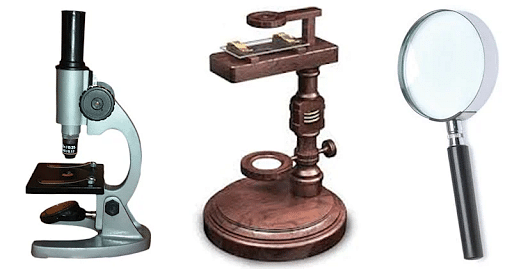
Simple Microscope is used at a very basic level, where there is no meticulous requirement for research. It comprises a single lens. It is an instrument that gives a large image of a minute object. It produces an erect virtual image of the object. It has a double convex lens with a short focal length.
Also Read:
Parts Of A Simple Microscope
[Click Here for Previous Year Questions]
Parts of a Simple Microscope include:
- Eyepiece: It is the lens through which the sample is viewed by the user.
- Body: This part connects the base of the microscope with the head thereby providing erect and vertical support.
- Specimen stage: It is the stage where the samples are kept for viewing.

Parts of Simple Microscope
- Objective lens: These are the lenses with magnifying power of 100x, 40x and 10x. These are colour coded and can be moved through according to the user’s needs.
- Aperture Diaphragm: It can be opened and closed and is used to control the amount of light falling on the sample.
- Nosepiece: It holds the objective lenses and can be rotated according to the magnification needed. It is also called a turret.
- Base: It acts as the supporting element to the microscope.
Application Of Simple Microscope
[Click Here for Sample Questions]
Applications of Simple Microscope include:
- Simple Microscope is used for the study of microscopic organisms such as fungi, algae, and biological specimens.
- Simple Microscope is commonly used by watchmakers to observe the magnified view of tiny parts of the watch.
- Simple Microscope is used to see the details of engravings, stamps and other archaeological evidence.
- Simple Microscope is used by jewellers to observe and check the jewellery in their magnified view.

Applications of Simple Microscope
- Simple Microscope is used by palmists and astrologers to observe the enlarged view of our fingerprints.
- Simple Microscope is used by skin specialists to check and diagnose skin allergies and diseases.
- Simple Microscope is used in the study of soils and nutrition.
- Simple Microscope is used to study ancient scriptures and manuscripts.
What Is A Compound Microscope?
[Click Here for Previous Year Questions]
The purpose of a compound microscope is similar to a simple microscope. It uses multiple lenses to magnify real-world objects that are microscopic to the naked eye. It is used for professional purposes where intense research is required. It comprises a plane mirror surface on one side and a concave mirror surface on the other side. Compound microscopes have multiple lenses.
The video below explains this:
Compound Microscope Detailed Video Explanation:
Solved Examples Related to Compound MicroscopesQues. Name the types of compound microscopes. (2 marks) Ans. There are several types of compound microscopes are:
Ques. The magnifying power of a microscope will be maximum for which color? (1 mark)
Ans. The answer is “d”, Violet. Ques. To produce a magnified erect image of a far object, we require a ___ along with a convex lens (MNR 1983) (1 mark)
Ans. The answer is “c”, Concave Lens. |
Parts Of a Compound Microscope
[Click Here for Sample Questions]
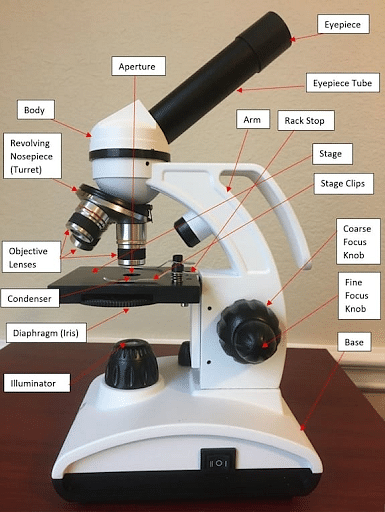
A compound microscope is usually also referred to as a Biological Microscope. The parts of a Compound Microscope include:
- Base: It acts as the supporting element to the compound microscope.
- Arm: It is the curved structure that acts as the vertical support to the microscope.
- Stage: The horizontal plate where the samples are kept for examination is called the stage. It has an adjustable aperture through which light can pass through.
- Clips: Clips are used to hold the slide in place.
- Diaphragm: It controls the amount of light that falls on the sample. There are two types of diaphragm, such as Iris and disc diaphragm.
- Nosepiece: It holds the objective lenses and can be rotated according to the magnification needed. It is also called a turret.
- Coarse adjustment knob: It is the large knob that is placed at the side of the body. It is used to adjust the body tube to accurately focus the sample.
- Fine adjustment knob: For finer and sharper focusing this knob can be adjusted. It is the small knob in front of the coarse adjustment knob.
Parts Of A Compound Microscope
Applications Of Compound Microscope
[Click Here for Previous Year Questions]
- It is used especially in pathology labs to identify various viruses and bacterias.
- Plant cells and the microorganisms flourishing on them can be ascertained with this microscope.
- It is used to identify the presence and absence of minerals and metals in blood samples etc.

- It helps to examine and understand the microbial field of viruses and bacteria, which is impossible to witness through our naked eyes.
- It is used in a forensics lab to help in solving criminal investigations.
- It is even used in schools and colleges to conduct academic experiments.
Key Differences Between Simple and Compound Microscope
[Click Here for Sample Questions]
The differences between Simple and Compound Microscope are:
| Simple Microscope | Compound Microscope |
|---|---|
| Simple microscope was invented and designed by Anton Van Leeuwenhoek in 1670. | The very first this type of microscope was designed by Hans and Zacharias Janssen in 1950. |
| Used in very basic places. | Used in the places where intense research is required. |
| It is used at a very basic level. It has a bi-convex lens with a short focal length. | It is used to have a magnified view of small objects. |
| It has a single lens. | At least two sets of lenses are required. |
| Total magnification is limited to one level only | Total magnification is a product of the objective lens and the eyepiece. |
| Magnifying power is up to 300X. | Magnifying power is up to 2,000X. |
| The object is placed within the focal length of the convex lens. | The object is placed beyond the focal length of the objective lens. |
| Condenser lens is absent. | Condenser lens is present. |
| The light source is natural. | Illuminator is used as a source of light. |
| It has a concave mirror. | Plane mirror at one side and concave at the other. |
| Used to observe minute objects such as to read words in small print, etc. | Used to observe plant’s leaves, animal cells, blood corpuscles, etc. |
Previous Year Questions
- Ray optics is valid, when characteristic dimensions … [NEET 1994]
- In total internal reflection when the angle of incidence is equal to the critical angle … [NEET 2019]
- In an astronomical telescope in normal adjustment a straight black line … [NEET 2015]
- If the focal length of objective lens is increased … [NEET 2014]
- For a normal eye, the cornea of eye provides a converging power … [NEET 2013]
- Focal length of a convex lens of refractive index … [NEET 1988]
- Find the value of the angle of emergence from the prism … [NEET 2021]
- Assume that light of wavelength 600nm is coming from a star … [NEET 2020]
- An object is placed at a distance of 40 cm … [NEET 2018]
- An equiconvex lens has power P … [NEET 2019]
- You are asked to design a shaving mirror assuming … [JEE Mains 2015]
- What is the position and nature of image formed by lens combination … [JEE Mains 2019]
- Light is incident from a medium into air at two possible angles … [JEE Mains 2013]
- Rainbow is formed due to … [KCET 2004]
- A microscope is having objective of focal length … [KCET 2014]
- The refractive index of a particular material is … [KCET 2004]
- A fish looking up through the water sees the outside world contained in a circular horizon … [KCET 2003]
- An object approaches a convergent lens from the left of the lens … [KCET 2020]
- Which colour of the light has the longest wavelength … [NEET 2019]
- When a biconvex lens of glass having refractive index 1.47 … [NEET 2012]
Things to Remember
- Simple Microscope is used at a very basic level, where there is no meticulous requirement of research.
- Compound microscope is used for professional purposes where intense research is required.
- Simple microscope uses only a single lens whereas a compound microscope uses two sets of lenses.
- The magnification of a simple microscope is around 300x whereas it is around 2000x for a compound microscope.
- Simple microscope has a lens. Compound microscope has a plane mirror on one side and a concave mirror on the other side.
Also Read:
Sample Questions
Ques. List the types of microscopes. (2 marks)
Ans. Epi-Fluorescence, stereo microscopes, Phase contrast microscope, Polarizing, Reflected light Metallurgical, Differential Interference microscope, and Brightfield Transmitted Microscope.
Ques. What is a Compound Microscope? (CBSE 2014) (2 marks)
Ans. A compound microscope consists of two convex lenses coaxially separated by some distance. The lens nearer to the object is called the objective. The lens through which the final image is viewed is called the eyepiece. The focal length of objective lens is smaller than eyepiece
Ques. Draw a ray diagram of a compound microscope. Write the expression for its magnifying power. (CBSE 2008) (3 marks)
Ans.


Ques. Why must both the objective and the eyepiece of a compound microscope have short focal lengths? (2 marks)
Ans. Firstly, the object gives a magnified image of the object and after that the eyepiece produces the angular magnification.

Ques. How does the power of a convex lens vary, if the incident red light is replaced by violet light? (Delhi 2008)(2 marks)
Ans. According to Lens Maker’s formula

∴ power of the lens will be increased.
Ques. Why must both the objective and the eyepiece of a compound microscope have short focal lengths? (CBSE 2017)(2 marks)
Ans. For getting higher magnification in compound microscope, both objective and eyepiece must have short focal length, because

Ques. Draw a ray diagram of a compound microscope. Write the expression for its magnifying power. (CBSE 2008)(3 marks)
Ans.

When the final image is formed at the least distance of distinct vision

Ques. Draw a labelled ray diagram of a compound microscope. Why are the objective and the eye-piece chosen to have a small focal length? (CBSE 2013)(2 marks)
Ans.

- If the focal lengths are less, then their magnifying power will be more.
- To avoid any aberration in refraction due to larger bend on passing through the eyepiece
Ques. You are given two converging lenses of focal lengths 1.25 cm and 5 cm to design a compound microscope. If it is desired to have a magnification of 30, find out the separation between the objective and the eyepiece. (CBSE 2014)(3 marks)
Ans. (a) When the image lies at infinity

(b) When the image is formed at the near point

30 × 1.25 = L × 6
L = 5 × 1.25 = 6.25 cm
Ques. Define the magnifying power of a compound microscope when the final image is formed at infinity. Why must both the objective and the eyepiece of a compound microscope have short focal lengths? Explain. (CBSE 2016)(2 marks)
Ans. Magnifying power of a compound microscope is defined as “the angle subtended at the eye by the image to the angle subtended (at the unaided eye) by the object”.
Reason : To increase the magnifying power, both the objective and the eyepiece must have short

Ques. A compound microscope uses an objective lens of focal length 4 cm and eyepiece lens of focal length 10 cm. An object is placed at 6 cm from the objective lens. Calculate the magnifying power of the compound microscope. Also calculate the length of the microscope. (CBSE 2011)(3 marks)
Ans.
Given f0 = 4 cm, fe = 10 cm, u0 = -6 cm
Magnifying power of microscope


Ques. Define resolving power of a microscope. (2 marks)
Ans. Definition of resolving power: Resolving power of compound microscope is defined as the reciprocal of the smallest distance between two point objects at which they can be just resolved when seen through microscope.

Ques. How to increase resolving power of a microscope? (2 marks)
Ans. Resolving power of a microscope can be increased by
- Increasing the diameter of objective lens upto a certain limit.
- Using light of smaller wavelength.
- Having a medium of higher refractive index.
For Latest Updates on Upcoming Board Exams, Click Here: https://t.me/class_10_12_board_updates
Check-Out:



Comments