



Content Curator
Hydraulic Lift is a device that lifts things by applying force to a liquid inside a cylinder, which drives a piston higher.
- The piston is pushed higher by incompressible oil injected into the cylinder.
- The piston descends due to gravity force when a valve opens to discharge the oil.
- The hydraulic lift concept is based on Pascal’s Law for producing force or motion.
- Pascal’s Law states that pressure change on an incompressible liquid in a confined area is distributed evenly in all directions.
- A hydraulic system works when the applied force is at one point to an incompressible liquid, sending the force to a second point.
- The method involves two pistons connected via an oil-filled pipe.
In a hydraulic lift, the two pistons are seen to be separated by the space filled with a liquid. A piston here has a small cross-section A1 that aids in the exertion of a force, i.e. F1 directly on the liquid. The pressure indicated by P =F/A is further transferred throughout the liquid to the larger cylinder that is attached to a bigger piston of A2 area resulting in an upward force of P × A2.
Read Also: Pressure of an Ideal Gas
| Table of Contents |
Key Terms: Hydraulic Lift, Hydraulics Jacks, Hydraulic Machine, Hydraulic System, Pascal’s Law, Cylinder, Mechanical Advantage, Pressure of Liquid
What is a Hydraulic Lift?
[Click Here for Sample Questions]
A hydraulic lift is used for moving objects using the force created by pressure on a liquid inside a cylinder. This force moves a piston upward. The hydraulic Lift Principle is based on Pascal‘s law for generating force or motion. The principle states that pressure change on an incompressible liquid in a confined space is passed equally throughout the liquid in all directions.
- The hydraulic lift is used typically in automobiles. In it, there are two pistons that are separated by a space filled with a liquid.
- A piston with a small cross-section A1 has been used to exert a force F1 directly on the liquid.
- The pressure characterised by P = F/A is then transferred throughout the liquid to the larger cylinder attached to a larger piston of area A2, resulting in an upward force P × A2.
- Therefore, it can be said that the piston can support a large force, which is the large weight of any car or truck set on the platform.
- By varying the area A1, the platform can be shifted either up or down.
- Therefore, the applied force is thus increased by a factor of A2/A1 and this factor can be expressed as the mechanical advantage of the device.
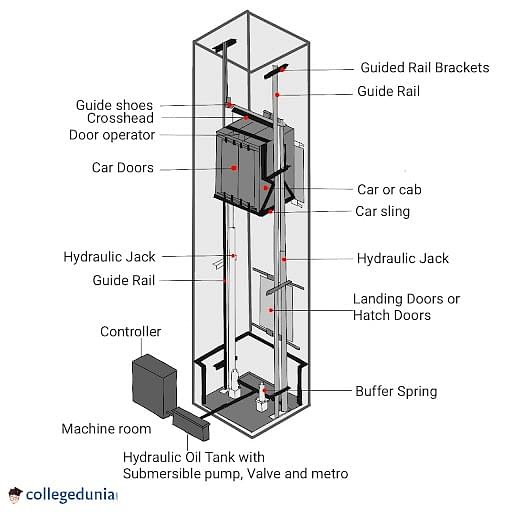
Examples of Hydraulic Lift
Hydraulic lifts are used for moving goods or people vertically. Some common examples are:
- Scissor lifts
- Two-post lifts
- Four-post lifts
- Carousel lifts
- Mezzanine
Check out:
Pascal’s Law
[Click Here for Previous Year Questions]
Pascal’s Law states that:
| "The external static pressure applied to a confined liquid is dispersed or transmitted uniformly throughout the liquid in all directions". |
Any surface in touch with the fluid is subjected to static pressure, which operates at right angles to it. Pascal also discovered that the pressure at a given location in a static fluid is the same in all planes travelling through that point. Pascal's law is also known as Pascal's principle or the principle of fluid-pressure transfer.
Hydraulic lift Pascal's Law states that hydraulic lift enables the usage of a relatively small input force to form a larger output force. It is because the pressure applied on one piston is equivalent to the pressure of the second piston.
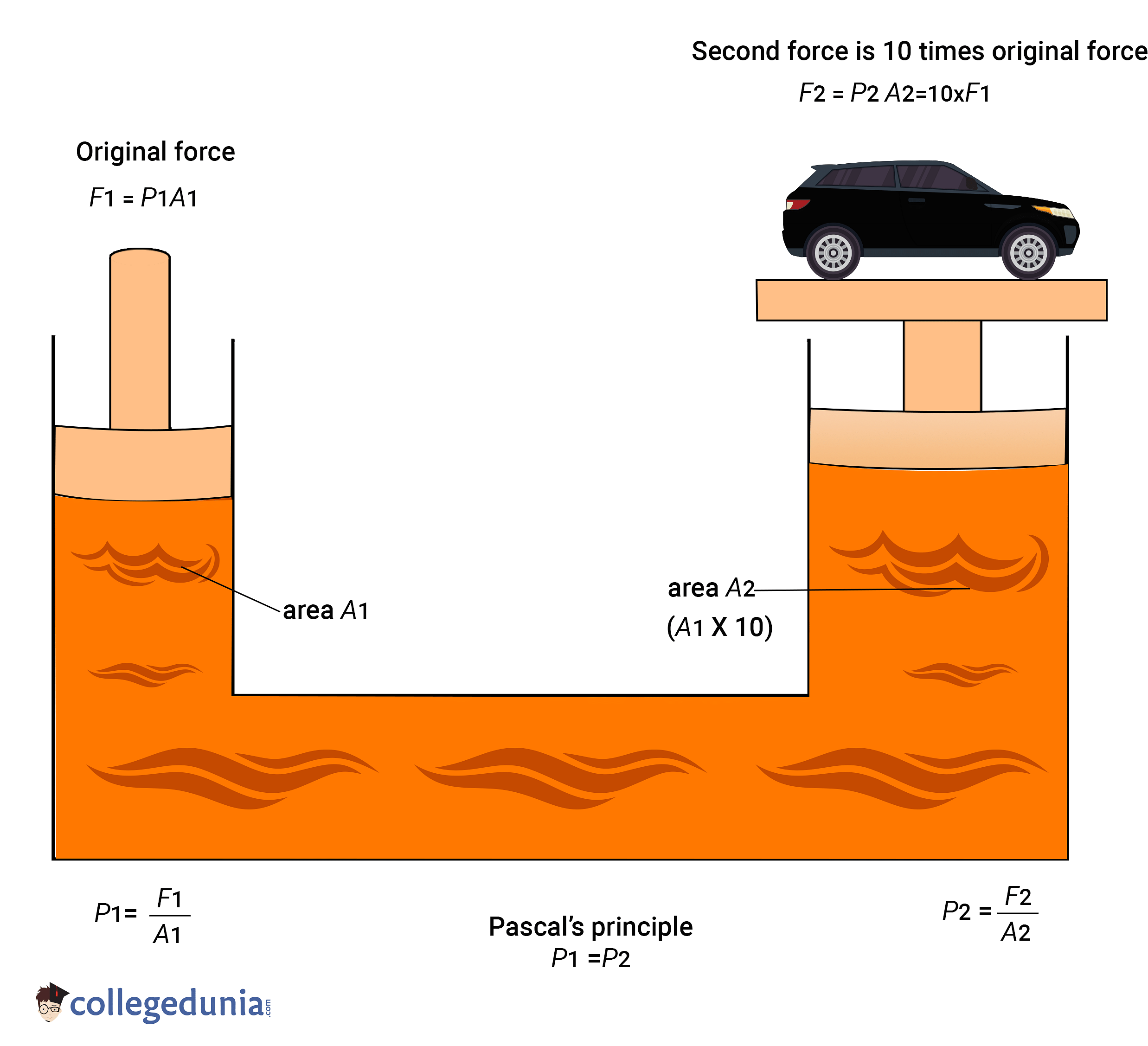
Pascal's Law
Pascal Law Formula
The formula of Pascal law is:
| F = PA |
Where,
- F = Force applied
- P = Pressure transmitted
- A = Cross-sectional area
Solved Example of Pascal’s LawExample: Area of A is 60 cm2 and area of B is 4,200 cm2, determine the external input force of F. Solution: Force of F calculated using the equation of Pascal’s principle: F1 / A1 = F2 / A2 F1 / 60 cm2 = 3500 N / 4200 cm2 F1 / 60 = 35 N / 42 F1 = (60)(35) / 42 F1 = 2100 / 42 F1 = 50 Newton |
Read More About: Charle’s Law
Hydraulic System Working
[Click Here for Sample Questions]
A hydraulic system delivers force to an incompressible liquid at one location, which then transfers force to another. Two pistons are linked via an oil-filled hose in this procedure.
- Hydraulic lifts work on the principle of going upwards, with a pump pushing oil into the cylinder, causing to push the piston.
- In order to go down, the valve opens. It enables the oil to go back into the reservoir and is caused to be pushed back by the help of the gravitational force of the lifted car.
- If the valve is closed, the oil can move from the reservoir to the cylinder. And if open, the oil can flow to the reservoir from the cylinder.
- In the lifted car, the controls cause the pump to operate, thrusting the oil.
- The pump is switched off, when the floor has been reached, and the lift car is set on top of the piston, retained in position by the oil trapped in the cylinder.
- The position, size and operation of the cylinder can either be, ‘holed’ or ‘hole-less’.

Hydraulic System Working
Hydraulic Machines UsesThe application of hydraulics in everyday life includes:
|
Hydraulic Lift Parts
[Click Here for Previous Year Questions]
Parts of Hydraulic Lift are elaborated below:
Hydraulic Circuit
The flow and pressure of the liquid in the system are controlled by hydraulic circuits. The diagram below depicts the many components of a hydraulic circuit:
Hydraulic Pump
The hydraulic pump is a device that transforms mechanical energy into hydraulic energy. At the pump inlet, hydraulic pumps generate a vacuum, which drives liquid from the reservoir into the intake line and out to the hydraulic system's outlet.
Hydraulic Motor
A hydraulic motor is a device that converts hydraulic pressure into spin and torque. It works similarly to a linear actuator in that it converts hydraulic energy's pressure and flow into rotating mechanical energy. The hydraulic motor is pushed by the pump, which provides hydraulic energy into the system.
Hydraulic Cylinder
The hydraulic cylinder transforms the hydraulic fluid's energy into force and starts the pressure in the fluid, which is regulated by the hydraulic motor.
Pistons
The Fluid pressure moves hydraulic pistons in a straight path. Axial designs have a revolving housing with a number of pistons arranged in a circular arrangement.
Applications of Hydraulic Lift
[Click Here for Sample Questions]
Applications of Hydraulic Lift are:
Hydraulic Elevator
It is a type of elevator that works by using fluid pressure created by a suitable fluid. It's used to elevate cars in garages and service facilities.
- Two pistons are separated by a liquid-filled gap in a hydraulic lift.
- To apply a force F1 directly on the liquid, a piston with a tiny cross-section A1 is employed.
- P =F/A is transferred through the liquid to the bigger cylinder linked to a larger piston of area A2, resulting in an upward force of P x A2.
- As a result, the piston can withstand a significant amount of force (large weight of, say a car, or a truck, placed on the platform).
- The platform may be moved up or down by adjusting the force at A1.
- As a result, the applied force is enhanced by a factor of A2/A1, which is the device's mechanical advantage.
Read More About Ideal Gas Equation
Hydraulic Brake
The hydraulic brake is a type of braking system in which appropriate brake fluid is utilised to transmit pressure from the control system to the braking system.
- Automobile hydraulic brakes function on the same basis.
- When we press down on the pedal, the master piston inside the master cylinder moves, and the resulting pressure is conveyed through the brake fluid to operate on a bigger piston.
- The piston is forced down by a significant force, expanding the braking shoes against the brake lining.
- A little push on the pedal creates a significant retarding force on the wheels in this manner.
Check out:
Things to Remember
- Hydraulic lift technology is used in a variety of industries, including construction and transportation.
- It is frequently used to operate heavy machinery or to transport and carry huge and heavy things such as vehicles, dirt, and shipping containers.
- "Pressure x area = force" is related to hydraulic lift technology. This aids in determining the amount of pressure that must be exerted on a liquid in a piston in order to create an adequate force to lift and move an item.
- Hydraulics are used in vehicle brakes as well. When you use the brakes, a tiny piston in the brake master cylinder is pushed.
- Hydraulic lift technology may be found in a variety of devices, including hydraulic jacks, forklifts, and vehicle lifts. It may be used by machines to give the necessary lift effort (force) to perform work, like moving another item.
Sample Questions
Ques: Is Pascal's Law valid for gases? (1 mark)
Ans: Pascal's Law holds true for gases. Pascal's concept is also known as the principle of fluid (water or gas) pressure transfer.
Ques: What is Hydraulic lift in Pascal's law? (1 mark)
Ans: Pascal's law claims that when there is a pressure increase at any point in a confined fluid, there is an equivalent increase at every other point in the container. For example, the hydraulic lift for automobiles shows a force multiplied by a hydraulic press and is based on Pascal's principle.
Ques: What is the formula for Hydraulic Lift? (1 mark)
Ans: The pressure P = F/A is conveyed throughout the liquid of the larger cylinder which has been attached to a larger piston of area A2, resulting in an upward force of P × A2.
Ques: In a hydraulic machine, two pistons of area of cross-section are in the ratio 1:10. Determine the force required on the narrow piston to withstand a force of 100N on the wider piston. (2 marks)
Ans: F1 =100N
A1 =10m2
F2 = xN
A2 = 1m2
Since pressure = constant
\(\frac{F_1}{A_1} = \frac{F_2}{A_2} = \frac{100}{10} = \frac{x}{1}\)
Hence, x = 10 N
Ques: What is the meaning of the hydrostatic paradox? (2 marks)
Ans: The hydrostatic paradox in fluid dynamics refers to the liquid pressure at all locations at the same depth (horizontal level).
"The pressure at a given horizontal level in the fluid is proportional to the vertical distance to the fluid's surface," says the definition.
Ques: Explain the working of hydraulic lift. (2 marks)
Ans: There are two pistons in the system. The object to be raised is held on the bigger piston while the force is given to the smaller one. When we wish to raise a box or a weight, we provide an equivalent pressure to the smaller piston, which is transferred to all directions in the liquid, and therefore to the bigger piston as well. As a result, the weight is lifted. This is how a hydraulic lift works.
Ques: What is Pascal's principle? (2 marks)
Ans: Pascal's principle (also known as Pascal's law) says that when a change in pressure is made to an enclosed fluid, it is transferred unchanged to all parts of the fluid as well as the container's walls. Because the fluid's atoms are allowed to move about in an enclosed fluid, they transfer pressure to all areas of the fluid as well as the container's walls. Any change in pressure is unaffectedly communicated.
Ques: Would a hydraulic press still operate properly if a gas is used instead of a liquid? (2 marks)
Ans: Yes, it would function, but because gas is compressible, it would not perform very efficiently. When the force is applied, the gas compresses and warms up first. As a result, in order for the brakes to operate correctly, the air in the brake lines must be bled out.
Ques: How will you hydraulic lift an automobile? (3 marks)
Ans: If the lift cylinder has a diameter of 25 cm and the small cylinder has a diameter of 1.25 cm, the ratio of the areas is 400, and the hydraulic press arrangement produces a force multiplier of 400 times.
- To raise a 6000-newton automobile, just 6000 N/400 = 15 N of force would be applied to the fluid in the tiny cylinder.
- To elevate the automobile 10 centimetre, however, the oil would have to be moved 400 x 10cm = 40 metres.
- This is accomplished by using a tiny compressor to pump oil into this little cylinder
Ques: In order to lift an automobile of 5000 kg, a hydraulic lift with a piston of 800 cm2 in area has been used. Determine the force applied to a small piston of area 5 cm2 to achieve the same. (5 marks)
Ans: Force applied on the large piston (F1) = mg
Thus, F1 = 5000 × 9.8 N = 4.9 × 10⁴ N
The area of large piston, as given, A1 = 800 cm2
Pressure of the large piston (P) = \(\frac{F_1}{A_1} = \frac{4.9 \times 10^4}{800 \times 10^{-4}}\) = 6.125 x 10⁵ Pa
Now, because the liquid transfers pressure equally, the pressure on the piston is going to be equivalent to the pressure on the larger piston.
Thus,
It can be said, \(\frac{F_1}{A_1} = \frac{F_2}{A_2} = P\)
Thus, the given area of the smaller piston A2 = 5 cm2
Hence,
Force on smaller piston is (F2) = P x A2 = 6.125 × 105 × (5 × 10−4) = 306.25 N
Previous Year Questions
- A soap bubble, having radius of 1mm, is blown from a detergent solution… [NEET 2019]
- A liquid is filled upto a height of 20cm20cm in a cylindrical vessel… [KEAM]
- The force acting on a window of area 50cm×50cm of a submarine… [KEAM]
- A small spherical ball falling through a viscous medium of negligible density… [KEAM]
- A spherical ball of diameter 1cm and density… [KEAM]
- Ice pieces are floating in a beaker A containing water and also… [KEAM]
- A boy's catapult is made of rubber cord which is… [JEE Main 2019]
- A man grows into a giant such that his linear dimensions… [JEE Main 2017]
- If the ratio of diameters, lengths and Young's modulus of steel… [NEET 2013]
- Two wires are made of the same material and have the same volume…. [NEET 2018]
- When a block of mass M is suspended by a long wire of length… [NEET 2019]
- Two wires A and B are stretched by the same load… [KCET 2018]
- Young's modulus is defined as the ratio of… [KCET 2017]
- Which of the following substances has the highest elasticity… [KCET 2010]
- The ratio of hydraulic stress to the corresponding strain is known as… [KEAM]
- Hydraulic Lift works on the basis of… [UPSEE 2017]
Read Also:



Comments