



Education Journalist | Study Abroad Lead
Aspirin, commonly known as Acetyl Salicylic acid, belongs to Non-Steroidal Anti-Inflammatory Drugs. Aspirin uses include relief from pain, aches and reduced production of thromboplastin in blood plasma. Aspirin is commonly prescribed as an OTC drug to treat mild to moderate inflammation, Kawasaki disease, rheumatic arthritis, pericarditis, rheumatic fever, etc. Aspirin is prescribed for cardiac patients for its blood-thinning capacity. Combined with Clopidogrel, aspirin liquidizes blood by reducing the conversion of prothrombin to thrombin.
| Table of Content |
Keyterms: Aspirin, Acetyl Salicylic acid, Drugs, iInflammation, Kawasaki disease, Rheumatic arthritis, Pericarditis, Rheumatic fever, Blood plasma, Thromboplastin, Blood
Also Read: Acetylation
Synthesis of Aspirin
[Click Here for Sample Questions]
Aspirin is synthesized in the laboratory by the process of Esterification using Sulphuric acid as a catalyst. Occasionally, Phosphoric acid replaces Sulphuric acid. Salicylic acid reacts with Acetic Anhydride, an acid derivative in the presence of a catalyst to give Aspirin and acetic acid, a by-product of the reaction.
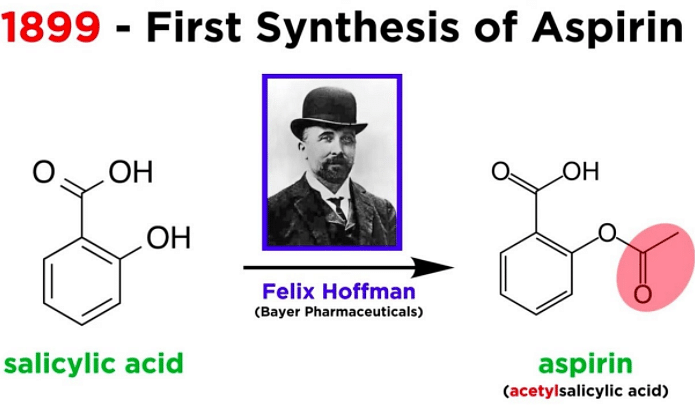
Fig. Synthesis of Aspirin
Physical Properties of Acetyl Salicylic Acid
[Click Here for Sample Questions]
Acetyl salicylic acid commonly referred as Aspirin comprises following physical properties.
Nature: crystalline solid
Colour: White
Odor: Odorless
Taste: Tasteless
Melting point: 136° C (277°F)
Boiling point: 140°C (284° F)
ph: Weakly acidic
Solubility: soluble in water
Also Read:
Chemical Properties of Acetyl Salicylic Acid
[Click Here for Sample Questions]
- Aspirin gets hydrolyzed when exposed to moist air.
- It reacts with ammonium acetate, carbonates, citrates, and alkali.
- It is easily oxidizable.
Medical Uses of Aspirin
[Click Here for Sample Questions]
- It is used to reduce pain.
- It decreases body temperature thereby reducing fever.
- It is used to treat pericarditis and rheumatic fever in children.
- It is used in the long term to prevent heart attack, ischemic strokes, and blood clots.
- It is a very good blood thinner.
- It prevents the conversion of prothrombin to thrombin thereby. stopping blood coagulation.
- It is used as an anti-inflammatory agent.
- It is used as an analgesic.
Also Read: Antidepressant Drugs
Side Effects of Aspirin
[Click Here for Sample Questions]
Few adverse effects are reported with intake of Aspirin. Usually, Aspirin is prescribed by a physician or pharmacist. Some of the adverse effects of Aspirin are:
- Stomach ulcer and stomach bleeding.
- Worsen asthma.
- Redness of eyes, toes, feet.
- Irritation in genital part, palms, and toes.
- Swelling of skin tissues.
- Gastrointestinal bleeding.
Also Read:
| Related Articles | ||
|---|---|---|
| Iodoform Test | Coupling Reaction | Rate of Reaction |
| Monomers | Sucrose | Maltose |
Things to Remember
- Aspirin is a salicylate used to treat pain, fever, inflammation, migraines, and reducing the risk of major adverse cardiovascular events.
- Chemical Name – Acetyl Salicylic Acid
- IUPAC Name – 2, Acetoxybenzoic acid.
- Formula – C9H8O4
- Molecular formula: CH3COOC6H4COOH
Sample Questions
Ques. Who is prevented from intake of Aspirin? (1 Mark)
Ans. Aspirin is not recommended for individuals who show allergic reactions to ibuprofen, naproxen, and other salicylates.
Ques. Why has Aspirin been banned OTC in New Delhi? (1 Mark)
Ans. Aspirin, generally, is a blood thinner that prevents the conversion of prothrombin to thrombin in blood plasma. As Dengue patients are prone to loss of platelets as the impact of viral infection, Aspirin is prohibited in such patients. So, OTC delivery has been banned in New Delhi.
Ques. Is Aspirin recommended during pregnancy? (1 Mark)
Ans. Aspirin is not recommended during pregnancy. Especially, during the third trimester of the gestational period, the drug is strictly prohibited by Gynecologists.
Ques. What are the other agents used as a catalyst in the preparation of Acetyl Salicylic Acid? (1 Mark)
Ans. Usually, the King of acids, Sulphuric acid is used as a catalyst in the preparation of Acetyl Salicylic acid. However, Phosphoric acid replaces the King of acids.
Ques. Is Aspirin a fine choice for long-term inflammation? (1 Mark)
Ans. Yes, Aspirin is used as an anti-inflammatory agent for long-term inflammation in individuals. For example, Rheumatoid arthritis is cured well by intake of Aspirin.
Ques. What is the role of Aspirin in the case of cardiac patients? (1 Mark)
Ans. Aspirin plays an important role in the treatment of heart attack in cardiac patients. The drug is indispensable for patients with heart blocks and clots. But not recommended for elders over 70.
Ques. What are the contraindications observed after the use of Aspirin? (1 Mark)
Ans. Rheumatic fever, stomach bleeding, stomach upset are a few contraindications noticed after treatment with Aspirin.
Ques. What is the solubility level of Acetyl Salicylic acid? (1 Mark)
Ans. The chemical is soluble in water. For instance: 3 g of acetylsalicylic acid dissolves in 1 liter of water.
Ques. What is the role of Aspirin in Cancer? (1 Mark)
Ans. Aspirin might reduce the risk of breast cancer. However, the effect of the drug against Cancer is mild to moderate.
Ques. Does Aspirin exhibit interactions with other drugs? (1 Mark)
Ans. Yes. Aspirin shows a good response in interaction with other drugs. Spironolactone, Penicillin G and Vitamin C are reported as interacting with Aspirin. NSAIDs like ibuprofen and naproxen reduce the antiplatelet effect of Aspirin.
For Latest Updates on Upcoming Board Exams, Click Here: https://t.me/class_10_12_board_updates
Check-Out:



Comments