



Education Journalist | Study Abroad Lead
Acetylation, in Chemistry, is a chemical reaction wherein a hydrogen atom gets substituted for an acetyl group (CH3C=O group). In acetylation reaction, the hydrogen atom of an alcohol group is replaced with an acetyl group, due to which ester is formed. The products formed during acetylation consist of an acetoxy functional group.
| Table of Content |
Key Terms: Acetylation, nucleophilic, compounds, acetyl group, alcohol, oxygen, acetoxy functional group, hydrogen, atom, ester, phenol group
What is Acetylation?
[Click Here for Sample Questions]
Acetylation is a chemical reaction wherein a compound, a hydrogen atom gets substituted for an acetyl group (CH3C=O group) and ester is formed. In acetylation of the compound glucose, the bonding in between the acetyl group in which extra electrons are present in nucleophilic oxygen supports the easy substitution of the H atoms present in the phenol group. The process of acetylation is used in the synthesis of various products like proteins, aspirins, and various other medical products.

Acetylation Reaction
Also Read:
Salicylic acid reaction of Acetylation
[Click Here for Sample Questions]
Acetic Anhydride is used for acetylation of salicylic acid which yields final products acetylsalicylic (aspirin) and acetic acid. Aspirin is also used as an acetylating agent for THC acetate ester synthesis and diacetylmorphine. The diagram below will briefly explain the reaction.
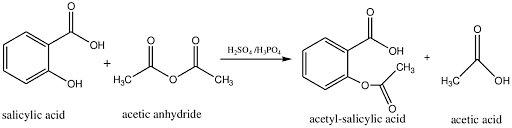
Acetylation of Salicylic Acid
Mechanism
In the presence of sulphuric acid, salicylic acid is facilitated as sulphuric acid helps in the detachment process of the acetate ion of the agent acetic anhydride. After the acetate ion forms a stable bond with the nucleophilic atom of Oxygen (with its free electron) of salicylic acid, the process of dehydrogenation (removal of hydrogen atom) takes place, where it yields acetic acid & aspirin.
Acetylation using Acetic Acid
[Click Here for Sample Questions]
When alcohols are treated with acetic acid, at high temperatures, the process of acetylation takes place. Toluene is used in this reaction as a solvent, in which an acetylated compound is generated.
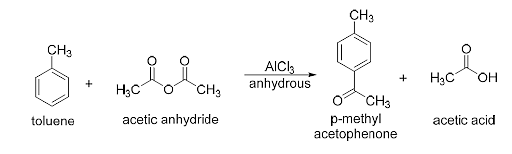
Acetylation using Acetic acid
Acetylation using Amines
[Click Here for Sample Questions]
Using acetic acids as catalysts and amines, several methods of acetylation take place with the help of butyl acetate or ethyl acetate. Formamides are formed at low room temperatures like 20°C. This chemical reaction is associated with the process of synthesis of the broad-spectrum amines:

Acetylation using Amines
Dimethylacetamide is known to be a storehouse for the synthesis of acetyl & dimethylamine gas. When easy acetylation takes place with several amines it is treated at temperature - 120 to 125°C and serves for the rest of acetylation equations as an alternative.
Deacetylation & Histone Acetylation
[Click Here for Sample Questions]
The proteins which are responsible to copy DNA for healing the damaged genetic material are required to be engineered with the help of acetylation for understanding the accuracy and energy required of the copying of genes. Utilization of lysine and several other activities of regulation of genes involves removal of the acetyl groups.
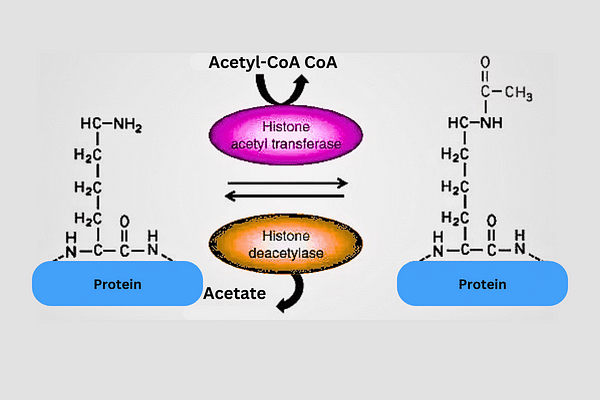
Deacetylation
This is a short process in which the residues of lysine in the N- terminal tail protrude from the histone core of the nucleosome. Being an important part of gene regulation, it gets acetylated and deacetylated. Deacetylation is the reverse process in which the acetyl group is removed from the molecule.
Acetylation of histone is said to increase the expression in genes through activation of transcription. This results in more accessibility to the DNA
Acetylation Reagents
[Click Here for Sample Questions]
Three major reagents are involved in the process of acetylation:
Ketene: Acetic anhydride is prepared by the reaction of ketene along with acetic acid.
H2C=C=O + CH3COOH → (CH3CO)2O
ΔH = -63 Kj/mol
Acetyl Chloride: It is a very common reagent used in various laboratories. The use of this reagent cogenerates hydrogen.
Acetic Anhydride: It is one of the most used reagents in laboratories. It also cogenerates acetic acid.
Some of the less- electrophilic reagents used are esters of thioacetic acid.
Acetylation Reaction Uses
[Click Here for Sample Questions]
Acetyltransferases are helpful for the treatment of cancer and other kinds of autoimmune diseases. Hence, these reactions come under IUPAC standards & regulations. Deacetylation, which is the opposite reaction, does not fall under the same IUPAC nomenclature.
Things to Remember
- Organic esterification with the help of acetic acid is known as acetylation.
- The opposite reaction in which the acetyl group is removed from a chemical compound is known as deacetylation.
- Preparation of Acetamides & acetate esters is done by acetylation.
- The most common reagent used in labs for acetylation is acetic anhydride.
- According to the nomenclature (IUPAC) acetylation is known as ethanoylation
- The cellulose esters obtained by acetylation are easily soluble in the organic solvents and can be formed into films and fibres
Also Read:
Sample Questions
Ques 1. State Difference between Acetylation & Methylation. (2 marks)
Ans. Methylation: methyl group is added to other molecules and occurs in the process of DNA protein synthesis.
Acetylation: Acetyl group is added to nucleophilic hydroxyl groups in the acetylation process.
Ques 2. Give some examples of Acetylation. (2 marks)
Ans. Given below are a few examples of Acetylation:
- Acetylation of salicylic acid with acetic anhydride results in the Synthesis of aspirin with acetic acid by
- Acetylation of Lysine Residues for gene regulation using histones
- N-Terminal Acetylation
- Acetylation reaction with aniline
Ques 3. What do you mean by histone acetylation? (2 marks)
Ans. The involvement of DNA-templated chemical reactions for gene regulation is what is known as Histone acetylation. It can be considered as a dynamic modification of epigenetic which is responsible for the regulation of chemical reactions which are DNA-templated.
Ques 4. What are the applications of Acetylation? (2 marks)
Ans. The creation of proteins that Replicate DNA and repair the damaged genetic material is done through acetylation. The energy of proteins and the accuracy of copying genes is also determined through acetylation.
Ques 5. Do amino acids undergo the process of acetylation? (2 marks)
Ans. Yes, Acetylated amino acids are mostly proteins with serine termini & alanine. More than 95% of amino-terminal acetylated residues are responsible for such proteins along with glycine, methionine & Threonine.
Ques 6. Arrange the following compounds in increasing order of their boiling points: (2 marks)
CH3CHO, CH3CH2OH, CH3OCH3, CH3CH2CH3
Ans. The order is : CH3CH2CH3 < CH3OCH3 < CH3CHO <CH3CH2OH
All these compounds have comparable molecular masses CH3CH2OH undergoes extensive intermolecular Il-bonding and thus its b.pt. is the highest. CH3CHO is more polar than CH3OCH3 so that dipole-dipole interactions in CH3CHO are greater than in CH3OCH3. Thus, b.pt. of CH3CHO > CH3OCH3. CH3CH2CH3 has only weak van der Waals forces between its molecules and hence has the lowest b.pt.
Ques 7. Arrange the following carbonyl compounds in increasing order of their reactivity in nucleophilic addition reactions :
(a) Ethanal, propanal, propanone, butanone
(b) Benzaldehyde, p-tolualdehyde, p-nitrobenzaldehyde, acetophenone (5 marks)
Ans. (a) The increasing order of reactivity of the carbonyl compounds towards nucleophilic addition reactions is :
butanone < propanone < propanal < ethanal
The reactivity is based upon two factors. These are steric factors and electronic factors.
(b) The increasing order of reactivity is :
acetophenone < p-tolualdehyde < benzaldehyde < p-nitrobenzaldehyde
Explanation: Acetophenone being a ketone is the least reactive towards nucleophilic addition. All others are aldehydes. Among them, p-tolualdehyde is less reactive than benzaldehyde because the CH3 group present at the para position w.r.t. -CHO group will increase the electron density on the carbonyl carbon atom due to the hyperconjugation effect. As a result, the nucleophile attack occurs to a lesser extent as compared to benzaldehyde.

In p-nitrobenzaldehyde, the nitro group has an opposing effect. It is electron withdrawing in nature due to the -I effect as well as -R effect. The electron density on the carbonyl carbon atom decreases and this favours the nucleophile attack.

Ques 8. Which acid from each of the following pairs would you expect to be a stronger acid? (3 marks)
(i) CH3COOH or CH2FCOOH
(ii) CH2FCOOH or CH2ClCOOH
(iii) CH2FCH2CH2COOH or CH3CHFCH2COOH

Ans. The CH3 group with +I effect increases the electron density on the oxygen atom in the O – H bond in the carboxyl group and cleavage of the bond becomes difficult. It, therefore, decreases the acidic strength. The F atom has a very strong -I effect, i.e., electron-withdrawing influence. It decreases the electron density on the oxygen atom and cleavage of the bond becomes easy. The acidic character, therefore, increases. It is further related to the
- No.of F atoms present in the molecule.
- The relative position of the F atom in the carbon atom chain.
In the light of the above discussion.
(i) CH2FCOOH is a stronger acid.
(ii) CH2FCOOH is a stronger acid.
(iii) CH3CHFCH2COOH is a stronger acid.

Ques 9. An organic compound with the molecular formula C9H10O forms a 2,4-DNP derivative, reduces Tollen’s reagent, and undergoes a Cannizzaro reaction. On vigorous oxidation, it gives 1,2-benzene dicarboxylic acid. Identify the compound. (2 marks)
Ans. Since the given compound with molecular formula C9H10O forms a 2,4-DNP derivative and reduces Tollen’s reagent, it must be an aldehyde. Since it undergoes Cannizzaro reaction, therefore, the CHO group is directly attached to the die Benzene ring.
Since vigorous oxidation, it gives 1, 2-benzene dicarboxylic acid, therefore, it must be an ortho-substituted benzaldehyde. The only o-substituted aromatic aldehyde having molecular formula C9H10O is o-ethyl benzaldehyde. All the reactions can now be explained on the basis of this structure.

Ques 10. Although phenoxide ions have more resonating structures than carboxylate ions, carboxylic acid is a stronger acid than phenol. Why? (2 marks)
Ans. Consider the resonating structures of carboxylate ions and phenoxide ions.

In case of phenoxide ions, structures (V – VII) carry a negative charge on the less electronegative carbon atom. Therefore, their contribution towards the resonance stabilization of phenoxide ions is very small.
In structures I and II, (carboxylate ion), the negative charge is delocalized over two oxygen atoms while in structures III and IV, the negative charge on the oxygen atom remains localized only the electrons of the benzene ring are delocalized. Since delocalization of benzene electrons contributes little towards the stability of phenoxide ions,therefore, carboxylate ions are much more resonance stabilized than phenoxide ions. Thus, the release of a proton from carboxylic acids is much easier than from phenols. In other words, carboxylic acids are stronger acids than phenols.
For Latest Updates on Upcoming Board Exams, Click Here: https://t.me/class_10_12_board_updates
Check-Out:



Comments